Category Archives: CitizenWill

Downtown Development: The LEEDs Trade-Off, AIA 2030 Up Next

Sally Greene suggested trading formal LEEDs certification, which RAM’s VP Casey Cummings said cost $225K, for a required %20 energy reduction, as measured against ASHRAE standards.

Cummings claimed that $14.5K of the $225K involved energy modeling and measurement – the rest involved paper shuffling.

After reviewing the current proposal, it is still not clear that the Town has discussed a baseline with RAM for what a “reduction” entails – let alone a methodology to establish meeting the ASHRAE goals.

That issue aside, if we trade away LEEDs, which as Sally pointed out is an arguably flawed tool (no surprise, local folks pointed that out over a year ago), we still need to establish a firm requirement for a reduced energy footprint and make the commitment to independently establish compliance with that requirement.

In other words, not just take RAM’s word (“trust but verify”).

So, if we spend the $14.5K to verify adherence to LEEDs principles without doing the LEEDs paper-shuffle – well, that seems reasonable in isolation.

But, then again, why are we trading away anything? We’ve already reduced the public space, we’ve upped our public investment 15-fold, we’ve assumed a significant liability for less and less public utility. Our compliant negotiating team let RAM chip, chip, chip away the value.

And why just %20? If RAM pushed for %50, they’d qualify for a hefty tax break – $1.80 per square foot. Heck, they would get $0.60 per square for hitting %17.

Why are we begging them to do the “right thing”?

Luckily, Council will have an opportunity to attenuate their environmental misstep when Tom and company submit the following challenge to Council calling on all local building to meet the much more stringent AIA 2030 goals – a suggestion, at least for Lot #5, that was dismissed almost without comment.

Resolution to the Town of Chapel Hill to Adopt the AIA 2030 Challenge:

Combating Climate Change through Building Design

Whereas buildings in the United States are responsible for 48% of primary energy consumption and 46% of greenhouse gases; and

Whereas current trends indicate that, unless immediately addressed, the amount of energy consumed by buildings will continue to escalate; and

Whereas 7% to 8% of energy consumed in the United States (150 Btus/gallon water) is associated with the treatment and transport of municipal water; and

Whereas to restrict global warming to less than 2 degrees C above pre-industrial era levels will require atmospheric carbon dioxide levels, now at 380 ppm, to be held below 450 ppm; and

Whereas the decisions made today in designing buildings will directly impact the amount of energy consumed by those buildings for decades to come; and

Whereas technologies and skills exist today that enable architects to design buildings to consume a fraction of the energy that is typical of current construction; and

Whereas the American Institute of Architects has adopted the targets of “The 2030 Challenge”, establishing the national goal of immediately reducing “site” fossil fuel consumption and carbon dioxide emissions in new buildings and major renovations by 50%, and continually improving energy performance so buildings constructed in 2030 will be carbon neutral; and

Whereas the Town of Chapel Hill has agreed with the University of North Carolina at Chapel Hill to jointly participate in a carbon reduction program;

Therefore, be it resolved that the Orange County Democratic Party calls upon the Town of Chapel Hill to recognize the imperative of immediately addressing climate change through the buildings built within the Town by taking all necessary steps to insure that all new buildings, major renovations and additions be required to consume 50% less fossil fuel energy than is typically consumed.

Further, in order to mitigate the impacts of climate change associated with the operation of buildings and to reduce greenhouse gas levels to those experienced in 1990, we additionally call upon the Town of Chapel Hill to require the improvement in the energy and water efficiency of our building designs at the following rates until, in 2030, our buildings consume only site-generated and/or purchased renewable energy.

Years % reduction in non-renewable energy
2007 – 2010 50%
2010 – 2015 60%
2015 – 2020 70%
2020 – 2025 80%
2025 – 2030 90%
2030+ 100%

For a Council that appears to be incapable of managing its own environmental concerns, the AIA 2030 challenge might be too much of a stretch.

I hope that I’m wrong and that they’ll rise to the challenge.

Downtown Development Intiative: Thank you Sir, May I Have Another?

I missed the exact vote but the Council has not only authorized the Lot #5 development but put it on a fast-track.

Talk about compounding a mistake. What’s clear, especially after this evening, is the bulk of Council does not comprehend the consequences of their decision. From my understanding, the SUP (special use permit) gives the Council little leverage to modify building requirements peripheral to the issues specified in the SUP.

To wit, any leverage to mitigate the hazardous waste liability, to make the %20 ASHRAE and AIA 2030 energy goals requirements, is gone.

Below is the liability language Laurin Easthom and Jim Ward referred to:

3.5 Town’s Obligation to Remediate.

In the event that any Hazardous Substance is found on Lot 5, the Town shall be responsible for adopting a remediation plan reasonably acceptable to Developer and the Town’s environmental engineer to remediate such Hazardous Substances in accordance with Environmental Laws. The parties agree that any remediation required will be undertaken by the Developer on behalf of the Town and the Town will reimburse the Developer for the actual cost thereof or, at Developer’s option, the Town will pay such cost on a direct basis, it being agreed that the Developer has no obligation to fund on an advanced basis the Town’s Remediation Cost. For purposes hereof the actual cost of the remediation shall be the incremental increase in construction costs directly relating to any required remediation (the “Town’s Remediation Cost.”) For example, in the event that the soil on Lot 5 is contaminated by a Hazardous Substance and must be removed, the cost of any excavation to remove the same shall not be treated as a remediation cost allocable to the Town if such excavation was otherwise required in connection with the construction of the Project.

However, if the soil excavated and removed must be treated under the remediation plan, then the cost of such treatment (but not the excavation) shall be borne by the Town. The Developer shall submit to the Town on a monthly basis the cost associated with any required remediation and the Town shall reimburse the Developer therefore, or pay such costs on a direct basis, within thirty (30) days of the receipt of an invoice.

Page 27, January Agreement

Prepare to bend over Chapel Hill.

The Sad Story of Council’s Downtown Development Initiative

They say, the story is buried in the details.

After reviewing hundreds of pages of confidential documents and listening to hours of ridiculously poor audio recordings of confidential meetings, I can, sadly, stand by my public assertions that the private-public Lot #5 development Council will most probably be thrusting upon us this evening is a terribly flawed beast.

By now, Council should realize that a re-think is in order. But I doubt that will happen….

Yes, it looks like Chapel Hill’s citizens are going to underwrite the development of million dollar condos, lose its moral leadership to criticize other environmentally poor initiatives, set the sub-standard for a new downtown development cycle that will create concrete canyons quashing the charm of our unique berg.

Like dumping a gallon of perfume in a reeking cesspool, the latest “updated” proposal does little to cover the stench that has settled about “the plan”.

RAM Development, directly, and Council, as I expect with tonight’s acquiescence, has no will to ameliorate the vast negative fiscal, environmental, social and political consequences of earlier versions of this plan.

Worse yet, instead of giving the public ample opportunity to review and reflect, the Council is voting to expedite the SUP (special use permit) to rush their development partner’s application through. Beyond the propriety of granting special favors to ones development partner, the problem of public participation has been swept to the side.

“Ahhh, Will, but the public has been given plenty of opportunity”. What a crock. The deal Council is voting on tonight runs to 160 pages – the public record thousands – yet the Council, generally, has made little attempt to integrate a broad perspective ala the NCD (neighborhood conservation district) process – to draw in to the process all the citizens of Chapel Hill.

We’ve heard quite a bit of enthusiasm from those that stand to gain from this precipitous decision. The developers – who benefit from Council’s ill-conceived direction. Those great social champions who want to broaden our affordable housing stock – but, in this case, at too steep a cost. Those that stand to make tons of bucks from the wealthy inhabitants of the publicly underwritten rooftop villas.

Why hasn’t Council tried to build a broader context around this development? Why didn’t they start a conversation with the wider public – the same public that will be picking up the tab for this mess – months ago?

Why? Because a measured assessment of this project, as currently constituted, by the public, would ring its death knell.

And for those Council members caught up in this “rah rah” – “do something, do anything” – atmosphere engendered by folks standing to win big by big, big, big development – that is unacceptable.

Downtown Development: RAM’s VP Cummings’ Smackdown

Ouch! Obviously stung by Council member Jim Wards comment about “switch-n-baiting”, RAM Development’s VP Casey Cummings delivered a death blow to Council’s request for affordable condo fees for the affordable housing units and a commitment to energy efficiency.


[MOVIE]

Both requests seem quite reasonable.

What use is it for the Land Trust to “sell” a condo to an affordable housing applicant just to have them priced out by condo and parking fees?

On the energy front, as former OWASA board member Terri Buckner notes over on OrangePolitics

Not a single citizen speaking at last night’s hearing or at the first public hearing on Lot 5 challenged the Council to ensure energy efficiency. There seemed to be an assumption that “LEED certified” means the development will be energy efficient. However, LEED certified is the lowest level of LEED and even at Platinum status there is no assurance that a LEED building will be energy efficient. To get around that problem, the state of North Carolina has adopted ASHRAE 90.1 for all state constructed buildings.

Chapel Hill is not willing to meet the same requirements as NC State? Dang, we usually lead the State in environmental initiative.

As far as “bait-n-switch”, RAM was challenged last year on their original rosy financial projections. Were they knowingly over promising expecting to under deliver to get the deal?

In the most stark example, Grubb’s financing model would produce a 21.77 percent return on its $10.5 million investment in condominiums on the Wallace Deck site. Ram sees only a 2.98 percent return on its $23 million investment there.

“If they’re willing to do it for that,” Harris said, “God bless ‘em.”

Even if the company wanted to, Grubb couldn’t make a counteroffer, Stainback said, explaining that the proposals are considered “best and final offers.”

Two council members asked Cummings whether Ram’s financial model was too good to be true.

He said no projection ever is exactly right but that his company hopes to ride the growing trend of people returning to downtown.

After the meeting, Ivy Greaner, Ram’s managing partner, said the profit margins are healthy enough to sustain the project.

But Ram also is seeking a foothold in North Carolina. The company is willing to make less money in Chapel Hill to get a centerpiece project in the Triangle.

“This is a special town,” Greaner said, in a suitor’s tone. “We love Chapel Hill.”

N&O

Town investment up 15-fold. Value of the property discounted. Property moving from public to private hands. I understand Jim Wards sentiments.

CarolinaNorth Community Meeting, December 13th: Ecological Assessment

Earlier this year, I asked the Carolina North Leadership Advisory committee to do an environmental assay of the highest caliber. It will be interesting to see this phase of Biohabitats’ research.

And kudos to UNC for scheduling two (2) sessions to accommodate the public. Yes, they’re both on the same day 😉 but progress all the same. Well done Linda and crew…

Subject: Carolina North Community Meeting, December 13

Dear Friends and Neighbors,

Many of you have expressed interest in Carolina North. I am writing to invite you to a review of the draft ecological assessment recently completed as part of the discovery phase of our planning process.

Chancellor Moeser has said that Carolina North will be a model of sustainability. As one of the first steps to that goal, Biohabitats, Inc. has produced an ecological assessment to inform our planning. We are eager to get your input to help us shape effective plans for sustainable development at Carolina North.

To accommodate different schedules, we will hold two sessions. The information reviewed at both will be the same so attend whichever is most convenient for you.

Both sessions will be on Wednesday, December 13th in room 2603 of the School of Government:

3:00 – 5:00 PM. Parking available in either the Hwy 54 Visitor Lot or n the Rams Head deck.
6:00 – 8:00 PM. Parking available in the School of Government parking deck.

Information on transit service to the School of Government is below.

If you are a neighborhood or community contact, please forward this to your group as well as any others who may be interested. We hope for extensive participation from the community. My apologies in advance to those who may receive duplicate emails.

Although an RSVP is not required, it would help with meeting logistics if you would contact Tiffany Clarke at tclarke@email.unc.edu. If you have questions about the review session content, please contact Mary
Jane Felgenhauer at mfelgenhauer@fac.unc.edu.

For Carolina North information, visit our web site at http://carolinanorth.unc.edu <http://carolinanorth.unc.edu/> . To learn more about our current planning efforts and our consulting team, click on Technical Workshops.

As always, please feel free to contact me if you would like more information. We know there is great community interest in Carolina North and look forward to working with you at this early stage.

Best,

Linda

The School of Government is served by numerous bus routes, including the FCX, HU, V. S and the RU. The U and G are available for the early session only. Please check the Chapel Hill Transit site at www.townofchapelhill.org <http://www.townofchapelhill.org/> for details.

Linda Convissor
Director of Local Relations

Linda_Convissor@unc.edu
CB# 6225
919-962-9245

Carrboro’s New Media Experiment

There’s been a small discussion over on SqueezeThePulp about the declining efficacy of local media outlets in covering our community. I suggested that new media outlets will soon move into this long fallow territory – intensively covering local events – to the possible detriment of traditional news outlets.

It appears that Carrboro is the center (once again) of local innovation.

Monday, the Carrboro Commons launched to fill the gap:

As we launch the Carrboro Commons today, we too feel the need for an introduction — sort of a 5W’s on us: the who, what, why, where, when and how.

In short, we are a new newspaper blog for this special place. Whether you call it “the Paris of the Piedmont,” “The People’s Republic of Carrboro,” “Karmaboro,” or just plain old Carrboro, if you’re a resident, you know that Carrboro is unique. And with apologies to Stephen Colbert, compared to Chapel Hill, we think Carrboro is “uniquer.”

That’s why we believe that Carrboro is an under-served media population. From everything Carrboro folk are telling us, this is a town that needs, wants and deserves a quality news, feature and A&E source.

More via the inimitable Paul Jones.

Out-Foxed Chapel Hill Style

The Downtown Development Initiative is a steamroller (in more ways then one). Check out this summary of comments from Nov. 20th’s public hearing. A little light and less nuanced than the opposition comments I recall. Good thing there’s a video record on-line.

So why introduce the following bias?

Potential Advantages of the Project

-Mixed use adds life to downtown
-Residents downtown year-round desirable
-Will stimulate other private development
-Residential development is the key to revitalization
-Will visit cultural facilities, businesses, increase tourist dollars
-Need diversity of pubic spaces and flexibility for uses
-Proposal could be a model for other developers
-Project embodies sustainability principles: economic, environmental, social
-Improves quality of life
-Reduces dependence on automobile
-Improves ability to work where live
-Helps prevent sprawl and retain rural buffer
-Removes surface parking
-Provides significant public open space
-Improves tax base
-Commend LEED certification and energy efficiency
-Improves public safety downtown
-Provides affordable housing
-Consistent with Downtown Small Area Plan
-Is right place for a taller building
-Downtown needs a multiple use center to attract people
-Quality of the design is high
-Public art will be center stage
-Supports vibrant, walkable, liveable community
-Economically a good deal for the Town
-Indirect public benefits make deal even better
-It is the right place for the project; keeps out of neighborhoods
-Will provide more people downtown to sustain retail downtown uses
-If we want to retain the rural buffer, we need more density in Town of Chapel Hill
-Thanks for keeping the affordable housing in the proposal

Concerns Noted Regarding the Project

-Make design fit in with Chapel Hill
-Financial risk too great for the Town
-Wrong place for this development; put in neighborhoods?
-Ruins spirit of Chapel Hill
-Principle of revenue neutral investment not being met
-Take more time to consider project
-Latest “magic bullet” that will not improve quality of life
-Will units be quiet and have firewall construction?
-Will it be family housing?
-Incorporate solar technology and be a model for energy conservation
-Is commitment to local businesses being met?
-What happens if the developer goes bankrupt?
-99-year lease is too long
-Buyout of rights in 50 years could be a concern for Town down the road
-Make sure underground parking is well-lit
-Make sure condominium association dues are reasonable for the affordable units

Downtown Development: Easthom’s questions, questions, questions…

More questions about the Town’s and RAM’s Lot 5 development (DDI) plan?

Well, there’s been a dearth of specifics, so there should be a wealth of questions.

Add to the throng of “those who want to know” Council member Laurin Easthom.

With tonight’s pre-vote presentation on DDI looming (not a public forum)), Easthom weighs in with her questions in what is the most public analysis by one of our elected officials of the “new” RAM development deal.

She’s not against development but is looking for solid answers to questions that should’ve been answered over the days since Nov. 20th:

There undoubtedly has been much written and discussed about the redevelopment of Parking Lot Number 5. Here are my feelings. I think that redevelopment of this site for residential and commercial use is important for being an impetus for more good redevelopment downtown in the future.

More here.

The Town’s stale site (as of 12/04/06) on the Downtown Development Initiative (DDI).

Downtown Development Initiative: A Few New Perspectives

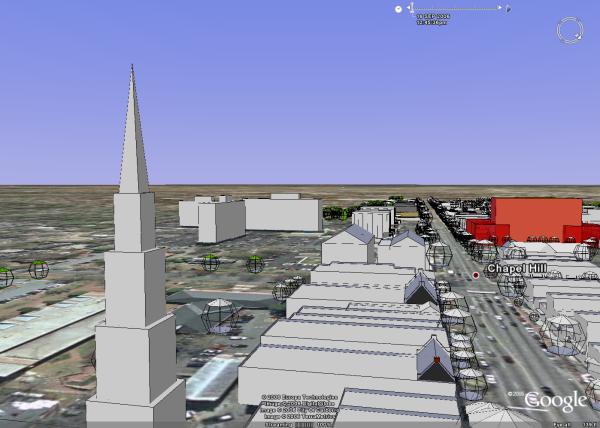
Lot #5 Downtown Development RAM building design based on Nov. 20th public hearing proposal . The model is in proportion and the proper height. It wasn’t until I laid out the model that I realized how large a beast we have here…


Looking North towards Lot 5 Dec2


Lot 5 Hovering above Baptist Church Steeple Dec2


Continue reading Downtown Development Initiative: A Few New Perspectives

Rogers Road: Mapping Out the Future

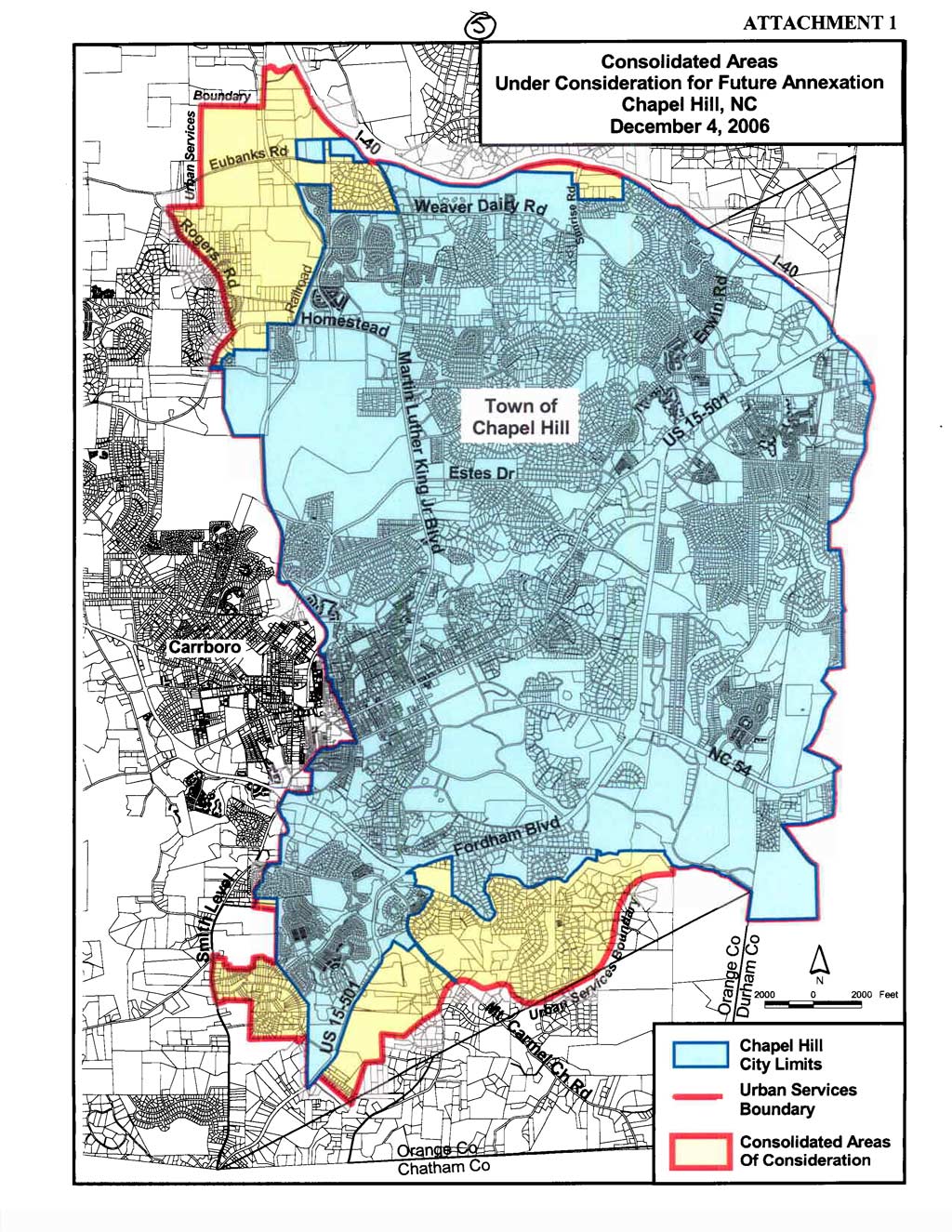
This Monday (Dec. 4th), Council will take up the composition the Roger Road Area Task Force, I posted on earlier, and the possible future annexation of the eastern side of Rogers Rd.

If you’re interested in working with the Rogers Road community to correct these longstanding problems, Monday would be a great time to turn out and let your views be heard.

Click images to expand.

GoogleEarth Experiment: RAM Development Flybys

This is still very raw, but I thought I’d put out this demo to stir some thought within the community. Visualization tools like GoogleEarth (GE) can help remove some of the difficulty in assessing the visual impact of new development.

Our town’s planning department has the raw data needed to create a GoogleEarth representation of our town which I plan to massage and then release into the public domain for other citizens to elaborate on.

Why GoogleEarth?

While GE is a proprietary tool, the datasets it uses are exportable. So, Google owns the tool, not the data.

Our planning department should be creating GE or NASA Wind World representations of Chapel Hill as a matter of course – it would help both them and the community create a common visual-based framework for development discussions.


The free and OSS tools used:

GE has a movie making module but that requires an upgrade to GE Pro at $400 per year (not quite ready for that…)

Downtown Development Initiative: Where’s the beef?

[UPDATE]

How could the negotiations team done a better job informing the public throughout the process?

Here’s two examples from Greensboro’s District 5 Council member Sandy Carmany covering their coliseum issues, this one from a year ago and this one from November.

Sure, she wasn’t hampered by reporting on material potentially shielded under NC’s open meetings laws, but, then again, not every decision or thought process going into RAM’s “new” deal was by necessity shielded.

The only Council member directly involved in the negotiations, Sally Greene, has done the best informing the public of her thinking process on Lot 5 though nothing I read prepared me for such a right turn.

Original post:

Council had an excellent opportunity over the last week to answer the critics of the new Downtown Development Initiative Lot #5 deal.

Over the Summer, the public’s investment in the deal ballooned 15-fold, from $500K to north of $7.2M (with additional revenue hits, etc.). The Wallace Deck portion excised. Public space diminished. Boutique shops up, affordable commercial space missing. $385-$415 per square foot property, slated, as one critic pointed out, probably for affluent student housing.

What, over the Summer, caused the deal to change so radically for what I, other downtown business folks, two Kenan-Flager business school professors and many other concerned citizens consider the worse?

Council could’ve released more information – to provide a solid foundation for the public’s understanding of “the deal”. I’ve followed this deal quite closely. I agreed to “bite my tongue”. to not criticize the problematic elements of the original deal, to wait on the “new deal” which would correct the more egregious of the public’s concerns.

I’ve spent hours trying to pull together all the whispers, hints, etc. that incidentally wafted the public’s direction over the course of the Summer. But what I have is not enough.

The Council has the responsibility and obligation to fully disclose the details, to the fullest extent
allowed by law, of this deal.

Mr. Manager, Mayor and Town Council,

Thank you for being more timely this week and publishing the RAM development agenda item before close of business. Unfortunately, the agenda item is fairly light on the background of the “new deal”.

Would you please publish the remaining reports, discussions notes, comments, etc. that went into forming the “new deal” over the Summer?

I know that there’s some legal issues involved in releasing all of the notes – legal issues that will become moot after you sign the deal – so I’m not asking for ALL the information now (though I will be exercising a citizen’s FOIA prerogative ASAP).

I’m asking that you release everything you can prior to the meeting, including information not protected under the confidentially agreement but also not,to date, publicly disseminated.

For instance, would you please provide details of your consultations with the Local Government Commission (LGC) on financing?

This would include notes, reports, detailed analysis, etc. Please be thorough in your disclosures.

I’m interested in the LGC’s take on leveraging the secured debt, effect on our town’s debt ratings, thoughts on the quoted interest rate, etc. Essentially, I imagine, the same kind of financial analysis that a private business uses in evaluating the risk-rewards of taking on debt.

Finally, the main conduit for publishing this data has been the DDI website which hasn’t been updated since Spring. I’ve asked the Council to update the information on the RAM deal in a timely fashion. Several folks told me to “hold my horses”, that I needed to wait until the “final” deal was set.

Well, the final deal is set and the public still doesn’t have those details. I was hoping that this issue would be addressed over the last 9 days but it hasn’t.

The public has one weekend to review these critical additional details.

Please, if you can’t update the website, then submit them to the citizenry directly. If emailing or providing paper copies is easier, that’s fine.

I’ll make sure they get into the public domain over the weekend.

Thank you for your prompt attention,

Will Raymond

Chapel Hill Downtown Development Initiative: The Debate

Posted these individual citizen comments from the Nov. 20th Public Hearing on the Downtown Development