All posts by WillR

Chapel Hill’s First Budget Meeting of 2010

I want to quickly respond to Chapel Hill Mayor Mark Kleinschmidt’s comments this evening.

First, spending $8-12M on the Lot #5 project, building luxury condos and enriching a private developer, is not the same as “protecting our Town’s infrastructure”.

The Lot #5 (West 140) project is discretionary – the push to keep it going is not based on sound economic fundamentals.

Putting Lot #5 on par with filling potholes or expanding the Library is a great political speaking point – but certainly not grounded in reality – suggestions otherwise does the public a disservice.

At the same time, other probable debt-related outlays aren’t included in the analysis. Mark suggesting the lump of general obligation (G.O.) debt covers the whole gamut of obligations minimizes the challenge before us.

Beyond that bit of misdirection, Mark knows (or should know) that our Town’s current reserves are low compared to historical reserves on a percentage basis.

That $1.9M increase Mark bandied about sounds big but isn’t considering the $55M hole we’re in. No matter how hard fought the battle to get that $1.9M last year, weighed against future operational and capital demands – like trying to expand the Library – the percentage improvement in overall reserves was slightly better than negligible and doesn’t position us any better to deal with MAJOR outlays (if you use a more reasonable debt ceiling).

To use the credit card example several Council members relied on this evening, there is a qualitative difference between the following two scenarios:
Continue reading Chapel Hill’s First Budget Meeting of 2010

WCHL Commentary: Library Expansion Next Year or Lot #5 Project, Not Both

Ron Stutts and WCHL 1360 invited me to do a commentary on a Chapel Hill issue.

I chose to speak out on the fiscally imprudent idea that we can “have our cake and eat it too”.

Run this and the following four year’s budget numbers, look at anticipated impacts – funding Town retirees’ health-care, fixing Police Headquarters, meeting our clean water responsibilities under the Lake Jordan compact, the doubling in demand on our social services, etc. – and it becomes clear – we can walk away now from the discretionary Lot #5 project – at little additional cost to the taxpayer – or do the Library expansion next year.

We can’t do both.

Thanks to Ron and crew for somehow squeezing 10 pounds of commentary [MP3] into a 5 pound bag. Amazing!

Jan. 25th the Council considered two projects with major financial impacts – the Library expansion and the problematic Lot #5 private/public development project.

After discussing their options at length, they decided to postpone approval of the Library expansion pending a more thorough review of the Town’s spending priorities during the Town’s normal budget process which, by the way, kicks off Wednesday, Feb. 3rd.

This was a reasonable and prudent course of action given the serious fiscal condition of the Town, the weakened economy, continued expectations of poor revenues and Council’s touted commitment to public participation.

Unfortunately, the Lot #5 project didn’t get the same level of concern.

The Town’s debt has doubled to $55M over the last 5 years. It’s been used to fund necessary and discretionary capital improvements like the construction of the new Aquatics Center – which at about $7M was almost on budget – and the Town Operations Center – which at $52M went roughly $10M over-budget.

Supporters claim the typical household will ONLY pay $40 more a year but that $40 only covers the increased cost of operating the Library and not the cost of discharging the $16M bond debt.

The Town Manager says that as we payoff existing obligations we can issue new bonds without increasing taxes. This might be true through 2011, but as the Town’s finance director pointed out, from 2012 on the construction debt pushes our overall debt very close – maybe even exceeding – the level necessary to keep our Town’s AAA bond rating.

At that point a tax increase is certain.

The Town Manager’s analysis is also rather one dimensional – challenges like the Town’s rapidly growing unfunded retirement obligations – projected to be as much as $56M or replacing Police headquarters – $10M if Council had purchased Dawson Hall – were not considered.

So what about Lot #5? Lot #5 requires 8 to 12M taxpayer dollars and represents the Town’s greatest, riskiest discretionary fiscal liability.

Part of the sales pitch for Lot #5 was the supposed need to stimulate development Downtown.

With Greenbridge nearly built and other Downtown projects on the way it’s clear that we didn’t need a stimulus. In fact, directly across Franklin St. the University at University Square is already putting forward a much more interesting, integrative proposal which better fulfills the goals of the Lot #5 project – and at little cost or risk to our taxpayers.

Given that the cost reductions that allowed RAM Development to lower their gold-plated condo prices haven’t been passed on to the taxpayer, that the number of pre-sold units hasn’t grown in-line with those price reductions, and that the Town still doesn’t know how it plans to borrow that $8 to 12M – now is the time to drop Lot #5.

Three years out – three contract extensions granted – no significant improvement in proposal.

What does this have to do with the Library?

We can have a Library expansion – hopefully starting next year – or we can have Lot #5 – we can’t handle both.

Contact Council – ask them to pull the plug on the Lot #5 project now so that we can take on projects that are more central to Council’s charter.

More information on my website, CitizenWill.org.

Chapel Hill 2010: Snow, Snow, Snow

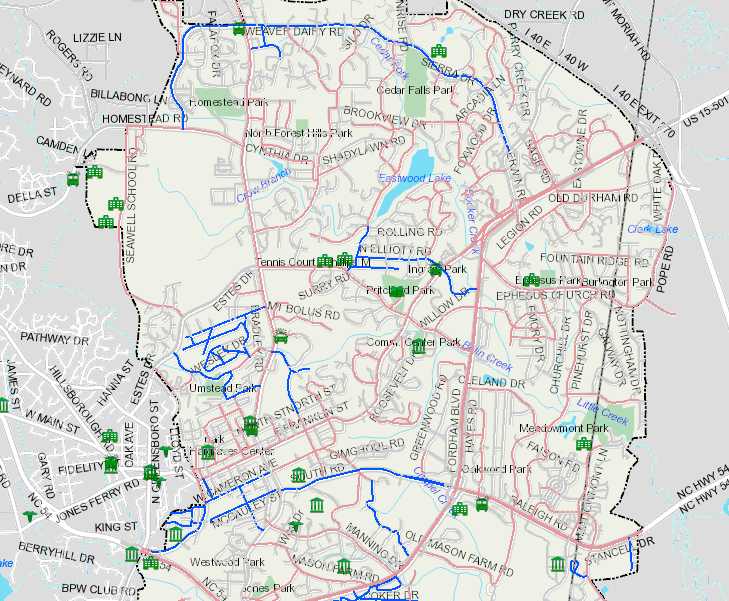
Chapel Hill has a new tool to track road conditions during adverse conditions, like today’s 3 to 6 inches snowfall.

The GIS map showing roads salted, cleared and relevant services is here.

Good to see this finally in place. The Tech Board discussed just such an application of the GIS system about 6 years ago.

Current weather conditions, courtesy of the Weather Underground, are available here.

The Town’s NextBus service, which usually shows current locations of the buses on their routes is available here.

Big caveat, though (from Chapel Hill Transit):

CHT’s NextBus system estimates the next arrivals for buses in real time, based on each vehicle’s location and average speed. But when many vehicles are off-route or significantly delayed, it cannot make accurate arrival predictions. NextBus can, however, tell you if your line is delayed, or the location of the next vehicle.

Longtime readers might recall that was one of the criticisms (beyond the expense, lack of WIFI and rejection of a local vendor) I had of the NextBus system.

Latest updates on the transit system here.

Library or Bust? Laurin Easthom’s Concerns

The Council decided to postpone the Library expansion decision pending further data and discussion.

Council member Laurin Easthom pointed out on Monday, once again, “We need to make some real serious decisions about citizens who use our library and don’t pay.” Laurin has been on-top of this issue for some time. She has also been quite clear in her concerns (THE LIBRARY AND THE FREE LUNCH) unlike several of her colleagues.

Laurin is not alone.

Her colleague Penny Rich added “Citizens in Chapel Hill are quite generous, but I think the endless supply of money in our wallets is not there anymore.” (Daily Tar Heel, Jan. 26th, 2010).

New member Gene Pease, who has been a stalwart supporter of the library for many years – raising significant funds as a member and leader of the Friends of the Library president of the Chapel Hill Public Library Foundation [thanks Fred!] to support its mission – said “To have no conversation about this and about how to attack this problem in the operating budget, I think it’s irresponsible to make the decision tonight” (Lauren Hills,NBC17) in justifying the delay.

I’ve watched this issue unfold for several years, called on former Council’s to show some fiscal restraint over the last 4 years so we could accommodate this project. It is clear that given the current economy, a prudent assessment of our Town’s revenue stream, the core fiscal liabilities and obligations we must discharge (which does not include that Lot #5 money pit), the Library expansion must wait.

Of course, that’s my considered opinion which is based on the data at hand, my entrepreneurial experience and a financial philosophy that emphasizes “living within our means”.

Laurin Easthom foresaw these same issues and tried to set several plans in motion to address this unfortunate juncture – the public’s growing desire for a new facility coupled with a bare public cupboard.

Last April, in fact, she directed the Town Manager and staff to come up “with a financial cost sharing plan” to help ameliorate the anticipated rise in operational costs. To date, no plan has emerged from Town Manager Roger Stancil and crew.

A quasi-plan did emerge on Monday from new Mayor Mark Kleinschmidt and Jim Ward – pressure the Orange County Board of Commissioners and, as Jim put it, make adequate library funding a “litmus test the winners are going to pass, period.” in this year’s county-level election cycle.

Given the County budget mess, the incredible pressure to fund the schools, existing debt obligations, new costs and lost revenues, threats are a non-starter. And, as Jim and Mark seemed to have forgotten, when the county commissioners (BOCC) pushed through election districts, Chapel Hill citizen’s leverage was somewhat diluted.

Our leadership must work with the BOCC on adequately funding the library using a more positive approach. Sure, we shouldn’t continue to accept “nice words that … are worth zero” as Jim Ward said of the Commissioners (Greg Childress, Herald-Sun, 01/26/10) but we also can’t expect to get blood from a turnip.

The best approach, I believe, is to jointly identify sources of funds, possible cost savings made possible by collaborating on other issues, to find the money we need for operating the facility.

That said, “absorbing” additional debt alone should push the start date of the expansion off until next year.

The Town Manager is recommending that as the Town retires existing debt we take on new debt by issuing the Library bonds. That might be a sensible approach if our Town wasn’t already burdened by an incredible debt load – historically unprecedented – during such a troubled economic time. The Town needs to retire existing debt, bring our reserves back up and take a small breather before launching into another spending spree.

Library or Lot #5?

Here is what I meant to say at this evening’s Council meeting.

Like a lot of my remarks, I find myself editing on the fly, so what I managed to get out in less than 3 minutes wasn’t quite what follows but I believe I made the points I needed.

The simple summary?

We can’t do the Lot #5 (140 West) project and the Library expansion together. Lot #5 hasn’t met its goals, the cost/benefit ratio is decidedly out-of-whack, the necessity quite clearly not there anymore.

Further, the Library expansion project needs to be delayed until taxpayers can bear the total cost. Beyond that, we need to request an extension from the North Carolina Local Government Commission to allow issuing bonds beyond the current deadline so when it is fiscally prudent we can move expeditiously.

Finally, public participation, once again, is barely considered.

Tonight’s remarks:

In 2010 you will be making several key budgetary decisions whose impacts will span the next decade – the Lot #5 (West 140) and Library expansion – two examples.

Lot #5 represents the greatest and riskiest fiscal liability going forward that can be safely dispensed with.

Part of the sales pitch made by some on this Council is we needed this project to kick-start development Downtown.

With Greenbridge nearly built, University Square poised for redevelopment, approval of Grove Park – which will displace the affordable Townhouse Apts. on Hillsborough St. with luxury condos – and other Downtown projects on the way it’s clear that we don’t need that supposed stimulus Lot #5 brings anymore.

It’s time to reconsider this troubled project especially given that:

1) the cost reductions that allowed RAM to lower prices haven’t been significantly passed on to the taxpayer,

2) the number of units pre-sold hasn’t grown in-line with price reductions (33 units pre-sold so far, down from the reported 2008 commitment of 35).

3) the open-ended nature of the cost of the environmental cleanup is still being underplayed,

4) the University at University Square has already put forward a much more sound, interesting and integrative proposal (123 West Franklin) for that stretch of Franklin St. than the expensive – at least to the Chapel Hill taxpayer – Lot #5,

5) still up in the air how we will borrow the money – COPs, TIFs, etc. In any case, however we borrow the $9-10M or more it will limit the Town’s ability to prudently respond in funding core needs,

6) and from what I can see in RAM’s recent missive ( RAM Dec. 22nd, 2009 letter [PDF]) no effort has been made to involve the nearby business and residential community in discussing mitigation of the type of construction-related problems that have plagued Greenbridge or even apprise their future neighbors of current developments (let alone present a coherent and consistent story to the local press).

Three years out and no significant improvement in the proposal. Three extensions to the contract granted by Council. Lot #5 should be shelved now so that the Town can take projects that are more central to its charter.

What does this have to do with the Library?

I want to see the Library expanded but now is not the time.

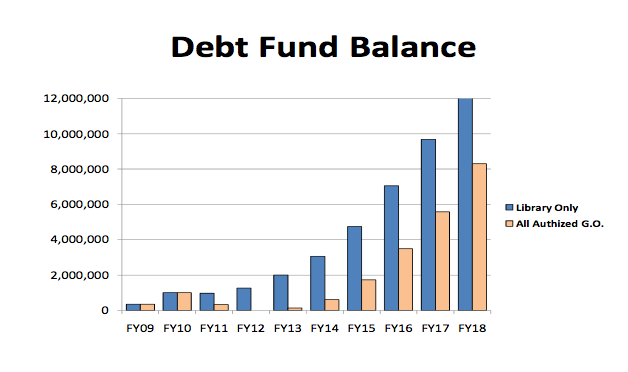
The memos before you [here] paint a fairly rosy picture of the borrowing in terms of adopting new debt but they don’t do a very good job in putting that increased debt in context of our already astonishing – at least by historical Chapel Hill standards – debt load.

Memo #A, in fact, disingenuously characterizes the increase to homeowners using examples of property valuations well below ($200K) the Chapel Hill baseline.

Look at the chart in Memo #A. The rate of increase in the debt load – that rapidly increasing impact on the Town’s flexibility in borrowing – running our debt right up to the debt ceiling for our AAA bond rating – starts in late 2012 and zooms steeply from there.

Of course, besides adding new debt that and anticipated G.O. additions will account for roughly several cents on the current tax rate while the real kicker is the growth in cost of Library operations – which appears to be even more significant.

Worse, the continued structural instability and weakness of our economy gets short shrift.

Now is not the time to take on a large forward liability.

Making a decision based on these figures tonight will be guaranteeing a tax increase or steep cuts or just ignoring basic obligations two years hence.

Here are my suggestions:

1) Shelve Lot #5. We can have a Library expansion – hopefully starting next year – or we can have Lot #5 – we can’t handle both.

2) The Library borrowing should be delayed until prevailing economic conditions show signs of improvement – strengthened sales tax revenues, stable fund markets which will lend money at a more favorable rate – say less than %100 of the 20 year Treasury bond ratio.

3) Have staff prepare a request to NC Local Government Commission to extend Chapel Hill’s time limit for issuing these bonds so the Council and community have adequate time to plan.

4) Use the established public budget process which kicks off next week [2/3/2010 7:00 PM Council Chambers Townhall) to discuss the Library in light of all our Town’s needs – competitive staff wages, affordable housing reserve funds, the growing retirement fund deficit (Unfunded Liabilities: Pay As You Go Not Sustainable) among many others.

Last Fall many of many on Council obligingly participated in a special “emergency” meeting to acquire Dawson Hall for police and other key Town services. That urgent need hasn’t gone away – the police department’s facility still needs attention – why isn’t that part of the rosy projections?

Our citizens deserve a diligent evaluation of the cost of the Library expansion and operations within the context of our total budget and foreseeable needs – not wants.

They also deserve to participate – not just get an agenda item 3 days before a decision is scheduled.

5) Finally, postponing tonight will give you the opportunity to carefully consider this proposal in light of all your priorities, give you time to evaluate the rosy picture drawn by these memos against your own understanding of the economy and think about how to engage the community during this weekend’s Council retreat.

In addition, it buys needed time for the public to review the current proposal, attend the budget sessions, ask their questions, get their answers and finally weigh in in a thoughtful manner.

Thank you.
[UPDATE: Council Postpones Consideration]

From tonight’s Council flash report:

Consideration of Proceeding with the Library Expansion Project: The Council considered the project schedule and associated costs for expansion of the Chapel Hill Public Library. The Council delayed action and indicated its desire to discuss the expansion costs in greater detail and in the context of the entire Town budget. The Council stated it wants to know what level of funding Orange County will provide toward Library services.

Orange County provides no capital support toward the Town’s Library expenses; this includes all past and present Library construction costs, debt service for same, equipment or special project costs. County support toward Library operating expenses has remained at $250,000 since 1995 and represents 11 percent of this year’s Library operating budget. About 12,000 of the Library’s patrons live in Orange County outside Chapel Hill limits. The number of materials borrowed by these patrons was 386,000 items last year. This represents approximately 40 percent of the Library’s annual circulation.

Magic 25

Catherine Lazorko, Chapel Hill’s information officer, sent me this email to Council from Town elder Roscoe Reeve. Roscoe recalls how the 25 bed limit for shelters was set. As suspected, it was somewhat arbitrary though based in an intent to make the approval process less onerous for community-oriented facilities.

Thanks Catherine!

From: Roscoe Reeve
Sent: Monday, January 11, 2010 11:03 PM
To: Town Council
Subject: The Magic 25 Number for Shelters

Dear Mayor Mark and Members of the Council,

I have followed your deliberations, this evening, on the 25 cap for shelters in the LUMO and can, perhaps, clear up its origin.

I was a member and Chair of the Chapel Hill Planning Board that created the 25 cap for shelters in the early 1980’s.

The cap was proposed by staff in the process of creation of the LUMO, a very long and complex process of study and meetings. There was never any discussion or rational for the number 25 as a cap appropriate to a shelter. The interest of the Board was to create (as Mark and Sally implied tonight) a number of permitted uses in appropriate zones so that standards would be clear and that long and expensive deliberations, such as the SUP process, would not impede needed public uses (shelter, school, day care, church, etc.). We thought that if things were appropriate in a zone, as determined by Council’s approval of the tables within the LUMO, arbitrary political passion would be discouraged, the famous “crap shoot” referred to tonight. Especially since schools, churches and private charities could ill afford a lengthy approval process governed by the whims of NIMBY. At that time there was a Council member who would not vote for the approval of any development application where the applicant did not meet personally with him, and in some cases the applicant would have to agree to a personal request of the Council member as arranged at that private meeting. And of course we board members were perplexed when totally complying development proposals were still voted down because a neighborhood didn’t want the development and they raised hell with the Council. Silly us.

In other words, we were all for getting basic development permitted uses so that the development process was logical, based on development standards, and could be completed in a time that did not bankrupt the applicant. Silly us.

I hope this in some way provides explanation for the 25 shelter cap. We assumed that shelters bigger than 25 would need to have a SUP. The number 25 itself was not studied or considered.

With warm regards,

roscoe

Chapel Hill’s 2009 Services Survey

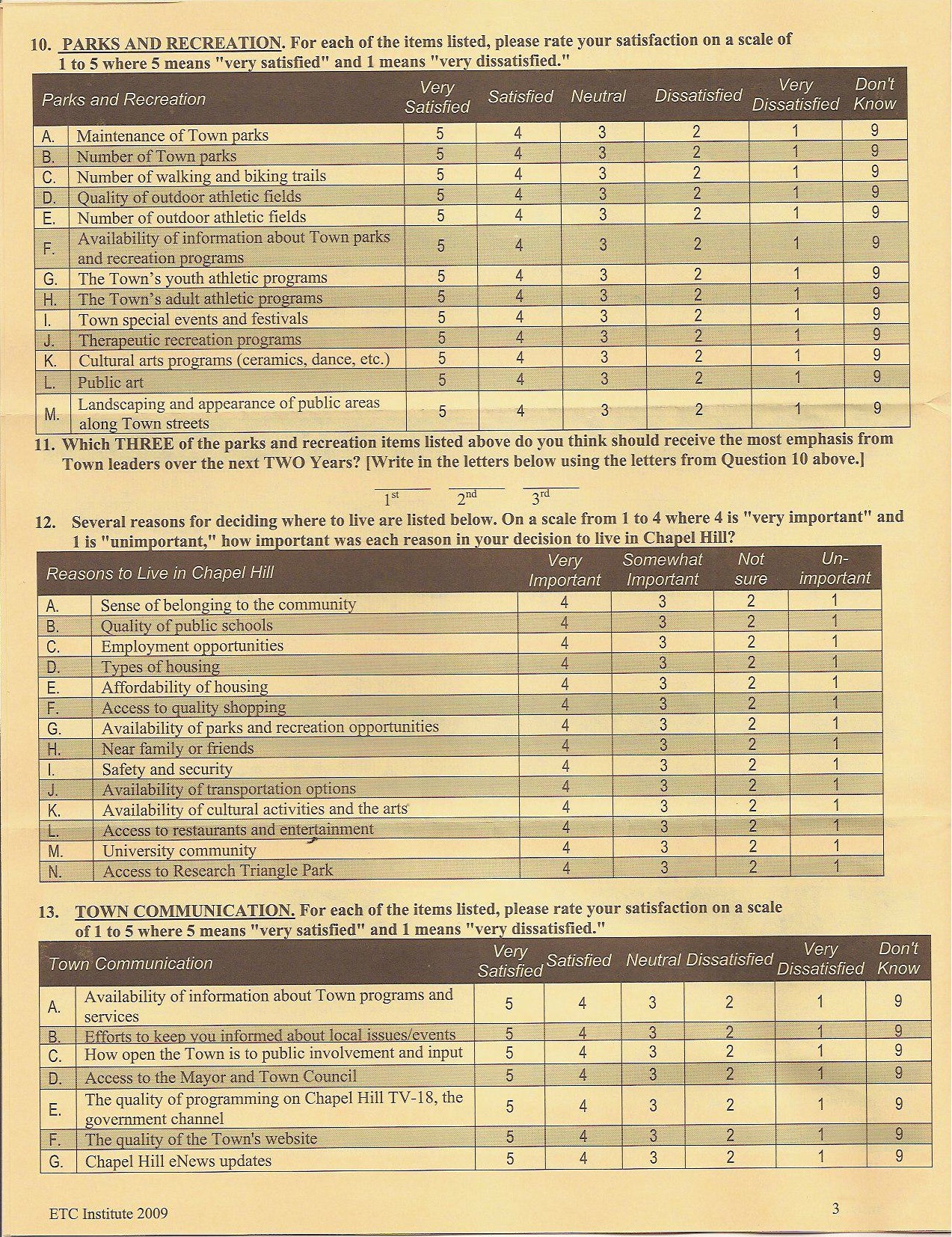
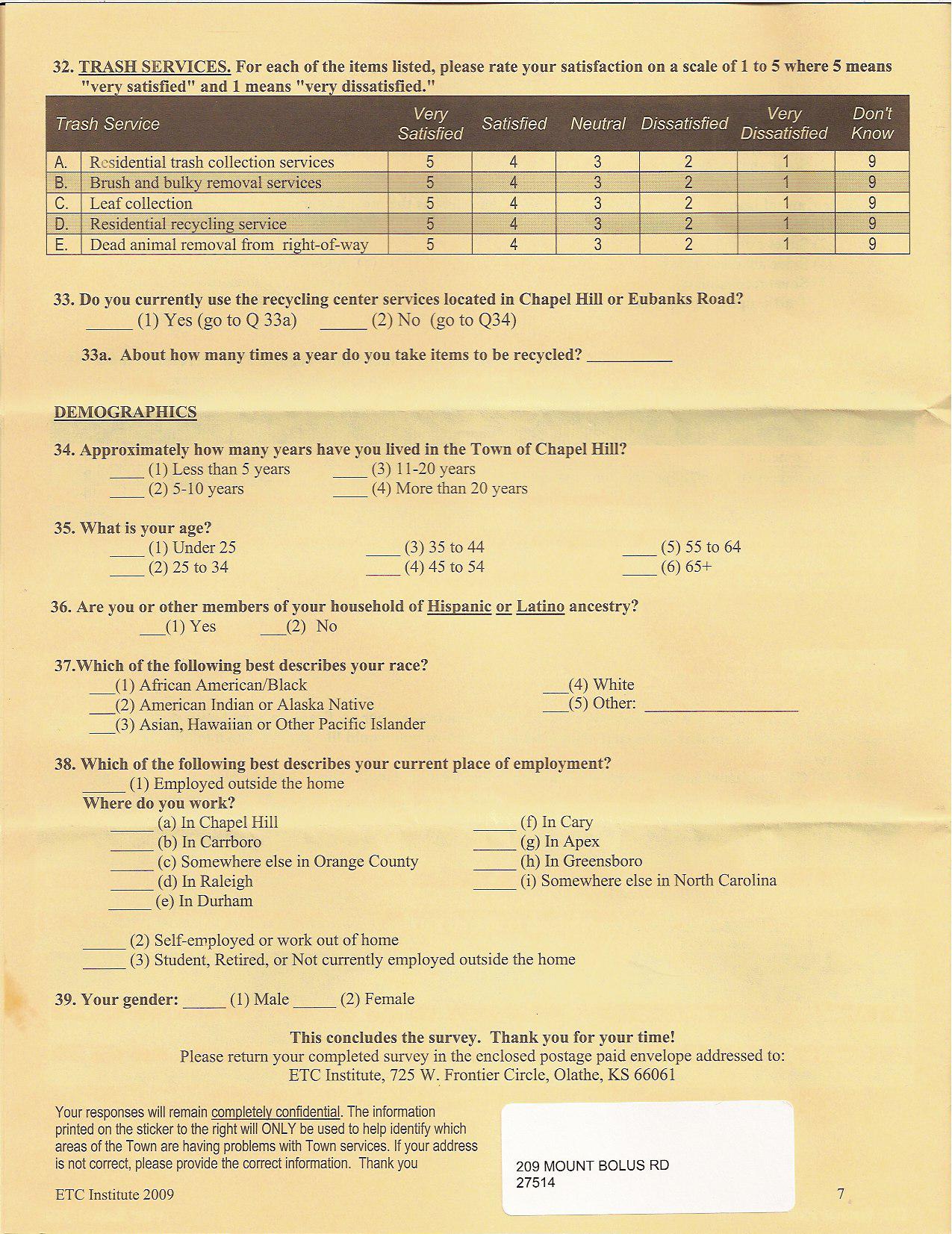
Chapel Hill’s government is finally doing the survey that the Town’s (now defunct) Technology Board recommended more than 5 years ago.

As you might expect, I have a few questions about the survey, including the cost, why it was done by an out-of-state company, how it was constructed, who it was targeted at initially (online version coming soon), how the data will be analyzed and how transparent the process will be among others.

Don Evans, over on Chapel Hill Watch has already started a thread discussing the survey here (“Survey Says” ).

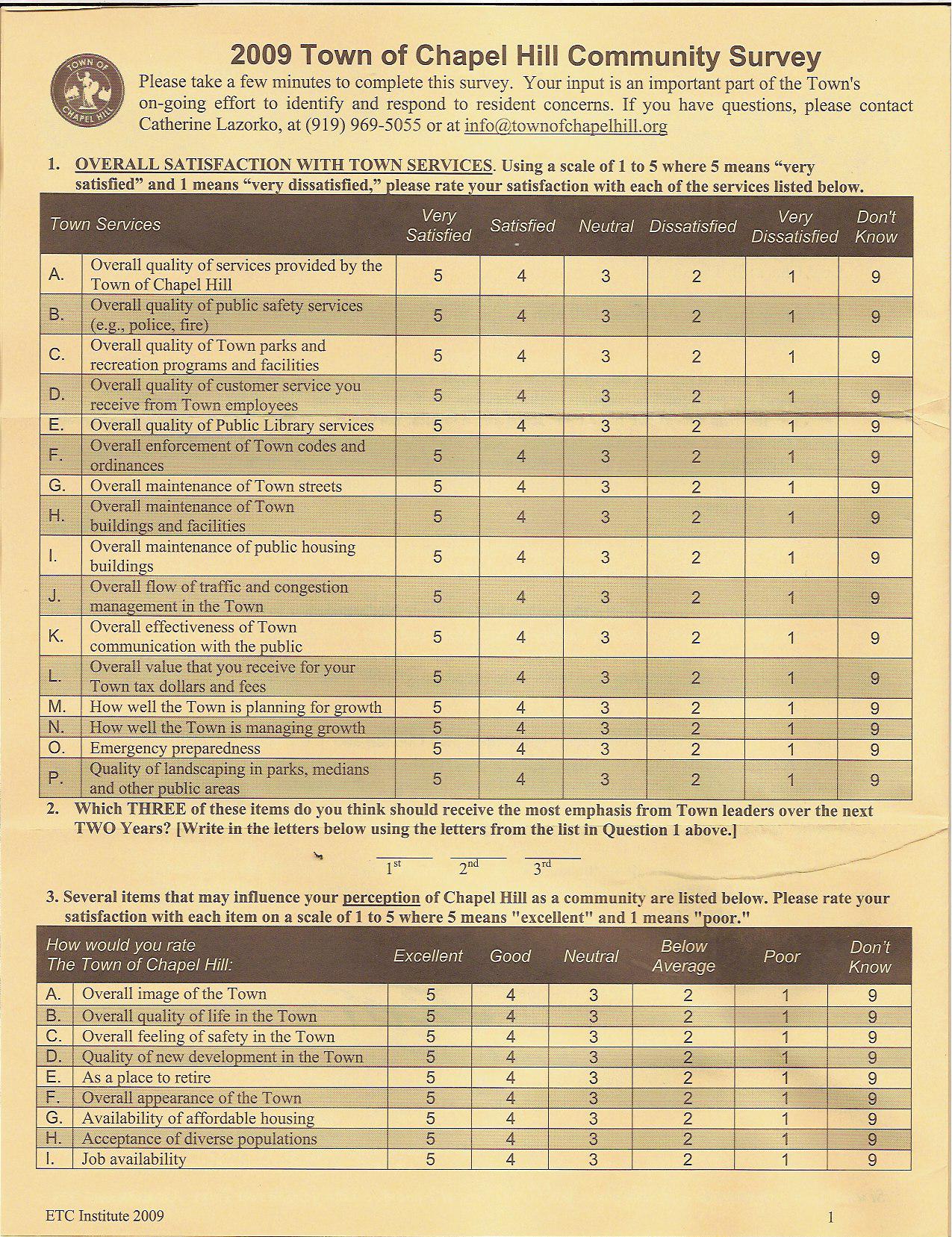
Here’s the scanned in survey if you’re curious about the questions:

ChapelHillSurvey2009.PDF (4M)
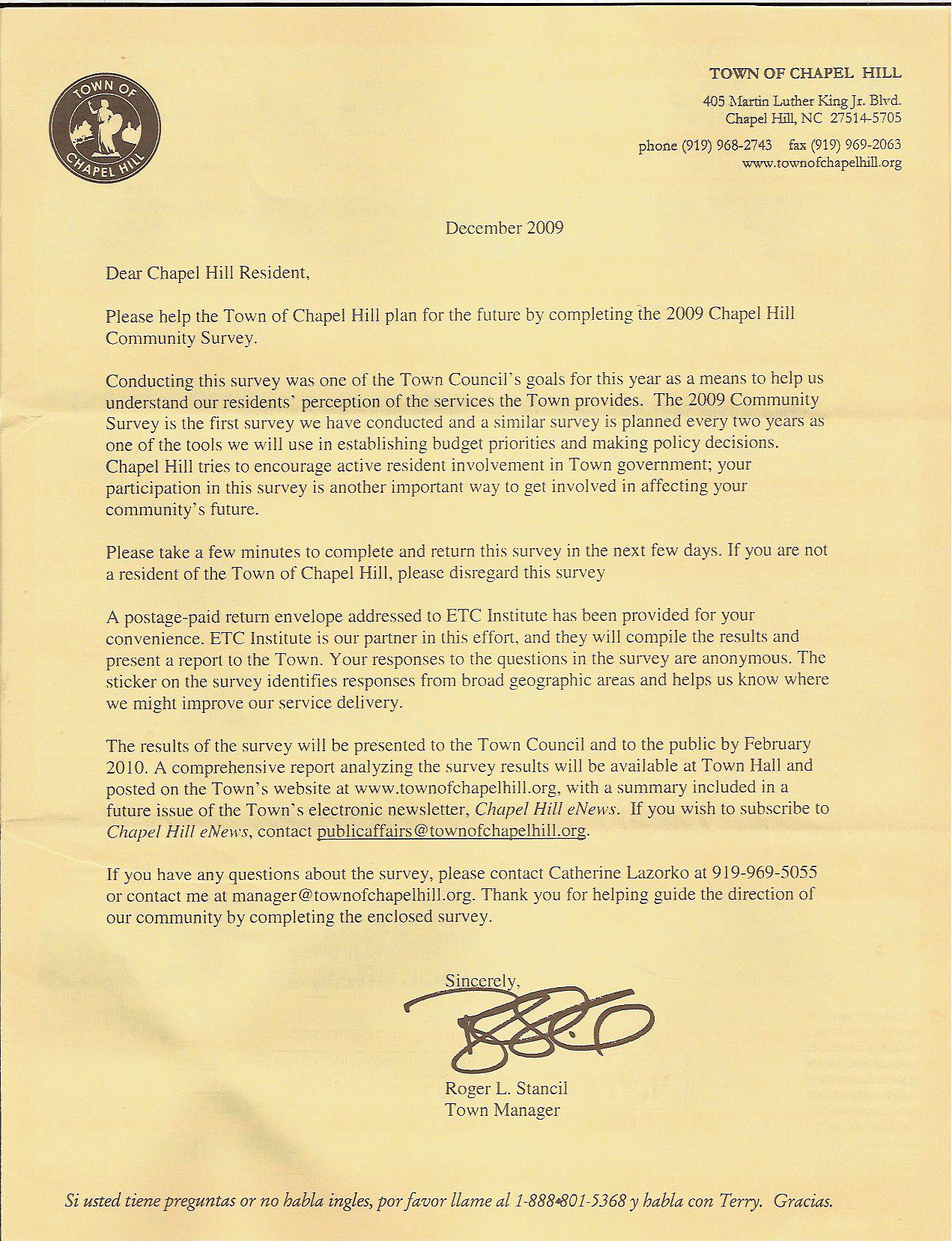
Chapel Hill Cover Page
Chapel Hill Survey Page 1
Chapel Hill Survey Page 2
Chapel Hill Survey Page 3
Chapel Hill Survey Page 4
Chapel Hill Survey Page 5
Chapel Hill Survey Page 6
Chapel Hill Survey Page 7

Applicants 2009 Chapel Hill Council Vacancy

Here’s each of the interested applicants for the current Council vacancy.

That vacancy will be discussed and probably filled at tonight’s special Council meeting.

Over the last 8 years I’ve served this community mainly as a citizen activist and volunteer. Over the last 4 years I ran 3 times for Council in order to serve our community more effectively.

Though I’ve only garnered 5,000+ votes the 3 times I ran, I still felt that those citizens supporting my platform deserved to have a fair airing of their issues and a call for those issues to be addressed by whomever the Council decides to seat.

This election year was marked by polarization of candidates into two clear aggregates (as it appears from Xan Gregg’s excellent analysis), neither of which I was a member.

I was a truly independent candidate raising a different set of issues, addressing a broader range of concerns and bringing a long history of taking on some of the least popular and toughest problems our community faced.

Even though I lost, I do believe I ran the best campaign to-date. I gave my honest appraisal of where the Town is, I didn’t dodge any questions and I always answered as fully and thoughtfully as practical.

The following is a youTube playlist of the presentations made by: Will Raymond, Donna Bell, Aaron Shah, Matt Pohlman, H. Brock Page, Joe Capowski and Jason Baker.


The Town’s video is posted here but is restricted to those platforms supporting Microsoft’s proprietary Silverlight spyware-laden technology.

Trash Talk: Mal de M.E.R. No Longer

Just back from this evening’s Orange County Board of Commissioners’ meeting.

Tonight’s big agenda item, “What to do about the waste transfer station?”

New County Manager Frank Clifton’s extensively reviewed the three proposed options: use the County’s Payfadar property (originally slated for a park) on Millhouse Road, pursue the ill-suited (and ever more expensive) Howell property on Hwy. 54 or “punt” (as Barry Jacobs put it) and temporarily ship our County’s waste to the existing Durham County facility (“Plan B”).

After an excellent set of balanced community presentations from Preserve Rural Orange County (PRO), Orange County Voice and the Rogers Road Coalition (CEER) – many of which covered not just the problems with the proposed sites but posited responsible alternatives – the Board voted 6-1 to not only use “Plan B” but to permanently take the Millhouse-Eubanks-Rogers Road community off the table.

Mal de M.E.R. no more.

I’ve been involved in one way or another on this issue for 5 years. Really pushed to get, and had some success, in creating a transparent community-based process for siting the transfer facility. Proposed using “Plan B” a couple years ago (here and here) to give the Board and community sufficient time to explore a wide range of alternatives.

And, as of this evening, seen the great work from a wide spectrum of County citizens, the thoughtful consideration of our Commissioners finally come to fruition in this decision.

Of course, the work is far from over. I believe that we must eventually managed our waste locally (for instance, like my 2006 suggestion to create an eco-industrial center on the Eno River Economic Development zone to sort, reuse and minimize the waste stream). I also believe that Chapel Hill must step up and bear a greater responsibility in dealing with our contribution to that waste stream. I also believe we must coordinate with our neighboring communities to create an environmentally responsible end-point for our waste.

That work has yet to begin.

Unfunded Liabilities: Pay As You Go Not Sustainable

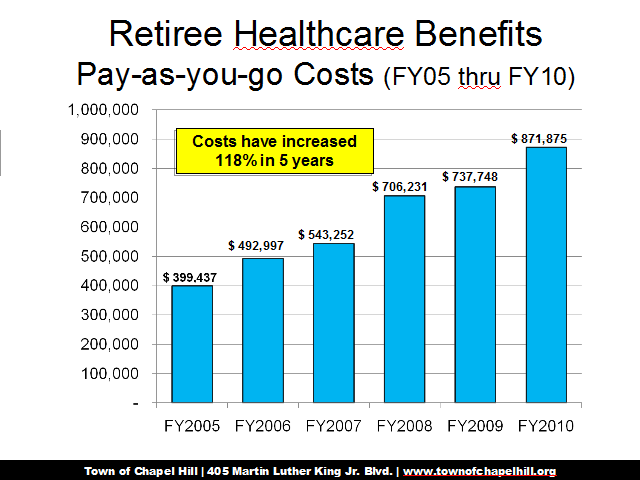
Following up on last night’s post Unfunded Liabilities, the presentation finance head Ken Pennoyer made is here [MS Powerpoint].

This graph isn’t only a call-to-arms for Chapel Hill but is reflective of why health care reform is critically needed NOW.

If the Town decides to change its plan in response to the OPEB criteria, the escalating cost of health-care and the inherent risk that at some point Chapel Hill’s taxpayers can no long sustainably “pay as you go”, we still must make sure that the end-result is a comprehensive, competitive, yet fiscally prudent, benefits package to continue to attract and retain topnotch staff.

Unfunded Liabilities

[X-POSTED from my campaign website]

Tonight was the final Council meeting before the election.

I’ve attended every Council meeting this Fall except the special Friday morning one. I go to quite a few Council meetings in general, so attending this Fall’s during my run for office was not much of a stretch. Penny Rich and Augustus Cho usually show up to catch what’s going on directly (Augustus was there this evening, Penny was participating in UNC Healthcare’s Tickled Pink event to benefit cancer research). Watching the meeting on TV or via the Web is just not quite the same.

Over the last eight years it has been interesting to see which candidates do show up – it seems like you would want to make sure you really want the job given the time commitment, to get up to speed on the relevant issues so you can hit the ground running, to learn a bit more of the nuts-n-bolts of how the Council operates so you can fit into the process fairly quickly – yet cycle after cycle it’s only a few that show.

While the media will probably focus on the Kidzu presentation, the approval moving Glen Lennox’s neighborhood conservation district (NCD) forward, Jim – on election eve – asking the Town to enforce Northside’s NCD (which I talk about in my recent brochure) or Council letting their next incarnation decide on Strom’s replacement, probably the most consequential issue on tonight’s agenda will not get word one.

Ken Pennoyer, the Town’s director of business management, was proposing a change in the structure of staff benefits. All new employees hired after June 30th, 2010 would get a defined benefit plan covering retirement health coverage. Existing employees would retain their Town guaranteed benefit, the payout based on term of service and retirement age.

What’s the big deal?

The existing plan, which is a “pay as you go” approach paid out of general revenues, has increased from $400K to $891k in 5 years – more than doubling our current obligation. To fully fund our commitment to our retired workforce would take $32M to $56M, roughly $3+ M or more per year, for a couple decades!

While the Town has set aside $400K in designated funds over the last two years, the forward obligation makes those contributions pale in comparison. $3-4M per year is equivalent to $0.05 to $0.07 of Chapel Hill’s tax rate – an additional $150 to $210 per year on a $300K home tax bill. This unfunded liability is just one of a number of other obligations – like the $3M affordable housing maintenance fund – which has been allowed to grow and grow over the last 6 years.

Tonight is the first attempt to truly grapple with that overhanging debt to our valued retirees. There are risks inherent in moving new employees to a defined benefit plan but the alternative, scrambling to find funds each fiscal cycle to adequately maintain that obligation, is not sustainable.
Continue reading Unfunded Liabilities

NRG Chapel Hill’s Mayor Candidate Forum

Thanks to Madeline Jefferson, Bob Henshaw, Julie McClintock, Janet Smith, Alan Snavely, Mickey Jo Sorrel and the rest of the membership of Neighborhoods For Responsible Growth (NRG) for both sponsoring the recent Chapel Hill Mayor candidate forum and making the following video available to the wider community.

While Julie did a great job of moving the event along unfortunately the “skip to” feature of this version of the Flash Player doesn’t allow one to move to a later point in the video. The video will start playing and as material is buffered you will be able to move forward.


Engage Now in the NC54 Planning Process

Given the time of year and Durham’s recent problems in protecting the Lake Jordan watershed, the fiscal impact of mitigating damage which might well be shared by Chapel Hill’s taxpayers, I was tempted to title this post “Trick or Treat on NC54?”

Even if the “development process is broken in Durham”, as LaDawnna Summers, who resigned from Durham’s Planning Commission over the Lake Jordan mess, it is important that both Chapel Hill’s elected folks and greater community engage directly in the NC54/I-40 corridor planning process.

Thirty years ago, when I first came to Chapel Hill, I drove into town on the scenic two-lane NC54 (I-40 from RDU on was still a set of dotted lines on a map). The beautiful pastured hills to the north are now covered by Meadowmont. The woods and vales to the south, by the Friday Center and office parks. And the majestic hill-side entry to the University? Now obscured by the “anywhere USA belt-line architecture” of the road hugging East54.

The process starts Wednesday, Nov. 18th, 2009 from 5pm to 8pm at the Friday Center [MAP]

What: NC-54/I-40 Corridor Study Public Workshop #1
Who: Durham-Chapel Hill-Carrboro Metropolitan Planning Organization (DCHC MPO), City of Durham, Durham County, and the Town of Chapel Hill
When: Wednesday, November 18, 2009, from 5 p.m. to 8 p.m.
Where: William and Ida Friday Center for Continuing Education
100 Friday Center Drive Chapel Hill, N.C. 27599-1020

Fast Facts:

  • The Durham-Chapel Hill-Carrboro Metropolitan Planning Organization (DCHC MPO) will host an interactive community workshop on November 18 to obtain guidance on developing a blueprint for mobility and development in the NC-54/I-40 corridor, a critical gateway linking the City of Durham, Town of Chapel Hill, and University of North Carolina at Chapel Hill.
  • The NC-54/I-40 corridor serves as one of the major gateways between Chapel Hill and southwest Durham, with its interchange with I-40 consistently ranking as the top congested location in the region. Development pressures within the corridor coupled with mobility and capacity issues have highlighted that the existing and planned transportation infrastructure is insufficient to accommodate growth and address land use and transportation problems.
  • To develop land use and transportation strategies to preserve this important corridor, the DCHC MPO, the City of Durham, Durham County, and the Town of Chapel Hill have begun a corridor study to analyze short- and long-term land use issues and multi-modal transportation problems, evaluate opportunities and challenges, and recommend short- and long-range land use and transportation solutions and strategies along the corridor.
  • The vision of the DCHC MPO is to develop and implement transportation plans that are multimodal and that fully integrate land use and transportation issues. To achieve this vision this study will:

    • Clearly define a realistic “blueprint” for an integrated growth and mobility strategy for the corridor;
    • Establish a development framework that strengthens multimodal travel options and reduces vehicle miles of travel;
    • Improve operations, safety, and travel time; and
    • Categorize strategies into near, mid-term, and long-term phases.
  • A critical component of this study is public outreach and involvement. Three public
    workshops will be held as a part of this study, which should be completed in June 2010.

    • The first public workshop on November 18 will present the community profile and
      solicit input on issues, opportunities, and trends to guide the development of future
      scenarios.
    • The second public workshop, tentatively scheduled for late winter 2010, will evaluate
      alternatives and seek public input in the selection of the preferred scenario.
    • The third workshop, tentatively scheduled for spring 2010, will give participants an opportunity to review and refine the corridor master plan and provide input on setting priorities for multimodal transportation and land use strategies, implementation strategies, and phasing.
  • Once the study is finished, the final master plan will be presented to the local and regional
    policy boards and used to inform transportation/traffic analysis, land use decisions, project
    planning, and funding priorities.

    • The total cost for the study is $257,432 with 80 percent of the funding coming from federal transportation planning funds and the remaining 20 percent funded jointly by the City of Durham, Durham County, and the Town of Chapel Hill.
    • Residents interested in joining a group of citizen contacts for this study should contact Leta Huntsinger with the DCHC MPO at (919) 560-4366 ext. 30423 or via email at leta.huntsinger@durhamnc.gov. For more information about this study, visit www.nc54-I40corridorstudy.com .

More on Summers’ resignation:

Continue reading Engage Now in the NC54 Planning Process

Varsity to Reopen: $3 Seats, $? Parking

According to this WCHL 1360 story Downtown’s Varsity will reopen in November.

The Varsity’ new website VarsityOnFranklin.com advertises all seats are $3 for “recently released and classic movies with excellent service and a customer focused staff to create an enjoyable movie experience at a discounted price.”

I’ve seen hundreds of movies at the Varsity over the last few decades and am happy, both as a customer and someone interested in enhancing Downtown’s vibrancy, that the Varsity is returning.

Quick question, “What is more expensive? A night at the movies – popcorn and all – or the cost of parking in the Town’s lots during the movie?”

Until Council starts rolling out the core recommendations of the Downtown Parking Task Force, of which I was a member, it seems like a venue that is targeted at providing a reasonably priced evening’s entertainment will have difficulty making that value proposition.