Category Archives: ChapelHill

Multi-modal Design I Appreciate


Today’s Chapel Hill News carries an interesting story from Jesse DeConto on concerns circulating around the misfire (not to sugarcoat it) known as East54. The story, which was as much about how the “dense/tall growth at any cost” Council majority’s vision is running up against reality, as it was the anonymous “I could be in Atlanta or Charlotte” East54.

OK, even though I wasn’t thrilled with East/West Partner’s “virtualization” of Chapel Hill, I did credit them for committing to meet the Leadership in Energy and Environmental Design for Neighborhood Development (LEED-ND) standards (though Council wasn’t clear on what to do if the project didn’t meet those goals).

But does that justify such a pedestrian (to be nice) heap?

I expressed my concerns about the trade-offs – minimal setbacks, in-lieu monies instead of affordable square footage, height on Highway 54, traffic patterns, etc. – but was in the minority as the project sailed through an orchestrated “public review” (count me in as one of East/West developer Roger Perry’s “vocal minority” that unfortunately points out that the current sustainability political palaver is parading sans clothes).

Though the story tried to be balanced, it appears, as reported here to have raised the hackles of a few folks.

I understand the realities of today’s news media but I really wish the CHN had spent a bit more time using the “wayback machine” to contrast today’s political posturing from the more “veteran” of the Council folks (including those up for re-election) with what they stood for when they were more than happy to push East54 (and Woodmont) right on through based on a strange read of sustainability.

More on that later.

Bill Strom, following his usual strategy of playing to his “expertise” in transportation, said

“It’s a change in the development pattern, but the guiding principle there is that it is at a regional rail stop,” said Strom. “In order to get federal and state support for these projects, you have to have density organized in a way that promotes ridership.”

Yes, approval of that pile of nondescript architecture, looming over the Glen Lennox neighborhoods and serving as the “de facto” gateway to Chapel Hill, was justified by a rail stop coming sometime mid-century.

This is what passes nowadays for cogent analysis.

In any case, I’d rather leap off the train ala “Slumdog Millionaire” than alight on East54’s commercial doorstep.

Is there an alternative I believe is better?

Sure. Look east to Durham’s new multi-modal public transit station which will serve the Bull’s ballpark, the “white elephant” (Durham’s County jail), Downtown Durham and the American Tobacco complex. Downtown shopping, the Durham Performance Center and Theater, the Durham public library and Arts Guild is not that far away.

The glass heavy design (not sure the role environmental concerns played there) would not be fitting for Chapel Hill but every time I drive by the construction site (finishing this month) it seems like the unfolding design complements Durham’s retrofitted Downtown. Of course, like other Durham projects, the budget was blown – not unlike Chapel Hill’s Town Operations Center.

Central. Convenient. Complementary to its urban environment.

More on Durham’s multi-modal transit station backstory from the Urban Planet forums.
Orange County Voice Pushes Plan B

Orange County Voice, another Orange County organization working on the trash transfer site issue along side Preserve Rural Orange, has picked up on the Plan B options I have posted on as recently as last Fall (Trash Talk:Commissioner Gordon “No Plan B”).

Bonnie Hauser, Tony Blake, Susan Walser (recent editorial) and other members have done their homework, presented their cases both for cost effectively using existing local transfer services (one of the options I proposed to the Orange County Commissioners starting several years ago) to partnering with UNC on Waste To Energy facilities [OCV research].

Feb. 11th they renewed their call as reported by Mark Schultz in the Chapel Hill News.

The report says vendors charge $40 to $50 per ton to dispose of waste using existing facilities. Two vendors run waste transfer facilities in Durham and are willing to take Orange County’s waste on a monthly or yearly basis, the report says.

By contrast, the report says Orange County estimates it would cost $47 to $62 per ton to dispose of waste using a new county transfer station. The difference comes in the county’s spending too much to buy property, spending too much to build the facility and locating it in a rural area that lacks water and sewer services, according to Orange County Voice.

The Commissioner’s have opted to research (Herald Sun, Jan. 27th, 2009) alternatives to siting and building a new facility in the particularly troublesome proposed Hwy 54 locale. The race is on to see if common sense and a keen eye towards the future will win out over the current course of events.

Preserve Rural Orange: Greensboro Transfer Station Review

Watching the folks who formed PRO – Preserve Rural Orange – in response to UNC’s foray into airport building and Orange County’s crazy siting of the trash transfer station on Hwy. 54 has been encouraging. From a small group of concerned citizens, they have developed an activist organization that puts the “pro” in PRO.

These are long term issues but, so far, they’ve done a great job rallying other concerned folks from across the county to address these significant issues.

Here’s Laura Streitfeld’s report on yesterday’s visit to Greensboro’s waste transfer facility.

To read and listen to WCHL 1360 AM coverage of Orange County Commissioners’ visit to the Greensboro Waste Transfer
Station, click on the link below: WCHL report.

Visit to the Greensboro Waste Transfer Station

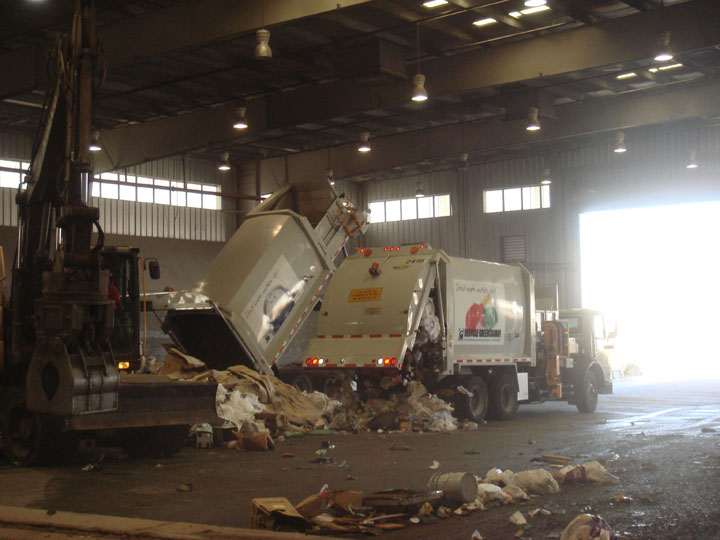
Yesterday morning I visited the City of Greensboro’s Waste Transfer Station, on a trip planned for new Orange County Commissioners. I rode in a van from Hillsborough with commissioners Pam Hemminger, Bernadette Pelissier and Steve Yuhasz, Orange County’s Solid Waste Director Gayle Wilson and Solid Waste Planner Blair Pollock, and reporters from the News and Observer, WCHL 1360 AM, and a student reporter and camera person from UNC. When we arrived at the station we were joined by Bonnie Hauser and Susan Walser of Orange County Voice and Forrest Covington, who is working on a video project with Bonnie Hauser. While at the site I took photos and video, and attached are two photos, one of a truck dumping trash inside the building and the other of trailers parked outside, with petroleum tanks in the background. Steve Yuhasz speaks with Jeri Covington in the second photo.

City of Greensboro Environmental Services Director Jeri Covington talked with us and answered questions about the city’s landfill and waste management history and the transfer station’s financing, construction and operations, then took us for a tour inside on the floor, where operations were slowed down for us to walk around. Like the proposed Orange County station, the two-story Greensboro station is entirely enclosed. Inside there was a thick dust in the air that clouded some of my photos, stirred up by the wind blowing in and by the constant motion of trucks and earthmoving equipment driving in and out, dumping and pushing trash across the floor. The smell was not as strong as I anticipated, but walking through the dusty interior I did get a vivid picture of how traffic, noise and airborne particles from an entire county’s waste would affect the ecosystem and watershed in southwest Orange County.

In selecting a site, Jeri Covington noted that they looked for property close to the interstate and near rail lines in an industrial zone. As we saw on our drive in, the station is close to an I-40 exit and and surrounded in all directions by petroleum tanks which Covington called “tank fields.” When it was built in 2005, the Greensboro facility’s cost of construction was $9 million, and the cost of the ten acre property, which Covington said was too small, was over $800,000. She described the station’s funding as a “hybrid,” explaining that they receive funds from city taxes and from tipping fees for taking trash from outside municipalities and companies. At the Greensboro station, garbage is dropped from the upper floor into tractor-trailers below and hauled to the Uwharrie Regional Landfill in Mt. Gilead, North Carolina.

The visit and the van ride were both informative. On the way to Greensboro I spoke with Pam Hemminger, and learned about her background, school board experience and new role as a commissioner. Riding back, Gayle Wilson and Blair Pollock shared their expertise on a broad array of waste management and recycling issues, answering Steve Yuhasz’s and my questions. Wilson discussed the future of the county’s collection centers on Bradshaw Quarry Road and Ferguson Road, one or both of which could close if a collection center were built on the Howell property near the proposed transfer station.

My purpose in visiting the station with the commissioners was to bring back information that would be useful to county residents. Photos, video and a description of the Greensboro station visit will be posted soon on the Preserve Rural Orange website. At our upcoming meeting on March 1st, I look forward to sharing more with you about recent developments in the waste transfer issue. Please feel free to contact me with questions or comments at: info@preserveruralorange.org

Carolina North: Easthom – “Now is the time!”

Council member Laurin Easthom says “Now is the time” for the community to get involved with the planning for Carolina North.

Now is the time. Now is the time to comment on Carolina North, the largest development to ever hit the Town of Chapel Hill. The Town Council and UNC Trustees are meeting monthly to hash out a development agreement that will allow UNC flexibility and assurances in its development of Carolina North. If we come to an agreement by June on how Carolina North will develop, we may be done for years in decision making on how things are done. It’s time to wake up, and get active, and come to these meetings so that UNC can hear what you think.

Damn straight, especially if you serve on one of our Town’s advisory boards. The Carolina North train has left the station and is picking up speed, “Now” is definitely the time.

More here.

Nov. 23: The History of Chapel Hill’s Dead Tree Media

The troubled News and Observer posted this reminder:

The Chapel Hill Historical Society will present The History of Print Media in Chapel Hill and Carrboro on Sunday from 3 to 5 p.m.

The featured speakers will be Don Evans, an editor and writer at The Chapel Hill News for three decades, and Kirk Ross, former managing editor of the Independent Weekly and co-founder of The Carrboro Citizen.

“Our event will look at the history of newspapers and print media in our towns and will surely spark a discussion about the future of newspapers here,” said Chapel Hill Historical Society Chairman Terry Barnett.

The program is free and open to the public and will be held in the lower level of the Chapel Hill Museum, 523 East Franklin St. Parking is available in the museum lot [MAP].

Chapel Hill has been blessed over the years with a variety of media outlets. Their evolutions and declines, reformations and restorations a harbinger of what comes next in journalism in the on-line age. Don’s (and formerly Kirk’s) Chapel Hill News has a ‘net presence via OrangeChat. Kirk is a pioneer – creating a newspaper, the Carrboro Citizen, on-line first then moving its content to the quaint dead tree distribution network.

Unfortunately I have a previous engagement on Sunday. This should be an interesting presentation where, I’m fairly sure, some curious back-stories of Chapel Hill will emerge.

Carolina North: Community needs to wake up and show up!

[UPDATE]

The Daily Tar Heel’s Emily Stephenson chimes in here (DTH ‘blogs). A story on yesterday’s poor turnout here.

[ORIGINAL]

Earlier today (Nov. 19th), UNC’s Board of Trustees approved the draft Carolina North design guidelines making the proposal official UNC policy.

This evening, the first in a series of informational/public feedback sessions on Carolina North was held. With the creation of the Carolina North development agreement well on its way, the Council’s explicit call to advisory boards to attend, if possible, and the aggressive schedule to meet next July’s commitment, I expected a fairly full house.

Crowded house? Not the case.

The meeting started with roughly two dozen citizens in attendance. By the time Jack wrapped his presentation covering UNC’s design intent the group of interested citizenry was down to 19. At the end of the Dr. Owen’s presentation, covering the development agreement process, only 17 non-staff/non-press folks remained. Of those, eleven were drawn from the “usual suspects” ( Fred Black, Joyce Brown, Fred Stang, David Godschalk, George Cianciolo, Lynne Kane, Mike Collins, Loren Hintz, Ed Harrison, Bob Henshaw, me).

Disappointing! As Carolina North’s development director Jack Evans noted this evening, the formal process for approval has begun. The first phase of Carolina North is on its way.

Chapel Hill residents need to wake up and show up.

Every resident will eventually be affected by Carolina North’s development. At least 5 advisory boards will be consulted on both the outline and details of the development agreement. Community groups like the Friends of Bolin Creek and Neighborhoods for Responsible Growth (well represented this evening) could play key roles in shaping the discussion.

There is quite a bit of work before the community. If we follow Pal Alto’s trajectory, the development agreement – which is, as Dr. Owens pointed out again this evening, essentially a binding legal contract – could swell to 200+ pages over the next 8 months (that’s 25 or more pages of detailed legal requirements per month – a heavy responsibility). Those pages will dictate development over a long period. Once set, unlike zoning ordinances, the ability to tweak conditions requires mutual agreement. Mistakes could be difficult to correct.

The community has a tremendous opportunity to shape the outcome at Carolina North. Both UNC and Chapel Hill’s Town Council agreed to involve the public at every point in the process. But, so far, Chapel Hill’s citizens have not turned out.

The negotiations between UNC and the Town will continue to accelerate. The momentum is building rapidly. My concern is that by the time citizens go into reactive-mode – recognizing missing elements in the plan, trying to wedge in protections beyond those outlined – the inertia will be too great and the time too short to significantly change course.

Now is the time for public concern. Now is the time for community involvement.

Because of the extensive impacts Carolina North will have on this community over the next several decades, I’ve asked Council to “bang the drum loudly”, to go beyond simply inviting the public into the process. We need to seek out folks, develop multiple avenues of engagement and draw them into the discussion. That said, at some point it comes down to whether our citizens want to shoulder their part of the burden and work on behalf of folks that will live here decades hence.

Community Oversight of the Planning Board

My previous posts tracking requests for information, feedback and general commentary to our Town staff and elected folks seem to be fairly popular.

I’m going to continue to post correspondence which might be of public interest.

The Town’s Technology Board (now defunct) was the first advisory board I regularly interacted with. The first meeting I attended was about six years ago (I was a lowly citizen then, not a member). I presented the group what I called a “technology manifesto” of proposed technology enhancements for the Town.

The “manifesto” outlined five major areas for improvement including cost saving initiatives, use of open source software, adoption of open standards, broadening community outreach via the Internet, tracking both the planning process and other relevant Town business processes, publishing Council and Town Manager emails, what is now called social networking sites for direct interaction between citizens and Town, WIFI to bridge the digital divide, public fiber infrastructure as an economic development differentiator, website accessibility, etc.

It was quite a list. The Technology Board seemed a bit stunned (or maybe bored) but, even so, they did me the courtesy of listening as I outlined my plan of action.

I continued working on those items when I became an official member of that board. Some of the initiatives have moved forward. Others languish. None have been completed.

One issue I brought forward was on-line video of Council and other important advisory board proceedings. Because of the sketchy minutes many advisory groups kept, I also wanted audio of all board proceedings.

When the Town lagged in their effort to put Council meetings on-line, I took it upon myself to upload (here) as many as possible. Finally the Town contracted with Granicus (which uses Microsoft’s proprietary technology) to do the same.

Now we have video (here) which is easily accessible for those folks running Winblows. Mac and Linux users are kind of cut out (see the problem with not using open standards?).

Anyway, long windup to another in a long line of re-requests. In this case, online video documenting the proceedings of our Planning Board (pretty common elsewhere, important when minutes lag Council approvals or don’t adequately capture debate).

Last week the cable-customer supported People’s Channel presented their annual report. As part of that report, they expressed an interest in doing more coverage of governmental events.

I sent this to the PC’s Director Chad Johnston Nov. 11th:

Hey Chad,

I’d like to follow up on Kevin’s comments last night.

I’m not sure if you are aware of my several year effort to get Council to broadcast advisory meetings, but I believe this is what Kevin was referring to.

In terms of priority, I have asked that the Planning Board be the first in line. As you know, the Planning Board’s decisions have significant impact on the community. Many other communities already broadcast their deliberations.

Do you think TPC could assist the Town in that effort?

Thanks

Here’s what I asked Mayor Foy the same day:

Kevin,

Since you brought the issue up last night. As you know, I’ve been calling for more extensive coverage of advisory board proceedings for years. Priority one, I believe, is broadcasting and posting video of all the Planning Board sessions. This is quite common elsewhere. Planning Board’s decisions have significant impact on the community. Beyond their process, which we could do a much better job explaining, zoning issues as a whole seem somewhat opaque to the wider community.

Televising their proceedings would go a long way towards involving our community at a point where their concerns can have the most impact.

I hope you will put this on a fast-track with Chad and company.

Thank you

To date I’ve had no response from either Chad or Kevin. I’ll update folks should I hear from them on what I think would be an excellent improvement to our governance process.

Chancellor Thorp on HWA Closure: Not until we have to…

UNC’s Chancellor Holden Thorp takes a postion (“Carolina North: A Glass Half-Full Perspective”) on Horace-William Airport’s closure.

One of the most vexing issues, though, has been the future of Horace Williams Airport. As you know, it occupies the heart of the Carolina North acreage. It’s the flattest part of the tract and, therefore, the best place to build Carolina North. So we have to close it.

Now, I realize it doesn’t take a lot of analysis to figure out that closing the airport is important for the future of Carolina North. But figuring out HOW to close the airport . . . that’s another story.

Ultimately, I think it comes down to this. The AHEC program is an extremely important asset to this University and to our state. Our doctors, nurses, other health professionals, and our MedAir pilots are as committed public servants as you will find. The work they do and the service they provide are fundamental to who we are as a university. And we are telling them that we have to close their airport to build Carolina North.

I have analyzed all the options, and I’m convinced that we really do have to close the airport to make Carolina North all that it must be. I’m equally convinced that we should fully support the airport authority authorized by the General Assembly as the best way to pursue creation of an airport in Orange County. It gives the county zoning authority, and it turns over the siting and development to a public body with greater expertise than we have.

For AHEC and MedAir, I think a move to RDU for the short-term is workable. But for the long-term, we owe it to our doctors to appoint the airport authority to see if there’s a better alternative.

We have said all along that we wouldn’t close Horace Williams Airport until we had to. With today’s challenging economic climate, we anticipate that funding for initial Carolina North construction likely will be delayed. Our state appropriation for planning and infrastructure for the Law School relocation to Carolina North is frozen, at least for now. And Alexandria Real Estate Equities, Inc., our partner for the Innovation Center, has put new projects on hold, although they have affirmed their interest in our project.

So, as I posted last night, the University maintains their stance that closure is contingent on Carolina North’s building projects moving forward.

I am disappointed that Holden continues to maintain that the only path to serving AHEC’s needs involves a new general aviation facility. This fixation makes no sense at this point and counters UNC’s own consultant’s recommendations to move AHEC to RDU.

Holden is “convinced that we should fully support the airport authority authorized by the General Assembly as the best way to pursue creation of an airport in Orange County. ”

Sure, the airport authority, with the sovereign powers the State granted it, is probably the best way to get an airport built in Orange County over local residents’ objections.

Where, though, is his concern for the Authority’s other duty – to factually justify the necessity of a general aviation facility? The Authority’s duty to “support the missions of the University of North Carolina at Chapel Hill or the University of North Carolina Health Care System” has to balance against the significant local impacts, the $60-100 million price tag, the infrastructure costs shoved onto local residents.

I applaud Holden’s willingness to engage the community in the discussion via his ‘blog. I wish other local officials took a lesson from him.

I already left him a comment on his post. I hope folks weigh in with their thoughtful and considered input.

Hat tip to Fred Black for highlighting Holden’s comments.

Carolina North: Nov. 18th Meeting Notes

Tonight’s meeting (background) was well attended . Many of the folks attending were there to send the message “No Airport!”. Chapel Hill News reporter Eric Ferriri did a pretty good job covering that part of the meeting over at OrangeChat.

The Chancellor was missing in action. I think that is two of three meetings now.

The Council-Trustee sessions allocate two public comment periods, before and after the main meeting. Jim Ward, responding to tonight’s turnout, suggested doubling the time for public commentary from 10 to 20 minutes. I believe the 8 folks signed up had adequate time to get our points in (though I could easily spend a few hours going through the detail divergences in UNC’s proposals, ways to flesh out the development agreement, setting goals/metrics/methodologies to measure compliance, etc.).

After thanking staff for producing a nearly complete agenda a few days before this meeting (unlike the few hour lead times of the last two meetings), I took a few moments to ask some questions and add some suggestions to my earlier list.
Continue reading Carolina North: Nov. 18th Meeting Notes

East 54’s Virtual Chapel Hill

Do you recognize the following scene?

This is East West Partner’s revisionist view of Chapel Hill as improved upon by their East 54 project. They have provided a cool animation of the eventual East 54 living experience.

One small problem.

Their Chapel Hill doesn’t match reality.

What is it about big time developers and their desire to re-conceptualize reality?

From what I hear, East West Partners are working hard on their Leadership in Energy and Environmental Design for Neighborhood Development (LEED-ND) certifications. East54 could be the first North Carolina development to leap LEED-ND’s hurdles. An accomplishment well worth noting if they run the whole race.

Isn’t that worth overlooking a little virtual retouching of Chapel Hill?

A middle finger to Northside

I wasn’t able to attend the spoken-word event concerning the corrosive effects of Greenbridge on Northside last evening, but according to the Daily Tar Heel, it stirred some sharp discussion.

UNC junior Kane Smego, who performed slam poetry at the event, described the project as two towers, “one 10 stories, the other seven — like a middle finger to the Northside.”

The Greenbridge promotional video added some controversy:

The video features interviews with black Northside residents recounting family history intermixed with narration about the proposed Greenbridge site.

Many of those featured in the video now say their words were taken out of context and misconstrued to seem as they were in full support of the project.

“I didn’t realize what I said was going to be used in that manner,” said Dolores Bailey, a Northside resident who was featured in the promotional video. “So that bothers me a lot.”

Delores (not Dolores) did support Greenbridge’s zoning application though she also wanted to carve out a better deal for the neighborhood:

Delores Bailey, a Northside resident, pointed out that Greenbridge could help but would not solve all of the problems in that area of Chapel Hill and/or Northside. She said the notion that preserving downtown is more important than preserving a neighborhood makes her “shudder.” Ms. Bailey said there were people in the neighborhood who did not understand that Greenbridge would be 10 stories high. She proposed putting half of the affordable units in the neighborhood, adding that this would address more needs. Ms. Bailey said that developers had listened, and that even though she had problems with the project she supports it because it is an attempt to work with the neighborhood and an understanding that some people will be living in its shadow. She stressed the importance of Greenbridge being respectful of the neighborhood and not making it feel shut out.

As far as that shadow, I argued that the socio-economic shadow this throws across Rosemary was not adequately discussed or evaluated (the physical shadow is pretty large also).

Alum08 at the DTH said:

It’s truly unclear what NOW is hoping to accomplish. This organization’s sole achievement has been complaining about something it does not fully understand. Additionally, this is all final and in the past. Why, as bright Carolina students, are we focusing on this instead of the future?

The future Downtown, at least as it is constituted by our current leadership, is high – high cost, high density, high buildings. The consequences, especially the long-term cumulative consequences, have not been adequately evaluated by our community.

Here’s a comment I left at the DTH:

It’s a shame that this dialog didn’t happen when the project was going through the approval process. I was one of the very few folks that stood up to challenge the project. I took a lot of heat for pointing out that this project would accelerate the gentrification going on not only into Northside but spreading South to Cameron, West to Pine Knolls, etc.

There are other shoes to drop here: the commercialization of Rosemary to the North, the cumulative impact of the Town’s Lot $5 project/Short Brothers project/University Square redevelopment on the nearby neighborhoods, the gentrification of nearby local businesses (how long will unsubsidized local business last as their rents rise or landlords redevelop to attract boutique shops?) and other corrosive effects of the high-priced/high-density vision our Council maintains.

Delores, as well as did other local leaders from organizations like the Hank Anderson Breakfast club, supported the project wholeheartedly. It was quite difficult to contest the social justice issue in the face of their support.

There’s a lot to like about Greenbridge, even as it sheds some of its “green” cred. I argued it was in the wrong place and that it would exacerbate the community displacements seen in Northside, Cameron and Pine Knoll.

Again, while Greenbridge is a “done deal”, there is still an incredible need to explore these other issues. I’m glad some other folks are taking up the challenge.

Characterizing Delores’ acquiescence as wholehearted is maybe too strong a sentiment but as I recall, in the end, there wasn’t a lot of struggle to get the final approval.

If there’s one lesson to be learned from last night’s event it is that our Town needs to look at improving our community outreach effort, get creative and more expansive, in order to build a broad consensus.

Eve Carson: Ripples of Hope

Eve Carson was universally lauded by the local community for epitomizing the Carolina Way. Her friends honor her by ensuring that her contribution to our community continues.

Linda send out this reminder.

Dear Friends and Neighbors,

The death of Eve Carson last year was a tragic moment that stunned us all. In the months since Eve’s death, students have planned ways to remember her and the things she loved and cared deeply about.

Come participate in the inaugural Eve Carson Memorial 5k for Education on Saturday, November 15th, 2008. Gather at Polk Place behind South Building for registration at 8:00 a.m.; the race will begin at 10:00 a.m. Children’s activities will be available. Kids under 7 run for free and dogs on leashes are welcome to run.

Go to the website http://educationforeve.com for information, registration options and a way to donate even if you don’t run.

The Pi Beta Phi sorority and Phi Delta Theta fraternity have organized this great community activity to raise funds in memory of Eve. Two thirds of the total proceeds will go to Eve’s scholarship foundation and the remaining third will be split between First Book, a nonprofit that gives new books to preschool children from low-income families, and the Clyde Erwin Elementary School in Onslow County.

Get your running shoes laced up and join us on Polk Place on November 15.

Dec. 10th: The Density Discussion

In my application for the Council seat, I called again for Council to sponsor a thorough, wide-ranging and comprehensive community discussion on development density.

How high, how dense?

Last Spring, Council decided to end their pursuit of high density development zones. We need to restart that discussion. We should take the recent work on twisting RSSC into a palatable high density zone and start fresh with the density discussion.

Our community might not embrace high density, but if we’re going to allow high-density development to go forward civic duty demands we have a clear, honest and open discussion among not only Council and those developers wishing to use a new zone but the wider community.

We won’t have to wait on Council to initiate that discussion. Dec. 10th, Neighborhoods for Responsible Growth (NRG) is holding a forum meant to begin a community conversation on acceptable limits to density and growth.

Dear NRG neighbors and supporters:

Mark your calendars for December 10, 2008!

Chapel Hill 2020: where are we headed?

Neighborhoods for Responsible Growth will hold a public forum on growth, density, and the future vision for our community on the evening of Wednesday, December 10, 2008, in the Chapel Hill Town Council Chambers, from 7 p.m. to 9 p.m.

As our community has grown, the need for a community-wide discussion on how we want our town to look has become acute. More and more citizens are expressing uncertainty and concern about what degree of density is most appropriate for our community, and where the best locations for it might be.

NRG believes that our region will develop best if it develops based on a comprehensive vision that is understood and endorsed by informed citizens. The goal of this forum is to kick off a community-wide discussion of these issues. NRG will be broadcasting more information as the agenda and speaker list firms up. But for now:

– Mark your calendar for this event

– Please forward this e-mail to any and all potentially interested friends and neighbors

– Please send any questions to NRG by return response to info@nrg nc.net

Thank you, and please watch for more details on this important event!

Julie McClintock and Kristina Peterson

Co-Chairs, NRG www.nrg-nc.net (email) info@nrg-nc.net

Like they say, mark your calendar for what promises to be an interesting event.

Persons Out of Place

In my application for Bill’s seat on Council, I mentioned my concern (“Walking is not a crime.”) that the recently announced Orange County Community Safety Partnership program, which trains Town staff and the general public to identify and report criminal activity or other public safety related issues, needs to be careful in discriminating what is and what isn’t considered “suspicious”.

When the Police Department announced the Orange County Community Safety Partnership, I was concerned because it sounded like the roundly criticized Homeland Security TIPS program. It wasn’t clear what kind of oversight, training or civil protections were part of the program. Pat Burns, our representative, walked me through the program and provided some insight on its operation. The training presentation has a few items I would like see addressed and I believe the community would be well-served by having Pat run Council through the process to solicit feedback. For me, the part about reporting “persons walking through yards of residential areas or seeming out of place” needs to be clarified. You might recall a recent embarrassing incident when a young man using his cell on his street corner had the police called because he “seemed out of place.”

The incident I’m referring to was reported throughout Town and on BlueNC.

Dear Lake Forest neighbors,

My name is Allen Buansi. I am 21 years old. I’m 5-11, weigh around 190 pounds and I am a black man. More often than not, you may see me in the neighborhood on a bicycle and wearing a backpack. I’ve lived in Chapel Hill for about 10 years and have lived in the Lake Forest neighborhood for much of that time. I attend Dartmouth College, and I head back up to school on September 14. I work at the local YMCA. I am in Chapel Hill for the summer, and I am an assistant football coach for East Chapel Hill High School, the school from which I graduated.

You may see me on the corner of Tadley Drive and Ridgecrest during the day or at night talking on a cell-phone to my girlfriend who lives in Texas. Or you may see me there talking on a cell-phone with my mother who lives in Richmond, Virginia and is a Ph.D student at UNC. You may even see me on a cell-phone talking to one of my best friends, Andres, who also lives in Texas. You may see me there on my bike because I have just ridden back from football practice at the high school. The reason why I am on that corner in the first place? I do not get a good signal back at the house, which is in Avalon Court, a block down from Tadley Drive. And so the only places I get a good signal at are at the corners of Avalon Court and Ridgecrest Drive and of Ridgecrest Drive and Tadley Drive.

…..

A neighbor had called the police department saying that there was a suspicious man standing on the corner. “There have been robbers in the area, and we came check out the situation,” one of the officers said to me. “I see,” I say. “So can I not talk here on my cell-phone? I get a pretty bad signal back at the house.”

The officer then recommended that I go down half a mile to the parking lot of Whole Foods to talk on my cell-phone. He recommended that I leave the neighborhood in which I live and have stayed for the past 10 years, so I could talk on the phone to my loved ones. “Otherwise if we get more calls, we’re going to keep coming down here.”

Last year we had a few day time break-ins at the end of the street. Pretty surprising given that the Police Department is only a block away. Our neighborhood got together and reviewed our community policing options.

During that meeting, a young black woman who lived on our road told us a similar story. She was walking home when a police cruiser slowly pulled-up. She was stopped, asked for ID and told to be “more cautious”. More cautious?

Anyway, it turns out her neighbor had called the police. The neighbor was quite embarrassed, apologized profusely.

I spoke with Pat Burns at length and he provided a copy of the training PowerPoint (here). While the language could be tightened up – “persons walking through yards of residential areas or seeming out of place” – this is the PowerPoint and not the actual training session. Obviously the class-setting provides an opportunity to flesh out what constitutes “suspicious” and provide guidelines on where the bar is set for calling in law enforcement.

Pat understood my concerns, said there was some provision to weed out false reports on ex-lovers, etc. He also offered to let me attend a session to see what kind of safeguards exist for myself (it is open to the public, space available).

If I get the chance, I’ll attend and report back my findings.