Category Archives: Government

Local Government

What Price Downtown

The following is from my first column for the Chapel Hill News. In a strange inversion of most ‘bloggers trajectories, I’m moving, slightly, from electronic to paper media.

First, a quick correction. In trying to trim my column to 750 words I made a mistake joining two sentences concerning the citizen’s financial outlays to-date. The Mayor says we’ve spent about $600K on the project plans. Matt Dee’s, in a Feb. 28th, 2006 News & Observer article, said:

Town leaders have spent about four years and more than $1 million taking plans from vague brainstorms to the detailed drawings shown Monday night.

I bet if you added in all the staff, Council and consultancy time, the real expenditures over the last 4-5 years, the figure would be above $1 million. If you pull in the legal and staff costs associated with the first run at leveraging the Wallace deck for downtown redevelopment, the Rosemary Square project, I’m sure the figure would go much higher.

In any case, it is not $4 million.

What are the true expenditures to-date? I will be doing some additional research to find out.

What about potential cost to the citizen? If we use the Mayor’s figures, we’ve spent $600K to-date, have a commitment to spend $500K more digging a futile hole in lot #5 and will be “kicking back” the $7.9 million earned on the 99 year lease agreement with RAM development. And, already, the $500K for the “hole” is in dispute.

With that in mind, here’s my column:

Over the nearly six years I’ve worked downtown, I’ve watched the nearby parking lot’s tree-lined sidewalks magnificently bloom in spring, shade our citizens in summer and explode with dazzling reds and yellows each fall. One of the few remaining unencumbered downtown public parcels, this human-scale open area visually connects and integrates Franklin Street into the surrounding neighborhoods.

A few months ago, two stately trees across the street were cut down, replaced by the mammoth metal posts of our town’s fancy new-style traffic signals. “How many folks thought about those trees?” I wondered. “Will anyone else miss them? How long will they furnish my memories?”

In 1979, the noxious gridlock of N.C. 54 years away, my first pleasant drive from Raleigh to town’s edge was interrupted only by the route’s sole traffic signal. Through rolling verdant pastures, past the quaint University Inn.

A right at the quiet Old Chapel Hill Cemetery. Under the arched trees of Raleigh Street. A left turn onto historic Franklin Street. An easy park at UNC’s publicly accessible lot in Porthole Alley.

Downtown, though replete with historic ambiance, exuded a youthful confidence. Locally owned record, grocery, hardware, clothes and stereo stores competed for my hard-earned lucre. Three cheap movie theaters within two blocks provided a welcome retreat into air-conditioned bliss. Restaurants ran the gamut of tastes and expense.

Enamored, I regularly spent a few bucks on the six-hour jaunt to Chapel Hill. Smelling of diesel fumes, I’d arrive at the bus terminal thirsty and travel wearied. Exiting onto the delightfully shaded lawn, I’d hop across the street to retrieve an ice-cold brew from Fowler’s Big Bertha (that grocery’s storied walk-in freezer).

I fondly remember that downtown.

Over the ensuing decades the evolving character of our “village on the rise” shifted. Fowler’s grocery closed with no replacement. Huggin’s Hardware, hammered by the pricing pressure of Lowe’s, became a casualty of our town’s first experiment with “big box” retailers. Competing against university and national chains, the Intimate Bookshop burned financially. Both Laundromats washed out. The Carolina Blue & White closed, then opened, now darkened again.

Meadowmont’s broken promise despoiled those welcoming pastures. The Wallace Deck vanquished the starry skies above my friends’ North Street back yard. UNC’s parking policies hampered free access. The Cobb chiller plant disturbed the quiet of the grave. A luxury hotel erased the terminal’s pleasant lawn.

During the same era, well-intentioned leadership, bolstered by developers’ promises, worked to constrain sprawl within our rural buffer, approved developments ringing town and created today’s donut-like topology that draws economic activity to the periphery.

Speculating that increased residency will revive downtown’s economic fortunes, the Town Council entered a private-public partnership with RAM Development to convert citizen-owned properties into mixed-use residential-commercial developments with 230 housing units.

Investing $4 million to date in the effort, the project is nearing the public hearing phase. Clear cut and excavated, my beautiful public space will vanish under the private heel of a looming “soft modernistic” behemoth. Rising nine stories, this disproportionate edifice will distort Franklin Street’s current village-like scale.

Where is the public utility, the community orientation? Why a hard concrete concourse, a “hands-off” fountain in lieu of a grassy sward and a kid-friendly splash park? Where’s the commitment to decent public bathrooms and drinking fountains? Why boutique shops instead of a natural community magnet like a grocery store? With competing private projects proposing hundreds of additional downtown dwellings and current cost projections more than $100 million, why develop the tracts at all?

Over the last 18 months, my disappointment increased, my support eroded. I began to wonder if town was following the failed trajectory of 1984’s $30 million Rosemary Square project as a council once again attempted to reform downtown.

The fires of my opposition ignited the night council discussed the project’s window treatments with more passion than the escalating public cost. Increased outlays to our consultant added tinder. When RAM Development disclosed plans to build 335 luxury condos near downtown, the largest such project in town’s history, and the mayor shrugged off the potential conflict of interest adjudging their development partner’s plans, the flickers swelled.

Finally, with the recent call for citizens to shoulder the developer’s private debt via tax incremental funding (TIFs), those nascent flickers firmed into the flame of resistance.

Council member Cam Hill, a key member of the negotiating team, recently said, “I do know I’m not afraid to walk away from it. I’m not wed to building something on lot 5 to the point of making a deal I don’t like.”

Cam, it’s time to dig out your running shoes and run, don’t walk, to the nearest exit.

Hot Spot U.S.A: Apparently Boone, NC

Following Mark K.’s lead in succumbing to some mid-Summer zaniness….

It appears Appalachian State University, located up in the North Carolina mountains [MAP], is also HOT! HOT! HOT!

Click to watch.

On a more serious note, what fearful impulse lead ASU to add a DMCA (Digital Millenium Copyright Act) link to the bottom of each of their web pages? Students are even directed to ASU’s designated DMCA enforcement agent to report on their fellow students violations:

Appalachian State University has designated an agent to receive notification of alleged copyright infringement.

Judith Walker
Academic Computing Services
Appalachian State University
Boone, NC, 28608
828-262-6272

email: dmca@appstate.edu

There must be an interesting [1] backstory [2] here for an academic institution to knuckle under to an act that the Electronic Frontier Foundation describes thus:

In practice, the anti-circumvention provisions have been used to stifle a wide array of legitimate activities, rather than to stop copyright infringement. As a result, the DMCA has developed into a serious threat to several important public policy priorities:

The DMCA Chills Free Expression and Scientific Research.
Experience with section 1201 demonstrates that it is being used to stifle free speech and scientific research. The lawsuit against 2600 magazine, threats against Princeton Professor Edward Felten’s team of researchers, and prosecution of Russian programmer Dmitry Sklyarov have chilled the legitimate activities of journalists, publishers, scientists, students, programmers, and members of the public.

The DMCA Jeopardizes Fair Use.
By banning all acts of circumvention, and all technologies and tools that can be used for circumvention, the DMCA grants to copyright owners the power to unilaterally eliminate the public’s fair use rights. Already, the movie industry’s use of encryption on DVDs has curtailed consumers’ ability to make legitimate, personal-use copies of movies they have purchased.

The DMCA Impedes Competition and Innovation.
Rather than focusing on pirates, many copyright owners have wielded the DMCA to hinder their legitimate competitors. For example, the DMCA has been used to block aftermarket competition in laser printer toner cartridges, garage door openers, and computer maintenance services. Similarly, Apple invoked the DMCA to chill RealNetworks’ efforts to sell music downloads to iPod owners.

The DMCA Interferes with Computer Intrusion Laws.
Further, the DMCA has been misused as a general-purpose prohibition on computer network access which, unlike most computer intrusion statutes, lacks any financial harm threshold. As a result, a disgruntled employer has used the DMCA against a former contractor for simply connecting to the company’s computer system through a VPN.

Unintended Consequences: Seven Years Under the DMCA

ASU, that’s not so hot, hot, hot…

Hot Spot U.S.A: Corner of Church and Franklin

Rolling back from lunch,1:45pm, I saw a cluster of police on the corner of Church and Franklin handing out blue flyers – and getting their pictures taken by some local media.

“Great”, I thought, “they’re looking for witnesses to the the recent Avalon shooting.”

Unfortunately, that’s not the case. The seven sweltering uniformed law enforcement were there for a PR photo-op to educate folks on the proper usage of the new Franklin St. crosswalk. I believe an additional two staff were across the street at University Square doing the same.

Seven law enforcement. One missing murderer.

No cool down in sight.

You can’t squeeze orange juice from a turnip….

Citizens aren’t geese and, for most, the golden eggs they pay in taxes don’t come easy.

While I’ve been critical of both the county’s and town’s 2006-2007 budgets, it’s Chapel Hill’s efforts that have disappointed me the most.

Why? The advertised “balance” was based on reductions in fiscal responsibility, a “lucky” sales tax windfall and some other sleight-of-hand. Beyond that, last years political promises to directly include our saavy citizenry in improving the cost-effectiveness of services were not followed through on. Additional campaign-promised expenditures made it into the budget but not the concomitantly discussed reductions.

I believe that a realistic appraisal of our community’s financial future should start with our elected officials weening themselves off the idea that real-estate values in our community will constantly accelerate. Both Orange county’s and Chapel Hill’s 2006-2007 budgets forecast a continued growth in real-estate values – a projection that belies macro-economic events.

To wit. Gross (as in vulgar) national debt. Accelerating energy costs. Potential war-related chaos. Stagflation. And the very real possibility of the real-estate boom busting.

Today’s rant on locally short-sighted taxation trends comes via UNC Prof. Eric Muller (isThatLegal.org) who tipped me last week to another excellent local pool of talent – a group of UNC Law School folks ‘blogging on credit, debt and bankruptcy ( Credit Slips ).

From today’s post Deregulation Drags Down Economy

The NYT ran a story that connects two dots—the housing bust and a slowing economy. Because housing has been a big employer, as new home construction comes a standstill, the effects will reverberate through the economy. Thus comes the answer to a question I’ve heard many times: So long as I’m not strung out on some crazy mortgage, why should I care if the housing market implodes? Because it affects the whole economy.

Not just the whole economy but the whole financial infrastructure of our country. This, of course, includes our local ability to fund required programs, let alone “nice to haves” (intern programs, swimming centers, etc.).

A prudent step would be to evaluate local tax revenue against longer time frames and a broader, maybe a bit more negative, perspective.

“The List” Part 2: From Whole Cloth

Someone must have been telling lies about Josef K., he knew he had done nothing wrong but, one morning, he was arrested.

“The Trial”, Kafka

Stumbled upon this troubling account from Denver’s ABC 7:

You could be on a secret government database or watch list for simply taking a picture on an airplane. Some federal air marshals say they’re reporting your actions to meet a quota, even though some top officials deny it.

San Jose Costa Rica
Outskirts of San Jose, Costa Rica

“Innocent passengers are being entered into an international intelligence database as suspicious persons, acting in a suspicious manner on an aircraft … and they did nothing wrong,” said one federal air marshal.

Continue reading “The List” Part 2: From Whole Cloth

“The List”

From the Boston Globe

The federal government has inflated the “No Fly List” to 200,000 names. But the list has nabbed more members of Congress than it has terrorists. US Senator Edward M. Kennedy and US Representative John Lewis have been inconvenienced by it, and anyone named David Nelson is likely to face a major interrogation each time he flies. Federal officials make it very difficult to correct the list, thus tormenting citizens who are guilty of nothing more than having a name resembling a name suspected sometime by some government official.

That’s the “No Fly” list. The “reach into ones pants” or “feel up ones bra” list is much, much bigger – an expansive and encompassing list – mutable based on secret recipes that seem to vary by airline.

And it’s a bit more than an inconvenience if you are on the wrong side of a SSSS ticket designation and draw a TSA agent who fondles your genitalia.

Lawless Bush

Bush’s Presidency should go down as the worst in our Republic’s short history. In the rush to create a new American Imperialism, Emperor Bush’s profligate Constitutional trespasses – the calculated, unchallenged scope and breadth of abuse of his Executive powers – have set a new standard of political authoritarianism.

Continue reading Lawless Bush

Haven’t we heard that before?

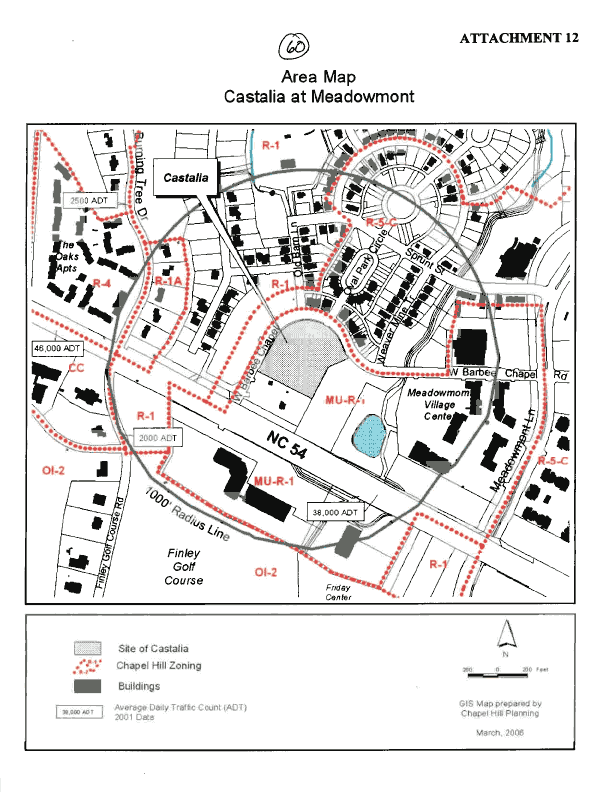
Council once again reviewed local businessman Michael Rosenberg’s (Health Decisions Inc.) Meadowmont palace Castalia. Castalia is a proposed mixed-use building, currently sited prominently in Meadowmont.

Tonight’s discussion focused on visibility.

Councilman Cam Hill gave a bit of a mixed message, saying in part that if the building really would be as hard to see from N.C. 54 as the architectural drawing purported, then that might be tempting. But he said he really didn’t think it was going to be that well screened.

HeraldSun, June 20th

Meadowmont? Not visibile? Where have I heard that before?

Let’s turn the wayback machine’s dial to Oct. 5th, 1994:

Design Review Board member Bob Stipe inquired whether proposed commercials buildings on the north side of NC 54 would be visible to passing vehicles. Mr. Davis said yes, adding that the buildings would have a maximum height below the area’s existing tree line. Julie Andresen inquired whether the developer was proposing a mixture of office and retail uses. Mr. Davis said yes. Ed Harrison inquired whether existing trees on the site would be preserved. Mr. Davis stated that the majority of trees up to three hundred and fifty feet into the site would be preserved.

Where did those trees go?

I’ve read that Castalia is the source of sacred waters used to clean Delphian temples . Maybe those waters could be used to clean out another mythic mess, Meadowmont’s Augean stable of promises.

Town Manager Stegall?

I’m impressed with what I’ve read by and about Sean Stegall.

With Sean we have a candidate for town manager that celebrates openness, wants to make community a cornerstone of his efforts and recognizes Chapel Hill’s need for some “conflict resolution”.

He has a flexible management-style – a trust in the folk working at all levels in our government and within the community.

But, as the town manager, the work of leadership is more about tapping into and leveraging the collective energies of those who work for the community, are served by the community and who are elected to govern.

The manager must create a sense of purpose that connects people together and drives the organization to a higher level of performance. This is best accomplished by assimilation of the collective “visions” held within the organization and community.

HS

As a person that can pinch the meanest of pennies – I heartily welcome a candidate thoroughly experienced in budgetary matters.

Sean is responsible for the preparation, execution and monitoring of a budget of $277,000,000. In addition, Sean is charged with development of the five (5) year financial plans for the City’s major operating funds.

c.v.

We could definitely use more than a spritz of entreprenurial spirit

If an organization is not constantly looking to improve its processes and procedures, it is falling behind.

– and the background and desire to use technology to drive operational efficiencies.

Stegall also is developing a wireless Internet program for Elgin residents, something that interests many Chapel Hill leaders as well.

Already, Elgin employees are using a Motorola system to communicate with each other, filing reports from the field, etc.

Wireless transmitters are on all city water towers.

“Being familiar with technology that may be one of the benefits of being 33,” Stegall said. “Technology is not an end in and of itself. It should be used for other ends.”

N&O

And he understands that the relationship between manager and Council is nuanced

The old saying goes, “Council makes policy, staff implements policy.” But policy making and policy implementation are not separate and distinct functions. In reality, policy making/implementation is a continuum of thought and relationships that transform ideas, policies, goals and plans into observable outcomes or ends such as a new street project, homeless shelter or park improvement. Because of this fact, council and staff share this continuum and are partners ensuring each other’s success. Because of this partnership, there must be open and on-going dialogue among the town council and department heads. Finally, this dialogue must include all community partners whether it is media outlets or neighborhood associations.

The Chapel Hill town manager must create a sense of purpose through a shared vision and open dialogue by and between the council, staff and community.

HS

Yes, he’s young. So what? We need a candidate with vitality and a fresh perspective to help our community make the next step in its evolution. Sean’s capabilities and diversity of experience are more than comparable to our current manager’s when he was selected.

Though I’m not a big fan of his take on TIFs (tax increment financing)  or the joy of gambling profits, I liked his current perspective on town and hope his responses are more than “window dressing”.

Good luck Sean on your interview. Remember, Chapel Hill, for all its age, is still a youthful community – expect a fair hearing.

Session closed under North Carolina General Statute 143-318.11(a)(6)

OrangePolitics (OP) is covering Council’s (injudicious?) final sprint to hire a new manager.

OP’s Ruby Sinreich commented June 2nd on the quick narrowing of the field to a handful of white males.

Robert Peterson, June 5th, put on his tin foil hat and, I believe with some accuracy, laid out a scenario where one of the three putative candidates is a “ringer” . As he observed What we have here, on paper at least, is a superstar. What better way to insure his getting the position than to pit him against someone mired in controversy and someone with 20 years less experience.

This week, Council will spend 38 hours reviewing and then selecting, with minimal opportunities for direct public interaction, a new Town Manager. Unless, as Council member Mark Kleinschmidt avers with all confidence that if there’s any doubt at the end of the week that we’re not hiring the best person for this job, we will hire no one.”

What role will Chapel Hill’s citizenry play in the evaluation of “what’s best”?

With the limited information before us; the Herald Sun’s Q&A’s of Ragan, Stancil and Sean Stegall – their bio’s ( Stegall,Ragan, Stancil) posted on the town’s manager search site – an article from the News and Observer – some Googled references – one wonders how the greater citizenry is supposed to evaluate these candidates.

They won’t have much of an opportunity this final week as 36 of the 38 hours set aside for candidate consideration are closed, closed, closed.

“The Council will move that this session be closed under North Carolina General Statute 143-318.11(a)(6).”

The Council’s actions to fill this key position with much less public discussion and involvement than other recent issues, for instance the renaming of Airport Rd. to Martin Luther King, Jr. Blvd., seems counter to our town’s stated desire for maximum governmental transparency. To cap the current process off by cloaking a majority of the discussion behind 143-318.11(a)(6), well, it puts the fine point to folks concerns.

The remaining two hours for public input? The Mayor will be juggling Council and public participation.

I don’t quite understand Mark K’s response to Ruby S’s rushed feeling by saying “I don’t know why you insist on calling it a runaway train” when so many of the search committee’s meetings were ill-scheduled (for reasonable public participation) or closed under 143-318.11(a)(6).

  • 10am, Weds. Mar. 15th, Mar. 22nd, Mar. 29th
  • 10am, Tues. Apr. 4th [CANCELLED], Apr. 11th
  • 8am, Tues. Apr. 18th; Sat. Apr. 22nd (the 1st possible one for me to attend)
  • CLOSED Mon. May 8th 10am ; Fri. May 19th, 2pm ;Tues. May 30th, 9am

Missing an opportunity for greater openness, the minutes of the open meetings were only available at Townhall and not published on the town’s website.

As someone that closely followed the process (as well as one can without easily accessible minutes of the search committee’s meetings), I disagree with Mark’s comment that

“The decisions regarding the development of the selection process were all held in open public meetings–I think there were at least two of those–and there was a public meeting to assist on development of a profile.”

Feb. 27th, Council discussed some exciting options like “a website with questionnaire for public comment” and a process structured so the “Community to meet with all finalists“. But, sadly, these proposed mechanisms for community outreach were subsequently discarded (the public commentary) and watered down (this week’s two-hour, Mayorally-filtered, candidate meet-n-greet).

Direct citizen commentary was limited to the regular 3 minute slot.

By the Mar. 6th meeting, OP poster and local personnel expert Anita Badrock (VP, Smithers and Associates) suggested two possible “processes” for selecting candidates. As she observed:

I recognize that we have a culture of openness in our community that the Council wants to respect, but I believe the citizens would understand and be better served by a process that would allow the best qualified candidates to confidentially explore this career opportunity to the maximum extent possible. Many of the most highly qualified applicants are probably the kind of professionals that aren’t unhappy with where they are currently, but are excited and intrigued about the possibilities and opportunities that exist in Chapel Hill. That’s the type of person that probably would not want his/her current employer to know (s)he’s looking.

As someone that’s hired their share of sensitive workers, I also recognize the need for some discretion.

Unfortunately, the concern for candidates confidentiality out-weighed public necessity and the more citizen-interactive options, factored into Process #2, were soon to be dispensed with.

As per Process #1, 30 or so folks – Council members, staff, the local political “usual suspects” (former Council members, business folk, the Chamber, etc.) – were “interviewed” to develop a candidate profile. These interviews constituted, I guess, a surrogate for the public feedback via website or a general solicitation for written/oral comments.

In another blow to timely transparency, it was only recently that the candidate profile was published.

Ruby is on to something when she remarks that the Council

has set-up this entire process without actively engaging or even encouraging the public’s input in a meaningful way (ie: before we were down to a choice between 3 straight, white, males). I’m not saying we should be sitting in on confidential meetings or anything, but it really shouldn’t surprise the Council if most Chapel Hill residents don’t even know this is going on, and rest of us are annoyed about how it’s going.

I’m concerned this is becoming a trend rather than an anomaly…

The Council was elected to make decisions. NC statute and local ordinances require minimal public participation in one of the hardest decisions a Council will make.

Only a growing Chapel Hill custom of transparency – part of what folks seriously or sarcastically call “Chapel Hill values” – obliges the Council to widen participation – to cast sunlight into the deepest shadows of the decision-making process – to reach beyond conservatively expedient approaches – in selecting a person, if recent history serves, that will have more influence on our community as any ephemeral elected Council member.

This week, to echo Ruby, the citizens of Chapel Hill will have a chance to see if Council continues a growing trend away from greater transparency and participation or if their behavior is an anomoly in their pell-mell rush to fill this key position.

7:30am Wake Up Call for Downtown Partnership Members

Are you an early morning person? Interested in Downtown’s evolution? Like to interact with political heavy-hitters? Chapel Hill’s Downtown Partnership, a confederation of UNC, Town and business interests, is looking for two new members.

ALL CALL

The Chapel Hill Downtown Partnership has two available board positions beginning July 1, 2006.

The first is a Town of Chapel Hill appointed position. It is a three year term, running July 1, 2006 – June 30, 2009. Eligible applicants are downtown property owners that contribute to the Municipal Service District Tax. Town Council will appoint this position on June 26, 2006.

The second is a CHDP board appointed position. It is a one-year term, running July 1, 2006-June 30, 2007. Anyone can apply for this position. The Board will appoint this position in June 28, 2006.

To apply for either position – please go to http://www.chapelhilldowntownpartnership.com/ and link onto the link at the bottom of the page for the application. The application should be sent to the Town Clerk’s office ASAP.

Liz Parham

Chapel Hill Downtown Partnership
308 West Rosemary Street, Suite 202
Chapel Hill, NC 27516
(919) 967-9440 office
(919) 967-9475 fax

They’re soliciting two members though the terms of Fine, Perry and Alexander, at least based on the website are up. Also, UNC representative Suttenfield is moving on to greener pastures.

[ UPDATE: ] Via Liz Parham – UNC has appointed Steve Allred and Linda Convissor to replace Nancy Suttenfield and Roger Perry.
Continue reading 7:30am Wake Up Call for Downtown Partnership Members

Council’s Conflict of Interest? Maybe just a slight edge….

Following up on my earlier post on RAM Development’s “425 Hillsborough Street” 335 condo megaplex, today’s HeraldSun reports:

Foy acknowledged that a good prior experience with the town might give a developer a slight edge.

“If we’ve had a good experience in the past, then we might know we can negotiate in good faith,” he said.

Someone that you trust – someone that delivers – usually does have an edge in business.

But our town leaders have responsibilities that transcend “business as usual”, as Foy acknowledges:

Mayor Kevin Foy said Friday he hasn’t seen plans for the project, which is being called 425 Hillsborough Street by the developer. But, he said, the plan will be judged on its merits alone and the town’s handling of an application will not be affected by the official relationship with Ram Development.

“We view every development through the prism of what’s best for the town,” Foy said. He added that the town will judge the developer’s project against the town’s Comprehensive Plan, which describes where growth should occur.

The project’s expanse, as reported by the HeraldSun, is greater than that reported in the New & Observer:

According to the Ram concept plan, the new development would have 390 multi-family units on 15.6 acres. The site, just north of the university campus, currently holds 111 rental units, most of which are occupied by UNC students.

That’s quite an increase in density. Luckily, the plan will require a rezoning – putting it squarely before Council and local citizens.

The article also mentions the problems with Lot #5’s development

Recently the town sent a letter to Ram indicating the Lot 5 project wasn’t fully meeting expectations for the redevelopment of that town site

and quotes out-going Town Manager Cal Horton:

Horton said Ram’s performance wouldn’t impact the town’s handling of an application on the Hillsborough Street project if the developer chooses to submit a formal proposal.

“In our process, every development stands on its own,” he said. “There are many occasions when we work with people who are doing multiple developments. This situation is pretty ordinary.”

The current Council hopes that ceding prime public properties to RAM Development (for, what I believe, less than their longterm value) will spur a downtown economic renaissance (a rebirth that’s proceeding apace without RAM’s help). Taxpayer monies have and will continue to flow into this project. Further, the Council is closely partnering with RAM in the overall design of their $90+ million buildout.

And, then, as the downtown development plan nears kick-off, RAM proposes what has been reported as the largest condominium development in Chapel Hill’s history? A development that will surely benefit by its proximity to the same project Council is partnering on?

Ordinary? Try unprecedented.

Council’s Conflict of Interest?

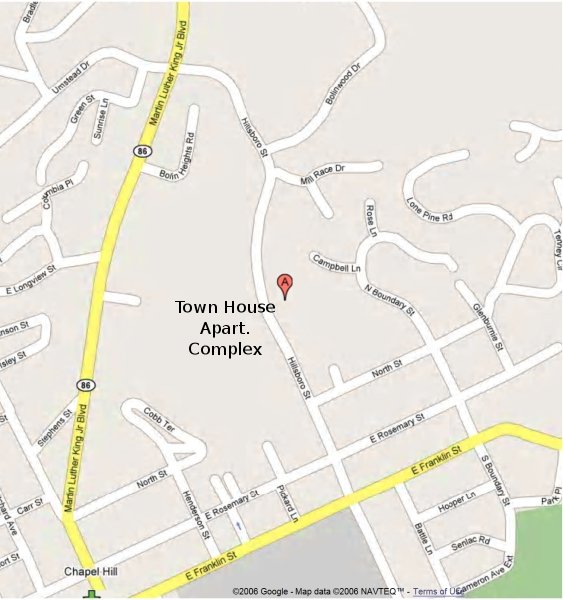
RAM Development, our town’s partner in an increasingly troubling downtown development project, is now looking to build the largest condominium project in Chapel Hill’s history. Sited along Hillsborough Rd. on the current Townhouse Apartment parcel, the project would include 335 condos in 6 story blocks.

Without a site proposal, it’s hard to envision how such a massive development couldn’t harm the Bolin Creek watershed, create an incompatible juxtaposition with nearby charming historic residential areas and pressure the already difficult Hillsborough/MLK transit corridor.

Considering Council is knee deep in on-going negotiations involving RAM’s design for downtown’s Lot #5 behemoth (next meeting June 19th, 2PM), what leverage, if any, does RAM have in getting approval for what I expect to be one of the more controversial developments in town’s history?

CHAPEL HILL – Townhouse Apartments, a wilting, close-to-campus haven to UNC-Chapel Hill students for four decades, may be demolished to make way for one of the biggest condominium projects in town history.

Ram Development of Palm Beach Gardens, Fla., wants to build 335 condominiums stacked six stories high and 22 townhouses on the 12.5-acre site by 2010.

The company has a contract to buy the 111-unit complex between Hillsborough Street and Martin Luther King Jr. Boulevard, less than half a mile north of Franklin Street.

The sale is to close next year. Meanwhile, Ram is to submit preliminary site plans for the project, simply called 425 Hillsborough St., this month, said John Florian, the company’s vice president of development in Raleigh.

News & Observer, June 15th, 2006

Townhouse Apartments

How low can Moeser go? Transit, transportation and parking lots.

[UPDATE:] Please excuse the draft of this post, with broken links, that was earlier erroneously posted.

During my 2005 Council run, I was advised by “folks in the political know” that my optimistic call to UNC to put their 2003 Carolina North development plans aside and start anew would fall on deaf ears. “Don’t waste your time. You set the bar too high. Too ambitious a challenge.”

That plan, with its many deficiencies – 17,000 parking spaces, unimaginative design, lack of transit opportunities – was neither worthy of our world-class University or of the charming Town it occupies.

UNC needed to rethink the initial parameters of this mega-project,to craft a new collaborative development process, to tap their incredible on-campus talent and to assure the local community that our local values would be honored – our zoning authority respected.

Six months later, UNC has set aside their initial RTP-lite development plans, created a new community outreach group (the Carolina North Leadership Advisory Comm.), committed to following the town’s zoning authority and participated diligently (with a few continuing missteps) in the recasting of Carolina North’s design and development principles.

Maybe my optimism wasn’t so misplaced.

Buried in today’s June 9th, 2006 letter to Mayor Foy from UNC’s Chancellor Moeser are some new positive commitments from UNC.

Continue reading How low can Moeser go? Transit, transportation and parking lots.