Category Archives: Government

Local Government

Judge Calabria, FairJudges.net and the problem of 527 monies

From todays New & Record (11/01/06):

An independent political organization called FairJudges.Net began airing the ad this week. By promoting four Supreme Court candidates, it upsets a system meant to create a level playing field in judicial contests. Watchdog groups are up in arms.

“Democracy North Carolina believes the activities of FairJudges.Net are a disturbing and unhealthy development for judicial elections in North Carolina,” director Bob Hall said.

The N.C. Center for Voter Education called on “those responsible to stop airing these advertisements,” executive director Chris Heagarty said.

Even a beneficiary, Chief Justice Sarah Parker, wasn’t pleased. “If I had my druthers, I’d prefer to run my own campaign and plan my own strategy without unsolicited help from outside parties,” she said. “It would suit me fine if the ads did not run.”

The ad promotes “fair judges,” naming Parker, Mark Martin, Patricia Timmons-Goodson and Robin Hudson.

Judge Calabria is so far the only judge to respond to my email on the possible deceptive campaigning practices over at Morehead Planetarium.

The injection of big money in judicial races is a concern – that’s why NC switched to “voter-owned” judicial elections (at least for some judicial positions).

The complaint puts a major test on the state’s public financing system, adopted two years ago and touted as a way to remove partisan and big money influence from the courts.

Participants in public financing are allowed to raise a maximum of about $70,000 in contributions. The state then chips in, giving candidates for Court of Appeals about $144,000 and Supreme Court chief justice hopefuls about $217,000.

WRAL5, 11/01/06

The end-run, legal though it may be, around these limits is troubling – something acknowledged by the chair of the organization former N.C. Supreme Court Chief Justice Burley Mitchell:

FairJudges.Net, chaired by former N.C. Supreme Court Chief Justice Burley Mitchell, says its mission is to provide “positive, accurate, bipartisan information about judges.”

That isn’t how Levinson sees it. In asking the state for additional funds, he protested that 527 spending bypasses “public financing restrictions and guidelines …”

He’s right. The playing field has tilted. This also pushes judicial politics into a potentially troubling realm, where special-interest groups can spend millions to sway voters.

In West Virginia two years ago, a 527 group funded with more than $2 million from a coal company executive helped defeat a Supreme Court justice. It prompted the legislature to enact tougher restrictions. North Carolina might have to do the same, at least barring 527s from pouring money into last-minute ad campaigns.

Mitchell conceded Wednesday that “527s generally should be of concern to people” but defended the ad as “nothing but positive.”

It may be, but the prospect of big-money, special-interest influence in judicial elections should raise a hue and cry every time.
N&R, 11/02/06

Carolina North: Housing from UNC’s perspective

From Jack Evans concerning housing at Carolina North.

At the LAC meeting on October 19, we agreed that the University would draft some thoughts for the continuation of our discussion regarding housing at Carolina North. The attached file is our response to that request. As you will see, we found a number of issues and questions that we think are worthy of further discussion within the LAC. We don’t believe that our discussions to this point have reached a stage that
would permit the formulation of consensus principles, but we hope our discussion tomorrow afternoon will move us in the direction.

This follows on Mayor Mark Chilton’s (Carrboro) discussion of Oct. 19th (documented on OrangePolitics)

The Leadership Advisory Committee on Carolina North had an interesting discussion about housing as a part of Carolina North this afternoon.

Here are some prepared comments that I presented as a way of launching the discussion:

The housing problem at Carolina North is, in short, that the new workers at Carolina North will either live at Carolina North or they will live elsewhere and need to commute to the campus. There is not a great deal of vacant housing currently available within the Chapel Hill Transit service area (although there is some), so new employees will either have to occupy housing that is to be built in the Chapel Hill Transit service area, or they will have to live outside that service area and commute. Let’s take a look at the scale of the problem…

I suggest you read the extended discussion. UNC’s issues and discussion follow:

Discussion Issues and Questions Related to
Housing at Carolina North

Prepared for the LAC discussion on November 2, 2006

We believe that housing at Carolina North is a critical aspect of attracting employees, both faculty and staff, to the University, and helping existing employees find housing closer to campus. However, we believe that many issues will require further discussion within the LAC in the process of formulating specific planning principles that will be used to guide planning related to housing.

We envision the housing at Carolina North as a mixed-income community. That is, the housing will be a mixture of market, work force, and affordable housing. We need clear understandings regarding the definitions of these three categories. And we do not yet have enough information to set percentages for these three categories, but we will commit to study the issues.

The housing planned for Carolina North must be financially feasible, financially sustainable, and market driven. Although the University will likely retain ownership of the land, we anticipate that a large portion of the housing will be privately developed, thus adding values to local tax rolls. On that premise, the housing must provide opportunities for a reasonable return to prospective developers.

While housing at Carolina North will not solve all of the housing problems of the Chapel Hill/Carrboro community, UNC-Chapel Hill has a commitment to finding the right mix of market, work force, and affordable housing that will avoid making those problems worse. In this regard the University will maintain the goal that each stage of development at Carolina North will contain some level of each of the three types of housing. It may be appropriate to think of the first stage (approximately 10 years) as a test market that will provide valuable information about housing and will inform planning for subsequent stages.

As discussed in the LAC meeting on October19, we do not anticipate undergraduate instruction at Carolina North. Consequently, we do not foresee the need to build undergraduate housing at Carolina North. We do, however, anticipate some level of housing at Carolina North for graduate students and post-doctoral fellows. These groups of residents are likely to be married with children. Since housing at Carolina North is likely to be multi-family construction, this could also assist the University’s efforts to attract the best graduate students and post-doctoral fellows. For this type of housing it is possible, though not necessarily certain, that the University would be the developer and operator of the housing.

The discussion of housing during the LAC meeting of October 19 explored linking overall employment at Carolina North and the planned supply of housing. We consider it to be difficult to define and implement a linkage of this sort in advance. A number of questions deserve consideration. For example, what restrictions should apply to housing at Carolina North?. Should CN housing be primarily or exclusively for employees of the University or UNC Health Care System, or should it serve a broader population? What issues related to social and cultural diversity in CN housing should we consider? If work force and affordable housing involve some form of subsidy or constrained appreciation in the form of price caps or restrictions on sale, what issues are raised if some of this housing is occupied by non-University employees?

To the extent that University employees occupy housing at Carolina North, use of SOVs would be favorably affected. Similarly, to the extent that University employees living anywhere make use of transit (whether within the service area of the Chapel Hill transit system or not) use of SOVs would be favorably affected.

One of the inputs that we need for this and subsequent discussions is information that incorporates our best estimates, stage by stage, of the level of employment to be anticipated at Carolina North. Although we will not be able to formulate these estimates with great precision, it is important to get the order of magnitude approximately correct so that our discussions about housing, transportation, and fiscal impact will be as realistic as we can be at this stage or our work.

11/1/06

BTW, here’s Mr. Evan’s contact information:

John P. Evans
Executive Director, Carolina North

Hettleman Professor of Business
304 South Building, CB 4000
Chapel Hill, NC 27599
919-843-2025

Nov. 1st: Carey, CitizenWill and the 2006 Redistricting Referendum in Hillsborough

I’m once again on the hot seat tomorrow as pro-referendum Orange County Commissioner Moses Carey (and legions of staffers) try to counter my pro-democracy arguments against local election redistricting 😉

Seriously, if folks walk away understanding how this redistricting actually diminishes “small d” democracy, distorts voter-power, potentially overweights rural influence and that other, better, alternatives were not adequately entertained, I’ll be satisfied.

Since the last “debate”, Commissioner Carey has reversed his previous assertion that the expansion of the board to seven members and the districting must be done together – it doesn’t. He did assert, evidence to the contrary (look southward to Chatham for instance), that districting isn’t divisive and that this referendum is the best way to promote minority representation. Again, alternatives, like cumulative voting, do a much better job promoting minority voices without sacrificing “small d” democracy.

Finally, based on this WCHL1360 [MP3] interview, Moses appears to have no idea or desire to carry forward with increasing local democratic access to our government if this referendum should fail.

Hey, at least he didn’t use the NC legislature as bogeyman argument.

ELECTION FORUM — The League of Women Voters-ODC will host an educational forum on the November referendum on district elections for Orange County commissioners at 7 p.m. in the Orange Water and Sewer Authority conference room, 400 Jones Ferry Road in Carrboro. A second forum is scheduled for Nov. 1 at 7 p.m. in the F. Gordon Battle Courtroom, 106 E. Margaret Lane in Hillsborough.

Map to tomorrow’s meeting.

Ho, Ho, Ho, North Carolina’s Lottery Pimps Christmas

WRAL5 reports …state lottery officials are in the Christmas spirit.

Excuse me while I puke.

Merry Money, the first $10 instant-ticket game in North Carolina, began appearing in stores Tuesday. The new game is part of a trend in the lottery industry toward holiday-themed scratch-off games, which officials hope will boost sales.

The new game features a colorful Christmas tree with gift boxes below. Six tickets out of more than 2 million for sale will be worth the top prize of $200,000. Another new game in stores is called Carolina Greetings, which costs $2 to play.

Lottery director Tom Shaheen says more games at $10 or above are expected, including the possibility of a $20 instant ticket game, which Shaheen says may be attractive to people who don’t always play the lottery.

Is nothing sacred? The ever increasing number of shrill advertisements for the failing NC lottery is bad enough, but to encourage folks to play the lottery in the “spirit of Christmas” is just about as crass as you can get…

Tip to Chad Adams over at the Locker Room.

Superior Court 15B: Prompt Financial Disclosures from Baddour and Stein

Superior Court 15B candidates Judge Baddour and Attorney Stein are first out of the blocks with their 3rd quarter campaign reports.

  • Judge Baddour’s report (as data, image to follow) is here.
  • Attorney Stein’s [amended] report (again, as data) is here.

[UPDATE: 1] Leon Bryant is Baddour’s grandfather.

[UPDATE: 2] As of 1PM, Nov.2nd neither Fox’s or Anderson’s reports are posted at the SBOE.

  • Judge Anderson’s report will appear here.
  • Judge Fox’s report here.

The promptness of Stein and Baddour (and possibly Fox and Anderson) is quite encouraging.

I hope that since the Oct. 22nd – Nov. 7th reports will be in too late to matter, the candidates will consider pre-releasing their contributions leading into Nov. 7th on the 6th.

Breakdown of 3rd quarter reports:

Judge Baddour’s

Expenditures of: $55248.77 (of $105506.85 overall).

Contributions based on the summary report for the 3rd quarter: $76144.50 which includes $25,000 loan from the candidate, a $4000 loan from his father and $1150 from Baddour relatives (might be more relatives).

Based on the detailed receipts report, $85885.19, of which $55589.50 was individual contributions, came in over the period in amounts and numbers of:

$8.19           1       loan
$10.00          1
$20.00          2
$25.00          21
$30.00          6
$35.00          1
$40.00          2
$45.00          1
$50.00          39
$60.00          3
$75.00          9
$97.50          1
$100.00         160
$150.00         8
$187.50         1       loan
$200.00         9
$250.00         21
$280.00         1
$300.00         2
$442.00         1
$450.00         1
$500.00         19
$700.00         1
$750.00         1
$800.00         1
$1000.00        8
$1100.00        1       loan
$2000.00        1
$4000.00        1       loan
$4000.00        1       contribution from Leon Bryant [UPDATE:] Baddour's grandfather.

Individual contributions came in amounts over time as:

$2015 in March
$2100 in April
$230 in May
$100 in June
$850 in July
$13255 in August
$17270 in September
$19769.50 in October

Contributions to-date: $139626.76 which includes a total of $30599.86 in loans.

Attorney Stein's

Expenditures of $36864.34 (of $93877.54).

Contributions based on the summary report for the 3rd quarter:  $42652.00, no loan proceeds.

Based on the detailed receipts report $51742 came in over the period of which $5000 was a loan from the candidate, $46793 were individual contributions.  The amount and number of contributions break down as:
$10.00          3
$15.00          1
$20.00          5
$25.00          38
$35.00          3
$40.00          1
$50.00          56
$60.00          1
$75.00          7
$90.00          1
$99.00          1
$100.00         130
$125.00         10
$150.00         10
$200.00         11
$250.00         41
$300.00         3
$500.00         14
$828.00         1
$1000.00        3
$2000.00        1   from David Byrd
$5000.00        1   loan

Contributions came in over time as:

$500 in February
$2500 in March
$5840 in April ($5000 loan)
$100 in May
$150 in June
$9019 in July
$11253 in August
$15015 in September
$7365 in October

Contributions to-date: $125084.00 which includes a total of $5000 in loans.

What does this all mean? Further analysis to follow…

Judge Free Speech

As I’ve mentioned a few times before, I’m hooked on the ‘blog CreditSlips, “A blog on all things about credit and bankruptcy. We are seven academics who will use this space to do what we like to do when we get together–discussing and debating what does happen and what should happen when consumers and businesses borrow money.”

Local UNC law professor, Japanese internment expert and battler of the Malkinator, Eric Muller (isThatLegal.org), turned me on to these wild-n-wacky debt analysts last year.

One of their more interesting and disturbing threads involves Judge Leif Clark, a man of conscience, driven to criticize the precipitous dissipation of our civil liberties. Turns out that the Judge exposed himself to censure for practicing his First Amendment right to declaim the Bush madministration’s actions.

Over the past two weeks, I have been following a story about Leif Clark, a bankruptcy judge in San Antonio (see here and here). As regular Credit Slips readers will remember, Judge Clark wrote a letter to National Public Radio responding to an interview. In the letter, Judge Clark made remarks highly critical of the Bush Administration’s attitude toward civil liberties. At the time, I thought we had the proverbial tempest in a teapot about whether Judge Clark’s comments violated the Canons of Judicial Ethics which forbid judges from engaging in “political activity.” The San Antonio News-Express has reported that Judge Clark’s comments are now “under review by the chief judge of the 5th Circuit Court of Appeals, the tribunal that disciplines federal judicial misconduct in Texas, Louisiana, and Mississippi.”

Further commentary over on CreditSlips.

WCHL Commentary: Oct. 24th Superior Court and BOCC Voluntary Campaign Finance Disclosure

More on this issue later.

Here’s the text of my Oct. 19th WCHL1360 commentary:

This week, I am asking candidates for this years Superior Court and Board of Commissioner races to voluntarily report their campaign finances by Wednesday, October 24th.

The last we heard about campaign fund-raising was June 30th.

At that time we discovered that one of our commissioner candidates was well on track to nearly double or more the previous record for election contributions. And much of that money came from out of the county.

Four months ago we also discovered that another local campaign record was in jeopardy as a couple of our Superior Court candidates raced towards the $100,000 mark.

Judge’s Anderson and Fox had raised and spent roughly the same amount of money. $25K for Anderson, $28K for Fox.

Judge Baddour, campaigning hard to retain his appointment to the bench, had raised $56K – $150 from myself.

But beyond all the candidates, celebrated Attorney Adam Stein, with a steady flow of $100 or more contributions, had raised $82K.

What has happened since? October 24th we can find out.

3 days after the end of the 3rd quarter reporting period.
6 days prior to the date the reports must be post-marked.
14 days before the election.

A voluntary disclosure of campaign finance activities will enhance our publics confidence in our election process

A voluntary disclosure also measures our candidates willingness to promote greater transparency in our justice and political systems.

Oct. 24th, our local voters deserve a timely report of our candidates campaign finances.

And here’s my “breathy” delivery [MP3]..

It sounds like I delivered my statement after chugging up a couple flights of stairs, which in a sense, I did (ran in during my lunch break from work – and tried to squeeze too much content into too little time).

Thanks Ron Stutts for the opportunity to raise a general election issue.

Oct. 18th: Carey, CitizenWill and the 2006 Redistricting Referendum

I’m on the hot seat tomorrow as pro-referendum Orange County Commissioner Moses Carey (and legions of staffers) try to counter my pro-democracy arguments against local election redistricting 😉

Seriously, if folks walk away understanding how this redistricting actually diminishes “small d” democracy, distorts voter-power, potentially overweights rural influence and that other, better, alternatives were not adequately entertained, I’ll be satisfied.

ELECTION FORUM — The League of Women Voters-ODC will host an educational forum on the November referendum on district elections for Orange County commissioners at 7 p.m. in the Orange Water and Sewer Authority conference room, 400 Jones Ferry Road in Carrboro. A second forum is scheduled for Nov. 1 at 7 p.m. in the F. Gordon Battle Courtroom, 106 E. Margaret Lane in Hillsborough.

I’ll be the long-haired, bleary-eyed, referendum rebuker.

BTW, I might not be able to make the Nov. 1st meeting. Anyone else interested in publicly countering the referendum?

A Splash of Campaign Finance, a Jump into the Jury Pool…

Judge Anderson, after Monday’s forum, kindly gave me a brochure from the American Judicature Society (AJS), a non-partisan group created to “secure and promote an independent and qualified judiciary and fair system of justice.”

He handed me the tract just minutes after I discussed my call for candidates in both the Superior Court District 15B and Board of Commissioner races to voluntarily disclose their campaigns current financial status by Weds. Oct. 24th. Why the 24th? It is 3 days after the Board of Elections July 1st to Oct. 21st campaign report closes, 6 days before the report has to be sent in and 14 days before the election. More on my call for campaign transparency later…

The AJS’s primary interests are: judicial independence, conduct and ethics, selection; the jury; the criminal justice system – convictions of the innocent;public understanding of the justice system;”pro se” litigation and assistance.

The brochure had a few eye-popping factoids: thousands of folks go to court without legal assistance, 1 of 10 inmates – as many as 200,000 prisoners – are factually innocent, %78 of Americans believe that judges’ decisions are influenced by campaign contributions and, to me, a really shocking tale of our failing democracy – overall 1 in 5, in some areas as many as 9 in 10, people ignore jury summons.

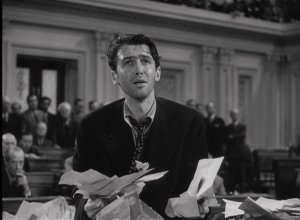
As you might guess, I’m a bit starry-eyed on the old democracy shtick. Heck, Mr. Smith Goes to Washington still stirs my heart.

Four decades in, I’ve worked on campaigns, done “get out the vote” drives (GOTV), publicly written and ranted about our republic’s founding principles, even run for office, but, somehow, I’ve never been called for one of the most intimate of civic responsibilities: jury duty.

Sounds like the AJS is trying to figure out why more citizens don’t participate – maybe it’s cynicism borne of too many years of rushed and ready justice.

It has been quite encouraging to see candidates like Anderson and Baddour propose specific remedies to address local disparities. That said, whatever the outcome of our current judicial race, I’m confident the winning candidates will strive to diminish that cynicism and work to strengthen our confidence.

By the way, the American Judicature Society (AJS) and citizen’s of Orange County aren’t the only folks wondering about money and its affect on judicial races

Although heavy interest-group spending on judicial elections is a relatively recent phenomenon in Washington, it’s well-established in other states, he said.

“Special interests that pick a judge based on ideological considerations are automatically not picking an impartial judge: They’re picking somebody who they think is going to vote their way,” said Wiggins, who has donated to the campaigns for Alexander and another incumbent, Susan Owens. “That’s the antithesis of what we should be doing.”

And, Alexander said, “When you start getting huge amounts of money coming in, then I think the public has every right to be skeptical of our system, and that, I think, would be a terrible blow to our society if people no longer have faith in our judiciary.”

Alexander’s only challenger is Groen, and the winner in the non-partisan primary will appear alone on the November ballot. A Bellevue property-rights lawyer, Groen has benefited from more than $1.5 million either raised in contributions directly to his campaign or shelled out in so-called independent expenditures by political action committees working for him or against Alexander — a sum greater than the total spent by all candidates for three Supreme Court seats in 2004.

Seattle Post Intelligencer, Sept. 15, 2006

ps. You can see Judge Anderson waving that pamphlet and highlighting judicial reform in this video.

Here comes the Judge: Superior Court District 15B Oct. 16th Bar Forum

There were 20+ folks tonight – with a couple from the media – maybe 4 or 5 organizers – some town staff and the balance being interested citizens. I was already convinced that District 15B voters have a heck of slate of candidates before them – tonight I was more impressed than ever.

Very simply – we can’t lose. Of course, we have to pick and the candidates did a good job differentiating their philosophies, approaches, procedures and performance.

Due to what turned out to be poor placement of the camera and some technical issues I botched Adam Steins opening statement. In my defense, I set my camera up early – on a tripod as per BrianR’s excellent recommendation – well away from onlookers and the moderator. But then “dancin’ Doyle” decide to move stage right. By that point, my bobbing photographic nemesis for the night had taken the high ground.

Opening statements in reverse order appearance on the ballot. Essentially, Adam Stein reviewed his service before the bar, his work on the Mel Watt and Daryl Hunt cases and laid out his career as per the first forum.

I apologize for cutting Judge Fox off during question on political parties influence: essentially he gave a reprise of his answer on parties and politics from the 1st forum.

Some interesting highlights.

  • Anderson on reforming the system for selecting judges – especially the perception of the public about what the effect of money has on jurisprudence.
  • Anderson on keeping current with the law.
  • Stein taking up the transition challenge with his closing statement.
  • Stein on why he’s punctual now – great story of his youth.
  • Fox on managing high profile cases.
  • Baddour on how a short term can hurt our system of justice.
  • Baddour on direct outreach and keeping the “common Joe” in the picture.

Again, I apologize to the candidates for weaving around, botching the focus, not anticipating “dancing Doyle” and, in Mr. Stein’s case, completely zapping a segment. I’m working to get better at this vLog business.

And to my readership, thanks for the feedback. I wasn’t sure if these videos would have any utility.

Oct. 16th Superior Court 15B Forum: Opening

Opening statements. I botched Mr. Stein’s statement. Later this week I hope to retrieve a video copy from the cable telecast.

youTube link to opening statements.

Oct. 16th Superior Court 15B Forum: Stein’s Short Term

This was one of the most interesting questions of the evening. Essentially, what did the candidates think if Mr. Stein was elected to serve only 2+ years of an 8 year term.

Judge Anderson dodged and weaved. Judge Fox left it to the people. Mr. Stein defended the propriety. Judge Baddour, in the most direct and thoughtful response, spoke of how a short-term can harm the system around justice – that beyond the public interest, litigants and court personnel alike will be impacted.

youTube link to video on Mr. Stein’s “built-in” obsolescence – a pre-determined exit less than 1/3 of a way through his term.