All posts by WillR

Superior Court 15B: Prompt Financial Disclosures from Baddour and Stein

Superior Court 15B candidates Judge Baddour and Attorney Stein are first out of the blocks with their 3rd quarter campaign reports.

  • Judge Baddour’s report (as data, image to follow) is here.
  • Attorney Stein’s [amended] report (again, as data) is here.

[UPDATE: 1] Leon Bryant is Baddour’s grandfather.

[UPDATE: 2] As of 1PM, Nov.2nd neither Fox’s or Anderson’s reports are posted at the SBOE.

  • Judge Anderson’s report will appear here.
  • Judge Fox’s report here.

The promptness of Stein and Baddour (and possibly Fox and Anderson) is quite encouraging.

I hope that since the Oct. 22nd – Nov. 7th reports will be in too late to matter, the candidates will consider pre-releasing their contributions leading into Nov. 7th on the 6th.

Breakdown of 3rd quarter reports:

Judge Baddour’s

Expenditures of: $55248.77 (of $105506.85 overall).

Contributions based on the summary report for the 3rd quarter: $76144.50 which includes $25,000 loan from the candidate, a $4000 loan from his father and $1150 from Baddour relatives (might be more relatives).

Based on the detailed receipts report, $85885.19, of which $55589.50 was individual contributions, came in over the period in amounts and numbers of:

$8.19           1       loan
$10.00          1
$20.00          2
$25.00          21
$30.00          6
$35.00          1
$40.00          2
$45.00          1
$50.00          39
$60.00          3
$75.00          9
$97.50          1
$100.00         160
$150.00         8
$187.50         1       loan
$200.00         9
$250.00         21
$280.00         1
$300.00         2
$442.00         1
$450.00         1
$500.00         19
$700.00         1
$750.00         1
$800.00         1
$1000.00        8
$1100.00        1       loan
$2000.00        1
$4000.00        1       loan
$4000.00        1       contribution from Leon Bryant [UPDATE:] Baddour's grandfather.

Individual contributions came in amounts over time as:

$2015 in March
$2100 in April
$230 in May
$100 in June
$850 in July
$13255 in August
$17270 in September
$19769.50 in October

Contributions to-date: $139626.76 which includes a total of $30599.86 in loans.

Attorney Stein's

Expenditures of $36864.34 (of $93877.54).

Contributions based on the summary report for the 3rd quarter:  $42652.00, no loan proceeds.

Based on the detailed receipts report $51742 came in over the period of which $5000 was a loan from the candidate, $46793 were individual contributions.  The amount and number of contributions break down as:
$10.00          3
$15.00          1
$20.00          5
$25.00          38
$35.00          3
$40.00          1
$50.00          56
$60.00          1
$75.00          7
$90.00          1
$99.00          1
$100.00         130
$125.00         10
$150.00         10
$200.00         11
$250.00         41
$300.00         3
$500.00         14
$828.00         1
$1000.00        3
$2000.00        1   from David Byrd
$5000.00        1   loan

Contributions came in over time as:

$500 in February
$2500 in March
$5840 in April ($5000 loan)
$100 in May
$150 in June
$9019 in July
$11253 in August
$15015 in September
$7365 in October

Contributions to-date: $125084.00 which includes a total of $5000 in loans.

What does this all mean? Further analysis to follow…
Downtown’s Homeless: What is the message? Who is the messenger?

…whatever you did not do for one of the least of these, you did not do for me…

While I was in Boston last week, the DPC’s (Downtown Partnership) Kiosk Giving Task Force morphed into the Downtown Outreach Work Group.

As the next step, the Downtown Outreach Work Group recommends a public-private partnership effort amongst the Town of Chapel Hill, the University of North Carolina, the Downtown Partnership, the human service agencies, the downtown property and business owners, religious organizations, the media and others, to jointly develop “the message” to request that citizens not give money to panhandlers in downtown Chapel Hill but to encourage them to give to the agencies that address the human service needs of downtown.

Once the message is clearly articulated, then the means and materials needed to address the target audiences will be identified. This is similar to efforts across the country typically called Real Change Not Spare Change campaigns. Raleigh is our closest neighbor that has adopted this program.  In Denver, they have adopted the Give A Better Way campaign, www.giveabetterway.com; and there are a number of other variations on this type of educational initiative.

Though encouraging on the face of it, I’m a bit troubled that this Town-sponsored group has taken on the “official” mantle of managing downtown’s homeless population issue with very little discussion.

The DPC’s charter is business-oriented, their issues business-directed. Panhandling is antithetical to their core directives. I’m concerned that this in-built bias won’t result in further draconian efforts to drive “undesirables” from downtown.

Today’s thoughtful analysis by Council member Sally Greene highlights the potential pitfalls in her excellent post Panhandling and Community Values.

Not all approaches are appropriate as Malcolm Gladwell’s recent New Yorker article “MILLION-DOLLAR MURRAY:Why problems like homelessness may be easier to solve than to manage.” points out.

Sure, I doubt our community would stand for criminalizing homeless support programs ala Las Vegas’ criminalizing feeding the hungry but it might blindly accept the recommendations of an important sounding group, like the Downtown Partnership, whose make-up and charter are not representative of the town as a whole.

Judge Free Speech

As I’ve mentioned a few times before, I’m hooked on the ‘blog CreditSlips, “A blog on all things about credit and bankruptcy. We are seven academics who will use this space to do what we like to do when we get together–discussing and debating what does happen and what should happen when consumers and businesses borrow money.”

Local UNC law professor, Japanese internment expert and battler of the Malkinator, Eric Muller (isThatLegal.org), turned me on to these wild-n-wacky debt analysts last year.

One of their more interesting and disturbing threads involves Judge Leif Clark, a man of conscience, driven to criticize the precipitous dissipation of our civil liberties. Turns out that the Judge exposed himself to censure for practicing his First Amendment right to declaim the Bush madministration’s actions.

Over the past two weeks, I have been following a story about Leif Clark, a bankruptcy judge in San Antonio (see here and here). As regular Credit Slips readers will remember, Judge Clark wrote a letter to National Public Radio responding to an interview. In the letter, Judge Clark made remarks highly critical of the Bush Administration’s attitude toward civil liberties. At the time, I thought we had the proverbial tempest in a teapot about whether Judge Clark’s comments violated the Canons of Judicial Ethics which forbid judges from engaging in “political activity.” The San Antonio News-Express has reported that Judge Clark’s comments are now “under review by the chief judge of the 5th Circuit Court of Appeals, the tribunal that disciplines federal judicial misconduct in Texas, Louisiana, and Mississippi.”

Further commentary over on CreditSlips.

WCHL Commentary: Oct. 24th Superior Court and BOCC Voluntary Campaign Finance Disclosure

More on this issue later.

Here’s the text of my Oct. 19th WCHL1360 commentary:

This week, I am asking candidates for this years Superior Court and Board of Commissioner races to voluntarily report their campaign finances by Wednesday, October 24th.

The last we heard about campaign fund-raising was June 30th.

At that time we discovered that one of our commissioner candidates was well on track to nearly double or more the previous record for election contributions. And much of that money came from out of the county.

Four months ago we also discovered that another local campaign record was in jeopardy as a couple of our Superior Court candidates raced towards the $100,000 mark.

Judge’s Anderson and Fox had raised and spent roughly the same amount of money. $25K for Anderson, $28K for Fox.

Judge Baddour, campaigning hard to retain his appointment to the bench, had raised $56K – $150 from myself.

But beyond all the candidates, celebrated Attorney Adam Stein, with a steady flow of $100 or more contributions, had raised $82K.

What has happened since? October 24th we can find out.

3 days after the end of the 3rd quarter reporting period.
6 days prior to the date the reports must be post-marked.
14 days before the election.

A voluntary disclosure of campaign finance activities will enhance our publics confidence in our election process

A voluntary disclosure also measures our candidates willingness to promote greater transparency in our justice and political systems.

Oct. 24th, our local voters deserve a timely report of our candidates campaign finances.

And here’s my “breathy” delivery [MP3]..

It sounds like I delivered my statement after chugging up a couple flights of stairs, which in a sense, I did (ran in during my lunch break from work – and tried to squeeze too much content into too little time).

Thanks Ron Stutts for the opportunity to raise a general election issue.

Homestead Twins: Joint Hearing Oct. 19th

Homestead Road is becoming quite the corridor. Stretching roughly east-west along the Chapel Hill/Carrboro urban boundary, the road, already servicing several developments and schools, will become a vital connector to UNC’s Carolina North (whether we want it to or not).

Tonight the Town Council and Orange County Commissioners will hold a rare joint zoning hearing to review a proposed development, Homestead Twins, on the corner of Seawell School Rd. and Homestead. While the development, with its 72 “twin” townhouses – some sized over 2000 sq./ft. – will obviously add to the traffic load on Homestead, the applicant has made a fairly decent case for pedestrian transit. The Town’s Comprehensive Plan emphasizes walkability, and with nearby schools, Homestead Park and the new Senior center, residents should have plenty to do within a quick jaunt.

Further pluses are the developers commitment to set aside %20 of the units for affordable housing and preservation of over %60 of the 21.5 acres as open space.

Further information for tonights 7:30pm hearing is here, background on the application is here [PDF].

Oct. 18th: Carey, CitizenWill and the 2006 Redistricting Referendum

I’m on the hot seat tomorrow as pro-referendum Orange County Commissioner Moses Carey (and legions of staffers) try to counter my pro-democracy arguments against local election redistricting 😉

Seriously, if folks walk away understanding how this redistricting actually diminishes “small d” democracy, distorts voter-power, potentially overweights rural influence and that other, better, alternatives were not adequately entertained, I’ll be satisfied.

ELECTION FORUM — The League of Women Voters-ODC will host an educational forum on the November referendum on district elections for Orange County commissioners at 7 p.m. in the Orange Water and Sewer Authority conference room, 400 Jones Ferry Road in Carrboro. A second forum is scheduled for Nov. 1 at 7 p.m. in the F. Gordon Battle Courtroom, 106 E. Margaret Lane in Hillsborough.

I’ll be the long-haired, bleary-eyed, referendum rebuker.

BTW, I might not be able to make the Nov. 1st meeting. Anyone else interested in publicly countering the referendum?

A Splash of Campaign Finance, a Jump into the Jury Pool…

Judge Anderson, after Monday’s forum, kindly gave me a brochure from the American Judicature Society (AJS), a non-partisan group created to “secure and promote an independent and qualified judiciary and fair system of justice.”

He handed me the tract just minutes after I discussed my call for candidates in both the Superior Court District 15B and Board of Commissioner races to voluntarily disclose their campaigns current financial status by Weds. Oct. 24th. Why the 24th? It is 3 days after the Board of Elections July 1st to Oct. 21st campaign report closes, 6 days before the report has to be sent in and 14 days before the election. More on my call for campaign transparency later…

The AJS’s primary interests are: judicial independence, conduct and ethics, selection; the jury; the criminal justice system – convictions of the innocent;public understanding of the justice system;”pro se” litigation and assistance.

The brochure had a few eye-popping factoids: thousands of folks go to court without legal assistance, 1 of 10 inmates – as many as 200,000 prisoners – are factually innocent, %78 of Americans believe that judges’ decisions are influenced by campaign contributions and, to me, a really shocking tale of our failing democracy – overall 1 in 5, in some areas as many as 9 in 10, people ignore jury summons.

As you might guess, I’m a bit starry-eyed on the old democracy shtick. Heck, Mr. Smith Goes to Washington still stirs my heart.

Four decades in, I’ve worked on campaigns, done “get out the vote” drives (GOTV), publicly written and ranted about our republic’s founding principles, even run for office, but, somehow, I’ve never been called for one of the most intimate of civic responsibilities: jury duty.

Sounds like the AJS is trying to figure out why more citizens don’t participate – maybe it’s cynicism borne of too many years of rushed and ready justice.

It has been quite encouraging to see candidates like Anderson and Baddour propose specific remedies to address local disparities. That said, whatever the outcome of our current judicial race, I’m confident the winning candidates will strive to diminish that cynicism and work to strengthen our confidence.

By the way, the American Judicature Society (AJS) and citizen’s of Orange County aren’t the only folks wondering about money and its affect on judicial races

Although heavy interest-group spending on judicial elections is a relatively recent phenomenon in Washington, it’s well-established in other states, he said.

“Special interests that pick a judge based on ideological considerations are automatically not picking an impartial judge: They’re picking somebody who they think is going to vote their way,” said Wiggins, who has donated to the campaigns for Alexander and another incumbent, Susan Owens. “That’s the antithesis of what we should be doing.”

And, Alexander said, “When you start getting huge amounts of money coming in, then I think the public has every right to be skeptical of our system, and that, I think, would be a terrible blow to our society if people no longer have faith in our judiciary.”

Alexander’s only challenger is Groen, and the winner in the non-partisan primary will appear alone on the November ballot. A Bellevue property-rights lawyer, Groen has benefited from more than $1.5 million either raised in contributions directly to his campaign or shelled out in so-called independent expenditures by political action committees working for him or against Alexander — a sum greater than the total spent by all candidates for three Supreme Court seats in 2004.

Seattle Post Intelligencer, Sept. 15, 2006

ps. You can see Judge Anderson waving that pamphlet and highlighting judicial reform in this video.

Greensboro’s Chief Problem: PleadTheFirst’s Timeline

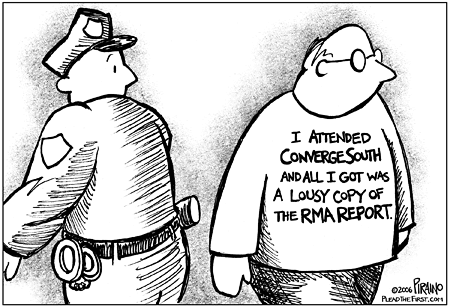
PleadTheFirst’s PotatoStew documents the unfolding drama of Greensboro’s Chief Wray RMA report debacle.

PotatoStew is an excellent political cartoonist with a great sense of humor (his ‘blogs tagline is “Congress shall make no law respecting an establishment of an unnecessary blog, or prohibiting the free posting therein.”).

Here comes the Judge: Superior Court District 15B Oct. 16th Bar Forum

There were 20+ folks tonight – with a couple from the media – maybe 4 or 5 organizers – some town staff and the balance being interested citizens. I was already convinced that District 15B voters have a heck of slate of candidates before them – tonight I was more impressed than ever.

Very simply – we can’t lose. Of course, we have to pick and the candidates did a good job differentiating their philosophies, approaches, procedures and performance.

Due to what turned out to be poor placement of the camera and some technical issues I botched Adam Steins opening statement. In my defense, I set my camera up early – on a tripod as per BrianR’s excellent recommendation – well away from onlookers and the moderator. But then “dancin’ Doyle” decide to move stage right. By that point, my bobbing photographic nemesis for the night had taken the high ground.

Opening statements in reverse order appearance on the ballot. Essentially, Adam Stein reviewed his service before the bar, his work on the Mel Watt and Daryl Hunt cases and laid out his career as per the first forum.

I apologize for cutting Judge Fox off during question on political parties influence: essentially he gave a reprise of his answer on parties and politics from the 1st forum.

Some interesting highlights.

  • Anderson on reforming the system for selecting judges – especially the perception of the public about what the effect of money has on jurisprudence.
  • Anderson on keeping current with the law.
  • Stein taking up the transition challenge with his closing statement.
  • Stein on why he’s punctual now – great story of his youth.
  • Fox on managing high profile cases.
  • Baddour on how a short term can hurt our system of justice.
  • Baddour on direct outreach and keeping the “common Joe” in the picture.

Again, I apologize to the candidates for weaving around, botching the focus, not anticipating “dancing Doyle” and, in Mr. Stein’s case, completely zapping a segment. I’m working to get better at this vLog business.

And to my readership, thanks for the feedback. I wasn’t sure if these videos would have any utility.

Oct. 16th Superior Court 15B Forum: Opening

Opening statements. I botched Mr. Stein’s statement. Later this week I hope to retrieve a video copy from the cable telecast.

youTube link to opening statements.

Oct. 16th Superior Court 15B Forum: Stein’s Short Term

This was one of the most interesting questions of the evening. Essentially, what did the candidates think if Mr. Stein was elected to serve only 2+ years of an 8 year term.

Judge Anderson dodged and weaved. Judge Fox left it to the people. Mr. Stein defended the propriety. Judge Baddour, in the most direct and thoughtful response, spoke of how a short-term can harm the system around justice – that beyond the public interest, litigants and court personnel alike will be impacted.

youTube link to video on Mr. Stein’s “built-in” obsolescence – a pre-determined exit less than 1/3 of a way through his term.