Category Archives: ChapelHill

Jim Ward Knee Jerk

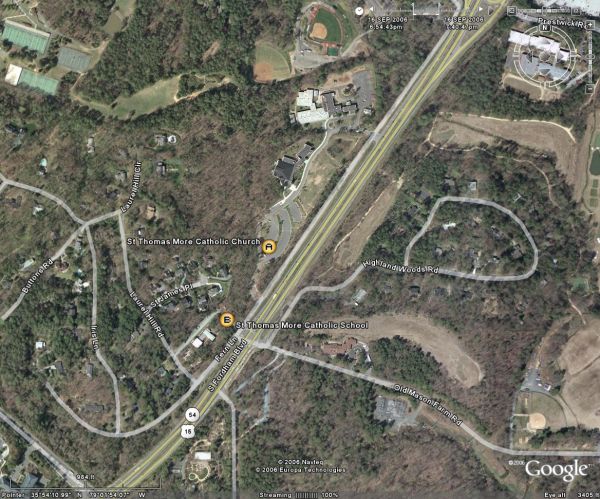
No, Jim hasn’t been co-opted by another AstroTurf organization, he was responding to Mayor Kevin Foy’s remarks on the St. Thomas More Catholic Church expansion plans:

Councilman Jim Ward, in a point seconded by Mayor Kevin Foy, argued the issue went beyond Carmichael Street and driveways, to the overall impact of increased traffic on roads in the area. He said he’d like to see St. Thomas More challenge its parishioners to be “part of the solution” and look for ways to reduce vehicle traffic to the church property, which includes a school.

“My knee-jerk reaction to this is, how in the world can you expect to put more facilities and attract more people to this site?” Ward said.

The 15-501 intersection, as Council member Cam Hill says is “quite galling”. More evaporating coverage at the web unfriendly HeraldSun.


The Fordham/15-501 corridor is going to get developed. We have an opportunity to use the St. Thomas More expansion as a kick-start to rethinking transit/transportation access patterns along one of our most highly traveled routes. The NC-DOT needs to jump in and do a bit more creative thinking (maybe even some circular thinking) instead of their usual add-and-expand schtick.

My guess is it’ll take the town’s leadership to get a decent result.

Hillsborough425: Daily Tar Heel Says “Scrap the Plan”

That’s the Daily Tar Heel’s Editorial Board.

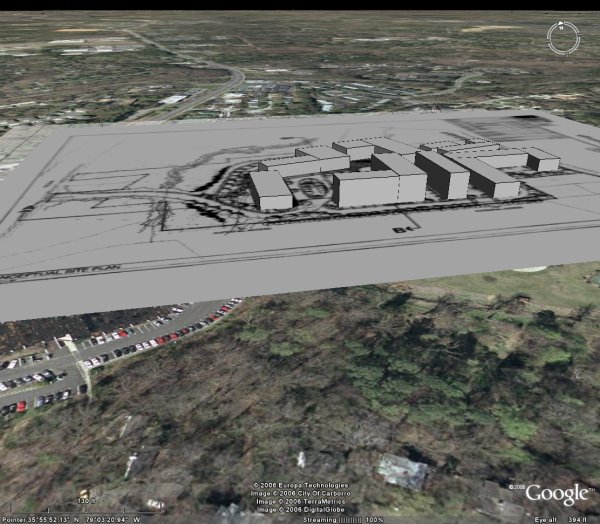
The concept plan to tear down the 111-unit Town House Apartment complex and build 322 new nonrental luxury units called the Residences at Grove Park should be scrapped before any more money is wasted investigating the issue.

They share some common concerns: traffic and affordable housing.

Chapel Hill Transit: A %1 Solution

Local transit activist Ellen Perry posted a heads up Car Free Day 09/22 on local ‘blog OrangePolitics.

On Friday, September 22, residents of Carrboro and Chapel Hill will for the third straight year join millions of others around the world in celebrating World Car Free Day, leaving their cars at home and using other means of transportation instead.

Residents of Orange County who formally pledge to go Car Free or at least Car Lite (reduced car use) for September 22 will be entered into a drawing for prizes that include Amtrak tickets to Washington, DC & New York, a new bicycle, gift certificates for Squid’s, Spanky’s or 411 West, and more. Anyone can pledge on-line at www.gocarfree.com pledge forms that can be mailed will also be available in the Chapel Hill News and Chapel Hill Herald over the next three weeks.

Prizes will be drawn at a Car Free Day celebration to be held on the lawn of Weaver Street Market from 5:30 pm to 7:30 pm on Friday, September 22. Celebrants will find information about public transportation, local biking and walking opportunities, and how to create communities that are less dependent on cars. The Village Project will show their designs and models for transit-oriented, walkable communities on the lawn, and Chapel Hill Transit will demonstrate how to load bikes and wheelchairs onto buses at the Fitch Lumber parking lot (309 North Greensboro St.).

The post spawned an interesting thread, including this comment by GeorgeC (George Cianciolo – former Chair of Chapel Hill’s Transportation Board, current member of UNC’s Carolina North LAC, the Planning Board, Design Commission and probably a few others 😉 ) on how to increase our transit resources:

Current contribution to CHT:

CH (taxes): $2,583,000 21%
UNC: 4,674,000 38%
Carrboro: 861,000 7%
sub-total: $8,118,000
add another $4,200,000 in federal & state monies, etc.
total: $12,318,000

CH’s contribution of $2,583,000 from taxes is 9.7% of what it collects in property taxes ($2,583,000 / 26,631,000). If we increased the transportation tax portion of property taxes by 10% we would increase the total property tax bill by 0.1 X 9.7% = 0.97%. Since CH taxes amount to roughly 1/3 of a citizen’s total tax bill (county taxes & school taxes comprising the other 2/3) this increase would amount to about a 1/3 of one-percent increase in CH property taxes. Thus, on a $3000 property tax bill the increase would amount to about $9.60.

Now, if all the transit partners increased their contributions by 10% as well, we would realize:

CH: $258,000
UNC: 467,000
Carrboro: 86,000
$811,000 new funds

This $811,000 would buy us an additional 14,000 hours of service. On existing routes we could add 4 hr/day for 12 routes for 6 days/week for 50 weeks. Or a number of different scenarios. But remember, you could only increase service on nights & weekends unless you spring for additional buses for use during the day when equipment is currently maxed out.

By the way, the town’s Transportation Board has two vacancies, application and more information on joining here.

Shearon-Harris Offline: Who tripped over the wire?

Local Progress Energy nuke plant Shearon-Harris went unexpectedly offline (or in nuke industry jargon “had an unplanned outage”) this morning:

Progress Energy’s Shearon Harris nuclear plant shut down today at about 10 a.m., in the first unplanned outage this year.

The nuclear plant, about 25 miles southwest of Raleigh, turned itself off automatically when the plant’s generator stopped working. Plant personnel are trying to determine the cause of the malfunction.

N&O

Progress Energy continues to have legal, technical and regulatory problems with Shearon-Harris and other operations, including whistle-blowing by security guards, issues with their plan to build additional on-site capacity (reactors) and, of course, the wondrous new over-charging meter fiasco.

Incredible timing as tomorrow (Sept. 20th), NCWarn, our local safe-nuke activists, are holding a meeting on Shearon-Harris’ fire violations.

Community Briefing
Emergency Action on Fire
Violations at Shearon Harris Nuclear Plant   

Wednesday. Sept 20, 7 pm
Central Carolina Community College,
Multi-purpose Room, Hwy 64 West, Pittsboro


Click here for more information [PDF]

Hillsborough425 aka “The Residences at Grove Park”

Plenty of kudzu, not much of a grove.


HeraldSun covers some of the issues with RAM Development’s strangely renamed condo-blivium project “The Residences at Grove Park”. I’ve already commented on Council’s need “to be as Caesar’s wife” in handling this project’s approvals in light of their existing relationship as co-developers with RAM on the $100 million downtown redevelopment project.

More to come on the project….

North Carolina Diktat: Thou Shalt Pledge Allegiance

It is a hollow affirmation that must be compelled.

[UPDATE:]

I find it incredibly encouraging for our country when a young person, within a deeply authoritarian framework like our school system, shows the fortitude and courage to calmly assert their Constitutional rights. Moreso in our current national anti-dissent climate – a climate fostered by officials at the highest levels of our government.

A parent must be doing something right when their child has both the strength of their convictions to stand firm and the poise, even when emotionally assailed, to do so without rancor or upset.

As encouraging? Finding leaders within our local school system who recognize the importance of strengthening our country’s next generation’s ability to respectfully stand firm on principle and create an environment cultivating that courage.

NC G.S.115C‑47.29A (2005):

To Encourage the Display of the United States and North Carolina Flags, and to Encourage the Recitation of the Pledge or Oath of Allegiance. – Local boards of education are encouraged to adopt policies to (i) provide for the display of the United States and North Carolina flags in each classroom, (ii) provide the opportunity for students to recite the Pledge or Oath of Allegiance on a regular basis, and (iii) provide age‑appropriate instruction on the meaning and historical origins of the flag and the Pledge of Allegiance. These policies shall not compel any person to stand, salute the flag, or recite the Pledge of Allegiance. If flags are donated or are otherwise available, flags shall be displayed in each classroom.

NC G.S.115C-47.29A (2006) as ratified July 12th and approved July 19th, 2006:

To Encourage Require the Display of the United States and North Carolina Flags, and to EncourageRequire the Recitation of the Pledge or Oath of Allegiance. – Local boards of education are encouraged to shall adopt policies to (i) provide for require the display of the United States and North Carolina flags in each classroom, when available, (ii) provide the opportunity for students to recite the Pledge or Oath of Allegiance on a regular basis,require that recitation of the Pledge of Allegiance be scheduled on a daily basis, and (iii) provide age‑appropriate instruction on the meaning and historical origins of the flag and the Pledge of Allegiance. These policies shall not compel any person to stand, salute the flag, or recite the Pledge of Allegiance. If flags are donated or are otherwise available, flags shall be displayed in each classroom.

So, recitation of the Pledge of Allegiance is required but participation, in line with the Supreme Court’s reversal of previous precedent in 1943’s WEST VIRGINIA STATE BOARD OF EDUCATION v. BARNETTE, 319 U.S. 624 (1943), cannot be compelled.

One hopes that distinction is clearly drawn among those reciters within our local school district who might be tempted, in a pique of conformist zeal, to force faux patriotism.

Municipal Wifi: St. Cloud on Cloud Nine

So let the naysayers and talking heads let fly, but the little secret that is secret no more is that the results of a carefully planned and deployed municipally owned system delivered free to the citizens as a public service is actually the most successful, beneficial and effective model in existence.

So says Jonathan Baltuch, who help found MRI, a consultancy specializing in planning economic development strategies for municipalities.

What naysayers? Those critical of St. Cloud, Florida’s deployment of a municipally-sponsored, tax-supported but externally managed citywide high-speed Internet service. After just 6 months, with %77 uptake this public service project is well on its way to providing %100 of the St. Cloud community with ubiquitous Internet access. Amazing for a community lacking Chapel Hill’s built-in audience of academic, entrepreneurial and professional communication consumers.

…championed by former Mayor Glenn Sangiovanni, [the service] was viewed from day one as an economic development project. Through the process it flourished with the realization that this one project benefited many different stake holders.

The City saw the opportunity to enhance public services and dramatically reduce the cost of delivery. The digital divide gap would be drawn much closer, creating universal opportunities for the community, small businesses would benefit from improved connectivity and reduced cost, educational institutions would be able to enhance learning and visitors would have more opportunities and choices.

Not to mention providing unique services, like ambulance telemetry, enhanced first responder support, filing in-field inspection reports or a better real-time passenger information system instead of Chapel Hill’s expensive and flawed NextBus deployment.

I’ve held up St. Cloud as a model (“Wifi for a few dollars less…”) for what we could do in Chapel Hill. That is if we had the leadership and foresight to forge ahead.
Continue reading Municipal Wifi: St. Cloud on Cloud Nine

Gangs of Chapel Hill

Last year, unlike most other Council candidates who wanted to reactively deploy our additional police resources downtown in a show of force that was more “feel-good” than strategic, I called for enhancing our forces expertise in “gang management”.

For the last few years, gangs, mostly from outside our community, have been involved in some of the worst incidents our force has faced. While it’s speculated that the recent Avalon shooting might be gang related, we know for sure that the shootings during this years After Chill (after Apple Chill) were associated with gang activity. Developing expertise now would be both tactical and strategic.

Well, earlier this year we put the extra-forces downtown sans gang management support. Troubling.

The good news is that as of today “the Chapel Hill police will focus on developing gang expertise among certain officers.”

Chapel Hill’s Capt. Chris Blue says that while we don’t have an epidemic, just, to-date, a presence, the force will take steps to pro-actively address the gang issue. I met Capt. Blue during this Spring’s WCHL Downtown discussion (where I once again brought up the gang issue) and was impressed by his desire to “work the issue”.

More from today’s N&O.

Licensed for the Lawn: Path to a Mediated Settlement

An quick update on next steps in the Weaver Street Market lawn saga…

September 11, 2006

To Weaver Street Market Owners:

We would like to take this opportunity to thank you for the feedback you are giving us about our handling of the lawn issue. We continue to be engaged in working toward a resolution that will maximize community use of the lawn. Here is a short update of what has happened in the last week. Please continue to send us your feedback and suggestions at feedback@weaverstreetmarket.coop.

Thank you

Ruffin Slater, General Manager

Update on Lawn in front of Weaver Street Market:

Weaver Street Market has engaged Andy Sachs of the Dispute Settlement Center to assist in facilitating a resolution to the lawn issues. Over the last week, Mr. Sachs met with several of the parties involved.

In addition, Carr Mill’s principal owner, Paul Greenberg, initiated a meeting, which took place on September 5 and included himself, Mall Manager Nathan Milian, Mayor Mark Chilton and Alderman Dan Coleman. The September 5 meeting included a frank exchange of information and concerns. Mr. Greenberg expressed his desire that Carr Mill continue to serve as a focal point for the Carrboro community. He also agreed with an idea put forth by Alderman Coleman that he meet with Bruce Thomas, who had already agreed to meet with Mr. Greenberg. It is expected that this meeting will take place on or around September 20. The Mayor has offered his office for this meeting and either he or Alderman Coleman will be present to facilitate. Mr. Greenberg agreed to reflect on the ideas discussed prior to his expected return to Carrboro on September 20.

Mayor Chilton and Alderman Coleman appreciated the Mall owner’s initial step toward resolution. Coleman said, “We appreciate Mr. Greenberg taking the initiative to seek to resolve this situation. We are confident that he will find Bruce Thomas to be easy-going, respectful of the mall’s concerns, and amenable to a win-win solution. Beyond that, we look forward to hearing Mr. Greenberg’s articulation of policy concerns that best serve the interests of the mall and our shared goal of its continuing to serve as a vital center for Carrboro.”

WSM General Manager Ruffin Slater added that the lawn and the activities that it supports have been a major asset to the community. “The activities on the lawn have existed in part because the Mall’s owners allow their property to be used by the community,” Slater said. “The challenge for the community and the owners of the property is how to continue the use of the lawn while respecting the legitimate needs of the property owner and of other users of Carr Mill.”

Slater said following a successful meeting between Mr. Greenberg and Mr. Thomas, Andy Sachs will remain available to help take up the challenge of balancing the needs of everyone involved.

Carolina North’s Evans: Don’t pin me down…

A third of the way through my second “live” LAC meeting – the second with Evans as UNC’s point man – and a nascent theme from the last meeting has emerged full-blown: “Don’t pin me down…”

Last week [PDF], when questioned on specific environmental goals for Carolina North, Evans dismissed specific language.

Dan Coleman: Can we assume that the University does not want Carolina North to have a negative impact on the air quality of Chapel Hill? Given the way the principle is worded, is it the word ‘insure’ that is too strong a word? Is the hang-up in that phrase?

Jack Evans: My interest is not in wordsmithing. Agreed that we want a different wording for that section. The University people are interested in doing something innovative here; but we don’t want to find ourselves trapped by wording that doesn’t have the right intention/target…

Further, when asked about using stiff protections to limit growth to a specific sized footprint at Carolina North, BOT member (and local developer) Roger Perry responded

Ken Broun: Others will have a chance to comment. University comments: University disagrees: preserve in perpetuity the maximum amount of open space, with goal of preserving 75% of Horace Williams property.

Roger Perry: The problem: we are firmly committed to building Carolina North on as small a portion of the property as possible; are committed to environmentally protecting Bolin Creek and sensitive environmental areas to the best possible reasonable practices. That will leave additional land in Carolina North, after you take out the footprint for Carolina North and the environment protection areas and the green spaces and trail system. There’s no way that the Board of Trustees could take the rest of that land and say that it will never be developed. Not responsible, even if we could. Technologies change. Needs change. Missions change. That remaining land that is developable is an asset of the State of North Carolina. To say that it would never be used is not responsible, in keeping with our mission to the State. We would never be able to do that.

More on Perry’s strange, strained intransigence later.

This week, Evans expressed concern that the local Chamber of Commerce’s request that “Carolina North Creates public amenities such as schools, parks, conference facilities, performance space, trails and greenways that are open and welcoming to the general public” would be used as a firm list of deliverables. In other words, this desire would eventually transmute into a promise to provide “a school,a park,a performance space”, etc.

The committee turns to transit.

Wow! Evans: “single occupancy vehicles critical to Carolina North”.

Comments from UNC’s delegation following that interesting revelation seem to indicate a decision, absent the pending transit study and analysis, that the single occupancy vehicle is king at Carolina North.

Their claims have the feeling of a conclusion chasing a justification.

Evans trundles out the red-herring smoke screen that Carolina North’s build out will be very slow…that it will take decades to reach a daily population of 20,000. I say red-herring because the recent massive main campus build out demonstrated that when UNC has the will and the money, they can build like mad.

Finally (at least for this update), Roger Perry comments he’s never seen a development brought before Council where Council has asked for some of the workers to be housed on-site. Of course, he has seen, with his own Meadowmont, a requirement that residents’ kids be schooled on-site.

This seems to be a continuing theme from UNC’s delegation: Carolina North is, short term, a small development – a development essentially no different than a private development – and the “conditions” that elected folk want to moderate its more negative impacts somehow violate “equal protection” , so to speak.

I’ll be digging through this weeks video to try to capture the nuance of UNC’s transit nyets. Hopefully, the video will be up on the Carolina North site fairly quickly. Until then, here’s a link [Video of August 24, 2006 meeting of Leadership Advisory Committee (WMV)] to last weeks.

Crawford-Brown: “I’ll take the brickbats from both sides…”

Dr. Crawford-Brown claimed at today’s LAC meeting that he feels he does more work on behalf of Chapel Hill’s Town Council than for the University even though he’s a member of the University’s delegation – and the director of UNC’s Carolina Environmental Program.

Trying to clarify his role, Crawford-Brown said he’s here as a scientist, an expert and that, though he works for UNC, he’s giving his balanced opinion. Or, as he colorfully put it, “I’ll take brickbats from both sides…”.

Dan Coleman followed up Crawford-Brown’s statement by asking Dean Jack Evans what role, then, was Crawford-Brown playing vis-a-vis UNC’s delegation. Essentially, he was asking Evans if Crawford-Brown’s statements should be construed as representing the University’s position. Evans danced around, avoiding answering the question, because he feels the firm roles of the committee members shouldn’t be pinned down while the substantive content of the recommendations are being formalized.

Sure, Crawford-Brown has a tough balancing act trying to forge a coherent vision of environmental analysis at Carolina North both as a member of the UNC delegation and a concerned scientist.

He is in an unenviable position considering he’s been positioned by UNC’s Jack Evans as their environmental expert. No matter what, to preserve his value as “THE” expert, he must continue to maintain at least the appearance of making unbiased appraisals of the LAC’s environmental strategies wherever his loyalties lie.

Evans could’ve helped Crawford-Brown by clarifying his specific role as “the expert.”

More on Crawford-Brown’s personal environmental philosophy.

4:17pm UNC Leadership Advisory Committee meeting on Carolina North development.

NC’s Mental Health Crisis: Penny-wise, Pound-foolish

A nice thread on NC’s deteriorating public mental health infrastructure is developing on local bulletin board SqueezeThePulp spawned by a discussion of the recent murder and ensuing non-fatal shooting at Orange High School by an arguably deranged individual:

Anita Badrock, says

Another problem here is the state’s attempt to restructure mental health services provided by state funds, and the resulting holes in the safety net. The taxpayers of this state need to educate themselves about how the proposed “privatization” of mental health care has resulted in some of the sickest and most needy of the mentally ill not getting the services they need.

I am generally a private sector champion, but it isn’t working with respect to delivery of mental health services to the poor. Talk to anyone who works at OPCMH and ask them what impact the state’s decisions have made in their abilty to care for their clients.

Fred Black, fresh from this morning’s NC Chamber of Commerce sponsored Legislative breakfast says “both Sen. Kinnaird and Rep. Insko emphatically made this point and said that even with what was done in the recent short session, they believed it just scratches the surface.”

Good to hear that Fred… and to see discussion continuing on this thread.

Carolina North: Moeser Tirelessly Seizing Future Territory

The October 1st, 2007 can’t come soon enough for some of UNC’s Board of Trustees. Yesterday, Chancellor Moeser once again disingenuously affirmed the absolutely critical role Carolina North’s development plays.

Important? Maybe. Critical? How can we assess that before we see a real evaluation of its business, educational and community-oriented impacts?

Leaning on previous assertions of broad economic impacts, Moeser talked of his administrations “tireless” pursuit of Carolina North’s rollout – including the appointment of Dean Jack Evans (Moeser somehow omitted mentioning Evans’ $208,000+ per year salary). At least Evans’ sees this not as territory to seize but more of a potentially futile intellectual exercise.

Our engagement with the state will be greatly enhanced by Carolina North, our 21st Century living-and-learning community. We will pursue this project tirelessly. It is absolutely critical to our future. We want this new campus to be a national model for sustainability, addressing the long-term needs of the University for accelerated transfer of our new knowledge into the economy, housing for faculty and staff, and new collaborations with the private sector.

A Leadership Advisory Committee of community, state, and University representatives is recommending guiding principles for building Carolina North. Last month, I appointed Professor Jack Evans as executive director of Carolina North. Our trustees have directed us to submit our zoning and development plan applications to local governments by October 1st of next year.

We want the Carolina North campus to have an aesthetic quality that will draw people to it and enhance the communities surrounding it, just as the main campus has for two centuries. We believe it can do all of that at the same time that it advances our missions of teaching, research, and public service.

Carolina North: My Own Words? A Recap of My Aug. 24th Environmental Request to the LAC

According to the online minutes [PDF] of August 24th’s Carolina North Leadership Advisory Committee meeting, this is what I asked for…

Will Raymond, citizen of Chapel Hill, former member of HWCC: Speaking on own behalf. Wants to talk about the environmental assay, which was an issue brought up by HWCC. Like what BioHabitats is doing, but it’s not extensive enough/not a true environmental assay that UNC would be capable of doing. Want University to look at this property as a science experiment; are performing a major experiment on it. Look at it the same way you look at 100 acres in the deep jungle: looking for champion species of trees, real counts of flora and fauna, on/off-site evaluations of air pollution. No good hydrological studies/no good on-off site air studies. Want the committee to do that, but put as a core principle continuous monitoring after the fact.

Troubled: Dean Evans referenced the minimum specs of the state; that concerns me; want to shoot for the stars, as George said. Should have world-class goals. University is capable of doing that. No one player should bear the burden? There is no other player that is building a community/development the size of Hillsborough in Chapel Hill. Unique project deserves unique environmental assay to determine the baselines.

Two minutes is not much time to cover a fairly extensive and somewhat nuanced perspective on the incredible environmental potential Carolina North’s development presents our State.

Many other great quotes highlighting Evan’s subtext throughout the minutes….

Next meeting is September 7th at the Friday Center.

UNC’s Moeser Prefers Butting Heads Over Carolina North…

One would assume UNC’s Chancellor Moeser prefers confrontation over collaboration – at least that’s what I think based on his choice of sports metaphors.

Along those lines, Chapel Hill News’ Mark Schultz chose an apt title, University puts on its game face, for my second CHN My View column.

Forming up across the slippery turf, the ragtag home team awaits the strong-arm tactics of a well-fortified offense. The ball is snapped. Team coverage failing, Broun dances, weaves, slips and fumbles the ball.

Timeout.

Under pressure, Coach Moeser watches the irate boosters, big-money guys, circle overhead. Yelling over the bellicose boosters’ truculent chants of “Take it to the goal,” Moeser leans forward into the huddle.

“Look boys, three points, four minutes, there’s plenty of time to turn this game around.”

As the team spreads onto the field, two heavyweight alums, Carter and Burnett, charge the bench. Sounds like they’re reminding the coach of his duty to build a grand legacy.

Responding to the barbs, the coach turns to his deep bench, looking for a solid, conservative, steady player to replace the current quarterback. “Evans. He’s got the background, the connections and, by gosh, he’s a true believer.”

Football in early August? No. Instead, unfortunately, UNC’s never-ending development games.

With the recent two-year appointment of “quarterback” Jack Evans, 10-year veteran Council-member Pat Evans’ husband and longtime Kenan-Flagler business dean, Chancellor James Moeser has signaled a troubling return to a historically failing strategy.

Moeser’s characterization of Evans’ role sets up a fake reverse. “On offense, he’ll try to help devise a plan for Carolina North that meets both university needs and community demands.”

On the other side of the ball, “Evans should be adept at reading the defense.”

Community demands? Reading the defense? A revealing and polarizing choice of words.

Centrally located, rivaling Hillsborough in scale, Carolina North is a huge project. Few residents will not feel its impact. Done right, the project could be the genesis of incredible academic and economic progress. Done wrong, our community will have a noisome blight, our taxpayer’s a terrible money pit.

Yes, Moeser is under pressure from an impatient UNC Board of Trustees. “Let’s fish or cut bait here,” as trustee Tim Burnett said in May just prior to the BOT setting an arbitrary October 2007 deadline for completing this critical phase of the process. Burnett claims he doesn’t “see how we can have the luxury of talking anymore. We’ve got to come up with a plan.”

What about UNC’s Leadership Advisory Committee? At a luxurious cost of $208,210 per year, what role does the high-stepping, hard-charging “quarterback” play? Made up of distinguished faculty, administrators, trustees, a few local elected officials and their representatives, the advisory committee has already advanced the yardstick. With the adoption of a number of key environmental, transit, financial and sustainability guiding principles as outlined by Chapel Hill’s Horace Williams Citizen’s Committee (of which I was a member), they’ve cleaved to their founding charter and taken “the first and most important step” of developing “the guiding principles for the physical development of Carolina North.”

A shame, then, that some of the trustees are falling back on the “same old, same old” pattern of conduct such as a thinly veiled threat, reminiscent of Sen. Tony Rand’s 2001 reprisal, to legislatively remove Chapel Hill’s zoning authority.

When Moeser officially announced the advisory committee’s formation, deep in December, some longtime UNC observers felt this was yet another attempt to create a false sense of community approval. “We’ve been down this road before” was a common refrain.

Yes, sometimes you need to look back to move forward. UNC’s recent handling of campus development is certainly rife with insensitivity, subterfuge and BOT upsets. Hard-won trust is easily lost. Even so, I asked folks to shed their mistrusts, start anew, and help forge a common vision of Carolina North’s future.

For most every early fumble — Chairman Ken Broun’s desire for secrecy, town’s disinterest in outside presentations, UNC’s unwillingness to field questions — there’s been incremental gains. Carolina North’s 17,000 parking spaces: off the table. Chapel Hill’s sovereign right to manage zoning: reaffirmed. A fairly thorough environmental assay, suitable for establishing a longitudinal baseline of the Horace Williams property: promised.

I’m not Chapel Hill’s defensive linebacker. I want to see a world-class Carolina North centered on “green technology.” For that, UNC’s leadership must break its habitual worldview of “us” and “them.”

Chancellor Moeser let me suggest a change of sports metaphors. Not football. Golf. Specifically, “scramble” golf.

Playing “scramble” rules, everyone is on the same team. Each player takes a stroke. The team moves on to the best shot and plays from there. Essentially, everyone contributes and excellence is reinforced.

A bit more rewarding, I believe, than butting heads.