Category Archives: ChapelHill

Sorting Out the Facts: Scope of Street Crime Occuring Downtown and Near Homestead Road

Beginning to get some of the crime statistics I requested 11 days ago.

I had asked for crime statistics going back 1 year covering Parkside, Northwoods, Vineyard (Weaver Dairy Ext.) and other neighborhoods around the proposed Homestead Rd. IFC men’s shelter. Unfortunately, since I’m not a Council member (as yet) but only a citizen, a bit of patience is required.

Until I get more data, here’s what Roger Stancil, the Town’s manager, has released so far:

…number of incidents involving Freedom House, located on New Stateside Drive…According to our records, there were no individuals arrested using the Freedom House as their home address. It is possible that if there were residents of the Freedom House arrested, they gave officers their permanent addresses, much like students do. Below are some statistics our Police Records Division put together regarding incidents in the New Parkside area that were generated for a recent Community Watch meeting.

Type of Call Jan-Dec 2007 Jan-Dec 2008 Jan- present 2009
Robbery 1 0 2
Aggravated_Assault 0 2 4
Break_&_Enter_Residence 4 6 6
Break_&_Enter_Vehicles 5 18 11
Other_Larcenies 3 5 1
Vehicle_Thefts 0 1 1
Simple_Assaults 3 4 8
Vandalism/Damage_to_Property 5 1 3
Disturbance_calls 14 6 18
All_other_calls 31 62 37
Total_Calls 66 105 91

Continue reading Sorting Out the Facts: Scope of Street Crime Occuring Downtown and Near Homestead Road

Orange County Justice United Northside/Pine Knolls Census

Big thank you to all the volunteers, including many, many UNC students who turned out this morning to help Orange County Justice United do a survey of the Northside and Pine Knolls areas in order to:

  • Position community priorities in the public eye,
  • Build relationships and get support for their social justice agenda by residents and institutions in the Northside neighborhood
  • Document housing issues and community infrastructure in disrepair

Orange County Justice United

is a broad-based, multi-racial, multi-faith, multi-issue, strictly non-partisan citizens’ power organization dedicated to making change on social justice issues (affordable housing, healthcare, education, living wages) affecting the lives of low- and middle-income residents in Orange County.

The organization is partnered with 30+ local churches and social support institutions in promoting their agenda.

Also, thanks to Delores Bailey and Empowerment for providing facilities and logistical support for today’s effort.

IFC Men’s Shelter Timeline

There are a lot of questions (and comments) about the potential relocation of the IFC Men’s Shelter to the corner of Homestead Rd. [MAP].

At last night’s WCHL 1360 candidate forum [MP3] I talked about how, if elected to Council, I would use an approach like the one I helped develop for siting the new Orange County trash transfer station; in conjunction with the community, staff, the IFC and technical experts develop objective, measurable, community and technically based criteria to apply to site approval that complements the Town’s existing planning process.

Using a facts based approach should help the community focus on the relevant issues, create a framework for discussion of issues that by their nature are necessarily subjective and reduce some of the tension that has arisen from misinformation (some of which continues to be promulgated).

Along those lines, I have requested crime statistics for the Homestead area for the last year, as many of the emails candidates and Council are receiving refer to incidents I wasn’t aware of (not reported in the press, by staff to Council, etc.). Based on these citizen emails, it appears that this area is already having difficulties that are not being adequately addressed.

Until I get the statistics, here’s a great tool that the Daily Tar Heel’s Sara Gregory developed for visualizing incidents.

In addition to the questions and answers the IFC’s Chris Moran provided earlier, Chris has also provided the following time-line, including proposed expansion and relocation of needed services, to the community to set the context for discussion:

  1. The Inter-Faith Council (IFC) has enjoyed a strong partnership with the Town of Chapel Hill for 24 years through the use of the Old Municipal Building (OMB) to house current Community House operations (residential facility and the Community Kitchen);
  2. Project Homestart, a HUD/Orange County sponsored transitional housing program for homeless families, officially opened in April 1998 on the Southern Human Services Center campus in Chapel Hill;
  3. In 1999, Chapel Hill Mayor, Rosemary Waldorf organized an IFC Relocation Taskforce;
  4. Since 1999, the IFC, the Town of Chapel Hill and partner agencies have been searching for a permanent location for our men’s facility without success;
  5. In 2003, HUD funding ended for Project Homestart; a community planning group announced a reorganized HomeStart plan for homeless women and children; and single women residents moved from the OMB to HomeStart campus;
  6. In January 2004, the Mayor of Chapel Hill and the President of the IFC co-convened a community process to address homelessness and new facilities;
  7. IFC/Town 2004 goals included:

    • creating a comprehensive food program in the IFC’s Carrboro building to offer a wide range of support services in partnership with other agencies for hungry persons and those at risk of homelessness
    • identifying a new site for Community House and moving to a more suitable facility
  8. Another IFC/Inter-Governmental Work Group was formed in 2006 to find new locations for IFC facilities including a request for county land at the Southern Human Services Center;
  9. On May 5, 2008 former Chancellor James Moeser and Mayor Kevin Foy announced a new partnership and gift of land for relocating Community House to MLK Blvd.;
  10. Moving forward, the partnership will be even stronger as it includes UNC participation and support;
  11. The land (50-year lease for Community House operations) will allow IFC to have a facility that will be better suited to meet resident needs;
  12. While close to the Orange County Southern Human Services Center and accessible to a major bus line, the location also provides a private setting where 50 men can enlist in a program that will restore health, well-being, learning skills, confidence and opportunities for independence;
  13. This new program will allow formerly homeless men to become productive members of the community;
  14. In the absence of finding a suitable location for the Community Kitchen, the IFC intends to consolidate its food programs (named FoodFirst) for member households at its 110 West Main Street facility in Carrboro unless a more desirable location is found;
  15. The IFC, local congregations and our various partners request that the Chapel Hill Town Council move forward with the Special Use Permit process and next steps to make Community House’s relocation a reality for the men that look to the IFC for support and new opportunities for regaining their independence. They’ve waited long enough!

Q&A IFC Community House

There are a lot of questions about the IFC’s plans to site the new men’s homeless shelter on Homestead Road. As a candidate for Town Council, I have been reading concerned citizens emails and letters – almost 100 or so – on this project.

Executive Chris Moran has prepared the following Q & A based on a number of questions the nearby neighborhoods raised. I’ve converted the first section of the document to HTML and will work to finish that conversion soon. Until then, here is the complete response as a PDF.

AUGUST 14, 2009 RESIDENT QUESTIONS AND RESPONSES ABOUT COMMUNITY HOUSE

  1. It is our understanding that the Town is involved with the development of the IFC Community House project. We know that the community Design Commission met about this issue on June 17, 2009 and that the Town council is scheduled to meet about this matter on September 21, 2009. We also know that there is a file about this project at the Town’s Planning Department. The full extent of the Town’s involvement, however, remains unclear.

    • What has been the formal planning and development process for the IFC Community House project relocation?

    • The Inter-Faith Council for Social Service (IFC) developed a formal partnership with the Town of Chapel Hill in 1985 when the Town Council offered the IFC a no-cost lease in the Old Municipal Building (OMB) to house homeless persons. The program began in congregations, then moved into the basement of the OMB and eventually expanded to the entire OMB after Council members approved a task force recommendation that the OMB be used as a homeless facility.

      The IFC formed another partnership with the Orange County Board of Commissioners in 1994 to plan and develop a new facility for homeless women and children initially called Project Homestart. The Board of Commissioners provided a no-cost 25-year three acre parcel on Homestead Road to the IFC at the Southern Human Services Center. Since HomeStart’s opening there has been no adverse or negative impact on neighboring areas. In fact, new neighborhoods have developed near and around our HomeStart campus. The Church of the Advocate will soon be building a new church in our vicinity.

      Here is some additional information about IFC’s history with shelter facilities:

      • In 1990, after a year-long renovation of the OMB, the IFC co-located the Community Kitchen and Community Shelter at the OMB officially known as Community House;
      • The IFC opened its HomeStart facility, originally known as Project Homestart, on Homestead Road in 1998 for homeless families;
      • After HUD funding ended for HomeStart in 2003, the IFC Board of Directors reorganized the HomeStart program for homeless women and children;
      • The new Homestart—whose model is based on the vision of the Planning Committee—has the mission of “providing a safe, structured home for homeless women and children, helping them to access community resources and offering everyone on-going support to break the cycle of poverty and homelessness” ;
      • And the IFC relocated single women guests from the downtown Community House facility to HomeStart during the same year.
    • There have been myriad community meetings and task forces appointed by Chapel Hill mayors since the year 2000 to find a permanent location for Community House. A formal agreement and special task force was created by Mayor Kevin Foy and IFC’s Board President in 2004 “to address homelessness and new facilities”. The Board of Directors came to three major conclusions based on task force recommendations during this process.

      • The Old Municipal Building was no longer adequate for IFC needs
      • The Town of Chapel Hill decided that the OMB was needed for other town offices
      • New facilities would consist of a men’s shelter and a separate building/location for combining IFC food programs (Community Kitchen and Food Pantry)
    • In May of 2008, after a long search for a permanent location for Community House, the UNC Chancellor, Chapel Hill Mayor and IFC Executive Director announced a new partnership and property location near the United Church of Chapel Hill on Martin Luther King, Jr. Blvd. The Chancellor announced that the University would lease 1.66 acres to the Town on a long-term basis. “The Town would then make the site available to the Inter-Faith Council for Social Service (IFC) for the construction and operation of a new men’s residential facility.”

    • When will a final determination (i.e., approval or disapproval) be made on this project?

    • The IFC will be applying for a special use permit (SUP) for the Community House project sometime this fall. Final Town approval is expected in the spring or summer of 2010. Timing is dependent on the Town’s planning process.

Sara Gregory’s Daily Tar Heel Chapel Hill Crime Map

The Daily Tar Heel’s online editor Sara Gregory has created this excellent tool for visualizing crime in Chapel Hill. This is an example of effectively using low or no cost Internet technologies to serve our community. Some of us on the Town’s now defunct Technology Board wanted to leverage technology like Google Maps to better inform our public.

For all the whizzy appearance of our Town’s new website, we still have a long way to go including tools to track crime, to report on the status of development projects and to allow citizens to log work requests for neighborhood issues (filling potholes, fixing streetlights, etc.) the Town needs to address.


View Chapel Hill Crime in a larger map

I’m contacting both Sara and Chapel Hill Police Chief Brian Curran to see if the Town can expand on what Sara has started. I’ll report back soon….

2009 Sierra Club Chapel Hill Candidate Forum

Thanks to Loren Hintz. Matt Scheer, Jason Baker (2005 candidate for Town Council), May Becker, Judith Ferster and the rest of the membership of the Orange-Chatham Sierra Club for both sponsoring the recent candidate forum and making the following video available to the wider community.

Also thanks to my fellow colleague on the Sustainability Task Force Matthew Scheer for moderating the event and James Carnahan for keeping time.


Quick technical note: the current video doesn’t support “quick search” but will start streaming right away.

2009 NRG Chapel Hill Candidate Forum

Thanks to Madeline Jefferson, Bob Henshaw, Julie McClintock, Janet Smith, Alan Snavely, Mickey Jo Sorrel and the rest of the membership of Neighborhoods For Responsible Growth (NRG) for both sponsoring the recent candidate forum and making the following video available to the wider community.

Also thanks to my neighbor (and former Chapel Hill Mayor) Jonathon Howes for moderating the event.


Quick technical note: the current video doesn’t support “quick search” but will start streaming right away.

Trash Talk: Council Confusion

Council seemed somewhat confused in making the decision to take the Rogers Rd./Millhouse community off the table as far as the new County transfer site. Details on the site selection criteria and an analysis of anticipated municipal fiscal impacts have been available since Spring here.

The community-based, technical and exclusionary criteria were well established prior to Mayor Foy throwing the Town Operations Center site on the table. Both the Mayor and Council have been briefed on the criteria, so the confusion this evening didn’t quite make sense. Further, if the Council was concerned about the objectivity or quality of the criteria, as Councilmember Ed Harrison said he was, they had plenty of opportunities to improve upon the community’s approach. Neither individuals, like Ed, or the Council as a whole took that opportunity.

I chalk up both that lack of participation and tonight’s confusion to institutionalized disengagement on solid waste management issues. Yes, technically the responsibility for managing Chapel Hill’s waste belongs to the County. No, that’s not an excuse for abrogating oversight and participation (if for no other reason than the link between Chapel Hill’s sustainable growth and responsible resource management).

Tonight I tried to get the Council to take both Millhouse sites off the table. The Town’s by having staff apply the community-based criteria. And, subsequently, the County’s site by implication. Along with other concerned citizens we managed to move Council halfway towards that goal.

[UPDATE] WCHL’s Elizabeth Friend’s report.

My remarks to Council:

Tonight Mayor Foy recommends that:

“the Council seek more information…regarding the potential impact each proposed option would have on Town operations….to review the four sites that are currently under consideration and provide the Council with a report detailing the benefit or detriment of each site as it affects Town operations.”

Restricting the evaluation to “effects” and “impacts” on Chapel Hill’s own operations takes a rather narrow view of our community’s responsibility for dealing with our solid waste.

Over two years ago, I and other concerned Chapel Hill and Orange County residents questioned the Solid Waste Advisory Board’s – SWAB – selection of the current landfill for use as a trash transfer site. The SWAB’s criteria for selecting that site seemed arbitrary and capricious – especially given the broken promises and many years of environmental and socioeconomic impacts on the Rogers Road/Millhouse community.

I’m quite familiar with the issue having collaborated with citizens and groups – such as Preserve Rural Orange represented by Laura Streitfeld, Orange County Voice represented by Bonnie Hauser, Orange County Community Awareness represent by Nathan Robinson and our local Rogers-Eubanks Coalition represented by Rev. Campbell ñ to convince the Orange County Board of Commissioners to adopt community-based, objective and measurable criteria for siting the trash transfer facility.

Adopting transparent criteria was critical to building community consensus with the final proposal.

The Commissioners agreed and our County consultant, Olver, began to meet with folks from all over the County. Last year, the culmination of that effort lead to the creation of a set of community-based, technical and exclusionary criteria for determining an appropriate location for the transfer site.

These criteria were well-publicized and in-place well before Mayor Foy recommended the Town Operations site. Further, these criteria had been presented to Council several times during Joint Governmental meetings.

A cursory review of those criteria – even from a laypersons viewpoint – would have immediately led one to understand how inappropriate the Town’s Operation Center site suggested is – violating 6 or more key criteria.

To continue to entertain this site not only flies in the face of the criteria our community developed in cooperation with Olver, the technical consultant, and the Orange County Commissioners but continues to undermine the community’s confidence in a transparent and fair approach in addressing this community’s responsibility for our waste.

I ask the Council to instruct staff to not only review the impacts upon Chapel Hill but to also analyze the Millhouse sites in light of the community-based, technical and exclusionary criteria that our citizens help create.

Once they do that, I believe the Rogers Road/Millhouse community sites will be off the table – once and for all – and that the Town can then turn back its attention to addressing the long standing obligations we have to our neighbors in that community.

ChapelHillWatch: Oates, Evans Invite New Perspectives

There’s a new ‘blog in Town!

Local journalists Don Evans and Nancy Oates have started a new ‘blog, Chapel Hill Watch, to serve our local community.

Both Don and Nancy have an extensive institutional memory of local history and a keen eye towards local issues (I, along with many readers of the Chapel Hill News, were sorry to see Don laid-off). I look forward to getting not only their perspective on local issues but to see if their ‘blog attracts additional commentary from our local ‘bloggers who are looking for alternatives amongst the currently limited choices.

To get things started Don has posted on the Library’s future ( Library with a Bright Future) and Nancy has posted on filling the Council vacancy (Take the Voters’ Concerns Seriously).

Here’s a bit more about the founders.

Don Evans has been a newspaper editor for 30 years, most recently with The Chapel Hill News. Nancy Oates is a freelance business and features writer and has voted in every election since she turned 18.

Way to go Nancy, I also have voted every election except a 2nd primary in the late ’80s since I turned 18.

Trash Talk: Plan B and Option D?

September 1st, the Orange County Board of Commissioners will once again review the progress of siting a new trash transfer site within the county (agenda here [PDF]).

The good news is that the “Plan B” option I pushed for in 2008 (here and here), utilizing Durham’s transfer site until Orange County sorts the site selection mess out, is firmly established on the agenda.

The bad news is that the Millhouse/Rogers Road community is under new assualt from “Option D” (here).

“Option D”, like Mayor Foy’s poorly considered suggestion to use property adjacent to the Town Operation Center on Millhouse, suggests using county land north of the old landfill on Millhouse.

Where and when was this option introduced?

I’ve asked BoCC Mike Nelson to clarify the genesis and integration of this new last minute twist on the troubled trash transfer site debate.

Carolina North: Where is the Development Agreement?

As some of you folks know I’ve been involved – as a citizen – fairly deeply in the attempt to create a successful agreement between UNC and the Town managing growth of the massive Carolina North project.

The Carolina North project could either contribute greatly to or severely diminish the quality of life in Chapel Hill.

To succeed we need a comprehensive agreement that we all can live with. It needs to be fair, not shifting significant costs onto local residents. It needs to manage impacts so that water, air, noise and traffic concerns don’t spill over into the wider community. It needs to meet the needs of the University while honoring the community in which it thrives. It also has to have understandable consequences, demarcated trade-offs and a compliance regimen that UNC will follow.

I’ve attended almost every forum, meeting and public hearing. Suggested improvements in both process and content, more than a few which have been incorporated into the CURRENT draft.

When Council started the final phase of the process, the creation of a binding legal contract between the Town and UNC governing some period and extent of development on the Horace-William’s Airport tract (Carolina North), I took the firm position that their schedule was too aggressive, the amount of work clearly underestimated.

Unlike a traditional development zone, once the agreement is signed the Town – which is us – will be bound not only to the agreement’s stipulations but the supplementary addenda – most notably UNC’s Carolina North Design guidelines [PDF] (which envisaged 8-story buildings lining Martin Luther King Jr./Estes).

There are many moving parts to the agreement – each serving a vital function: protecting the environment, maintaining nearby neighborhoods’ integrity, providing a flexible and transparent process to manage UNC’s growth, etc.

I argued then, as I do today, that the schedule – which has become even more arbitrary (no money to build) – would severely limit the Council’s and wider public’s ability to review and digest the final agreement.

I knew that the bulk of the work would be rushed at the finish line with the public short-changed in the end.

Many of the meetings I would start my comments by pointing out that the public was ill-served by the continuing trend of providing key documents late, incomplete or not at all. As recently as last Thursday’s “public” information event (more like window dressing) the revised development agreement was not available until nearly 6pm (for a 7pm session!).

The information session reviewed a version of the agreement, completely reorganized and extended, with folks who had no opportunity to have read it (I had my laptop and was scrambling to both read the new revision and find out if my prepared questions had any relevance anymore).

Worse, I had to guess on where to find the correct revision (it is here [PDF], not available as a markup or clean version as noted on Monday’s agenda here) [I notified staff later that evening – the problem still exists as of 4:30pm Sunday].

How can Council hold a public hearing on a development agreement that is unavailable to the public 24 hours prior?

They can’t but they will.

Unfortunately, with key underlying studies delivered nearly a year late, with the development agreement still in flux, informal public input not only not fully integrated but cut-off, my prediction of a rush to failure was all to correct.

Council is poised to adopt an agreement incorporating hundreds of pages of supplementary material that they and the Town Manager have not fully read (watch June 8th’s Council meeting) , that is not – as of June 15th – finalized and that continues to have several substantial points of contention – including major traffic issues and costs essentially amounting to a yearly fee of up to several hundreds of dollars per homeowner.

Worse, the current draft agreement is peppered – just like a lousy credit-card deal – with “to be determineds”.

Without a firm contract and the time to adequately review it, the public continues to be ill-served (heck, when you buy a house you get at least 3 business days to back out after signing – and that contract has legal boilerplate that is well-established, one house instead of 3 million square feet of development and an established legal framework to protect your rights).

Why Council is insisting on adopting an agreement that is unfinished and unread? Why not limit the term from 5 to 8 years, the scope to 800,000 to 1,000,000 square feet to protect the public’s interest in maintain our quality of life? Why the rush?

Please contact Council here and ask them to grant the public fully 60 days to review a complete and finalized agreement.

Penny Rich Up to Bat

Seems like the municipal elections are officially on. Kevin bowed out as mayor. Mark bowed in. Laurin, not surprisingly, ready to go again. And now Penny.

I ran with Penny in 2007 and welcome her 2009 run.

She did her homework, was firm in her convictions, eloquent and handled some rather nasty rebukes by two of the incumbents with grace and good cheer.

I’m hoping that this year, unlike the 2007 campaign where the incumbents orchestrated an issues shut out, will be a year in which the rather substantial problems before our community get not only a fair hearing but elicit specific proposed remedies by the candidates.

Here’s Penny’s announcement:

I am proud to announce my candidacy for Chapel Hill Town Council. While running in the 2007 council race I was honored to meet many folks that live and work in Chapel Hill who share my love for this beautiful town. Chapel Hill has a bright future, and I believe I would be a positive addition to the Town Council as they guide us through the next phase of growth. As a small business owner raising a family in Chapel Hill, I represent the unique perspective of the average everyday citizen. In the coming months I look forward to talking to the people of Chapel Hill to gain an understanding of their priorities, needs, and concerns. I can best represent Chapel Hill by ensuring that everyone has the chance for their voice to be heard as we shape the future of our town.

Tar Heel Basketball, Proven Excellence

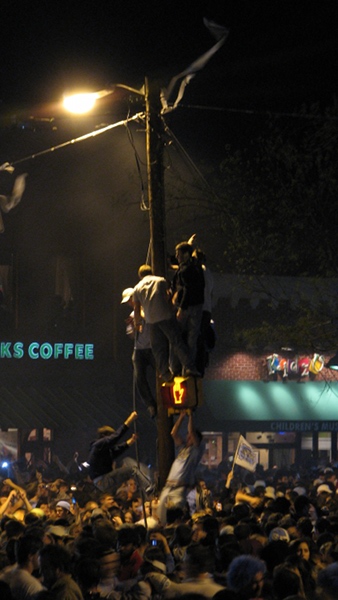
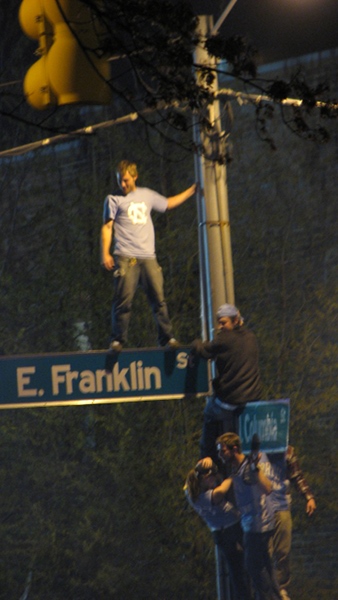
Though I wished UNC had clinched the ACC championship, tonight’s 89-72 stomping of Michigan State provided a conclusive and satisfying end to UNC’s great 2009 basketball season.

In case you haven’t heard the rumble rolling forth from Downtown, UNC fans are as jubilant as the players.

I’ve had the uncanny luck to have seen the 1982, 1993, 2005 and, now, the 2009 national championship celebrations and this one, at least as of 1:35am, seemed to be one of the best managed – no burning cars, major fires or parking lots full of triaged injured fans. Kudos to Town staff, UNC/Chapel Hill/State and local law enforcement, our fire and rescue personnel (who, I presume, missed most of the game prepping for the turnout) and all the other folks that made this year’s celebration a reasonably safe affair.

Congratulations to Roy Williams, the team and the University for an exciting demonstration of excellence.

Feb. 19th: Busy Thursday

A couple meetings tonight that folks may want to check out.

First, a meeting on Northside and the corrosive effect burgeoning development, taxes and shrinking opportunities is having on that traditional community.

From today’s Herald-Sun:

Local activists united to address what they view as “historic discrimination, rising property taxes, and development that threaten communities of color in Chapel Hill” will share alternate visions for collaborative sustainability and social change at 6 tonight.

United with the Northside Community Now (UNC-NOW), St. Joseph C.M.E., NAACP, and EmPOWERment Inc. will host a community meeting at St. Joseph C.M.E. Church, 510 W. Rosemary St., to discuss the impact of local development on historically African American neighborhoods.

“It is important that we come together as a community to be the voice of righteousness and justice in the face of the injustice and racist environmentalism that is threatening our neighborhoods,” the Rev. Troy F. Harrison of St. Joseph C.M.E. said in a news release.

Second, at 7pm, the second Town-sponsored community outreach on the Carolina North development agreement.

A Public Input/Information Session on Carolina North will be held at 7 p.m. Thursday, Feb. 19, in the Chapel Hill Town Council Chambers of Town Hall, 405 Martin Luther King Jr. Boulevard.

Carolina North is a proposed satellite campus of UNC-Chapel Hill. It is expected to be contained within about 250 acres of the Horace Williams Tract’s 1,000 acres and be built in phases over the next 50 years, as proposed. The property lies just to the north of Estes Drive adjacent to Martin Luther King Jr. Boulevard.

The Thursday session will provide an update on the status of UNC-Chapel Hill’s
Carolina North plans and a description of issues being addressed by policy-makers and Town/University staffs. These issues include the following: design standards and public art; police/fire/EMS facilities and services; school site; recreation facilities; greenways, connections; historic, cultural features; stormwater management on site; water use and reclamation; energy conservation, carbon credits; Solid waste management; remediation of landfill; stream buffers; trees, landscaping; sedimentation; neighboring lands, compatibility, buffers; noise, lighting. A public comment period is scheduled.

This meeting will be aired live on Chapel Hill Government TV 18. Additional informational sessions on Carolina North have been scheduled for 1 to 5 p.m. March 4 and 7 to 9 p.m. April 1.

For more information, contact the Town of Chapel Hill Planning Department at (919) 968-2728 or carolinanorth@townofchapelhill.org.

Additional material is posted online at www.townofchapelhill.org/carolinanorth.

Tonight presents an excellent opportunity to not only get information but to help steer the discussion on what should be part of the development agreement which will codify the community’s expectations.

Easthom on Being a Good Councilmember

Laurin, a sitting member of the current Council ruminates this evening on what makes a good Mayor and Councilmember.

Public service is not a right, but a privilege. Holding public office can be one of the most rewarding experiences in life. Being a good mayor or a good council member certainly comes by trial and error and by experience itself. The bottom line is to never lose sight of what drew you to the position in the first place.

Laurin, a one-termer (so far), is up for re-election with Mark Kleinschmidt, Ed Harrison and recent appointee James Merritt.

With elections almost 8 months off it appears that the jockeying for position has begun.

More from Laurin here.