Category Archives: OrangeCounty

Orange County’s White Vote

OK, before folks freak out, I have gotten to know the staff at the Orange County Board of Elections fairly well over the last 5 years. They’re friendly, professional and have always gone the extra mile to clarify issues/fix problems. I’m fairly sure they had no hand in the selection of this, ummmm, very white image to welcome all of Orange County’s voters to their site.

Orange County has recently spiffed up their website, making it more difficult to navigate by some folks estimation (besides making it more difficult to find contact info, having used the old site extensively for general research, I concur).

I’m sure the pictured family are fine upstanding citizens raring to vote. I’m also pretty sure I could find local analogues (maybe even doppelgangers) living right around the corner. Still, for a department interested in encouraging the greatest participation, the drama implicit in the image is rather interesting.

No Comment: The Mayor Turns Away the Public

For going on two years I’ve worked with the stalwart defenders of the Lincoln Arts Center.

The long-time, self-supporting hands-on Chapel Hill ceramics arts program is poised to die. Decades spent by staff and students alike building a strong community. Fostering creativity in the young, old, rich, poor, infirm and not. Gone because more than two years is too short for our leadership to act.

Continuity, it appears, be damned.

Incredible irony for a Town bent on satisfying a lust for arts consumption (upping developer contributions to purchasing art to %2).

This isn’t about the lone program that has kept the flame of recreational arts production alive. This is about furthering a commitment to assist the growth of our residents – body and mind. This year’s budget has $2.7+ million allocated for body, none, as of two weeks ago, for preserving this program squarely aimed at expanding the artistic mind.

An incredible shame given how long, years and years in this case, the Town has known about that tickling clock. The sands have nearly run out for this venerable, popular program. The school system has asked it to vacate Lincoln Center.

The roads must roll – the program must move or perish.

Earlier last week (Tuesday), the group met to draft a response to an April 23rd agenda item covering staff’s response to our previous petition to save the program.

These citizens pulled together their critique of the two small and unsuitable spaces. Firmed up, once again, the costs ($25-40K) of making the Community Park’s Plant Road garage a great space for ceramics. Spoke of how saving this program should serve as a catalyst for more investment in hands-on arts programs. Gathered speakers to respond – in detail – to the rather insubstantial effort the current interim head of Parks and Recreations’ so far has proffered.

Then, sometime after, the online agenda changed. Staff would now respond May 7th.

Considering the very, very, very short time left to budget and plan for the programs continuity (roughly 60 days), these supporters decided to appear before Council anyway on April 23rd to share their research and concerns.

I contacted the Town Manager’s office to make sure they knew these folks were on the way – no problem.

Our five speakers gathered this evening to find out the Mayor would not allow them to speak on this issue.

No comment allowed, even during the 3 minutes every one – citizen and not – has traditionally had to air any issues whether they’re on the agenda or not.

In all the years I’ve participated in Town politics, I don’t recall anyone, even some North Raleigh visitors upset with the way our Town won’t discriminate against folks, not being allowed to use their 3 minutes before Council.

The Town had notice these Lincoln Center activists would appear. the Mayor knows a timely resolution is necessary – that we’ve come to those last critical weeks before the budget is finalized – that circumstances are threatening to overwhelm any desire they may have to save the program. It was “Sorry, no comment.”

The group took their dismissal in stride – in good spirits prepared to return May 7th.

They’ll be back then present their research and concerns to the Mayor and Council. To me, it’s another two weeks gone in a process dragging on more than two years. Another two weeks staff fails to tap into the creativity of our citizenry. Another two weeks for a poor result to be set in the bureaucratic concrete.

Sorry guys, to me, the dismissal is an uncalled usurpation of the citizen’s right to redress – an uncharacteristic and unfortunate turn of events for a Council that’s so far held to the great Chapel Hill tradition of letting folks say their piece.

WCHL’s 2007 Babble-thon: Growing, Learning, and Living Together

[UPDATE]

I just called in to challenge the Chamber’s Aaron Nelson’s “triple bottom line” bull (the idea that the Town has greatly ignored economic development in deference to social and environmental justice) and to ask how we keep Chapel Hill affordable for existing residents. I’m afraid they’re not quite setup to take questions. I spoke with Christy Dixon who is working the problem. This is a great opportunity to get direct responses from some of our key local leaders – I hope folks are willing to slog through and call to comment.

[ORIGINAL]

It’s time again for WCHL 1360’s

2007 Chapel Hill- Carrboro-Orange County Forum: Growing, Learning, and Living Together. The forum will be held on Wednesday, April 18th and broadcast LIVE on WCHL from 8:00 am – 6:00 pm.

What an interesting group of local talent WCHL has assembled – elected folks, University leaders, the distinguished and even some old-school rabble rousers.

If you have an issue you’re particularly interested in, I suggest you call [ 919.929.WCHL (9245) ] during the forum. It’s also a great opportunity to solicit “clarifications” on local public policy from both our elected leaders and the University..

The all-day forum features five panels and ten hours of discussion. Panelists include Town and University officials, local business owners, representatives from civic organizations, as well as local residents.

8:00 am Town & Gown Relations: Growing Together

Moderator: Walter Sturdivant

  • Dick Baddour, Director of Athletics, UNC-CH
  • Ken Broun, Chair, Leadership Advisory Committee on Carolina North/Former Mayor, Town of Chapel Hill
  • James Carnahan, Chair, Carrboro Planning Board
  • Mark Chilton, Mayor, Town of Carrboro
  • Dan Coleman, member, Carrboro Board of Aldermen
  • Mike Collins, Co-Chair, Neighbors for Responsible Growth
  • Laurin Easthom, member, Chapel Hill Town Council
  • Kevin Foy, Mayor, Chapel Hill
  • Jonathan Howes, Vice Chancellor of University Advancement, UNC-CH
  • Richard Mann, Vice Chancellor for Finance and Administration, UNC-CH
  • Gene Pease, Gimghoul Neighborhood Resident
  • Roger Perry, member, UNC-CH Board of Trustees
  • Roger Stancil, Town Manager, Town of Chapel Hill
  • Bill Strom, Mayor Pro Tem, Chapel Hill Town Council
  • TBD

10:00 am Keeping it in Orange: The Price of an Unsustainable Economy

Moderator: TBD

  • Delores Bailey, Executive Director, EmPOWERment, Inc.
  • Creighton Blackwell, Chapel Hill Market Executice, RBC Centura
  • Robert Dowling, Executive Director, Orange Community Housing and Land Trust
  • Barbara Jessie-Black, Executive Director, PTA Thrift Stores
  • Scott Maitland, Owner, Top of the Hill Restaurant and Brewery
  • Chris Moran, Executive Director, Inter-faith Council
  • Aaron Nelson, Executive Director, Chapel Hill-Carrboro Chamber of Commerce
  • Greg Overbeck, Owner, Chapel Hill Restaurant Group
  • Ruffin Slater, Owner, Weaver Street Market
  • Steve Stewart, Town Manager, Town of Carrboro
  • Tim Toben, Vice Chairman, Board of Visitors at the UNC-CH Environmental Program
  • TBD

12:00 pm Crime & Safety: Its Not Mayberry Anymore

Moderator: Walter Sturdivant

  • Allen Baddour, Orange/Chatham Superior Court Judge
  • Margaret Barrett, Executive Director, Orange County Rape Crisis Center
  • Charles Blackwood, Captain, Orange County Sheriff Department
  • Joel Booker, Captain, Carrboro Police Department
  • Joe Buckner, District Court Judge 15B
  • Brian Currin, Interim Chief, Chapel Hill Police Department
  • Carl Fox, Orange/Chatham Superior Court Judge
  • Kevin Gunter, Lieutenant, Chapel Hill Police Department Community Services
  • Carolyn Hutchinson, Chief, Carrboro Police Department
  • Dan Jones, Chief, Fire Department of Chapel Hill
  • Joyce Kuhn, Executive Director, Orange Chatham Alternative Sentencing, Inc.
  • Steven Moore, Chapel Hill resident
  • Lindy Pendergrass, Sheriff, Orange County Sheriff Department
  • Donna Kay Smith, Executive Director, Family Violence Prevention Center
  • Tom Tucker, Chairman, Chapel Hill Downtown Partnership
  • TBD

2:00 pm Education: Think Globally, Teach Locally

Moderator: Ron Stutts

  • Mosey Carey, Orange County Commissioner
  • Mike Hanas, Principal, Carolina Friends School
  • Kim Hoke, Director, Public Schools Foundation
  • Graig Meyer, Coordinator, Blue Ribbon Mentor-Advocate
  • Denise Morton, Associate Superintendent of Curriculum Instruction, Orange County Schools
  • Neil Pedersen, Superintendent, Chapel Hill-Carrboro City Schools
  • Sharon Ritchie, Co-Director (First School), Frank Porter Graham Development Institute
  • Lisa Stuckey, Chair, Chapel Hill-Carrboro City Schools Board
  • Jeff Thomas, Principal, Carrboro High School
  • Steven Weber, Director of Secondary Education, Orange County Schools
  • TBD

4:00 pm The Arts: Too Important to Leave to Professionals

Moderator: Jon Wilner

  • Steve Balcom, The Splinter Group
  • Glenn Booth, owner, Local 506
  • Joseph Haj, Producing Artistic Director, Playmakers Repertory Company
  • Randee Haven-ODonnell, member, Carrboro Board of Aldermen
  • Emil Kang, Executive Director of the Arts, Carolina Performing Arts
  • Michael Maher, owner, Wootini
  • Tess Mangum-Ocana, Concerts and Facility Director, The ArtsCenter
  • Mac McCaughan, Co-Founder, Merge Records
  • John Plymale, Producer, Sixty-Five Roses
  • Derek Powers, Manager, Cats Cradle
  • Mike Roig, artist
  • Kirk Ross, local musician
  • Alex Zaffron, member, Carrboro Board of Aldermen

Trash Talk: I Like Vinegar on My BBQ

The old Southern saying goes “You can catch more flies with honey than with vinegar.”

Then again, there’s nothing like a little vinegar or Tabasco to cut though the cloying fat of smoked BBQ.

An open e:mail to the Orange County Board of Commissioners:

On Tuesday evening, at the Orange County BOC meeting in Hillsborough it became glaringly apparent there was a complete failure of do diligence in the Waste Transfer Station site selection process. In fact there was no real process at all. Chairman Carey, 2 years of talking is not a process, it was just 2 years of talking and no basis for a decision.

Unfortunately if this failure is allowed to stand the people who will most directly carry the consequences and burden will be the working class African American community on Rogers Road, the same people who have carried the burden of the county’s landfill for 34 years. There is absolutely no way to deny that this failure to act professionally is in itself an act of environmental injustice. There is much irony in that Orange County is considered the most progressive county in North Carolina, and home to Senator Edwards and his Presidential Campaign which is centered around helping the “Other America”.

My anger was apparent at the meeting and still apparent in this e-mail, I make no apologies. I am not a politician or a policy wonk. Nor do I make a pretense of tactful persuasion. My wife’s parents lived their lives in north central Philadelphia and were 50 plus year members of the Zion Baptist Church which was led for many years my the late Reverend Leon Sullivan. When visiting my in-laws they would bring us to the church even though I am not a Christian. Listening to Reverend Sullivan was always an education and an inspiration. In my early twenties I remember Reverend Sullivan talking about personal integrity and professional integrity and that both were tied hand in hand. He told us that we can not claim to have one without the other. He was relating this concept from his involvement with American and international business executives and political leaders.

It became obvious in Tuesday’s meeting that the Waste Transfer siting process had , no professional integrity, no intellectual integrity, no moral or ethical integrity and formed no solid basis for any decision. Chairman Cary, in your e-mail response of 2/17/07 to my request of all the leaders of this community to take as stand on this issue, you said to quote:

“… it would be premature and unethical in my opinion for any elected official to respond to you as you have requested prior to considering all information which must be considered to make an informed decision on this matter.”

With all due respect, by calling for a vote on this issue on Tuesday you were violating your own stated ethical standard. It is clear The Orange County BOC nor anyone else for that matter has all the facts needed to make an informed decision. It is now in the open that the Orange County BOC has never directed anyone or any group to get all the facts.

It is also misleading that the BOC can only start “mitigation talks” to compensate the Rogers Road community after a site is chosen. The Rogers Road community has already earned that compensation through their 34 years of sacrifice. Why should they have to acquiesce to a Waste Transfer Station to receive compensation? Discussions can start whenever the BOC decides to do so.

It was also clear that Commissioner Foushee, Commissioner Jacobs and Commissioner Gordon were struggling with what they witnessed Tuesday night. Commissioner Foushee was the first to speak with eloquence and concern, articulating her distress on the deficiencies of the process to date. She expressed the desire to get this right. If an academic study were to be conducted on the right and wrong ways to site a waste facility as things currently stand Greensboro would be the case study of the right way and Orange County would be the contrasting case study on how get it all wrong. I am asking all the commissioners: Are you proud of where we are on this issue? Are you proud of how we got here? Is this an example of good governance?

If each of you abide the principle of tying personal and professional integrity together then you have no choice but to vote against siting the Waste Transfer Station on Eubanks Road. You have no choice but to restart the siting process.

David Richter

I published David’s earlier correspondence with Commissioner Moses Carey highlighting the lack of a systematic approach in selecting a waste transfer site. Since then, even knowing of this troubling deficit, Carey pushed for an immediate vote to solidify the choice of the Eubanks Road site.

But some sense prevailed during last week’s Orange County Board of Commissioner’s meeting as the other BOCC members responded to both the illogic of the current situation and to the many folks that showed up to ask for more prudence. They directed staff not only to do a more exhaustive evaluation but to incorporate a more multi-dimensional approach like the one I’ve previously suggested.

I’ve heard a few comments from folks that David is coming on a little too strong. I understand his passion.

The calculated lack of process was destined to produce one answer – an answer BOCC member Carey is obviously comfortable with – an answer extending the 34 years of ills the Rogers Road community has borne by decades.

That deficit is so glaring, the troubling consequences to the Rogers Road community so apparent, it is an injustice crying for redress.

And when the redress comes slowly, grudgingly, even a bit bitterly from our elected folk, well, a little bit of vinegar is quite excusable.

Trash Talk: Waste Not Methane, Want Not Energy – Additional SWAB Conversations

To try to get the conversation caught up to date (and put the notes in a format Google, Yahoo, etc. will index), I’m republishing the further conversations the Orange County Solid Waste Advisory Board (SWAB) has had on land fill gas utilization.

Current membership (as of January 2007) and contact list for the SWAB includes:

Contact List
Members
Name Representing Email Work # Home # FAX #
Jan Sassaman (Chair) Chapel Hill (A) janopus@nc.rr.com 933-1609    
Randolph Kabrick Chapel Hill (B) rkabrick@retec.com 484-2200 942-4062

484-8100
Albert F. Vickers Carrboro (B) alvickers@cleansites.com 656-5271 929-0502 929-0011
Linda Bowerman Carrboro (A)

lbowerman@mindspring.com

967-8571    
Vacant Hillsborough (A) Contact Donna Armbrister donna.armbrister@hillsboroughnc.org 732-1270 ext. 71    
Remus Smith Hillsborough (B)   732-3807 732-3807  
Bonnie Norwood Orange County (A)     967-4401  
Joe Clayton Orange County (B) jclayton@nc.rr.com 644-6981    
 
Commissioner Liaisons
Mike Nelson Board of County Commissioners mnelson@co.orange.nc.us      
Barry Jacobs Board of County Commissioners barry.j@mindspring.com 732-4941 732-4384 732-4486
 
UNC Liaison
B J Tipton UNC-CH btipton@fac.unc.edu 962-7251


962-8794
 
Staff
Rod Visser   rvisser@co.orange.nc.us 245-2308   644-3004
John Link   jlink@co.orange.nc.us 245-2300   644-3004
Gayle Wilson   gwilson@co.orange.nc.us 968-2885   932-2900
Blair Pollock   bpollock@co.orange.nc.us 968-2788   932-2900

From May 4th, 2006’s meeting [PDF]:

Landfill Gas

Wilson states that we are going to initiate a further study to examine two options for possible utilization of the landfill gas. One is to work with the University to determine if it is feasible [for use of the gas by the University] and if so what the economics would be of piping actual gas to Chapel Hill North. It’s probably not worth it if they’re not going to build anything there for six or seven years (as they will miss gas production peak). The other alternative is to consider providing energy for a cluster of government buildings on Eubanks Road, which would be the Animal Shelter, the Operations Center, possible transfer station and a school. In two to three months we’ll have that report and know if it’s a go or not. Economically an option with the University would make more sense and be less costly. They won’t have to worry about generating electricity, putting it on the grid, negotiating with Duke Power; they would clean up the gas a little and pipe it directly to a UNC boiler.

Sassaman asks what will be required for the collection system.

Spire states that [it will require] the wells, piping it altogether to a main header and depending how much it will have to be cleaned up, compressed and used to run a micro turbine or if we can clean it up less and put it in a pipeline to the University.

Wilson notes the industry is moving towards micro turbines and away from internal combustion engines which are noisier and tend to produce more emissions.

Smith asks what does a “well” look like?

Spire replies that a well is a hole dug into the trash that a PVC pipe is stuck into to draw the gas into using a vacuum pump. The wells are 18 to 24 inches in diameter. You can put a lot in and put lateral pipes to connect to vertical headers.

Wilson notes its likely gas will be extracted only from the south side, not the north side.

Spire notes that Greensboro’s landfill is already producing gas.

Norwood asks if there is anyway to gather information about the dangers of the installation?

Wilson states that it’s dangerous with a small “d”. It’s not like it is going to blow up 20 or 30 acres. It’s dangerous if you don’t know what you are doing. It’s possible that someone right next to the extraction point might be killed, but I don’t think it’s dangerous to the neighborhood.

Sassaman notes that this is not high-pressure pipeline gas. It is low-grade gas with moisture, CO2, other contaminants.

Pollock notes that the gas company does not want this gas in their pipeline.

From August 3, 2006 SWAB minutes:

Landfill Gas Study

Wilson states that the consultant is tentatively scheduled for the September 12th [BOCC] meeting to make a presentation on one half of the study that they are doing. They have been asked to do a study on providing energy for county facilities on Eubanks Road, which will potentially include a school, a new animal shelter, our operations center and possibly a transfer station. That part is done and will be presented at a future meeting. The other half of the study is to evaluate the feasibility of providing energy pipe line gas to Carolina North, the University facility. We have been instructed that before that study is done to meet with the University. We are in the process of setting up the meeting with the University.

Sassaman asks if the SWAB will get a chance to look at the study before it is presented on the 12th.
Wilson states that you are welcome to see the report.

The formal report was actually delayed (as reported by Wilson in October).

From the minutes of September 7th, 2006:

Landfill Gas Study

Wilson states that there is a landfill gas feasibility study looking at two potential possibilities. One is utilizing landfill gas to provide energy to a complex of local government facilities on Eubanks Road. That part of the study is complete.

The other option is providing energy to the University for their Chapel Hill North facility. That part of the study is underway. That report should be ready for the Commissioners in another month or so and will be shared with you all. The next step is once the report is complete the Commissioners will indicate a preference for one or the other and then the next step of more evaluation and measurement will happen.

Pollock asks if there will be consideration of making electricity but everything to be direct fire.

Wilson states that the University option is essentially cleaning up the gas and piping it directly to them. The other option has sub-options but is generating electricity.

From the minutes of October 5th, 2006:

Landfill Gas Study

Wilson states that I also met with Olver today regarding this project, regarding the option to power a cluster of local government facilities including school, Animal Shelter and our new facility on Eubanks Road or piping gas or generating power for Carolina North. The effectiveness of this is determined by when they will have something on the ground. If it is six or seven years out this is not a good option as we will be going down in gas production. Generally we’re venting gas; we flare gas from one wet well as there have been some special [odor] issues at that manhole. [CitizenWill: emphasis mine]

Kabrick asks is there a draft report.

Wilson replies not at this time. There are draft spreadsheets. The consultant is going to make some changes, take that to the University staff for comments and make a final report to BOCC and UNC and the BOCC will have to decide if they want to pursue one option or the other. The UNC option is break even, [the other is worse]. We can’t take advantage of the credits that a private developer could. The whole set of credits is complicated.

Kabrick asks if you have talked to UNC about the carbon reduction program that the Town has signed up for. This will be a good way to do something with greenhouse gases.

There might’ve been additional discussion post Nov. 2006 but those minutes are not online.

Side note: Minutes of meetings are an important source of information. A delay of months, especially in a discussion as critical as the trash transfer station, is unreasonable. That said, if the county staff are as overwhelmed by the workload as Chapel Hill’s Clerk’s office, then the delay is understandable – but not forgivable.

But it isn’t the folks doing the work that need forgiveness, it is the job of our elective officials, especially those banging their chest about transparent open governance, to provide sufficient manpower and resources to get the job done.

Given that, as a frequent consumer of our public records, and someone that thinks our diligent Clerk’s office needs more help, I’ll be asking Town Council this budget season to allocate sufficient resources for the timely production and publishing of written, audio and video records.

Trash Talk: Waste Not Methane, Want Not Energy, A Few Examples

I quoted in my post Trash Talk: 1 Megawatt of Waste Not Methane, Want Not Energy… a February, 2006 GeoTimes report titled Recovering Landfill Gas for Energy. Two of the authors, Amarjit Riat and Wayne Blake-Hedges work just North of us at Virginia’s Fairfax County I-95 landfill complex [MAP & INFO]:

Riat, a professional engineer, is chief of the I-95 Landfill Complex in Fairfax County in northern Virginia, and has 20 years of experience in construction and management of sanitary landfills. Blake-Hedges is senior engineering technician for the I-95 Landfill Complex, and has 16 years of experience in construction, operation and maintenance of landfill gas systems.

What struck me about this article was the breadth of experience Fairfax County developed in implementing their land fill gas recovery system – a system first implemented 17 years ago.

The landfill gas extraction system in Fairfax County started in 1989, to keep landfill gas from migrating offsite to a neighboring prison complex (Lorton Youth Center) and for future beneficial use of the gas. The original 27 exterior passive vents were converted to extraction wells, including seven interior extraction wells. The seven interior wells were meant to serve as enrichment wells, to ensure that the gas composition had enough methane to allow the gas to be burned in an incinerating flare. On startup of this system, the flow of gas was considerably greater than anticipated, with flows averaging 700 to 900 cubic feet per minute. The county awarded a contract for landfill gas utilization to Michigan Cogeneration Systems, Inc. (Michigan Cogen), in 1990, when it began construction of its first landfill gas-to-electricity plant. The plant went online in December 1991. This first plant utilized 1,150 cubic feet per minute of landfill gas to generate 3 megawatts of electricity for direct sale to Dominion Virginia Power, the local electrical utility. The plant houses four generator units, each capable of producing 800 kilowatts of electricity. Approximately 200 kilowatts are used by the plant, leaving a 3-megawatt net output. Subsequently, the I-95 landfill began expanding its landfill gas collection system and piping to deliver gas to the new landfill gas-to-electricity plant.

Building upon their initial success, Fairfax has expanded their utilization of recovered gas and continued to upgrade their facility as recently as 2005.

In 1992, Michigan Cogen began constructing a second 3-megawatt electrical generation facility. This plant became operational in January 1993, and is essentially identical to the first plant. Like the first, it is also solely fueled by landfill gas. This system consisted of 75 additional interior landfill gas extraction wells, 22 horizontal collection trenches and collection piping.

In May 1997, Michigan Cogen began operating its third landfill gas utilization project. This facility compresses the landfill gas into 10 pounds per square inch, removes the majority of moisture and then delivers the dry gas to the Noman Cole Pollution Control Plant for use in sludge incineration. In an afterburner process, the gas cleans up the emissions from sludge incineration.

This landfill gas replaces natural gas previously purchased from Washington Gas. Instead, pipelines deliver gas directly from the I-95 landfill to the Noman Cole Pollution Control Plant. Landfill gas utilization by the pollution control plant is extremely variable and is based on the amount of sludge incinerated and the moisture contained in the sludge, but averages between 300 to 1,400 cubic feet per minute.

In March 2005, five standard natural gas infrared heaters were retrofitted and installed in the maintenance building of the I-95 landfill. These units replaced two existing propane-fired forced air heaters and tapped the existing pipeline that delivers landfill gas to the Noman Cole wastewater facility. A simple treatment system was installed to remove any remaining moisture and contamination. After treatment, the gas is delivered to the heaters through a stainless steel piping system. The radiant heaters use a maximum of 30 cubic feet per minute of landfill gas.

An interesting factoid they present is that “A 1-megawatt electric power plant working on an internal combustion gas engine needs a sustained flow of about 350 standard cubic feet per minute of landfill gas.”

As I noted before, based on SWAB member Randy Kabrick’s 500,000 cubic feet of methane being out-gassed from our “older”, less productive landfill into the atmosphere daily, our county is currently wasting at least 1 megawatt of electrical generation capacity.

Worse, methane as a greenhouse gas is considered to be more harmful than CO2.

Methane is about 21 times more powerful at warming the atmosphere than carbon dioxide (CO2) by weight (see box below). Methane’s chemical lifetime in the atmosphere is approximately 12 years. Methane’s relatively short atmospheric lifetime, coupled with its potency as a greenhouse gas, makes it a candidate for mitigating global warming over the near-term (i.e., next 25 years or so).

EPA

Worse yet, the “21 times more powerful” is considered by some to be a gross underestimation as the NASA reports Methane’s Impacts on Climate Change May Be Twice Previous Estimates.

Of course, the benefits extend beyond displacing “outside the county” sources of energy and mitigating gas releases:

Using landfill gas for energy is a win-win opportunity. Landfill gas utilization projects involve citizens, nonprofit organizations, local governments and industry in sustainable community planning, and they create partnerships. These projects go hand in hand with community and corporate commitments to cleaner air, renewable energy, economic development, improved public welfare and safety, and reductions in greenhouse gas emissions.

Directly using landfill gas to offset the use of another fuel (natural gas, coal and oil) is occurring in about one-third of the currently operational projects. This direct use of landfill gas can be in a boiler, dryer, greenhouse or other thermal applications. Innovative direct uses include firing pottery and glass-blowing kilns; powering and heating greenhouses and an ice rink; and heating water for an aquaculture (fish farming) operation. Industries currently using landfill gas include auto manufacturing; food processing; pharmaceutical manufacturing; wastewater treatment; consumer electronics; and paper and steel production, just to name a few.

Generating energy through the landfill gas projects provides many environmental benefits. The projects assist in destroying methane, a potent heat-trapping gas, and offset the use of nonrenewable resources such as coal, natural gas and oil. They help reduce air pollution, and the landfill gas emitted from decomposing trash is a reliable and renewable fuel.

The benefits from the I-95 landfill project are approximately equal to any one of these: removal of emissions equivalent to 50,000 vehicles, planting 72,000 acres of forest, offsetting the use of 1,300 railcars of coal or powering 3,800 homes.

The technology is also cost-saving. The savings in fuel costs are approximately $500,000 annually from the landfill gas use at the Noman Cole Pollution Control Plant and $5,800 from use of landfill gas for heating the maintenance building at the I-95 landfill.

This from folks that have decades long experience with this technology. The complete Feb. 2006 GeoTimes article is here.

Trash Talk: 1 Megawatt of Waste Not Methane, Want Not Energy, April’s SWAB Report Reveals Opportunity

To flesh out my earlier post “Trash Talk: Waste Not Methane, Want Not Energy” here’s a few comments from the April 6th, 2006 Orange County Solid Waste Advisory Board (SWAB).

There’s a few inline comments demarcated by [CitizenWill:…].

Landfill Gas Preliminary Report (discussed after item 1)

Tipton [BJ Tipton – member ] states that other than what was in the newspaper I don’t know a lot about what is going on. I just wanted to get the update.

Wilson [Gayle Wilson – OC staff] states that a presentation was given at the Assembly of Government’s meeting March 30 regarding this. Back in 1997-98 an EPA representative, myself and another staff member met with UNC Energy Services officials who were in the process of designing a fourth boiler (at UNC) and that was when they decided to look at modifying the boiler to use landfill gas. The University never formally responded.

Over the years the use of landfill gas at Chapel Hill North has come up. Phil Barner of UNC facility services called at the end of October early November and stated as they were talking about Carolina North they wanted to know about using landfill gas. I explained that we had a consultant do a report and would be glad to send it to him. After the report was sent in February, I didn’t hear anymore about it until a couple of weeks ago.

Then we got a letter from Carolyn Efland at UNC about landfill gas.

Now there appears to be competing interest in landfill gas. Some of the Commissioners are interested, if it’s feasible, in powering the new Animal Shelter, a new elementary school to be developed on Eubanks Road, our Operations Center and possibly the transfer station. The University has some interest as well. We are in the process of discussing further work with our consultants to do an additional evaluation regarding each of those potential uses. We know that we have gas, but if Carolina North isn’t coming on line for another six or seven years it won’t be worth it.

There are no partners imminent, like next June.

Sassaman [Jan Sassaman – member] states that the gas would have to be used, you can’t store it.

[CitizenWill: Don’t understand this comment as the gas can be converted into methanol or liquid natural gas or propane, etc.]

Smith [Remus Smith – member] asks if the landfill was closed tomorrow how many years would it take to produce gas?

Wilson states that gas worthy of recovery – 12-15 years of time left.

Tipton states that the report talks about the flow.

Wilson states that there are two landfills. The old one on the north is down the [gas production; it started in 1972] curve. The one on the south side isn’t half way up the curve. It has some good stuff coming from it now, but it will not produce for a long period of time [because it’s small].

[CitizenWill: Below we find out this “good stuff” is being vented!]

Kabrick [Randy Kabrick – member] asks if it is being flared now?

Wilson states that we are passively venting it. We have one flare at a central point. I have been resistant in the past because I didn’t want to scare the neighbors lighting up the landfill like a birthday cake. Now we are going to take another look at it even though we are below the regulatory threshold for recovering it.

Kabrick estimates 500,000 cubic feet a day are vented.

[CitizenWill: 500,000/day is roughly 350 cubic feet per minute. This article from GeoTimes points out that “A 1-megawatt electric power plant working on an internal combustion gas engine needs a sustained flow of about 350 standard cubic feet per minute of landfill gas.” So, we’re pissing away from this small, old landfill 1 MEGAWATT of electrical generation capacity.]

Wilson notes that the biggest single cost of recovery is the network of piping that must be installed and for an active landfill it’s more difficult until it’s closed.

Spire [Paul Spire – staff] notes that there is no infrastructure for recovery on the south side now at all and there are problems with putting this gas into the pipeline; the gas company doesn’t want it.

Wilson notes that [unlike Duke Power] the gas company is not required to accept landfill gas.

Tipton asks when will this group take any action on this?

Wilson states that I plan to keep you all apprised of any reports. If you all have any input it would not be out of line to make a recommendation. You will be hearing more about it in the next six months.

As I noted above, we are currently venting from the smaller, older (1972) landfill enough gas to drive a 1 megawatt electric power plant. 1 megawatt of discarded capacity seems like a profligate waste to me.

Imagine what we could do with the “newer” landfill.

Imagine if we used fuel cells with land fill gas [PDF] instead of internal combustion (more expensive upfront but the lack of nasty byproducts make it worth considering).

Imagine if we positioned our county to be more self-sufficient, reduce dependence on Duke Power’s coal-fired misery and generate some positive cash flow to boot!

Is that the Orange County we live in?

Trash Talk: Systematic is the New Watchword

The commissioners asked county staff to do a more exhaustive search of sites, citing solid waste management director Gayle Wilson’s statement that the process of looking for a transfer station site hadn’t been as “systematic” as previous searches for landfill space.

From today’s N&O report on last night’s (Mar. 13th) BOCC meeting.

After reviewing the Orange County Solid Waste Advisory Board (SWAB) and Landfill Owner’s Group minutes covering the transfer station site search, I’m more convinced than ever we need a decision matrix that incorporates more dimensions than a straight engineering site selection suggests.

That matrix should assign values to social, environmental, economic, growth, transportation impacts and assess possible sites against that more “full blooded” metric. I’ll be interested in seeing if staff will first create a new process for evaluation or tailor the current criteria to narrow the search.

The lack of a systematic approach didn’t stop BOCC member Moses Carey from pushing forward for an immediate decision:

Chairman Moses Carey had pushed the board to make a decision Tuesday, citing a time crunch. A consultant hired by the county said it will take as long as four years to get a transfer station up and running. The Eubanks Road landfill is expected to be full by late 2010.

Not quite sure why taking the time for a measured approach now will greatly delay a project scheduled for 2010. Given the current status, a delay now to select more appropriate criteria – say criteria suggested by the landfill’s current neighbors – is the most prudent path.

Draft timetable from Mar. 13th’s agenda item:

Trash Talk: Waste Not Methane, Want Not Energy

One of the “planks” I ran on for Town Council involved inculcating a conservationist ethic within our local government. Besides practicing energy efficiency (Leather Seated SUVs), I suggested we could start using both energy recovery and decentralized energy production technologies to help make our Town’s operations more sustainable and economical.

One such technology is methane recovery.

To quote EPA (links via LocalEcology’s Terri Buckner):

EPA created the Landfill Methane Outreach Program (LMOP) in 1994 to significantly reduce methane emissions from municipal solid waste (MSW) landfills by encouraging the use of landfill gas (LFG) for energy, which has the added benefit of offsetting the use of fossil fuels such as coal and natural gas. Since the program’s inception, LMOP’s efforts have reduced landfill methane emissions by nearly 21 million metric tons of carbon equivalent (MMTCE). The greenhouse gas reduction benefits are equivalent to having planted 21.2 million acres of forest or removed the annual emissions from 14.9 million vehicles.

EPA is interested in developing LFG energy for many reasons:

  • Projects help destroy methane, a potent heat-trapping gas, and offset the use of non-renewable resources such as coal, natural gas, and oil.
  • There are many cost-effective options for reducing methane emissions while generating energy. (To learn more about the economic feasibility of a LFG energy project, see LFGcost-Web under Documents, Tools, and Resources.)
  • Projects help reduce local air pollution.
  • Projects create jobs, revenues, and cost savings.

Of the 2,300 or so currently operating or recently closed MSW landfills in the United States, about 380 have LFG utilization projects. We estimate that approximately 600 more MSW landfills could turn their gas into energy, producing enough electricity to power over 900,000 homes.

Landfill gas emitted from decomposing garbage is a reliable and renewable fuel option that remains largely untapped at many landfills across the United States, despite its many benefits. Generating energy from LFG creates a number of environmental benefits:

Municipal solid waste landfills are the largest human-generated source of methane emissions in the United States, releasing an estimated 38 MMTCE to the atmosphere in 2004 alone. Given that all landfills generate methane, it makes sense to use the gas for the beneficial purpose of energy generation rather than emitting it to the atmosphere. Methane is a very potent greenhouse gas that is a key contributor to global climate change (over 21 times stronger than CO2). Methane also has a short (10-year) atmospheric life. Because methane is both potent and short-lived, reducing methane emissions from MSW landfills is one of the best ways to achieve a near-term beneficial impact in mitigating global climate change.

It is estimated that a LFG project will capture roughly 60-90% of the methane emitted from the landfill, depending on system design and effectiveness. The captured methane is destroyed (converted to water and the much less potent CO2) when the gas is burned to produce electricity.

Another idea was to use Orange County’s bio-mass waste stream to produce bio-fuels. One of the great thing about attributes of these technologies is that you can start small with pilot projects and build on your success. No million dollar upfront investment required.

Unfortunately, Orange County believes it to be too expensive:

Rod Visser said that this topic has been of interest to the Board for some time in terms of looking into the feasibility of extracting energy from a landfill from methane gas and how might this be used, etc. The staff asked the consulting engineer to provide a brief analysis.
Gayle Wilson said that they looked at three energy recovery options:

• Producing energy either through micro-turbines or internal combustion engines
• Extraction of dirty gas and delivery to a nearby industrial use
• Capturing the gas and processing it to upgrade it and selling it, or putting it into a gas company line

He said that the only two options that the consultant thought were feasible were the high grade BTU pipeline gas or the creation of electricity through micro-turbines or internal combustion engines. He said that the landfill gas recovery process requires a balance of maximizing the amount of electricity produced with the generation ability. The old landfill on the north side is probably not worth pursuing for this. The only one with potential is the new landfill on the south side. The consultants did not seem to believe that there is an economically viable gas energy project. When the staff asked about the new schools planned in the future as well as a new animal shelter, the consultants said that they could do a more focused analysis of providing energy to one or more of those facilities.

The analysis that was done looked at three options and none broke even. Some of the costs were steep and the County would have to invest in a collection system. He said that if the County Commissioners want them to pursue this further, they would need additional information on the facilities and the energy demands.

Commissioner Halkiotis said that it would be nice to explore a micro-turbine providing electricity for the Solid Waste administration building. He would also like to explore this possibility for the schools and the animal shelter.

Chair Jacobs said that there is a critical mass of needs in this area and for them to talk to Steve Scroggs of CHCCS because they are going to operate on a quick timeframe for a new school. He would like to do some additional analyses.

Commissioner Halkiotis said that it might be good to plan on a transfer hookup for a possible micro-turbine machine in design of buildings.

BOCC Minutes, 03/15/2006 [PDF]

But UNC thinks pursuing the idea worthwhile as Commissioner Alice Gordon reported to the BOCC April 4th, 2006:

Commissioner Gordon said that she went to the first Air Quality Advisory Committee meeting and they reviewed how they wanted to reduce greenhouse gases. After the meeting, a representative from UNC spoke to her about the University being interested in purchasing methane gas from the landfill on Eubanks Road. She asked that the County investigate this possibility.

The County’s staff reported back to the BOCC Oct. 24th, 2006 [PDF] explaining the methane recovery options for the Eubanks landfill.

[ Please excuse the formatting, the original is a PDF. I’m looking for the original Powerpoint. ]

a) Landfill Gas Opportunities

Gayle Wilson introduced Bob Sallack of Olver, Inc. Bob Sallack is performing the feasibility analysis for landfill gas and he made a PowerPoint presentation.
LANDFILL GAS RECOVERY STATUS REPORT

Previous Conclusions:
– Based upon current electric rates, the sale of electricity alone will not support development of a Eubanks Road LFG recovery project
– Cogeneration is required to make an LFG recovery project more attractive
o Cogeneration generation of electric power and recovery of waste heat from electric power generation equipment
o Coincident user need for electric power and thermal energy
o Thermal energy (heating)

Microturbine Technology
– Small combustion turbine 25 kW to 400 kW capacity units
– Compact size
– Modular can be brought online quickly
– Less maintenance fewer moving parts
– Multi-fuel flexibility can burn LFG, natural gas, etc.

Cogeneration Opportunities
– Eubanks Road Project
o Solid Waste Operations Center
o Animal Shelter
o Possible Transfer Station
o Auxiliary Site Use
o Elementary School
– Carolina North Project
o Multi Building campus Development (8,251,000 GSF)

Eubanks Road User Energy Demands and Energy Balance graphs

Eubanks Road System Components
– LFG Extraction Wells and Collection System (South Eubanks MSWLF)
– Blower and Flare Station (South Eubanks MSWLF)
– Moisture Removal and Compressor Station (S

Eubanks Road Economic Evaluation

Energy Sales and Avoided Costs $168,100
Energy Production Costs $276,700
Renewable Energy Cost ($108,600)

Eubanks Road Status
– Preliminary Economic Assessment
o Estimated Costs exceed Revenues and Avoided Costs ($108,600)
o Economics Negatively Impacted by Low Thermal Energy Demands of Primary Users

Eubanks Road Key Action Items
– Refine Energy Demands
o Animal Shelter
o School

– Assess Economic Impact of Public/Private Partnership Options
o Maximize Green Power and Energy Credit Benefits

Energy Demand Comparison graph

Carolina North System Components
– LFG Extraction Wells and Collection System (North and South Eubanks MSWLFs)
– Blower and Flare Station (North and South Eubanks MSWLFs)
– Moisture Removal an

Carolina North Energy Summary

Carolina North Economic Evaluation

Energy Sales and Avoided Costs $507,400
Energy Production Costs $506,700
Renewable Energy Cost $0

Carolina North Status
– Preliminary Economic Assessment
o Economically Viable Breakeven given Current Assumptions
o Must Maximize Cogeneration Energy Production and Usage
o Delays in Carolina North Development Timeline

Economic Feasibility Time Dependent Decline in LFG Generation Rates

– Environmental Benefits
o Green Power/Energy Conservation
o LFG Emission Control at Landfills

– Economic Proforma Submitted to University for Review

Carolina North Key Action Items
– Finalize Economic Proforma
– Establish Energy Contract Framework
– Conduct LFG Testing Program
– Finalize Implementation Plan

Renewable Energy Incentives
– Public Sector
o Energy Improvement Loan Program (EILP) – $500,000; 1% Interest; 10-Year Maximum Term
o NC GreenPower Production Incentive RFP Procurement Process; $0.015- 0.019/kWh

Renewable Energy Incentives

– Private Sector
o Renewable Energy Equipment Manufacturer Incentive; 25% of Construction (equal installments over 5 years)
o Renewable Energy Tax Credit; 35% of Construction (equal installments over 5 years); $2,500,000 per installation
o Energy Improvement Loan Program
o NC GreenPower Production Incentive

Chair Jacobs asked if the Chapel Hill operations center was considered and Gayle Wilson said that the infrastructure is already present there, but it could be considered. Bob Sallack said that the only thing that could happen there is the sale of electricity.

Commissioner Carey asked about the timeline for the economic proforma. Bob Sallack said that the University has a proforma, but there is no timeline for feedback yet.

Gayle Wilson said that the County is somewhat at the mercy of the University.
Chair Jacobs said that groups are being put together to study infrastructure the first and second weeks of November. He said that he does not think that building will begin until 2009.

Commissioner Carey asked about the estimated cost of equipment to make this work.
Bob Sallack said that the capital cost for the Eubanks Road project is $2.5 million and for the
Carolina North project is $5 million.

Chair Jacobs asked about the $500,000 and if this was total or annual and it was answered annual for 30 years.

Chair Jacobs said that this is to be taken as information. Gayle Wilson said that the staff would come back with the final report as soon as they get information from the University.

The projections in this preliminary report seem underweighted on the benefit-side and over-weighted on the cost-side. And there’s a few curious omissions, like the Section 45 and Section 29 ($0.009 per kWH) tax federal tax credits and the sale of CO2 as incentives to form a private/public partnership.

Still, a good start to build upon. As the methane fritters away, I hope we don’t have too long of a wait on UNC.

Trash Talk: Do you have a Minute? How about 17 years worth?

I appreciate folks dropping by and sampling my blather.

While I write CitizenWill from a Will-perspective, I also try to be somewhat objective in my analysis. Not just say, for instance, that Greenbridge is too tall but to actually measure and model its footprint in GoogleEarth. I also like to link to my source materials so that folks can cut through my BS and do their own homework.

In fact, one reader just asked for some of the SWAB minutes I’ve drawn upon. I’ll deliver that plus 17 years of Orange County BOCC minutes to boot.

Unfortunately, quite a few documents are Adobe PDFs. Worse, many are actually scanned as images instead of textual documents that a Google or Yahoo can index making searching a real beast (for a couple hundred bucks, the county could purchase OCR software to convert those images to text).

Textual PDFs of the Orange County Solid Waste Advisory Board (SWAB):

The following are the minutes for the landfill’s LAND OWNER’S GROUP (LOG) 0/01/1990 to 04/01/2007 [no, I haven’t read them all – yet 😉 ]
I’ve tried to remove duplicate references and narrow the list to those minutes most pertinent to both the landfill and transfer station site selection.

WARNING! The list is over a hundred items long and may take a while to load on a dial-up Internet connection.

Continue reading Trash Talk: Do you have a Minute? How about 17 years worth?

Trash Talk: If not Eubanks, where?

Given the anticipated growth patterns in Orange County, siting the transfer station near a high capacity transit corridor would seem to be best. The BOCC has two additional sites located at just such a location – the Eno Economic Development District [EEDD] (as I noted in Orange County’s Garbage Center of Gravity).

The EEDD is not without some flaws, including the nearby Eno River, but given the access to the already heavily travelled Hwy. 70/I-85 and a nearly adjacent railroad corridor, the EEDD’s transit profile appears quite promising.

After reviewing the various advisory board, staff and other recommendations made over the last few years on siting a transfer station I’m struck by how options were narrowed in absence of other factors.

It would be great if the reassessment that Mark Chilton has called for would include a new kind of decision matrix that took into account a wider variety of factors for deciding a new location:
economic, social and environmental impacts, future growth – including Carolina North, the current and projected centers of waste creation (like UNC), energy costs, etc.

In other words, we need a decision matrix that incorporates more dimensions than a straight landfill engineering problem. That matrix should assign values to social, environmental, economic, etc. impacts and assess possible sites against that metric.

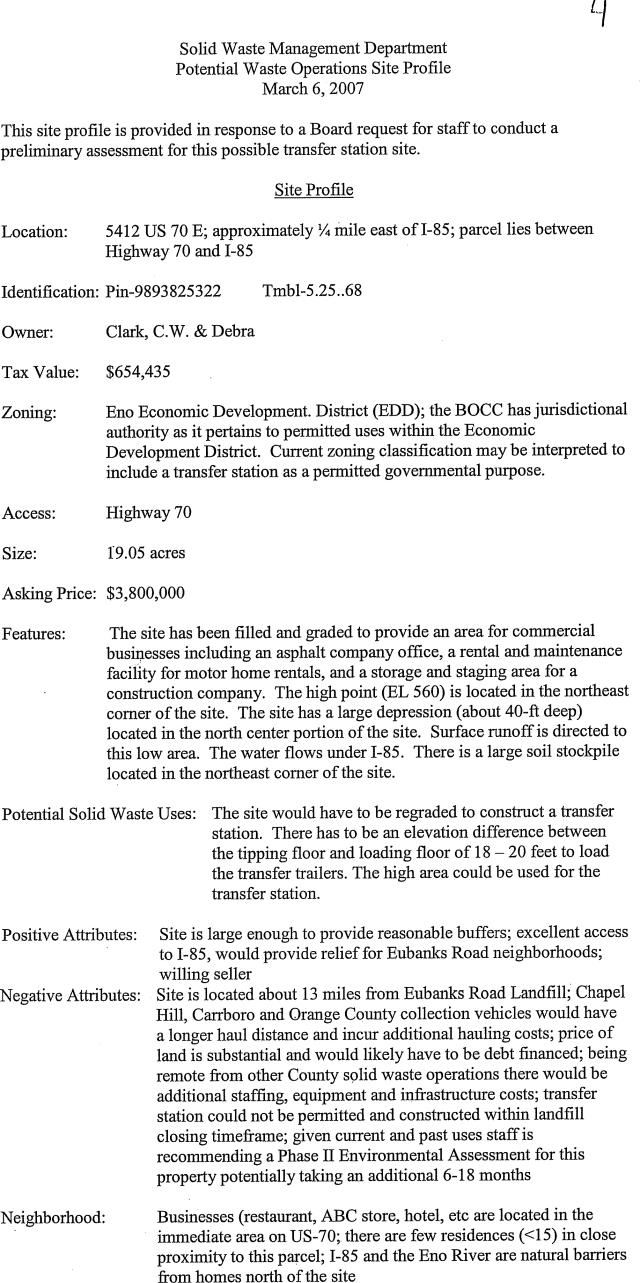
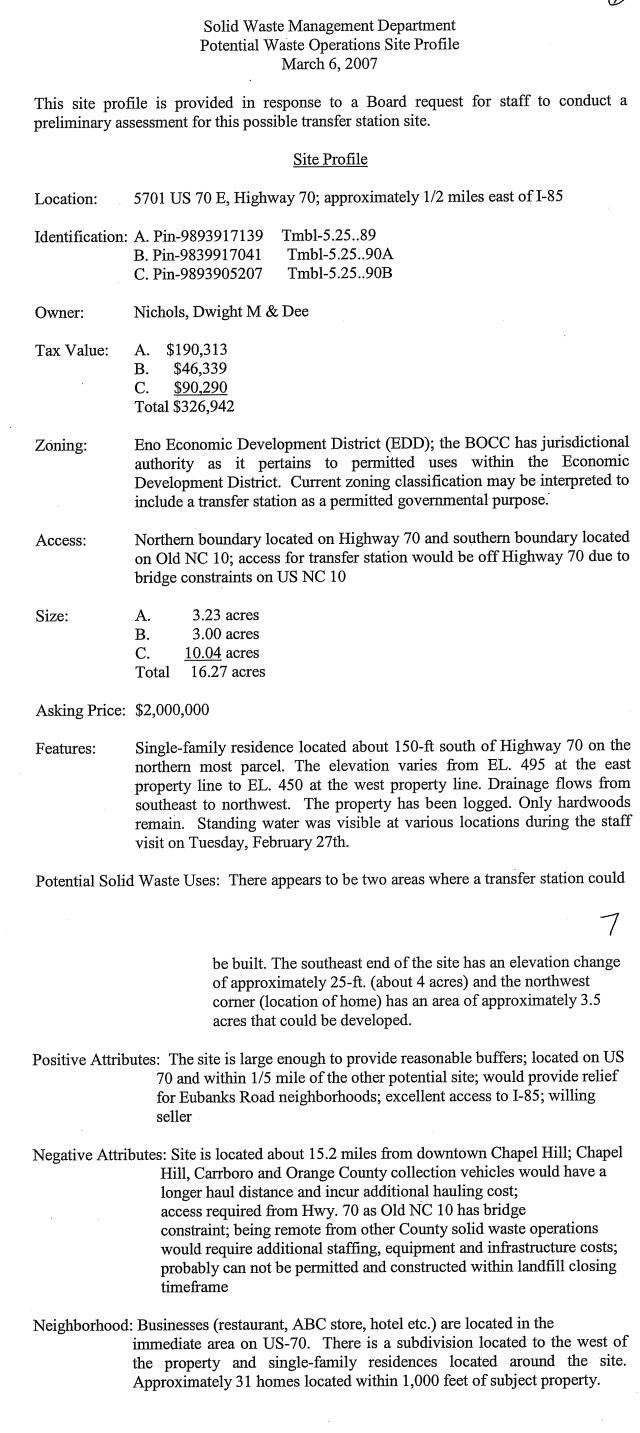
The two US70E sites referenced in tonight’s agenda item [PDF] are:

5412 US70E. Tax Value: $654,435. Asking Price: $3.8M. Size: 19.05 acres.

5701 US70E. Tax Value: $326,942. Asking Price: $2.0M. Size: 16.27 acres.

Google MAP of general area.

Here are the profiles for each of the selected sites:

5412 US 70E (click image to expand) 5701 US 70E (click image to expand)

Trash Talk: Media Steps Up to the Plate

Who, what, where, when and why might provide the context for local issues but without relevant analysis the local media falls down on their obligation to the inform, as fully as possible, the citizenry.

“Light and Liberty go together”, as Jefferson said. So does “light and good public policy”. The Chapel Hill News (of which I’m an occasional columnist) has been on top of the recent Rogers Road story – not only providing background, like Aarne Vesilind’s Bravery and broken promises mark landfill saga but also editorial leadership like Taking out the trash

There are some good reasons for locating Orange County’s planned solid waste transfer station at the site of the current landfill on Eubanks Road.

That site is closer to the population centers that produce most of the trash than the other possible locations that have been mentioned. The landfill site is already used to handle trash, of course, so you wouldn’t have to disturb any additional parcels of land. And, best of all, it’s the cheapest option on the table.

Reasonable considerations all.

But they’re outweighed by the arguments, moral and practical, against putting a waste transfer station on Eubanks Road. If a transfer station is necessary — and that’s a question that needs some better answers — put it somewhere else.

Back in the early 1970s, the landfill opened on Eubanks Road, where the people living next door were — here’s a shock — the predominantly low-income, black residents of the Rogers Road area.

Those residents were assured at the time by local leaders that they would have to live with the landfill only for a limited time, and then the county would move its solid waste facilities elsewhere.

That never happened. The landfill was expanded, not closed, and for more than 30 years the people who live along Rogers Road have lived with the noise, smell, traffic, trash, discolored groundwater and other noxious side effects of the landfill.

They’ve done their time.

….

Here’s some of their other recent coverage:

The Daily Tar Heel and WCHL 1360 have done their bit:

Trash Talk: SqueezeThePulp Led Online

Though I’ve quoted many relevant comments from OrangePolitics, a watering-hole for local pols, the “other” local forum, SqueezeThePulp has been popping with online commentary for months.

Here’s one of the more active threads Proposed Orange County Landfill Transfer Station Survey which led off with this David Richter open letter to the Orange County Board of Commissioners (BOCC) and elective councils of Carrboro and Chapel Hill:

An open e-mail and appeal to each of elected leaders of Orange County, Chapel Hill and Carrboro:

Proposed: Eubanks Road and the surrounding areas should be removed as a proposed site for the Orange County Landfill Transfer Station from further consideration for now and for the foreseeable future.

Dear Elected Leaders:

I am asking each of you to take an immediate public and personal position on the above proposal. There was a column in the Chapel Hill Herald on Tuesday, 2/13/07 and the Chapel Hill News, 2/14/07 that talked to all the reasons why Eubanks Road should not be the site of the new Landfill Transfer Station. However, the simple fact is that the Rogers Road community was made a promise in 1972 on placement of the Orange County landfill on Eubanks Road. When the landfill was filled to capacity, the Rogers Road community would no longer be subject to Orange County waste facilities and activities. We should not quibble on technicalities or wording. That was the spirit of the promise.

We can talk about how that promise was already broken, but that would not be useful or productive. If the transfer station is located on or near Eubanks Road, it will clearly be a break of the promise and an act of intentional or unintentional “Environmental Racism”. This promise and the decades of contribution by the Rogers Road Community override all the other considerations of cost and expediency. As our current elected leaders, you are responsible to fulfill that original 1972 promise assuring the integrity of our local governments, adhering to the values of our community and just plain doing the right thing.

I am asking each of you to respond to me by March 1^st . The response should be a Yes or No to the above proposal. I will compile all the responses and report it to the local papers. I will also feedback all the responses to those who did respond. Besides each of your names, I will place one of the following entries with no caveats:

– Yes (for the proposal)
– No (against the proposal)
– No position
– No response

I appreciate your attention to this issue and look forward to your responses and a positive result. Thanks.

David Richter

Commissioner Moses Carey responded to David

Mr. Richter;

I am certain that you have followed the process the County is using to make this important decision about the location of the Transfer Station. Our efforts to communicate with the area residents and consider all available sites have been reported in local papers. Additionally the issue of a “Promise ” has been discussed in this community for many years. While you may not be familiar with those past discussions, you may consult the archives of the news papers to become updated on those discussions.

The BOCC has a process to make a decision on the Transfer Station site and I trust we will adhere to it. That process includes listening to area residents and weighing all available information before making a decision. The views of the Towns on the currently considered sites is the next bit of information we will receive for discussion at our march 1st work session during which the public may listen, but not speak. You may wish to attend to be further informed.

However, it would be premature and unethical in my opinion for any elected official to respond to you as you have requested prior to considering all information which must be considered to make an informed decision on this matter.

I look forward to seeing you at our meeting.

and David responded to Moses

Commissioner Carey:

Thank you for responding to my e-mail. I do appreciate your time and consideration. However, I am baffled by your response and disagree with your rationale.

1) I do agree that we have an ethical problem but disagree where the ethical problem lies. Regardless of whether people agree on the reality or the interpretation of the “promise”, it is an undeniable fact the Roger’s Road community has lived with the Orange County Landfill for over three decades in their back yard and all the resulting negative impacts to their quality of life. After three plus decades the fact that Orange County Board of Commissioners is even considering the same area as the site of the Transfer Station is of itself unethical. It is time to look else where to solve Orange County’s waste problems.

2) I do not understand what process you were referencing in your response. I was unable to retrieve any process with a search. If there is a documented process please point me to it. However, in the last posted minutes of the Solid Waste Advisory Board meeting of 11/2/06 it seems there is no current alternative Orange County site list or search of a site in progress. In fact it is my understanding there is no official criteria for a Transfer Station site in place. The minutes clearly promote the Eubanks Road site for the Transfer Station as the path of least resistance. As far as I can tell, Eubanks Road is the “ONLY” site within Orange County under consideration. Please tell me if I am wrong and if so I apologize and where can I find the list? It is also important to note that any “process” leading to an unethical result is far from appropriate.

For our elected leaders to stand up at this time and be counted is not unethical; it is the right thing for them to do. I urge them to be counted, if not through an e-mail to me (I am just a single citizen speaking for myself) then through other venues. I also urge the Orange County Board of Commissioners to take the ethical path and instruct the Solid Waste Advisory board to take Eubanks Road off the table and find another site for the Transfer Station regardless of the convenience factor. After all, the Rogers Road Community has been living with the “inconvenience” for a long time.

David Richter
Carrboro

Yes, SqueezeThePulp snide, nasty and tough at times with a few dust ups that drown the signal out with noise (like the crappy tit-for-tat that Fred Black and Mark Gill had in the middle of this transfer station discussion) but it does serve a locally online community that Ruby’s OrangePolitics doesn’t.

And that online community, on the Rogers Road issue, led the way.

Trash Talk: Aarne Vesilind’s History

I mentioned this before, but on the cusp of tonight’s meeting I’d like to remind folks of Aarne Vesilind excellent overview in the Chapel Hill News (Feb. 21, 2007) of some of the history of the Eubanks landfill.

Before the early 1970s, Chapel Hill was using a small landfill owned by the university for the disposal of its solid waste. This landfill was rapidly running out of space and the university wanted to close it, so a search commenced for a new landfill site. The Town Council decided to buy a piece of land to the north of town for the new landfill.

Abutting this land was a vibrant black community, the Rogers Road neighborhood. They did not want the landfill so close to their homes and went to Mayor Howard Lee for help. The mayor talked them into accepting the decision and promised them that this would be the one and only landfill that would be located near their neighborhood, and if they could endure this affront for 10 years the finished landfill would be made into a neighborhood park.

Most importantly, they were told that the next solid waste landfill for Chapel Hill would be somewhere else and that their area would not become a permanent dumping site. The citizens of the Rogers Road neighborhood grudgingly accepted this deal and promise and then watched as the Orange County Regional Landfill was built near their community.

Although Lee acknowledged making this promise, this was never found on any written document. In addition, the people who lived in the Rogers Road neighborhood were told that the LSC was not bound by promises made by former elected officials.

The fact that the Greene tract was too small to afford a long-term solution continued to be a source of encouragement to the Rogers Road neighborhood, but late in the process and well after the public hearings, Eddie Mann introduced a new site, named OC-17. This site abutted the Greene tract and the Rogers Road neighborhood and included a large tract of land in Duke Forest. The LSC quickly approved OC-3 and OC-17 as the new landfill site and the decision went to the LOG for its approval.

The vote in the LOG was 6-3 in favor of the selected site. Two of the negative votes were by the representatives from Carrboro. Even though Carrboro ought to have had a clear, selfish motive for choosing this site, the two Carrboro representatives, Mayor Mike Nelson and Alderman Jacquelyn Gist, argued that the promise made by Howard Lee to the Rogers Road neighborhood should be kept.

He closes with this observation:

The question in front of the people in Orange County now is whether to continue along their path of least resistance and least cost and place yet another solid waste processing facility in the Rogers Road neighborhood, or to thank these people for all the years that they have had to endure the presence of the landfill in their community, and to tell them once and for all that they have indeed done their part.

Complete column here.

Trash Talk: Promises Unmet

[UPDATE:] Dan Coleman posted this nice summary over on OrangePolitics of the ’97 minutes:

Thanks, Mark. Your four points are absolutely correct. As well as reviewing the 1997 agreements, the Commissioner’s ought to take a close look at the landfill neighbors’ current “Hope List”:

  • 1) Cover open bed trucks going to landfill (agreed to in 1997 document)
  • 2) Lower speed limit from 40 to 25 (issue with DOT)
  • 3) Trash pick up along side Rogers Road (agreed to in 1997 document)
  • 4) Site clean up and community assistance
  • 5) Transit system for Rogers Road (promised in 1997, cost estimate for next FY requested last month)
  • 6) Summer jobs for youth (15-19)
  • 7) Sidewalks on both side of road (Carrboro is proceeding with study of its side)
  • 8 ) Define county-wide goals as relate to Rogers Road communities
  • 9) Recreation program in this community

I met with Reverend Campbell and Barbara Hopskin last week to discuss this list. It seems to convey a clear sense of what the neighborhood is looking for. I was struck by the extent to which these items are matters of common-sense, with many part of our regular processes for neighborhood improvements (improvements Rogers Road has waited on for far too long).

Thank you Dan for doing the heavy editing!

[ORIGINAL]

As I posted before, the Rogers Road community was supposed to receive value in trade for siting a landfill in their backyards.

During the Oct. 22nd, 1997, Assembly of Governments meeting (minutes [PDF] ) the following statements were made, reviewed, submitted to a vote and either passed or not.

First, these 5 key points of which each governmental body was asked to agree upon:

1. The County becomes the local government with primary authority and responsibility over operational and policy matters related to the solid waste system, subject to the limitations imposed by the Agreement.
2. In its capacity as the system operator, the County agrees to establish and maintain a new disposal facility, and in return for access to disposal capacities the Towns agree to provide their solid waste and recyclables to the County system.
3. The parties jointly agree on the location of that new disposal facility.
4. The parties agree on benefits or benefits processes related to the communities (a) in the area of the existing landfill and (b) in the area of the new disposal facility.
5. The parties agree on some treatment of the Greene Tract.

The following commitments were made:

ITEM FOURTEEN (xiv): This item reads as follows: The Working Group recommends that three residents of the area near the Eubanks Road landfill (two in the Rogers Road area, an one in the Millhouse Road area) be identified to receive all mailings and information sent to members of the Landfill Owners Group or its successor agency. This information should be made available to all residents of the area.

A motion was made by Council member Chilton, seconded to Alderman Gist, to approve this item as written.

VOTE: MOTION PASSED

Status: I’m not aware of the compliance with this directive.

ITEM TEN (x): This item reads as follows: The Working Group recommends that Chapel Hill Transit re-route the North-South connector bus line to serve Rogers Road on either its northbound or southbound trip, starting with the 1998-1999 service year. For the duration of the 1997-1998 service year, the Rogers Road area should be designated as a Shared Ride Feeder Zone if this can be accomplished within adopted budgets and available resources. [MY EMPHASIS]

Council member Franck stated that changing the bus route would be a “zero” cost option from a budgetary viewpoint. It will have a slight cost from a transit operation standpoint. This was not the first choice of Manager Cal Horton who recommended an alternative route.

A motion was made by Council member Franck, seconded by Alderman McDuffee, to approve Item Ten.

VOTE: Motion Passed

Status: Unmet due to various reasons. Brought up again during 2005 Chapel Hill election. Finally looks to be implemented.

This item reads as follows: The Working Group recommends that Orange County erect “Children Playing” and “School Bus Stop” signs on Rogers Road. Residents of the Rogers Road neighborhood will identify appropriate locations for these signs.

Commissioner Halkiotis asked if the Department of Transportation had declined this request.

Council member Chilton said that they had declined, however, the Town of Chapel Hill would provide these signs.
A motion was made by Council member Chilton, seconded by Alderman Gist, to approve this item as presented.

VOTE: Motion Passed

Status: For several years I’ve heard complaints from Rogers Road citizens that the signage is not sufficient.

ITEM EIGHT (viii): This item reads as follows: The Landfill Owners Group will budget for the installation of perimeter fencing around the Orange Regional Landfill no later than the 1998-1999 Budget Year. Prior to completion of the fence, the Director of the Orange County APS shall be notified ,strong>to ensure that no large animals are trapped inside the fence.

Commissioner Gordon requested clarification regarding the concerns staff had about providing this perimeter fencing.

County Manager Link indicated that staff had questions about whether a 6’ fence was adequate given that deer could jump over a fence that high.

Council member Chilton stated that the neighbors were concerned about animals going into and out of the area, in particular dogs and vermin. The construction of a fence designed to control animals would be approximately $50,000 more expensive than the cost of the original fence which was approximately $150,000.

Commissioner Halkiotis suggested that the height and mesh needed to be adequate to keep out both vermin and deer.

A motion was made by Mayor Nelson, seconded by Alderman Gist, to approve this item as presented.

VOTE: Motion Passed

Status: Might’ve dealt with large animals getting out but the converse, keeping small animals like rats in, not complied with to the Rogers Road community’s satisfaction.

ITEM SEVEN (vii): This item reads as follows: The Working Group recommends that residents living near the Orange Regional Landfill take initiative in identifying perpetrators of illegal dumping near the landfill to assist in successful prosecutions. Identification of vehicles, license tags, drivers, and/or types of articles discarded should be made when possible.

The Landfill Owners Group will investigate with the Orange County Attorney the possibility of enacting legislation which would provide for civil penalties for illegal dumping, to make it easier to penalize people who litter. In addition, the LOG will publicize the names of those convicted of illegal dumping.

The Working Group recommends that additional “No Littering” signs be erected in the neighborhoods near the landfill.

A motion was made by Commissioner Carey, seconded by Alderman Gist, to approve Number Seven.

VOTE: Motion Passed

Status: A common complaint is that the current garbage transfer trucks produce a great amount of roadside litter. I’d be interested if anyone knows of haulers being cited for violating either local or state litter laws.

ITEM SIX (vi): This item reads as follows: The Landfill Owners Group will adopt a policy governing construction at the Orange Regional Landfill. This policy will govern issues affecting neighboring residents, including nighttime construction, blasting, and noise. The policy will identify ways to mitigate or eliminate adverse effects on landfill neighbors, and will require all neighbors (those living in the areas to be provided with water and sewer service) to be notified one week in advance of the start of construction. Such notification shall include the estimated duration of construction, and a description of any special construction activities which may impact neighbors. Notification will, at a minimum, include posting of signs on the four roadway entrances into these neighborhoods (the north end of Millhouse Road, both ends of Eubanks Road, and the south end of Rogers Road).

Under ordinary circumstances, the LOG and its contractors will avoid construction between the hours of 11:00 p.m. and 6:00 am and will provide for immediate notification of neighbors when emergency circumstances dictate that construction activities are unavoidable during these hours. The LOG will ensure that any contractors carrying out construction at the landfill follow the Orange County Noise Ordinance.

Council member Chilton stated that Chapel Hill staff’s assessment was that construction would most likely be happening all of the time, which would mean that signs would be posted all of the time.

A motion was made by Alderman Zaffron, seconded by Mayor Nelson, to approve Number Six of this agreement.

VOTE: Motion Passed.

Status: I remember complaints about construction noise when the landfill infrastructure was being modified/expanded during the early 2000’s. Not sure how the complaints were resolved.

I would hope that a similar provision would be adopted and ENFORCED if the transfer station is built on Eubanks.

ITEM FIVE (v): This item reads as follows: The Landfill Owners Group will adopt a policy which doubles the minimum frequency of litter pickup on roads surrounding the Orange Regional Landfill. This will result in litter pickup on Eubanks Road east of the landfill entrance at least twice weekly, on Eubanks Road west of the landfill entrance at least six times annually, and on Rogers Road at least eight times annually. Future modifications of these pickup frequencies shall be made only by the Landfill Owners Group or its successors.
A motion was made by Council member Franck, seconded by Alderman Zaffron, to approve this item.

VOTE: Motion Passed.

Status: Roadside litter is a common complaint. I don’t recall any complaints on frequency – I hope to get a better read on this soon.

ITEM FOUR (iv): This item reads as follows: The Landfill Owners Group will adopt a policy which requires loads of mulch leaving the Orange Regional Landfill to be covered. The Landfill will make available for sale tarps of various sizes for purchasers of mulch to cover their loads. This policy will become effective after a three month grace period, during which time education will be provided to mulch purchasers at the landfill.

A motion was made by Alderman McDuffee, seconded by Council member Franck, to approve this item.

VOTE: Motion Passed

Status: From personal observation (based on several years of following trucks on Eubanks after exiting Millhouse) it seems that government-related loads of mulch are the most likely to be inadequately covered and blowing out. Not sure what the general compliance has been with this provision.

ITEM THREE (iii): This item reads as follows: The Landfill Owners Group will prepare and recommend a policy for adoption by the Chapel Hill Town Council which will require loads of waste (MSW and Construction and Demolition waste) being brought to the Orange Regional Landfill to be covered. Under the policy, loads which are not covered would be subject to fine. The fines would become effective after a three month grace period. Non-commercial first-time offenders should be offered the option of purchasing a tarp at the landfill in lieu of paying the fine.

Council Member Chilton stated that there is already a state law to this effect but it is not as stringent as this requirement would be.

A motion was made by Council member Pavao, seconded by Alderman Zaffron, to approve this item.

Status: Need more information. My personal observation is that compliance has slipped over the years as development has increased.

[UPDATE:] Carrboro Board of Aldermen Dan Coleman offers this succinct list of motions approved and defeated. From OrangePolitics:

ASSEMBLY OF GOVERNMENTS
OCTOBER 22, 1997

  • Item: three residents of the area near the Eubanks Road landfill (two in the Rogers Road area, an one in the Millhouse Road area) be identified to receive all mailings and information sent to members of the Landfill Owners Group or its successor agency.

    Motion Passed

  • Item: no expansion (beyond the existing permitted disposal capacity) of the disposal areas (MSW or Construction and Demolition) of the Eubanks Road landfill occur.
    The Working Group recommends that the Landfill Owners Group or its successor make no incremental land acquisitions at the Eubanks Road Landfill.

    MOTION FAILED

  • Item: following the closure of The Eubanks Road landfill, portions of the landfill (as allowed by regulations), the Neville tract, and at least 50 acres of the Green tract will be used for recreation facilities.

    MOTION FAILED

  • Item: sponsor a public information meeting regarding the planning boundary (future annexation boundary) between Chapel Hill and Carrboro.

    MOTION FAILED

  • Item: re-route the North-South connector bus line to serve Rogers Road on either its northbound or southbound trip, starting with the 1998-1999 service year

    Motion Passed

  • Item: erect “Children Playing” and “School Bus Stop” signs on Rogers Road.

    Motion Passed

  • Item: budget for the installation of perimeter fencing around the Orange Regional Landfill no later than the 1998-1999

    Motion Passed

  • Item: Investigate with the Orange County Attorney the possibility of enacting legislation which would provide for civil penalties for illegal dumping, to make it easier to penalize people who litter. In addition, the LOG will publicize the names of those convicted of illegal dumping.
  • Item: The Working Group recommends that additional “No Littering” signs be erected in the neighborhoods near the landfill.

    Motion Passed

  • Item: policy will govern issues affecting neighboring residents, including nighttime construction, blasting, and noise. The policy will identify ways to mitigate or eliminate adverse effects on landfill neighbors

    Motion Passed

  • Item: litter pickup on Eubanks Road east of the landfill entrance at least twice weekly, on Eubanks Road west of the landfill entrance at least six times annually, and on Rogers Road at least eight times annually.

    Motion Passed

  • Item: requires loads of mulch leaving the Orange Regional Landfill to be covered. The Landfill will make available for sale tarps of various sizes for purchasers of mulch to cover their loads.

    Motion Passed

  • Item: require loads of waste (MSW and Construction and Demolition waste) being brought to the Orange Regional Landfill to be covered.

    Motion Passed

  • Item: water and sewer mains be extended to provide service to the area along the entire length of Rogers Road; Millhouse Road from Eubanks Road to New Jericho Road; and serving households on other side streets off these main roads (including, but not limited to Purefoy Drive, Rusch Road, Priscilla Lane, Sandberg Lane, Meadow Run Court, Manor Drive, Manor Court and Blackwood Mountain Road)

    Motion Did Not Pass