Category Archives: Ruminations

Trash Talk: The Ticking Clock

For a problem 35 years in the making, the push to finalize the site of the transfer station seems precipitous. To echo Mark Chilton’s letter, until a county-wide assessment is made, setting a timetable now is not prudent.

Here’s the draft timetable from tonight’s agenda item:

It would be nice to see a concurrent push to reduce, reuse and recycle (even more) of the waste stream that paralleled the implementation of the transfer site irrespective of where it is sited.

For instance, a plan to effectively utilize the biomass to produce bio-diesel, methanol or methane to supplement other centralized sources of energy should go hand-in-hand with our transition to a new waste site (wherever it is sited).

CitizenWill is Certifiable

As some of the more “critical” of you readers have noted elsewhere, CitizenWill is certifiable – and here’s the proof.


I zipped down yesterday to Raleigh for the 2 hour campaign treasurer training session to comply with the new NC election statutes. Though I’ve been filing reports since 2005, and a lot of the material was old hat, the session, held at the tucked away State Board of Elections (SBOE) was still interesting.

Here’s a few observations.

Of the 24 folks attending, PACs and candidates were equally represented. I sat next to Linda Stevens treasurer. Time-Warner’s PAC was there. Some very spiffy dressed folks – election newbies – helping run Rocky Mount’s mayoral and sheriff elections attended.

Only one other candidate, former or otherwise, came – a man running for Zebulon council and his wife. He said that election campaign rules were being prolifically broken in Zebulon.

As a side note, Mike Nelson told me I was foolish to be my own treasurer – which, given all the “complex” contributions he received in 2006 😉 – I can appreciate. He also said he didn’t review the reports, something I think is a bit foolish. Mike’s pushing for some reforms at the county level – non-partisan elections, unfortunately, is not one of them.

A long lead up to mentioning that the training I received will be online and available in May.

I suggest every candidate – even those like Mike with the luxury of a campaign treasurers – go through the self-paced tutorial. In the end, the buck stops with the candidate.

Some confusion was introduced by the SBOE this year as the reports are now based on an election cycle – which starts the day after the election – instead of current method, which tracks the years. The gap between Nov. 8th to Dec 31st has to be handled differently. Several PAC folks whinged on about the delta.

In the toothless election law reforms department, county party executive committees can give unlimited funds and receive unlimited funds. Chapel Hill municipal elections are non-partisan (wink, wink, nudge, nudge) so this wide open avenue to funding doesn’t pertain but what a major gap.

Also in the toothless vein, folks can give $50 per day in cash up to $4000. Why toothless? Cash is fungible and hard to track – like a check. Bundling contributions appears to be a problem.

Business contributions, which are illegal, continue to be an issue.

Lots of time spent talking about in-kind from folks who are self-employed – are they acting as an individual or a business? For those folks, if you receive a check on their business letterhead, a “business statement” must be filed by the campaign asserting that the individual commingles personal/business funds and only has a single account for everything…

Using administrative staff or even your business phone for campaign activities is verbotten.

The trainer underlined that contributions from out-of-state require all info be reported (too bad the same couldn’t be said for out-of-county).

That said, records of all contributions must contain complete info though complete reports are only necessary if the aggregate contributions are over $50.

In-kind contributions require a receipt – including candidate in-kinds. Receipts are not reported.

Another common mistake: loan proceeds plus contributions from an individual cannot exceed $4000 per individual unless one of the excepted groups – (candidate, spouse, party committee). My total campaign was a little more than $3300…

Any amount of postage can be paid in cash.

Expenditures. Vendor expenses must be itemized. I’ve seen local reports that didn’t itemize.

Designation of Committee Funds form needs to be filled out to dictate
the fund transfer if you should die/etc. Leaving funds to a 501c3 allowed.

NCS: 163-278.16B “Use of contributions for certain purposes.” [PDF] was the biggy.

(a) A candidate or candidate campaign committee may use contributions only for the following purposes:
(1) Expenditures resulting from the campaign for public office by the candidate or candidate’s campaign committee.
(2) Expenditures resulting from holding public office.
(3) Contributions to an organization described in section 170(c) of the Internal Revenue Code of 1986 (26 U.S.C. § 170(c)), provided that the candidate or the candidate’s spouse, children, parents, brothers, or sisters are not employed by the organization.
(4) Contributions to a national, State, or district or county committee of a political party or a caucus of the political party.
(5) Contributions to another candidate or candidate’s campaign committee.
(6) To return all or a portion of a contribution to the contributor.
(7) Payment of any penalties against the candidate or candidate’s campaign committee for violation of this Article imposed by a board of elections or a court of competent jurisdiction.
(8) Payment to the Escheat Fund established by Chapter 116B of the General Statutes.
(b) As used in this section, the term “candidate campaign committee” means the same as in G.S. 163-278.38Z(3).
(c) Contributions made to a candidate or candidate campaign committee do not become a part of the personal estate of the individual candidate. A candidate or the candidate who directs the candidate campaign committee may file with the board a written designation of those funds that directs to which of the permitted uses in subsection (a) of this section they shall be paid in the event of the death or incapacity of the candidate. After the payment of permitted outstanding debts of the account, the candidate’s filed written designation shall control. If the candidate files no such written designation, the funds after payment of permitted outstanding debts shall be distributed in accordance with subdivision (a)(8) of this section. (2006-161, s. 1.)

The update of this statute was prompted by the Speaker Black debacle.

Interesting point raised on the fashion front. Under the new regulations a candidate can’t purchase a new suit to campaign in and pay for it with campaign funds. Since the suit has a lifetime beyond the campaign, it’s considered a personal expenditure.

Websites and email are not addressed in media regulations. Personal website can be used for campaign purposes without a disclaimer if no new costs associated otherwise it might possibly be considered an in-kind. The law is silent on “new media”.

Another major problem (that the crew over at BlueNC are well aware of), independent media buys with a “Not Authorized by…” can be bought in unlimited amounts. That is, if someone, like Anglico’s Puppetmaster, wants to purchase unlimited media for a candidate and states “This ad is not authorized by my toady to be…”, then it’s alright.

I was astonished by this loophole and had the trainer clarify my understanding. Amazing!

Printed disclosures no less than 12pts, for newspaper 28pts. I threw one of the SBOE staff a curve when I pointed out that different fonts have different sizes at 12 pts.

Interestingly , in television, if you mention opposition candidate the candidate must speak the disclaimer. Not sure about radio.

youTube is not covered.

Over and over, the SBOE emphasized yo need to keep records of every contribution no matter how small. And look for edge cases. Example – sell $20 t-shirt + $30 contribution, you trigger the $50 reporting limit.

Any committee can use the SBOE’s software for managing reports.

That’s about it. I’m now a qualified campaign treasurer for the next 4 years.

If anyone needs a hand forming their committee, I’ll be happy to help: campaign AT willraymond.org

They Count: 2007 Point in Time Orange County Homeless Census

Cross-posted from Terri Buckner’s (TerriB’s) ‘blog LocalEcology

Orange County Homelessness Fact Sheet
February 2007

Total Number of Homeless People Counted in January 2007: 224

  • Homeless people staying in temporary shelter: 199
  • Homeless people without shelter (i.e. on the streets): 25
  • Homeless families: 23
  • Homeless people in families (including children): 60
  • Homeless children: 35
  • Homeless individuals (not in families): 164
  • Homeless people with a history of domestic violence: 23
  • Chronically homeless people: 71

These figures do not include numbers of people who are “doubled up,” that is without a legal residence of their own and temporarily staying with another person. Furthermore, the data does not account for people who are at-risk of homelessness for any reason including unemployment, foreclosure, eviction, chronic or sudden illness and domestic violence. According to the 2000 U.S. Census, 40.5% of renters in Orange County pay 35% or more of household income toward rent which qualifies as at-risk of homelessness.

In Orange County:

  • A minimum wage earner (earning $5.15 per hour) must work 117 hours per week, 52 weeks per year, to afford the fair market rent (FMR) for a two-bedroom unit, which is $785 per month. An SSI recipient (receiving $603 monthly) can afford monthly rent of no more than $181, while the fair market rent for a one-bedroom is $603 (Out of Reach Report, 2006).
  • In order to afford FMR for a two-bedroom unit ($785), without paying more than 30% of income on housing, a household must earn $2,617 monthly or $31,400 annually. Assuming a 40-hour work week, 52 weeks per year, this level of income translates into a Housing Wage of $15.10 (Out of Reach Report, 2006).
  • In 2006, the Inter-Faith Council served 85,055 hot meals; provided 7,726 bags of groceries to 7,187 members of the community; granted 3,500 requests for food, cash, and help with utilities and other service needs representing more than 2,100 households; and offered 813 homeless individuals a place to sleep through its Community House and HomeStart program.
  • Neighbor House, Inc. distributed at least 17, 680 dinners to members of Northern Orange County through its Food for All Program in 2006. They are currently serving an average of 85 meals per night, four nights per week.
  • In 2005, the Community Initiative to End Homelessness received approximately $275,000 to provide permanent housing to homeless and disabled individuals or families. The funding is shared among OPC Area Program, the Chrysalis Foundation for Mental Health, Inter-Faith Council for Social Service and UNC Horizon’s. The CIEH applied for additional homeless assistance funding in 2006, but award letters have not been received as of 2/13/07.

I’m trying to find how the $275,000 in Community Initiative to End Homelessness funds were actually dispersed.

Council member Sally Greene has also been doing work (and blogging about it) with the ORANGE COUNTY PARTNERSHIP TO END HOMELESSNESS

Thanks Teri for shining a light into the shadows, please keep the posts coming.

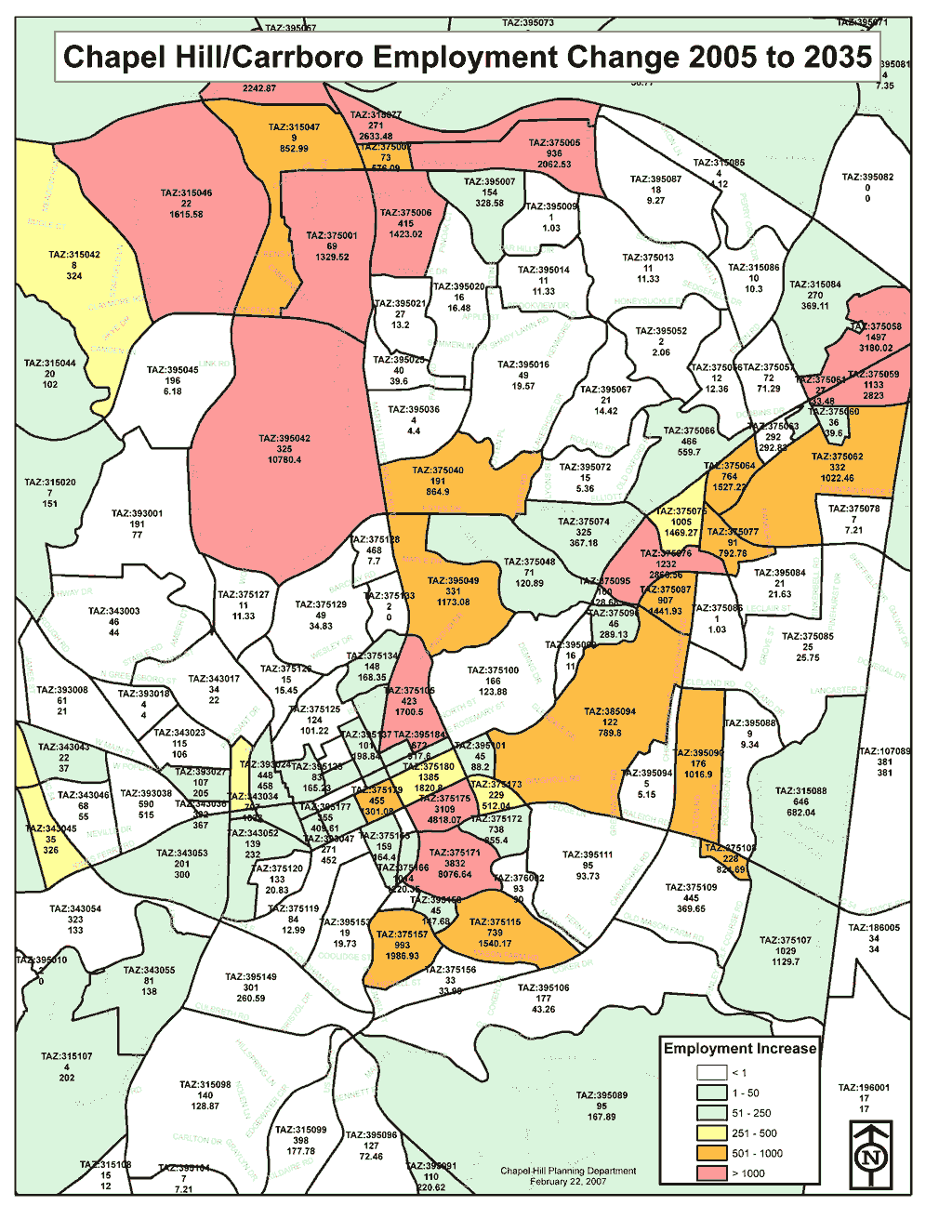
2035 Orange County’s Garbage Center of Gravity?

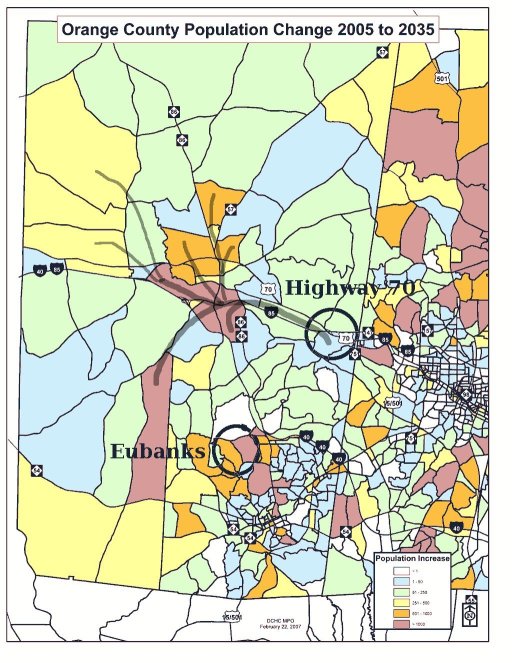
I was struck by a conjunction between the following image from the Durham-Chapel Hill-Carrboro Metropolitan Planning Organization 2035 Long Range Transportation Plan Socio-Economic projections I mentioned earlier and the debate currently raging over siting a trash transfer station on Eubanks Road.

35 years ago the Orange County landfill currently blighting the Rogers Road community was sited close to Chapel Hill/Carrboro communities because they constituted the predominant source of garbage.

Now, with projections of dramatic population shifts 30 years hence, it seems like the center of gravity for Orange County’s trash production (creation?) is shifting North.

I did a quick review of the Orange County Board of Commissioners agenda items covering the Rogers Road issue and couldn’t find a discussion of a new “trash axis”.

Maybe those more mathematically inclined could weigh in on how to calculate this new centroid which, it would seem, help locate the most effective transfer site.

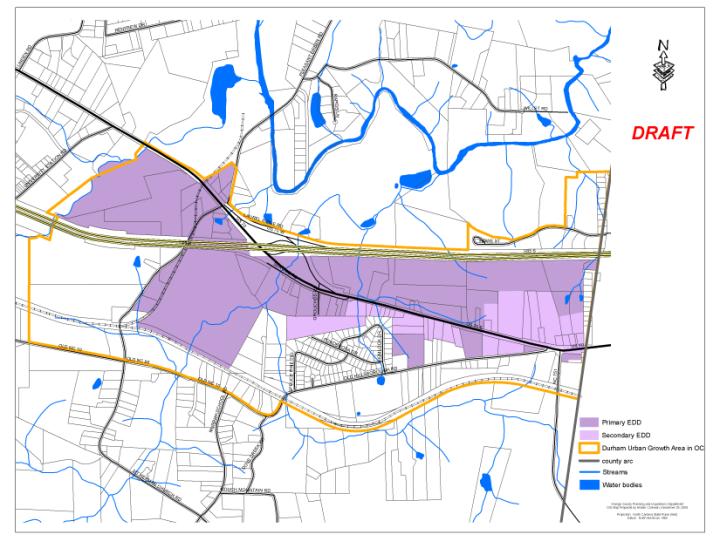
Potential site for transfer station at the Hwy 70/I-85 split (within the Eno Economic Development District):


Eno Economic
Development District

Oh,Oh Walgreen

One of RAM Development’s Chapel Hill projects is the poorly sited Walgreen’s on the corner of MLK (Airport Rd.)/Weaver Dairy Rd [MAP]. I’ve commented ( Godzilla vs. Bambi: RAM Development and Chapel Hill) on the problematic expeditious manner this project is taking through “official” channels.

Our Council’s dealings with RAM Development shouldn’t even have the appearance of being preferential.

RAM’s customer, Walgreen Co., seems to be having a bit of trouble involving preferential treatment:

Walgreen Co., the largest U.S. drugstore retailer, was sued by the Equal Employment Opportunity Commission over claims the company assigned black managers and denied them promotions based on race.

The retailer, based in Deerfield, Illinois, used race as a reason to send managers, management trainees and pharmacists to low-performing stores and to stores in black communities, the agency claimed in a statement. Walgreen also denied employees promotion opportunities in violation of U.S. law, the EEOC said.

“It is quite serious,” said Andrea Baran, a senior trial attorney for the EEOC, in an interview. “We received charges from around 20 individuals in the Kansas City-St. Louis area,” as well as Florida, Detroit and other regions, she said. “All of the evidence supported these people’s claims.”

The U.S. government lawsuit follows a court victory for the company last month in a case also related to discrimination allegations. Walgreen won a jury verdict in a suit brought by four Texas men who claimed a clerk used a racial slur when they tried to have film developed at a store in Reno, Nevada.

Bloomberg, Mar. 7, 2007

Chapel Hill 2035

[UPDATE] The Chapel Hill News’ OrangeChat noted the growth Mar. 5th.

The Durham-Chapel Hill-Carrboro Metropolitan Planning Organization 2035 Long Range Transportation Plan Socio-Economic projections are in and, as Sally notes, they forecast a whopping increase in population.

Table 1: Draft 2035 Plan Socio-Economic Projections

Jurisdiction

Population

Employment

2005

2035

% inc.

2005

2035

% inc.

Chatham County*

34,629

153,362

343%

8,196

16,953

107%

Durham County

229,796

370,007

61%

172,825

308,886

79%

Carrboro

21,328

26,879

26%

4,320

6,751

56%

Chapel Hill

52,394

81,297

55%

35,314

81,227

130%

Hillsborough

12,651

22,613

79%

5,762

14,606

153%

Orange County**

43,739

55,537

27%

3,946

7,255

84%

*Includes the portion
of Chatham County that is in the Triangle Regional Model area.

55% increase in population, 130% in employment! 81,297 folks living in Chapel Hill with employment at 81,227 seems to indicate quite a few folks will be coming from out of town. If you review their maps, it also appears that UNC’s Carolina North plays a huge role in that projected employment increase.

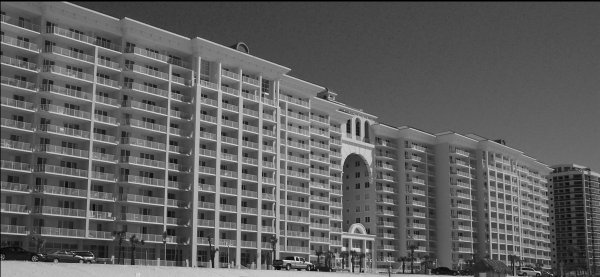
Whatever the reliability of the projections, and coming on the heels of Council’s dreadful and precipitous decision to create a TC-3 zone allowing 120′ tall buildings, I hope our fair Downtown doesn’t end up looking like this:

CAMPO’s Racetrack 5 Miles Long

The Durham-Chapel Hill Carrboro Metropolitan Planning Commission (DCHC-MPO) has formed a special advisory task force in conjunction with Capital Area Metropolitan Planning Organization (CAMPO) “to recommend a plan for major transit investments in the Triangle area.”

Their charter?

This commission will play a critically important role in the development of a unified vision for future transit investments in the Triangle area. The recommendations that the commission develops will be forwarded to the Transportation Advisory Committees (TACs) of both the DCHC MPO and the CAMPO for use in the formulation of their Long Range Transportation Plans.

Thanks to Patrick McDonough for the heads up.

Part of their agenda is to reevaluate the Triangle Transit Association’s (TTA) Regional Rail plan.

Though not averse to appropriate rail deployments, I’d like to see our community support the cheaper, more flexible Bus Rapid Transit (BRT) approach before plunging back into a rail-centric system.

Regional transit policy needs an “evergreen” process to address our community’s rapidly changing needs.

The commission membership has some real local talent, including former Council member Gerry Cohen (of the excellent NC Bill Drafting ‘blog) and Chapel Hill Planning Board member George Cianciolo (GeorgeC on OP).

Gerry kindly fills out the list of appointees:

Here is the membership list of the new 4 county transit planning committee, CAMPO are the Wake/Johnston appointments, DCHC-MPO are the Durham/Orange appointments. Bio sketches are from the staff memoranda.

CAMPO:

Bill Cavanaugh, (Co-Chair)
Former chairman, chief executive officer, and president, Progress Energy Chairman of the World Association of Nuclear Operators (WANO) Member of the National Academy of Engineering Board of visitors at the University Of North Carolina Kenan Flagler School Of Business Advisory Board of Tulane’s School of Engineering Board of Directors for Research Triangle Foundation

Smedes York, (Co-Vice Chair)
Mayor, City of Raleigh, 1979-1983 Raleigh City Councilman, District E, 1977 to 1979. President of York Properties, Inc. Board Chairman York Simpson Underwood and McDonald-York Past chairman of the North Carolina Citizens for Business and Industry Past chairman N.C. State University Board of Trustees Board of Directors of the Research Triangle Foundation YMCA of the Triangle North Carolina Amateur Sports Trustee of the Urban Land Institute Founding Co-Chair of Regional Transportation Alliance

Tom Bradshaw
Mayor, City of Raleigh 1971-1973 Secretary of N.C. Dept. of Transportation, 1976 – 1979 Member – Blue Ribbon Commission on the Future of Wake County Managing Director, Public Finance Dept., CitiGroup Global Markets, Inc.

Daniel Coleman
Attorney, Liveable Streets Partnership, Raleigh-Wake Citizens Association

Trish Dowty
Vice President of the Corporate Services Division, SAS Property, Procurement, and Logistics Management, CTI Data and Denelcor, Inc. Board of Directors, Cary Chamber of Commerce

Greg Flynn
NC Dept of Public Instruction School Planning NC Division of Forest Resources Architect

Mike Hendren
Wake Forest Chamber of Commerce.Board of Directors, Chair of the Government Affairs Committee

Jodi LaFreniere
Morrisville Chamber of Commerce President Member – Business Alliance Leadership Team Member Regional Transportation Alliance

Jennifer Lewis
Graduate Research Asst., Department of City and Regional Planning, UNC-CH Transportation Planning, Town of Chapel Hill Transportation Planner, The Louis Berger Group

Rusine Mitchell-Sinclair
Vice President at Large – North Carolina Electronics and Information Technologies Association (NCEITA) Regional Transportation Alliance – Vice chair of Regional Leadership Senior State Executive, VP Strategy & Implementation, Global IT Delivery – IBM

Mack Paul
Past President – Triangle Tomorrow Chief of Staff and legal counsel to Lieutenant Governor Dennis Wicker Associate General Counsel for Blue Cross and Blue Shield of North Carolina

Warren Sawicki
Fuquay-Varina – Chamber of Commerce Retired Manufacturing Executive

Frank Timberlake
R.F. Timberlake and Company
President Carolinas/Virginia Chapter NAMA (National Agri-Marketing Association)

Ed Willingham
2006-07 chair of the Regional Transportation Alliance Executive Vice President for First Citizens Bank’s Triangle Region

Frank Price
President of F. L. Price & Associates Chair – Clayton Planning Board

Gerry Cohen
Director of Legislative Drafting, NC General Assembly Former Member-Chapel Hill Town Council Former Member-Chapel Hill Transportation Board

Tim Reed
Conservation Co-Chair of the Capital Group Sierra Club

Ex Officio Members:
Joe Bryan
Chair, Capital Area MPO TAC Commissioner, Wake County

Charles Meeker
Vice Chair, Capital Area MPO TAC Mayor, City of Raleigh

John Brantley
Director, RDU International Airport Commission member – Blue Ribbon Commission on the Future of Wake County

Rick Weddle
President and CEO of the Research Triangle Foundation Vice Chair for Governmental Affairs – Regional Transportation Alliance Commission member – Blue Ribbon Commission on the Future of Wake County

=========================

DCHC_MPO appointees (Durham/Orange)

Cassandra Atkinson, Ph.D.
Adjunct Associate Professor, Department of Public Administration Director of Community Research and Technical Assistance Initiative Project Director, Transportation Management Bachelor’s Degree Program North Carolina Central University (Chancellor Ammons’ nominee) She has written several grants with the NC Department of Transportation and conducted research on transportation management needs.

George Cianciolo, Ph.D. (Co-Chair)
Member, Chapel Hill Planning Board Member, Chapel Hill Community Design Commission Former chair and member, Chapel Hill Transportation Board (six years) Former member, University of North Carolina Leadership Advisory Committee Associate Professor of Pathology, Duke University Medical Center

Carolyn Elfland
Associate Vice Chancellor for Campus Services University of North Carolina at Chapel Hill (Chancellor Moeser’s nominee) The University’s transportation planning, transportation demand management, and transit functions are within her area of responsibility. Member of the partnership committee that guides the Chapel Hill Transit system Represented the University on the 15-501 and 54 corridor studies

Robert (”Bo”) Glenn
Chair, Durham Open Space and Trails Commission Member, Durham Bicycle and Pedestrian Commission Member, Tarwheels Bicycle Club Served on the Durham Housing Authority for over 20 years Senior Budget Analyst, Office of the Governor, State Budget and Management Former Congressional Fellow for Rep. Earl Blumenauer (Portland, Oregon) Master’s in Regional Planning and Public Administration

Chris Harder
Vice chair, Durham Area Transit Authority (DATA) Board

Cal Horton
Former Town Manager (16 years, until 2006), Town of Chapel Hill As Manager, he has been a regional leader on transportation issues.

Sandy Ogburn
Member of the Board of Directors of several organizations in the Durham community, including the Durham Community Land Trust and the West End Community Center Former member of the Durham City Council, the Durham-Chapel Hill-Carrboro MPO, and the Triangle Transit Authority Board of Trustees

Bernadette Pelissier, Ph.D.
Chair, Orange Chatham Group of the Sierra Club Member, Orange County Planning Board Member, Orange County Commission for the Environment Former member, University of North Carolina Leadership Advisory Committee Ph.D. in Sociology. Recently retired from the Federal government

Roger Perry
Chair, Triangle Tomorrow President, East West Partners (member of the Chapel Hill-Carrboro Chamber of Commerce and the Regional Transportation Alliance) Member, Board of Trustees, University of North Carolina at Chapel Hill Served on the Board of Visitors of UNC and Executive Committee of the Center for Real Estate at UNC’s Kenan Flagler School Past chair, Triangle United Way

Mike Shiflett
Member, Durham Inter-Neighborhood Council, Northgate Park Member, Board of Directors for the Coordinating Council for Senior Citizens President and CEO, American Labor (member of the Durham Chamber of Commerce and the Regional Transportation Alliance) Member, Durham Chamber of Commerce, Transportation Committee Served on US 40 HOV task force, Durham Comprehensive Plan, Travel Demand Ordinance Task Force Former member, Orange County’s Economic Development District Transportation Task Force

Holly Reid
President, Board of Trustees, Eno River Association Co-Founder, Walkable Hillsborough Coalition

Sam Nichols Jr.
Senior Vice President, First Citizens Bank Durham Chamber of Commerce, Transportation and Economic Development Committees

Ex-Officio Members:

TAC Chair, Alice Gordon (Orange County Commissioner)
TAC Vice Chair, Becky Heron (Durham Coounty Commissioner)

TTA has entered the ‘net realm in soliciting community feedback with their online Design Game.

You can vote your wallet on transit priorities there through March 9th, 2007. The choices are a bit slim but at least you can lend your weight towards options you endorse.

Community Networking: Profiting from Poor Leadership Clearwire Gains a Toe-hold

Profiting from Council’s continued inability to craft effective technology policy, Clearwire, a wireless Internet service provider utilizing proprietary spectrum, has gained a toe-hold in our community.

These days, it’s hard to imagine getting through high school without the Internet.

However, there are at least 100 students at East Chapel Hill High School whose families cannot afford the service.

This number is a big concern for Ginny Guilfoile, East Chapel Hill’s Parent Teacher Student Association president who started a program to provide loaner computers and Internet access for students in need.

“I thought, how would it be if my kid didn’t have a computer,” Guilfoile said. “I knew there were kids that could not keep up with the other kids at East without the Internet.”

The district’s Information Technology Division was able to form a partnership with Clearwire, a high-speed wireless Internet provider.

Ray Reitz, the district’s chief technology officer, explained that by using Clearwire, the need for costly land-line phones or cable is eliminated.

“The cost of Internet access has been the main obstacle. The Clearwire solution is a completely wireless solution,” Reitz said.

Daily Tar Heel, Feb. 28th, 2007

Long time readers know how I’ve promoted the development of a community-owned network to stimulate economic development, bridge the digital divide and increase Town’s operational efficiency.

Councilmember Laurin Easthom has been the only elective leader to-date promoting the cost effective and tactical deployment of this “must have” infrastructure.

“Must have”? Yes, to compete effectively in the global marketplace we need to invest a modest amount in technological infrastructure.

Rider said she has received very positive feedback from the 42 students to whom the program has provided Internet access so far.

“One student told me the quality of her work improved because she had time in between going to school and working on assignments,” Rider said. “Basically they all talk about the same thing – how it was very hard to do their work and how much easier it is right now.”

Guilfoile said that although the program has been successful this year, the PTSA might not be able to sustain the funds needed to continue it unless they find a long-term source for funding.

Only 42 students now out of 100 alone at East covered by the $15,000 in grant money.

What of all the other students and residents within Town that are cut-off from the new Town Commons?

Free access to both information and information infrastructure is critical for our community’s success.

Recently, local activist Ellen Perry pointed out in a thread on OrangePolitics the problem the homeless have when cut-off from communication:

has any one ever thought about helping these folks get social security and a post office box so they could start to help themselves . if people dont have anywhere to get there mail its hard to start to get a check or a medicaid card or food stamps or apply for any of the stuff people have when they have a home.

As last week’s Independent headlined (Bridging the divide
Techies across the Triangle are finding ways to connect people around the world
), more and more services are being directed and delivered via the ‘net.

For a community that prides itself on social justice and intellectual prowess, the continuing failure to bridge the gap is inexcusable.

The Other Citizen

Looks like one of our community’s cooler cats is out of the bag.

The Daily Tar Heel reports today on pioneering on-line journalist, State political analyst, former editor of the Indy Kirk Ross’ ( Exile On Jones Street) latest venture: The Carrboro Citizen.

Why create a new media outlet for Carrboro?

“It’s got 17,000 people, seven schools, good schools, growing, annexing; it’s next to exploding Chatham County – we think it needs a newspaper,” [ROSS] said.

Ross also said he has been unhappy with the way outside papers cover the town.

“You read a Carrboro story, and it’s not written for Carrboro; it’s written to explain things to the Triangle.”

The Citizen is an interesting inversion of current trends in newsprint. This new media effort is tapping their strong on-line content to publish newspapers. Yep, real paper, delivered weekly on Wednesdays.

Hey, not everyone is online, yet…

Congratulations to Kirk, his allies at the Carrboro Commons and to the Carrboro community for supporting their own “home town” news outlet.

Parking Downtown: Water, Water Everywhere, Nary a Drop to Drink

I served on Chapel Hill’s Downtown Parking Taskforce, which wrapped up its business two weeks ago and which will be presenting its findings formally on Feb. 26th [AGENDA].

I meant to comment more frequently on our work but circumstances and some cautionary notes from staff intervened. It’s an interesting issue – how much of the preliminary work of a committee you serve on do you want to expose?

I wouldn’t want to shut down the free expression of the wildest of ideas. And, though the process was open to the public, like so many of our citizen’s groups rarely covered by the media – hardly attended by those outside the relevant committee.

I certainly commented frequently (and vociferously) on my and others participation in the Horace Williams Citizens’ Committee. I went into the issues discussed within the Technology Board, but didn’t speak to the internal and external tensions that contributed to its dissolution.

Reporting on my next committee (if I’m ever appointed to one after my vocal opposition to Lot #5) will probably be dependent on a number of factors…of which I hope to get some feedback on from my readers…

The Parking Taskforce was pretty effective – and ranks up there with the HWCC for citizen participation.

The meetings usually stayed on point – had some humorous commentaries (including a prominent local comparing University Square to Cabrini Green) – and generated a slew of good ideas.

Here is the cover letter [DOC] and finalized [DOC] report that will be presented on Feb. 26th.

I’ll be adding my support and a little commentary that night – please send me any comments (campaign AT willraymond.org ) or add them to this post.

I appreciate that my central themes of cooperation/collaboration in terms of parking resource allocation made it into the final report.

Unfortunately, the section on using modeling and metrics to manage parking policy – a section I promoted – was excised. Maybe too business-like an approach – but I believe any implementation plan that doesn’t incorporate targets, a methodology to measure progress and actual timely measurements is flawed. We should have time to repair this omission as staff fleshes out the recommendations.

The guidelines I drew up on behalf of the committee were also not included, partially because they were redundant, partially because they didn’t fit into the report structure and partially because we ran out of time to discuss/elaborate/refine on them.

I present them here for completeness.

1. Parking is provided for the public good by the citizens of our community. The public, irrespective of economic, social or other status, will come first. Parking policy, to the greatest extent possible, shall not be discriminatory.

2. Public and private parking is an important and strategic common resource for our Downtown’s success. Parking policy will cultivate private-public management policies to successfully conserve and cultivate this common resource.

3. Fees collected from public parking will not be seen as a revenue generator for the general fund.

4. Fees from public parking are to be utilized for parking and other transit oriented infrastructure support and improvement.

5. While productive public parking policy furthers the social and environmental goals of our town, the primary focus of downtown parking is economic development.

6. Public parking policy will be driven by timely metrics. An “evergreen” process based on measured utilization will be used to adapt to changing conditions.

7. The public’s ability to understand novel parking strategies is not to be underestimated.

8. Parking strategies will be based on “best in class” flexible approaches. Parking requirements fluctuate by time of day and year, location and special activities. “One size, fits all” policy is not appropriate.

9. Failure to abide by commitments to utilize transit in lieu of providing required parking facilities has consequences. [update: this applies to businesses that made commitments to use transit in lieu of building lots]

Additional documents used during our discussions:

I have some additional resources I used that I’ll try to post sometime soon…

Rogers Road, Trashed Again? Carrboro Board of Alderman Weigh In

[UPDATE II:] Excellent write-up covering the history of the landfill by Aarne Vesilind in today’s Chapel Hill News.

[UPDATE:] It appears some of the videos have synch issues introduced by the youTube post processor. They’re watchable. I’ll be reloading them once I’ve identified the problem.

I was planning to speak at the Feb. 20th, 2007 Carrboro Board of Alderman meeting on the apparent predetermined decision to trash the Rogers Road community once again. Instead I attended to a family matter.

It didn’t matter as the concerned citizenry turned out to ask the Carrboro BOA for help.

Mark Schultz’s Chapel Hill News Orange Chat posted a piece in near real time (way to go guys).

These snippets were mixed down from this complete [REALMEDIA] recording provide on-line by the Town of Carrboro (imagine that 😉 ).

GoogleVideo of whole discussion.

Comments by concerned citizens:

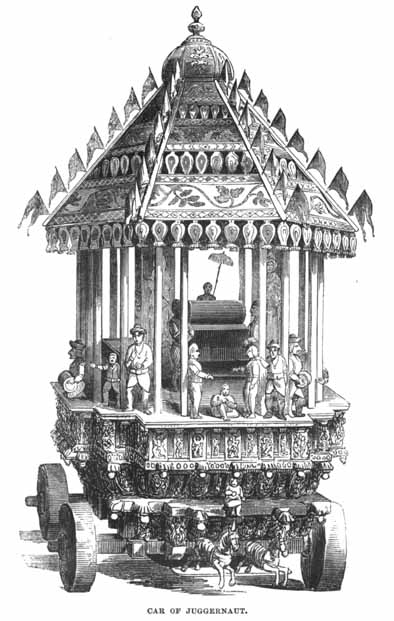
Chapel Hill News: Crushed by Council’s Jagganath

I commented Dec. 4th that the Lot #5 development juggernaut was powered by an all-consuming illogic I fully expected to crush rational opposition.

I wasn’t disappointed [VIDEO].

Echoing that sentiment, today’s Chapel Hill News speaks of a

“proposal…so big and had so much town involvement — Mayor Kevin Foy and council member Bill Strom have been its primary cheerleaders — that it has generated its own momentum.”

Private-public partnerships have and can be quite effective in promoting good policy on many fronts, but, unfortunately, land development is one that’s been subject to quite a bit of abuse.

Whether being consumed and co-opted by the process or willful ignorance, the landscape is rife with examples [thanks Molly, I miss you] of private interests implementing poor public policy – and a perversion of the public good in a rush to implement “sustainable economic development”.

By any objective standard, the ever quickening trajectory of this project has left judicicious public review in the dust:

When they unveiled the new version in November, the scale of the thing had dramatically shrunk — no more Wallace Deck project — although its cost remained just about the same, and the town’s financial stake had dramatically grown, from the original half-mil to $7.25 million. That’s more than a little tweak.

The project has been on a fast track ever since, and apparently will remain on one; the council agreed to move the project speedily through its review process.

Yep, the steamroller was shifted into higher gear last week.

The CHN shares my qualms:

The town is too closely bound to the project for our taste. Either retain the property and use it for truly public purposes — as a park, for example — or sell it to a private developer and be rigorous in reviewing whatever plans that developer proposes.

What can we do?

Contact our Council members (CONTACT) and let them know you don’t want to be steam-rolled by private interest.

Remember, Laurin Easthom and Jim Ward are fighting this proposal – Bill Strom and Kevin Foy are the most vocal boosters with Mark Kleinschmidt facilitating. Sally Greene, Cam Hill, Ed Harrison and Bill Thorpe support this “taking” to various degrees.

I’ll also be reporting on alternative modes of protest as they develop.

Beverly McIver’s Journey

[UPDATE:] N&O coverage, tip from enthusiastic fan Paul Jones’ post.

Used with the kind permission of
Beverly McIver

Renee

Artist Beverly McIver will be speaking tomorrow (Feb. 18th) from 2-3pm at Tyndall Galleries in Chapel Hill’s University Mall [MAP].

Beverly has documented her personal trajectory through autobiographical portraiture using an authentic and stylized approach – an approach and style I’ve watched develop for nearly two decades.

Local folks, like Paul Jones, have also been following this Greensboro artist’s NC successes.

Tomorrow is an excellent opportunity to hear Beverly’s reflections on life, art and “her role in a society that historically has marginalized minorities and women” (to requote Preview: The Magazine of the North Carolina Museum of Art, March/April 2006).

Further works.

Jon Wilner’s Shocking Culture

From the Chapel Hill News ‘blog OrangeChat, a guest post by Jon Wilner, executive director of the Carrboro ArtsCenter:

Culture Shock would be a vehicle for marketing the arts in our community in an attempt to create a destination for what the evening’s facilitator, Bill Flexner, called the “diamond in the rough.” The “diamond” refers to the four towns of Chapel Hill, Carrboro, Hillsborough, and Pittsboro.

The folks over on OP weighed in, with Ruby Sinreich reacting strongly to an N&O report titled “Area wants to cash in on arts assets.”

I had the same initial reaction. Wilner joined the fray with some illuminating commentary.

Chapel Hill has led the way on buying or commissioning art, like the notable $671,000 being spent on an out-of-town artist for Lot #5’s plaza, but we’ve lagged on support for hands-on art (more on that later).

The facilitator’s report on the first CultureShock gathering is available now from their website.

I’m just a Bill

Former Council member, occasional OP poster and Director of Bill Drafting for the North Carolina General Assembly since 1981, Gerry Cohen has a new ‘blog, NC Bill Drafting: 30 Years on Jones St., capturing the tug-n-pull of NC’s legislative tides.


What a great niche subject covered by a key player. For instance, he notes in this interesting post that 2007 is a banner year for legislative proposals – up over %40 since 2005.

Didn’t see that covered in the MSM. Thanks Gerry.

Here’s two other local legal ‘blogs that I like to read:

UNC Law prof Eric Muller’s Is That Legal – covering subjects as diverse as the WWII Japanese internment (which he’s an expert) to the near rescue of his great-Uncle Leopold from the Holocaust.

CreditSlips, which covers all things credit worthy. Their posts on payday lending, health-care related bankruptcy and credit in general are fascinating.

Both have educated me in areas I’d probably never stray to without the ‘blog-o-sphere.

I have a feeling Gerry’s ‘blog will be the same….