Category Archives: Government

Local Government

Hail to Our New Chief: Brian Curran Takes the Helm

[UPDATE:] Not 15 minutes went by before I got the chance to congratulate Chief Curran in person. He was making his rounds through the Northside neighborhood (I noticed him rolling around Town before – he doesn’t seem to be much of a desk jockey).

[ORIGINAL]

I’ve had an opportunity to meet Brian in a few different venues these last few months and my initial impression that he was a talented officer capable of leading our department through transitional times has only been strengthened.

When he was initially appointed to take Chief Jarvies position I did a little research and was impressed by the commitment he has shown our Town.

When Town Manager Roger Stancil cast a wide net seeking a new Chief, I was hoping that our own law enforcement folks would be considered fully. With the failure to secure Roger’s first choice (due to the candidate’s failure to pass a health exam), I was looking forward to a re-evaluation of our home team bench.

Today Roger announced the permanent appointment of Brian to Chief.

Concurrently, Roger set some specific goals that will keep Brian busy over the next couple years.

To: Mayor and Town Council
From: Roger L. Stancil, Town Manager
CC: Senior Management Team

Date: September 24, 2007

Subject: Appointment of Brian Curran as Police Chief

I am proud to appoint Brian Curran as the Chief of Police of the Town of Chapel Hill. This appointment is effective immediately.

Since April 1, 2006, when Chief Gregg Jarvies retired, Brian Curran has served as our Interim Chief. During that time, he has exhibited the qualities that our community said they wanted in a chief during a series of community focus groups. As I made my decision, I reviewed the notes of those focus groups carefully. The words they used describe the behaviors and characteristics I have seen in Brian: Fair, honest, well-rounded law enforcement experience, understanding Chapel Hill, experience with University relations, understanding of neighborhood needs and concerns, leads by example, decisive, team player, experience with managing large gatherings of people, ability to relate to everyone in the community, good manager, approachable.

Having seen those behaviors, I have decided Brian is the best person to lead our Police Department and become a part of the Town’s Senior Management Team as we work collaboratively to make Chapel Hill an even better place to live.

Brian has worked for the Town of Chapel Hill since 1982. He began work in the Parks and Recreation department. He then served as a non-sworn communications specialist with the Police Department before becoming a Public Safety Officer in 1987. He has served in various roles in the department that give him a broad view and an understanding of the department and the community. I have attached his resume for your information.

The process.

As stated above, I carefully reviewed the characteristics of a chief of police as stated by the various community, employee, management team and Town Council focus groups earlier this year. I also reviewed the matrix of leadership characteristics that evolved from those focus groups. I reviewed the remaining finalists in the original round of applications as well as the applications received since we readvertised the position in July. I assessed the behavior of Chief Curran since he became interim chief in April. I asked the interview panel from our assessment center, supplemented by other assessors, to interview him and provide feedback. Based on the behavior I observed in his interim role and the feedback from the interview panel, I determined that Brian has demonstrated the characteristics sought by our community and is the best person to lead our police department.

The charge.

I have charged Brian with the following goals:

  • Assess the department, involving our employees and the community to tell us what we are doing well and where we have opportunities for improvement.
  • Create a leadership development program for our officers and our non-sworn employees to develop our future leaders internally.
  • Take positive steps to create a diverse command and supervisory structure that represents the various cultural faces of Chapel Hill.
  • Expand the community policing efforts of the department so that community policing becomes a belief system within our department.
  • Take the lead in innovation and teamwork to find solutions to community issues.

I look forward to working with Chief Curran.

As so do I, Roger. I especially like the goals Roger has set our new chief. Community policing needs to be a reflexive ethic of our department. Developing AND RETAINING our young turks will serve the Town well over the next few decades. And working to encompass the diversity of our community should make our law enforcement officers task smoother.

Congratulations Chief Curran.

Software Freedom Day 2007

As long time readers know, I’ve been trying to get our Town to adopt free/open source software products for the last 6 years.

There’s been some success but not enough.

FOSS (free/open source software) is a low cost alternative to the Microsoft Monopoly (the Town could’ve saved between $500-700K by now if it had adopted some of the recommendations of the now defunct Technology Advisory Board). Beyond driving cost out of the process, many of these products use (heck, celebrate) open standards which will preserve our information assets over the long haul and prevent costly proprietary lock-in.

Tomorrow, the Carolina Open Source Initiative (COSI), an organization dedicated to promoting and supporting Open Source software, principles and practices at UNC-CH will sponsor Software Freedom Day 2007.

Check out their FAQ “to learn more about Open Source software, and why you should get involved!”

Thanks to UNC’s Free Culture folks for the tip.

Speakers and Participants

10am Max Spevack from Red Hat.

Max is the Fedora Project Leader

11am Amit Bhutani from DELL. Amit is a Sr. Linux Software Engineer

12, noon – Pam Sessoms, University Library

Pam will be giving a talk on how her team customized the Pidgin chat client for use by librarians at UNC-CH. Multiple librarians can seamlessly answer questions using the ‘davisrefdesk’ IM nickname, and evening questions can be routed to librarians at Duke and NCSU as part of the Night Owl chat feature. Such customization would not have been possible if Pidgin had not been released under an Open license.

12:45pm Mark Finkle of Mozilla.

Mark is a Platform Evangelist at Mozilla Corporation. His primary job is to make it easy for people to develop extensions for Firefox. He also provides support for developers building applications on XULRunner and embedding Gecko in native applications.

1:45 Joseph Mack of AustinTek

Joseph will be discussing the Linux Virtual Server for people who are unfamiliar with the project and for those who would like to get started but want some background.

I’ll be banging the drum, once again, this year for wider adoption of these technologies by the Town to improve service delivery, preserve our information assets, promote greater transparency in the governance process and DRIVE COST out of the system.

National Conversation on Climate Action: A Local Perspective

As I mentioned in my post “The Climate Heats Up AND The Mayor Has A Website?”, the Town is hosting an all day “conversation” on climate change (as part of our Town’s ongoing commitment to sustainability).

The program is sponsored by ICLEI US (Local Governments For Sustainability) and the local Chamber of Commerce’s “green” coordinating arm, Foundation for a Sustainable Community.

The advertisement on the Mayor’s (www.chapelhillmayorsoffice.com) website says the program is FREE but the link takes you to this Chamber of Commerce signup page that only lists an October 4th Sustainability Workshop costing $30 for non-members.

I’ve sent an email to Director Aaron Nelson asking for a clarification.

Here’s the program:

Speakers:

Part I:

  • Lyle Estill, Piedmont Biofuels (biodiesel, sustainable community design, sustainability movement)
  • David Lee, Bland Landscaping
  • Tobin Freid, Triangle Clean Cities Program
  • Eric Henry, T.S. Designs
  • Greg Overbeck, Chapel HIll Restaurant Group

Part II:

  • Kevin Foy, Mayor of the Town of Chapel Hill
  • Anne Waple, National Climatic Data Center, NESDIS
  • Cindy Pollock Shea, Director of UNC Sustainability of Office
  • Tom Jensen, North Carolina Sierra Club

Program:

Part I:

2007 Sustainability Workshop

Location: Town of Chapel Hill Public Library, 12:00 pm – 4 :00 pm

To register and see the Part I Workshop schedule click here

Part II:

2007 National Conversation on Climate Change

6:00-7:30 pm National Conversation on Climate Change Workshop

Program Agenda: TBA

This program is free and open to the public.

For additional information about this event please email the Mayor’s Office, crobustelli@townofchapelhill.org.

An interesting program, though it’s not clear from the schedule when or how the “conversation” will occur. We’ve had some great local success using an unconference format to stimulate, educate and inform the public on technical issues.

Maybe the evening program could be reserved for a “conversation” built around and directed by the attendees?

Carolina Innovation Center: Alexandria Equities, the Citizens Partner?

At yesterday’s UNC Board of Trustees meeting, the Carolina Innovation Center took center stage when Carolina North’s quarterback Jack Evans confirmed it as the first step in Carolina North’s development.

The center will be sited upon the recently vacated Chapel Hill municipal facility.

Jack has written a Sunday column for the Chapel Hill News, a sneak peek which has been published on their OrangeChat ‘blog.

I will be responding to his Q&A in more detail once the column is published.

As part of preparing to respond, I was doing background research on Alexandria Real Estate Equities, Inc., the private partner in this private-public partnership. Alexandria, as this Triangle Business Journal report notes will OWN and manage the facility.

What kind of partner in this public endeavor would Alexandria be?

If their website is any indication, not so open:

TERMS OF USE

The www.labspace.com World Wide Web site (the “Site”) is a copyrighted work belonging to Alexandria Real Estate Equities, Inc. (“Alexandria”) and its suppliers. Alexandria grants you the right to access and use the Site subject to the following terms and conditions (the “Terms of Use”). PLEASE READ THE TERMS OF USE CAREFULLY. BY ACCESSING THE SITE, YOU AGREE TO BE BOUND BY THE TERMS AND CONDITIONS BELOW. IF YOU DO NOT WISH TO BE BOUND BY THESE TERMS AND CONDITIONS, YOU MAY NOT ACCESS OR USE THIS SITE.

The FIRST thing one sees on the company’s website, http://www.labspace.com/, is their TERMS OF SERVICE asking you to bind yourself to their conditions.

If you read through the 1182 words, agree to the 12 legal clauses, you’re allowed in, bound, I guess, in virtual chains forged of legalese.

I’ve used the Internet before there was an Internet. I’ve learned a few things surfing the Web.

One thing I’ve learned? A company that throws legalistic mumbo-jumbo in your face and demands your acquiescence before entry is either woefully over-staffed with paranoid legal talent, in some kind of trouble, been burned by bad PR, has no sense of customer service or some kind of witches brew of all those reasons and more.

Maybe Alexandria just needs a ticket on the Cluetrain express?

Yes, there could be quite legitimate reasons for raising the Web wall but, at least based on this not so friendly “Howdy Do”, I have to wonder what kind of partner Alexandria will be….

UNC BOT Chairman Perry: Carolina North “…before it’s too late”

They say history has a way of repeating itself.

The trustees, led by new chairman and Chapel Hill developer Roger Perry, are full steam ahead on the project. Final trustee approval is expected in September, with a plan to be submitted to the town by the end of October.

“The time of talking about Carolina North is over,” Perry said. “It is time to do something. It is time to get it on the ground before it is too late.”

N&O report from today’s UNC Board of Trustees meeting..

No more “time for talking”. Does that mean that the July 31st Carolina North community outreach meeting is just for show?

[UPDATE:]

As some of you know, I try to attend many of the local meetings that influence public policy. To date, I’ve been to most every Carolina North community outreach stretching back to 2005. I attended several of the UNC-LAC meetings and have watched those and the ones I missed. Arguably, UNC’s BOT meetings are as important to setting local policy – a shame that they don’t release a video or audio record of their deliberations.

I have had an opportunity to hear a little bit more about this morning’s BOT meeting and it seems that the N&O missed a little nuance.

It appears Roger Perry was asking the UNC staff to stop talking and start moving. I don’t know if that makes much of a difference in how that negatively affects community input – same effect, twice removed – but at least it is more polite than telling the community to shut up and go away.

Again, I wish I could’ve attended to hear the BOT for myself. I wish UNC would make a timely online record – including publishing minutes – available so folks like myself don’t have to wade through others interpretations.

[ORIGINAL]

Two years ago, when I proposed a framework for a more collaborative process between UNC and our community to work through Carolina North’s issues, several local political insiders told me I was naive and acting the fool.

Sure, I knew the history of our Town’s interactions with the University – that any discussion would have to involve five distinct parties – our local elected leadership, UNC’s Moeser administration, UNC’s Board of Trustees, local activists and Carolina North’s promoters. No doubt, that’s a lot of folks to corral.

A few months after the 2005 election, UNC did create a new framework – the UNC Leadership Advisory Committee (UNC LAC) – comprised of many, not all, of the community elements I had proposed. At that time I threw what little political capital I had behind the new UNC LAC process calling on our elected leadership to leave history behind and begin anew.

Enthusiasm didn’t equal abandonment of common sense. I was quick to point out (“Chafing: Prevention and Treatment”) when UNC started to fall back on old habits.

One of those old habits was UNC’s Board of Trustees proclivity derailing, at the last minute, the careful negotiations between UNC’s administration and our local governments.

Over the last year, the BOT did show a few symptoms of using the LAC process more as a public relations smokescreen than a new start on a truly collaborative process. For instance, when they introduced a surprising and disappointing fixed timeline before the LAC had completed their primary discussions.

Concern about the BOT was not limited to those longtime citizen watchdogs who have been participating in UNC’s new community outreach process. Jack Evans, UNC’s leader on Carolina North, has expressed his frustration with the BOT commenting one time that the Board wasn’t interested in reading a 15 page summary of the projects guiding principles.

UNC’s Board of Trustees was definitely a wild-card but the inclusion of BOT member Roger Perry was supposed to make sure there would be no surprises.

Then again, Roger Perry has tried to shut down discussion before, as I noted last September after this HeraldSun 09/27/06 report

UNC trustee and local developer Roger Perry said his sense was that UW-Madison officials essentially tell the community that the university’s mission requires it to do a certain project, and then everyone goes to work on preventing negative impacts, without trying to stop the project in general.

He said he’d like to get to that point in Chapel Hill, and that it can be somewhat “insulting” when someone not connected to UNC says they really aren’t convinced the university needs to do what it says it needs to do.

I said then

Roger Perry and the rest of UNC’s Board of Trustees absolutely must address the glaring absence of any reasonable, documented, calculable return on investment before I, a single North Carolina citizen taxpayer, will be convinced of the soundness of their plans.

So, as of today, UNC has approved a building design without producing solid documentation on the taxpaying publics return on their investment. We have a firm start date but little firm understanding of the local fiscal, environmental and transit impacts.

And, as some suspected, we have evidence that UNC’s Board of Trustees are not, possibly never were, interested in working through these key issues with community participation.

[UPDATE:]

Carolina North, when fully developed, will rival today’s Hillsborough in size. I believe it will loom larger in environmental, social and economic terms.

Finally, as far as Roger, from what I’ve observed he is a patient man. Developers often are. If he’s frustrated with the pace, well, that’s forgivable. To use his new role to make haste, though, to an endpoint yet determined, well, that is neither prudent or supportable.

Rogers Road: Unify the Community with a Back To School Bash

There’s a thread over on OrangePolitics (“Historic Rogers Road Community Enhancement Plan Development and Monitoring Task Force “) covering the historic ills and vexations of the Rogers Road community.

I plan to discuss some of the comments in a future post but couldn’t pass up this request by Rev. Robert Campbell (who, thankfully, has recently joined that forum to bring his 34 years of Rogers Road experience to the local ‘blog-o-spheres attention).

The Faith Tabernacle Church will have its Back to School Bash on 08-11-07. We give out school supplies to school age children on this date. Drop off your donations at 8005 Rogers Road to show your support to unify this community as well as Orange County for this back to [school] bash is for [all] no matter where you are from.

Love can go far.

Robert Campbell
919-933-6210

As this recent Carrboro Citizen article (” Be it further resolved”) by Taylor Sisk reveals, Rev. Campbell is neither a stranger to the Rogers Road community

The sanctuary of the Faith Tabernacle Oasis of Love Church is certainly no refuge for Robert Campbell. Outreach is his calling. For 34 years, Rev. Campbell has been ministering to the needs of a finely knit community on and around Rogers Road of, as Campbell observes, “many faces, many skills.”

or a weak advocate for their cause

Campbell quickly became active in the community. He recalls that things “really escalated in the latter part of the ‘80s, right on into the middle part of the ‘90s, when they really began to start searching for another place to put a landfill, and we spent countless hours negotiating with the politicians—right here in this sanctuary. We had it set up where you had community members that were part of a fact-finding group that came up with ideas, that came up with things that the neighborhood wanted done.”

Tonight, responding to a series of comments, Rev. Campbell provided some context and then suggested how the Chapel Hill/Carrboro community can pitch in to help their neighbors (Rev. Campbell is new to this, I edited his comments slightly for clarity):

We do many things out on Rogers Road promoting the good will of this community. We do not sit back and do nothing.

The good neighbor program has not worked for this part of Chapel Hill. Rather all government agents have over looked this area when it comes to enhancement. Took pave roads some twenty plus years to come to this community. Municipal water – I will go as far as to say the municipality dropped the ball when Robert’s Assocation did the first development in this community.

Someone looked the other way – no water, no sewage, no sidewalks, no real insight for the future. And we are still making excuses. Let us do the right thing now. Let us help make Orange County a better place.

We are to be our brother keeper. Let us look one another in deed, let us be doers of the word and not just hearers and talkers. Let us work together.

With this said, the Faith Tabernacle Church will have its Back to School Bash on 08-11-07. We give out school supplies to school age children on this date. Drop off your donations at 8005 Rogers Road to show your support to unify this community as well as Orange County for this back to [school] bash is for [all] no matter where you are from.

Love can go far.

Robert Campbell
919 -933-6210
1711 Purefoy Dr.
Chapel Hill N.C. ,27516

Simple. Straightforward. Practical. I like it and, after a quick check with Robert to see what is needed most (the results I’ll post here), will be dropping some supplies by soon.

Unedited version follows:
Continue reading Rogers Road: Unify the Community with a Back To School Bash

Carolina North: Not So Innovative Location for the Innovation Center?

As I predicted (“Carolina North: What’s Next?”) last week, the Carrboro Citizen is reporting that UNC is prepared to move the Carolina North Innovation Center north of Estes to sit roughly on the Town’s former municipal services site.

Not a hard guess given UNC’s Jack Evans recent comments.

…one indication that the university is intent on the timetable is a related matter on the trustees agenda — the shift of a proposed site for an 80,000-square-foot Innovation Center from the south side of Estes Drive Extension to an area just off Municipal Drive near the Town of Chapel Hill’s former Public Works facility.

Earlier this month, Jack Evans, Carolina North’s executive director, said that the area would likely be in the very first phases of construction. In addition to being already cleared and served by utilities, the site also avoids a potential conflict over the closing of Horace Williams Airport. University officials have said they’d like to close the airport as soon as a new facility is ready for its Medical Air operations. But that idea has met resistance in the North Carolina General Assembly.

While the first 15-year phase of the Carolina North plans include using sections of the current airport runway near Martin Luther King Jr. Boulevard, the site for the innovations center is out of the way of the airport approach.

At the last community outreach session, the reported [PDF] size of the facility was 85,000 square/feet not 80,000 as the CarrboroCitizen reports. I’m not sure if there’s been a shift.


Click to Enlarge


What is the Carolina Innovation Center?

The Triangle Business Journal had this nice overview published May 18, 2007:

The University of North Carolina at Chapel Hill is working with a high-profile West Coast developer to build a business incubator near its proposed Carolina North campus that could put the university back in the market for venture capital.

Preliminary discussions between UNC officials and Pasadena, Calif.-based Alexandria Real Estate Equities have yielded a model for the proposed “Carolina Innovation Center” that would provide more than just office space for university spinoffs.

Alexandria CEO Joel Marcus says the center would round out traditional incubator resources such as office and laboratory space with on-site business and managerial experts and a cadre of investors ranging from local and national venture firms to the university itself.

In short, the Alexandria-owned facility[emph. CW] would act as a one-stop clearinghouse capable of matching top technology prospects flowing out of UNC’s research departments with the financial backing and expertise needed to keep a startup alive.

The UNC center would be modeled in large part on Accelerator Corp., a biotech incubator in Seattle completed by Alexandria in 2003. The private biotech development and investment incubator has attracted nearly $22 million in venture capital from blue chip investors such as Amgen Ventures, MPM Capital and Arch Venture Partners. So far, Accelerator Corp. has invested in five emerging biotech firms.

Mark Crowell, associate vice chancellor for business development and technology transfer at UNC, says the venture capital component of the Carolina Innovation Center could total as much as $25 million and would not be limited to life sciences startups. Pending receipt of a special use permit from the town of Chapel Hill to construct the incubator facility, Crowell says UNC could begin “paying visits” to potential investors as early as this fall.

“At the end of the day, we would like to go to four, five, six institutional investors, as well as make a presentation to (UNC’s endowment) management company” says Crowell. “I can’t imagine we wouldn’t visit every local fund.”

Crowell goes on to say

“This project is going to make a sound and create a smell that is going to be attractive to the venture capitalists,” he says. “It is an incredibly attractive way to introduce Carolina North to the community, and it’s really starting to gain momentum.”

Of course, the sounds and smells nearby neighborhoods are concerned with are not so attractive as the lure of big money is too UNC’s venture capital specialists.

I wonder if getting anywhere on Carolina North seems harder than running a sub 4-minute mile for former world record holder and current UNC vice chancellor for research and economic development Tony Waldrop:

Corporate funds are vital to filling the gap, but, with neither an incubator facility nor a research campus similar to NCSU’s Centennial Campus, those dollars are difficult to come by, says Tony Waldrop, UNC’s vice chancellor for research and economic development.

“Seventy percent of campuses have either a research park campus or an incubator, and here we are without either. It puts us at a disadvantage,” Waldrop says. “In terms of getting federal funding from the corporate sector for research, we have not competed with our peers.”

Centennial Campus envy once again?

Tomorrow’s UNC Board of Trustees’ meeting starts 8am at the Carolina Inn: floor plan and map.

The BOT agenda is here.

The Carolina North draft concept plan is item #8 on the following agenda.
Continue reading Carolina North: Not So Innovative Location for the Innovation Center?

Election 2007: Early Voting On The Move

Orange County Commissioner Mike Nelson reports that:

I have just been told that the Director of the Orange County Board of Elections is recommending that the one-stop, early voting site in Chapel Hill be moved from UNC to the Senior Center.

I’ll be checking into this. If true, this decision needs to be revisited. In the recent past, the UNC site has been extraordinarily popular with students, staff and folks who live and work near downtown Chapel Hill. It would be a real shame to make it harder for these folks to vote.

Mike, it would be more than a shame.

Since the early ’90’s I’ve concentrated my Get Out The Vote (GOTV) efforts on campus and the student population (not always so successful as evidenced by the municipal turnouts in ’99, ’01, ’03, ’05). The Morehead Planetarium has been a great location servicing not only the student community but folks working/living on and around campus.

The polling location at Morehead won’t be available due to construction but surely the Board of Elections and UNC can work out an alternative – maybe the lobby of UNC’s Memorial Hall? Besides being centrally located, like Morehead Planetarium, most everyone knows where Memorial Hall is located, some parking is available and folks working Downtown will still have easy access.

If not Memorial Hall, maybe the Student Center, the dining hall or some other public and well-trafficked area.

Unfortunately, the campus super-precinct I’ve long lobbied for will not be available this year either. Another shame it seems as if the bulk of my pre-election GOTV effort goes into identifying which of many precincts a person has to vote at…

The Elections Board

  • Billie J. Cox – Chair
  • Henry (Hank) Elkins, Jr. – Secretary
  • John J. Felten – Member

will be meeting next Tuesday, 4pm 4:00 pm at the board of election office 110 E. King Street in Hillsborough [MAP]
if you would like to personally weigh in.

You can contact Director of Elections Barry Garner here.

Or call or mail.

BOE contact information:

Board of Elections
110 E. King St
P.O. Box 220
Hillsborough, North Carolina 27278

Telephone: (919) 245-2350
Fax Number: 919-644-3318

Hours of Operation: Monday – Friday, 8:00 a.m. – 5:00 p.m.

June 6th’s Closed Council Session

As we wind down the planning for this fiscal year, Council’s deliberations take on a bit more gravitas, thus demand even more attention by the public.

As one might observe listening to last year’s Lot #5 closed negotiations ( “Downtown Development Initiative: Listen and Learn How Negotiations Went Awry”), going too long or waiting until to an eve of a decision without public participation or oversight does not serve the public interest.

Looking back through my recent notes, I didn’t find a reference to the purpose of this Wednesdays closed door Council session.

With the Lot #5 deal still a bit wobbly (now up 17 fold from $500K to $8.4M), disclosure that our just hired economic development officer was charged with embezzlement in 2003 (charges subsequently dropped), a probable $0.02 hike in town taxes and a raft of other issues before them, I would hope the Council takes more counsel and welcomes more public oversight as the year closes than try to wrestle with their problems out-of-sight.

With that in mind, I’ve asked for a clarification on the purpose of this Wednesday’s meeting.

Catherine, Roger,

Excuse me for asking both of you the same question, but I wasn’t quite sure whom to address
this question to.

What statutory reason is Council using to hold a closed session June 6th?

Our town’s website suggests it must be one of the following:

# Confidential information
# Consultations with an attorney
# Business location or expansion
# Real property acquisition
# Employment contracts
# Certain personnel matters
# Investigations

and that the specific reason for going to closed session have been adopted in an open session.

Quoting from our town’s website:

“The statute provides that a closed session may be held only on a motion adopted in open session by a majority of those present and voting. The motion must state the purpose set out in the statute that permits the closed session, such as “to consider matters relating to the location or expansion of industry.” In addition, two of the purposes require a more detailed motion. First, if the purpose is to discuss some matter that is confidential by law, the motion must cite the law that makes the matter confidential. For example, if an area authority meets to consider matters relating to a specific patient, the motion to go into closed session would have to cite G.S. 122C-52, the statute that makes patient information confidential. Second, if the purpose is to discuss pending litigation, the motion must identify the parties to the litigation.”

I couldn’t find a reference in my recent notes to indicate for what purpose this particular
closed session was being held, any information you can provide would be appreciated.

Thank you,

Will

If you’re interested in open meetings and the free flow of information from the governing to the governed, check out NC Open Government, an organization sponsored by some of the top press outlets in our state.

Here’s their two cents on closed meetings.

Municipal Networking: Eyes on the Road

[SPRING CLEANING]

I asked Town Manager Roger Stancil May 17th how the CCTV (closed-circuit TV) packaged in the Town’s first steps towards municipal networking (Municipal Networking:Could We Have a Little Less Big Brother?).

Roger and Kumar Neppalli, our Town’s traffic (and now streetlight) point person, both clarified the bullet item. The CCTVs will be used strictly for monitoring traffic flows.

Roger apologizes for taking 3 days to respond – which might seem strange if you dealt with Townhall before – but Roger has set a goal of improving the flow of information into the community, a refreshing change.

Thank you Roger and Kumar for a quick turnaround (now, if we can just get a 7 day warning on those Council agendas).

From: Roger Stancil
Sent: Mon 5/21/2007 4:27 PM
Subject: RE: Clarification on CCTV usage

I apologize for the delay in responding to you. The cameras are generally for monitoring intersections for traffic management purposes. I am sure it will be done in accordance with this community’s concern for privacy and policies that ensure privacy is not invaded. Thank you for your questions. By copy of this email, I will ask Kumar if he has additional information.

Roger

Roger L. Stancil
Town Manager
Town Manager’s Office
Town of Chapel Hill
405 Martin Luther King Jr Blvd
Chapel Hill, NC 27514-5705

Phone: (919) 968-2743
Fax: (919) 969-2063

Note: Mail sent to or received from the Town Manager is subject to publication under the provisions of the North Carolina public records law.

—-

Mr. Raymond,

Mr. Stancil is correct and the cameras are used strictly for the purpose of monitoring traffic and provide guidance to motorists using variable message signs. These cameras are similar to the traffic monitoring cameras on I-40. Privacy of the motorists and passengers are protected and the cameras will not be used for enforcement of traffic regulations such as speeding, signal violations.

I will find the State Policy for use of these cameras and will e-mail you. Thanks.

Kumar Neppalli
Engineering Services Manager
Ph: (919)969-5093

—–Original Message—–

Subject: Clarification on CCTV usage

Roger,

I notice that the use of CCTV was mentioned in this resolution: http://townhall.townofchapelhill.org/agendas/2007/05/21/4f/

Could you clarify where and for what use closed-circuit surveillance will be deployed in Chapel Hill?

I’m thrilled we’re making a smart tactical move to improve our information infrastructure. I’m
hoping that deployment and usage of CCTV, for whatever purpose, will be guided by a policy grounded in transparency and informed by a strong commitment to preserve our residents
privacy.

Thank you,

Will

The Power of Sorry

It’s been nearly a year since the General Assembly’s 1898 Wilmington Race Riot Commission released their 1898 Wilmington Race Riot Report.

Tonight, NPR’s Laura Leslie, over on Isaac Hunter’s Tavern reports:

State lawmakers made history today by unanimously (both chambers!) passing a resolution apologizing for their predecessors’ role in promulgating slavery in North Carolina.

Lawmakers from both sides of the aisle spent two and a half hours speaking in support of the apology…about their personal experiences with discrimination, about the bigger social issues at play in this apology, and about the hostile feedback they’ve received from some constituents who see the apology as a waste of time or worse.

House Majority Leader Hugh Holliman delivered a simple but jaw-dropping history lesson — three minutes on what the state should apologize for. You can hear it here.  It’s well worth the download time. 

One of the follow ups was from our eloquent North Carolina NAACP President Rev. William Barber:

…repentance doesn’t mean much unless you’re willing to back it up. 

You can read the NAACP’s full reaction here.

One of the State’s more powerful media outlets, the News and Observer, began to experience the “power of sorry” more than a year ago when they started to unravel former editor Josephus Daniels complicity (“1898 riot designed to disfranchise blacks”) in Wilmington’s terrible tragedy.

The paper’s Nov. 17th, 2006 coverage,The Ghosts of 1898 ,helmed by Oxford native Tim Tyson ( “Blood Done Sign My Name”) extended the amends.

In a week with several reminders of how far we’ve yet to go, the legislature’s unanimous “mea culpa” for their predecessors’ actions (or inactions) is more than welcomed.

Hazardous Consequences: A Report, a Rushed Decision, a Regrettable Day for Chapel Hill

The Chapel Hill News’ ‘blog OrangeChat first alerted me to the Town’s completion of the Lot #5 negotiations with RAM Development (more to come in the N&O).

The Town’s April 3rd news release celebrates what I believe will eventually be seen to be a rushed decision foisting a counter-productive, fiscally irresponsible obligation to construct expensive rental properties for out-of-town landlords on our citizen’s dime:

04/03/07 — The $75 million residential and retail complex to be constructed on Town-owned Parking Lot 5 in downtown Chapel Hill moves a step closer to reality. Town Manager Roger L. Stancil today concluded final negotiations and executed the development agreement with Ram Development Co.

April 3rd, 2007, a regrettable day in our Town’s history.

Why? According to our Town’s legal counsel, the only way now to back out of this troubled deal is to default. Default means difficult to defend lawsuits against our Town. Default means probable expensive judgments against our community. Default, after today, puts all our residents firmly on the hook for millions of dollars of expenditures.

The Council last month authorized the Manager to finalize negotiations and execute the agreement. The project will now follow the Town’s normal regulatory process for a Special Use Permit, including review by the Town’s advisory boards and commissions and a public hearing before the Council.

While they did authorize the Town Manager to proceed with negotiations, the Council also directed Roger Stancil to achieve certain goals – like a firm commitment to improve energy efficiency as per ASHRAE 90.1 20% efficiency standards and an increase on-site affordable housing parking.

Without the final modified agreement (not available this evening), it is not clear our Town Manager achieved these goals. Further, for the partial success reported – 5 additional on-site parking – the trade-offs required by RAM to get those spaces remains unknown.

Final negotiations centered on energy efficiency construction. Recognizing the importance of reducing the energy demand of buildings and dependence on energy from fossil fuels, the Council directed that the agreement require the design and construction of the project to meet a minimum 20 percent improvement in energy efficiency (as measured against standards established by the American Society of Heating, Refrigerating and Air-Conditioning Engineers – ASHRAE).

Again, the language of the announcement leaves it somewhat unclear, at least to me, if the commitment to the ASHRAE 90.1 %20 energy efficiency standard is measurably firm.

[UPDATE] From today’s N&O

As part of the final contract, Ram agreed to achieve an energy efficiency level 20 percent better than standards established by the American Society of Heating, Refrigerating and Air-Conditioning Engineers.

It appears the LEEDs trade-off discussed here was the key to ASHRAE acceptance. Of course, without the final contract before us it’s difficult to ascertain how compliance with ASHRAE or LEEDs will be measured.

The project will incorporate sustainable, “green” features that will result in at least 26 points under Leadership in Environment and Energy Design (LEED) standards, the equivalent minimum number of points for basic certification under the LEED system. The Council has established a Town-wide goal to reduce carbon dioxide emissions by 60 percent by 2050 through the Carbon Reduction Program.

Councilmember Sally Greene suggested trading the potentially expensive formal LEEDs review for simple compliance with the LEEDs basic certification goals. Councilmember Jim Ward countered that RAM Development’s assertion of compliance was insufficient – that the review process was a necessary element to achieving those goals. I lean more towards Sally on this with the proviso that a specific, standards-based methodology for measuring compliance outside of the LEEDs process be agreed upon prior to a final commitment (would’ve been nice to also pursue some of the AIA’s 2030 sustainability goals). Again, sans the modified agreement, it’s unclear whether any process for measuring LEEDs compliance is in place.

To the Town’s credit, the environmental reports I asked for in my Mar. 27 petition were provided as part of the announcement.

The completed environmental assessment report will be on the Town’s website.  The assessment detected no underground gasoline tanks, only limited sections of petroleum-impacted soil that will require remediation.

Timed too late for our talented citizens with expertise in geology and environmental remediation to influence Stancil’s decision, this coincident release demonstrates, once again, the ascendancy of clever political gamesmanship over good public policy.

This bit of Town PR vastly downplays the caveats and disclaimers the authors used:

The report’s findings are based on conditions that existed on the dates of ECS’s site visits and should not be relied upon to precisely represent conditions at any other time. ECS did not assess areas other than those discussed in the report.

The conclusions included in this report are based on: ECS’s observation of existing site conditions; our interpretation of site history and site usage information; and the results of a limited program of subsurface assessment, sample screening, and chemical testing. The concentration of contaminants ECS measured may not be representative of conditions between locations sampled. Be aware that conditions may change at any sampled or unsampled location as a function of time in response to natural conditions, chemical reactions, and/or other events.

Conclusions about site conditions under no circumstances comprise a warranty that conditions in all areas within the site and beneath structures are of the same quality as those sampled. Recognize, too, that contamination might exist in forms not indicated by the assessment ECS conducted.

April 2nd’s letter from ECS Carolinas, LLP concerning the “Phase II ESA and Limited Soil Delineation Report”, p. 2

Based on approximate measurements of the property boundary and sample locations, ECS estimates that approximately 8,600 cubic yards (~13,000 tons assuming 1.5 tons per cubic yard) of petroleum-impacted soil may be present at the site. This is a preliminary estimate only; the actual quantity of potentially impacted soils may vary based on conditions observed during soil excavation. [CW: EMPHASIS by ECS]

April 2nd’s letter from ECS Carolinas, LLP concerning the “Phase II ESA and Limited Soil Delineation Report”, p. 6

The concerns of the report’s authors are clear. What is left unsupported is the Town’s cost estimate.

The estimated cost of the clean-up will be $232,000. The Town will assume the costs for remediation, and the developer will fund the excavation.

So, RAM Development will pick up the tab for excavating 13,000 tons/8600 cubic yards of hazardous material and the Town will pay, I assume, to haul it safely off-site and dispose of it in an acceptable manner. Given the author’s caveats and the lack of discussion of hazardous material intrusions into the underlying bedrock, I’d like to see the analysis behind the $232,000 cost estimate.

Is it as solid as RAM Development’s Spring 2006 claim of a total $500,000 in public outlays? I hope not since a 15-fold increase in the environmental costs, similar to the 10 month increase from $500,000 to $7,425,000 for those 161 buried parking spaces, would be in the neighborhood of $3.5 million!

One notable improvement in our Town’s communications is a savvy ability to propagandize, making a gold-filled silk purse out of the hazardous waste sows ear by now trumpeting development on “brownfields”.

“Developing a project in downtown reflects Chapel Hill’s commitment to build on brownfields rather than greenfields in order to preserve our environment,” said Manager Roger L. Stancil. “Brownfields are properties where redevelopment or reuse can be complicated by the presence or potential presence of pollutants or contaminants from past use. Developing on greenfields is to build on undeveloped properties on the urban fringe, often farmland. Chapel Hill intends to keep the greenfields green.”

A month ago we weren’t supposed to worry about hazardous waste on Lot #5. Today it’s an asset.

There’s a lot of fertile “brown” in the “fields” lay bare by this announcement. Once again, the liabilities are down-played, the potential fiscal “surprises” ignored, the value of the project over-stated while the obligations continue to be heaped upon our citizens.

April 3rd, 2007, a regrettable day in Chapel Hill’s history.

A Matter of Process: Greenbridge and Council’s Devolving Standard of Public Review

I haven’t been reticent in my criticism of the process Council used recently to manage the approvals for Greenbridge, the environmental uber-project and possible end of the traditional Northside neighborhood. Adopting a new zone, TC-3, developed and refined during the months bridging Thanksgiving to Christmas, within the context of Greenbridge’s approval ill-served our citizens.

Claims, most notably by Bill Strom, that Greenbridge’s TC-3 is somehow unique (video coming soon) and folks won’t have to worry about another use will be tested all too soon.

Most of the Council members are aware of the public discussion and scrutiny of the 90′ limit and 1.97 density ratio. Unfortunately, the minimal opportunity citizens had to respond within the public hearing process didn’t reflect those hard learned lessons. Only two citizens spent any of their 3 minutes of public comment suggesting the impropriety of making a major change to Downtown’s future geography within the narrow context of Greenbridge. Doubling the density, raising the height limits by %30, with the SUP establishing a height precedent fully %50 above the previous 90′ will carry serious consequences for “human scale” Chapel Hill. Now that door has been opened, does anyone truly believe developers on our doorstep will not press for even more consequential change?

I recall Sally Greene, prior to being elected to Council, making numerous appearances before Council on OI-4 (the most probable zone for Carolina North) counseling not only greater public outreach but public education. She argued process, process, process and was obviously aware that a significant change in public policy demands a significant effort to build understanding.

Yes, the effort to build understanding can also build opposition. One might argue that the best “political” strategy “playing the approval game” is to keep your head down, limit public understanding and bull on through. Good strategy for a “player”, maybe, but terrible public policy.

Tonight, the Chapel Hill News’ breaks the story, on their ‘blog OrangeChat, that the son of one of our Council members sought to represent the developer of Greenbridge.

Sometime last fall, the son of Town Council member Bill Thorpe approached the developers of the Greenbridge condominium towers and offered to work as their public relations consultant.

Thorpe said his son, William Thorpe Jr., is a grown man and did not consult him before making the pitch.

UPDATE:
From today’s followup in the N&O

Thorpe said his son, William Thorpe Jr., is a grown man and did not consult him before approaching the developers. Thorpe said he only heard rumors that his son had asked for a $40,000 consulting fee.

“He was trying to get a contract with them, but I haven’t done anything with them,” Thorpe Sr. said this week. “It had nothing to do with me.”

Yes, we’ve seen our share of national problems with relatives representing interests before their elective relations but certainly this doesn’t rise to that level. Bill spoke of his son during the 2005 election, I don’t recall his saying he did PR. In any case, Bill made it clear his involvement was nothing to be troubled by: “I ain’t got nothing to hide,” Thorpe said this week. “I can tell you right now, I have not asked anybody for no money.”

[UPDATE] GeorgeC over on OPsays the Mayor and Attorney reviewed this, not the Council, yet the article and post both say “Foy said the council did not pursue the matter further…” Now, was that the Mayor using the royal “We” or did the Council know? I’ll ask either the reporter or a Council member next time I see them. If this was the Mayor acting as the lone “decider”, well, that’s a bit troubling in itself.

[ORIGINAL]
The Mayor and Council, it appears, reviewed the issue on discovering it:

Mayor Kevin Foy learned of the situation before a public hearing on the downtown condo project Jan. 17 and asked Town Attorney Ralph Karpinos for advice.

Foy said the council did not pursue the matter further because Thorpe Sr. was not personally involved. Foy said he believed that his colleague’s hands were clean in the matter.

That January 17th meeting was a key public hearing for Greenbridge.

This is most troubling. I can accept Bill Thorpe’s assertions about his son’s involvement. I can appreciate Council and (?) the Mayor responding immediately with a legal consultation and review.

What I can’t understand, and will not accept, is the absence of public disclosure.

Yes, the appearance of impropriety can sting. Trying to mitigate the possible embarrassment and pain of a friend and colleague is laudable. But these are public servants. Many of these Council members, one time or another, during elections or otherwise, have pledged to increase openness and transparency within our local governance. They (?) The mayor had an obligation to reveal, for Bill’s sake, in as tactful a fashion as possible, this story and not leave it to the 4th estate (Chapel Hill News)

The process of openness and transparency must be consistent to be reliable. The public trust demands and deserves disclosure.

And yet another lapse in judgment related to a development deal.

Lot #5 Development: Two Pictures 1,000 Words Apart

Looks like this will be the last Spring I watch these trees bloom…


and the last year I’ll see Chapel Hill’s Downtown signature church steeple from the second floor roost of where I work.


Cline Associates Concept Plan Drawing for Lot #5


Corner of Church St. and Frankin St., Chapel Hill, NC – Mar. 18th, 2007 [MAP]


Not quite “Where’s Waldo?” but, to twist a phrase from Sesame Street, one of these things is not like “reality”.


I remember when many of these trees were planted, have watched them develop over the years. I wonder how long I’ll remember their flowering? The memory of those wonderful gateway trees to University Square and along Franklin, since replaced by the green poles of the Church St. signal lights, are still firmly rooted in my mind, maybe these too will persist.

The HeraldSun Turns A Corner: Trouble on the horizon at lot 5

The HeraldSun’s editorial stance on Chapel Hill’s Lot #5 project has always been somewhat “peppy”.

Tom Jensen’s Chapel Hill Herald (CHH) columns have been singularly reflective of the papers ebullient attitude towards this troubled development. In spite of the narrowing scope – halving the size of the project – and escalating taxpayer commitments – keeping the cost the same, increasing the public outlay 15-fold, ignoring the potentially expensive hazardous waste remediation, discounting further cost increases – the message continued to be move forward at a reckless rate and let the details be damned.

Tom,a recent graduate of UNC, political insider, Sierra staffer and Chapel Hill Planning Board member looks forward to the day he can live Downtown:

On a personal note, one of the reasons I love this project is that I would like to live in it myself.

I don’t own a car and I commute by TTA to work in Raleigh every day. Lot 5 is about two minutes away from where I pick up the bus. It would be great to be able to walk right out of my house, catch the bus, and then come home at night and meet my daily needs within walking distance of my condo.

Right now there’s nowhere that meets both the niceness and affordability criteria I would need to see to live on Franklin or Rosemary Street.

Affordability, Tom, considering the $385-$415 per square foot price of the condos, is reserved for those qualifying for the affordable housing component. It might be tough to qualify if Councilmember Strom makes good on his statement that the bulk of these roughly 600 square foot affordable units will be used for families.

Today’s HeraldSun editorial takes a different, more cautionary tack.

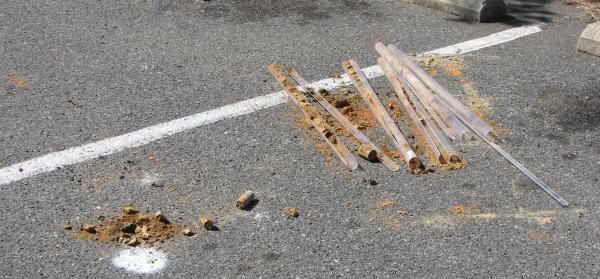
Let’s hope they don’t find anything. Let’s hope the environmental assessment, being undertaken this weekend, on downtown parking lot 5 shows no problems at all.

Because if it doesn’t, there are very serious consequences.

Yes, it would be nice to think there is no hazardous material to remove, but with at least one known gas station sited on that lot, it isn’t likely. Serious? The price tag could run into the millions.

And from what I observed this weekend, digging a deep parking deck just got a lot more expensive.

The editorial continues with this interesting assertion:

It is the linchpin for the town’s attempt to reinvigorate downtown, to bring more people to live by the community’s historic core, to create a market for downtown businesses and to make sure the area remains the vital, throbbing heart of Chapel Hill.

As I’ve mentioned before, this project lacks a “communal” center – something like a grocery store – to both serve the residents of the complex and to draw in the thousands of walking distance residents noted in recent cautionary testimony before Council. The commercial component seems oriented towards boutique shopping – Sunglass Huts and Jumba Juice – over sustaining, locally-owned concerns.

Because that goal is so important, the town has been willing to accept a far-less beneficial deal to develop lot 5. What once was an arrangement last year with the private developer that would have cost the town under $1 million, now may cost more than $7 million — and that price could be going up.

We have noted in the past in this space that on balance, the increased financial liability for the town still was worth it. The ultimate benefit — to downtown and the entire community — would offset the increased cost.

It is nice to see a bit of concern about the value returned being somewhat in the ballpark of the value given – even if the editorials numbers are off by a factor of 2 on the low-end. The original investment was $500,000 with a more restrictive land deal – increasing to today’s $7.3 million with a real-estate giveaway. And, of course, the $7.3M figure doesn’t incorporate the true value of the property – commercial real-estate folks have quoted $5-$13 million conservatively, the probable high costs of environmental remediation, the slew of new expensive consultants to manage our Town’s end of the deal and another round of predictable increases (like having to deal with a huge rock under the lot).

But if the consultants conducting the assessment this weekend find evidence of possible environmental contamination at the site — and previous consultants had, in fact, found that kind of evidence — the town, as the owner of the property, would have to pay for any cleanup needed.

There’s no telling, at this point, how much that could cost, but the price tag could be significant, in the millions. If it is, that could jeopardize the entire project. If it is, that probably should jeopardize the entire project.

The town cannot afford — either literally or figuratively — to put excessive sums down the deep hole being bored this weekend at lot 5. Let’s hope it doesn’t come to that, but if it does, the town should be ready to cut its losses and head in a different direction.

Absolutely correct. On the cusp of expanding the Lot #5 moneypit I hope the majority of our Council reassess our citizen’s liability – drops the current deal – totes up the “lessons well-learned” and starts again.