All posts by WillR

Feb. 19th: Busy Thursday

A couple meetings tonight that folks may want to check out.

First, a meeting on Northside and the corrosive effect burgeoning development, taxes and shrinking opportunities is having on that traditional community.

From today’s Herald-Sun:

Local activists united to address what they view as “historic discrimination, rising property taxes, and development that threaten communities of color in Chapel Hill” will share alternate visions for collaborative sustainability and social change at 6 tonight.

United with the Northside Community Now (UNC-NOW), St. Joseph C.M.E., NAACP, and EmPOWERment Inc. will host a community meeting at St. Joseph C.M.E. Church, 510 W. Rosemary St., to discuss the impact of local development on historically African American neighborhoods.

“It is important that we come together as a community to be the voice of righteousness and justice in the face of the injustice and racist environmentalism that is threatening our neighborhoods,” the Rev. Troy F. Harrison of St. Joseph C.M.E. said in a news release.

Second, at 7pm, the second Town-sponsored community outreach on the Carolina North development agreement.

A Public Input/Information Session on Carolina North will be held at 7 p.m. Thursday, Feb. 19, in the Chapel Hill Town Council Chambers of Town Hall, 405 Martin Luther King Jr. Boulevard.

Carolina North is a proposed satellite campus of UNC-Chapel Hill. It is expected to be contained within about 250 acres of the Horace Williams Tract’s 1,000 acres and be built in phases over the next 50 years, as proposed. The property lies just to the north of Estes Drive adjacent to Martin Luther King Jr. Boulevard.

The Thursday session will provide an update on the status of UNC-Chapel Hill’s
Carolina North plans and a description of issues being addressed by policy-makers and Town/University staffs. These issues include the following: design standards and public art; police/fire/EMS facilities and services; school site; recreation facilities; greenways, connections; historic, cultural features; stormwater management on site; water use and reclamation; energy conservation, carbon credits; Solid waste management; remediation of landfill; stream buffers; trees, landscaping; sedimentation; neighboring lands, compatibility, buffers; noise, lighting. A public comment period is scheduled.

This meeting will be aired live on Chapel Hill Government TV 18. Additional informational sessions on Carolina North have been scheduled for 1 to 5 p.m. March 4 and 7 to 9 p.m. April 1.

For more information, contact the Town of Chapel Hill Planning Department at (919) 968-2728 or carolinanorth@townofchapelhill.org.

Additional material is posted online at www.townofchapelhill.org/carolinanorth.

Tonight presents an excellent opportunity to not only get information but to help steer the discussion on what should be part of the development agreement which will codify the community’s expectations.

Easthom on Being a Good Councilmember

Laurin, a sitting member of the current Council ruminates this evening on what makes a good Mayor and Councilmember.

Public service is not a right, but a privilege. Holding public office can be one of the most rewarding experiences in life. Being a good mayor or a good council member certainly comes by trial and error and by experience itself. The bottom line is to never lose sight of what drew you to the position in the first place.

Laurin, a one-termer (so far), is up for re-election with Mark Kleinschmidt, Ed Harrison and recent appointee James Merritt.

With elections almost 8 months off it appears that the jockeying for position has begun.

More from Laurin here.

Multi-modal Design I Appreciate


Today’s Chapel Hill News carries an interesting story from Jesse DeConto on concerns circulating around the misfire (not to sugarcoat it) known as East54. The story, which was as much about how the “dense/tall growth at any cost” Council majority’s vision is running up against reality, as it was the anonymous “I could be in Atlanta or Charlotte” East54.

OK, even though I wasn’t thrilled with East/West Partner’s “virtualization” of Chapel Hill, I did credit them for committing to meet the Leadership in Energy and Environmental Design for Neighborhood Development (LEED-ND) standards (though Council wasn’t clear on what to do if the project didn’t meet those goals).

But does that justify such a pedestrian (to be nice) heap?

I expressed my concerns about the trade-offs – minimal setbacks, in-lieu monies instead of affordable square footage, height on Highway 54, traffic patterns, etc. – but was in the minority as the project sailed through an orchestrated “public review” (count me in as one of East/West developer Roger Perry’s “vocal minority” that unfortunately points out that the current sustainability political palaver is parading sans clothes).

Though the story tried to be balanced, it appears, as reported here to have raised the hackles of a few folks.

I understand the realities of today’s news media but I really wish the CHN had spent a bit more time using the “wayback machine” to contrast today’s political posturing from the more “veteran” of the Council folks (including those up for re-election) with what they stood for when they were more than happy to push East54 (and Woodmont) right on through based on a strange read of sustainability.

More on that later.

Bill Strom, following his usual strategy of playing to his “expertise” in transportation, said

“It’s a change in the development pattern, but the guiding principle there is that it is at a regional rail stop,” said Strom. “In order to get federal and state support for these projects, you have to have density organized in a way that promotes ridership.”

Yes, approval of that pile of nondescript architecture, looming over the Glen Lennox neighborhoods and serving as the “de facto” gateway to Chapel Hill, was justified by a rail stop coming sometime mid-century.

This is what passes nowadays for cogent analysis.

In any case, I’d rather leap off the train ala “Slumdog Millionaire” than alight on East54’s commercial doorstep.

Is there an alternative I believe is better?

Sure. Look east to Durham’s new multi-modal public transit station which will serve the Bull’s ballpark, the “white elephant” (Durham’s County jail), Downtown Durham and the American Tobacco complex. Downtown shopping, the Durham Performance Center and Theater, the Durham public library and Arts Guild is not that far away.

The glass heavy design (not sure the role environmental concerns played there) would not be fitting for Chapel Hill but every time I drive by the construction site (finishing this month) it seems like the unfolding design complements Durham’s retrofitted Downtown. Of course, like other Durham projects, the budget was blown – not unlike Chapel Hill’s Town Operations Center.

Central. Convenient. Complementary to its urban environment.

More on Durham’s multi-modal transit station backstory from the Urban Planet forums.

Orange County Voice Pushes Plan B

Orange County Voice, another Orange County organization working on the trash transfer site issue along side Preserve Rural Orange, has picked up on the Plan B options I have posted on as recently as last Fall (Trash Talk:Commissioner Gordon “No Plan B”).

Bonnie Hauser, Tony Blake, Susan Walser (recent editorial) and other members have done their homework, presented their cases both for cost effectively using existing local transfer services (one of the options I proposed to the Orange County Commissioners starting several years ago) to partnering with UNC on Waste To Energy facilities [OCV research].

Feb. 11th they renewed their call as reported by Mark Schultz in the Chapel Hill News.

The report says vendors charge $40 to $50 per ton to dispose of waste using existing facilities. Two vendors run waste transfer facilities in Durham and are willing to take Orange County’s waste on a monthly or yearly basis, the report says.

By contrast, the report says Orange County estimates it would cost $47 to $62 per ton to dispose of waste using a new county transfer station. The difference comes in the county’s spending too much to buy property, spending too much to build the facility and locating it in a rural area that lacks water and sewer services, according to Orange County Voice.

The Commissioner’s have opted to research (Herald Sun, Jan. 27th, 2009) alternatives to siting and building a new facility in the particularly troublesome proposed Hwy 54 locale. The race is on to see if common sense and a keen eye towards the future will win out over the current course of events.

Preserve Rural Orange: Greensboro Transfer Station Review

Watching the folks who formed PRO – Preserve Rural Orange – in response to UNC’s foray into airport building and Orange County’s crazy siting of the trash transfer station on Hwy. 54 has been encouraging. From a small group of concerned citizens, they have developed an activist organization that puts the “pro” in PRO.

These are long term issues but, so far, they’ve done a great job rallying other concerned folks from across the county to address these significant issues.

Here’s Laura Streitfeld’s report on yesterday’s visit to Greensboro’s waste transfer facility.

To read and listen to WCHL 1360 AM coverage of Orange County Commissioners’ visit to the Greensboro Waste Transfer
Station, click on the link below: WCHL report.

Visit to the Greensboro Waste Transfer Station

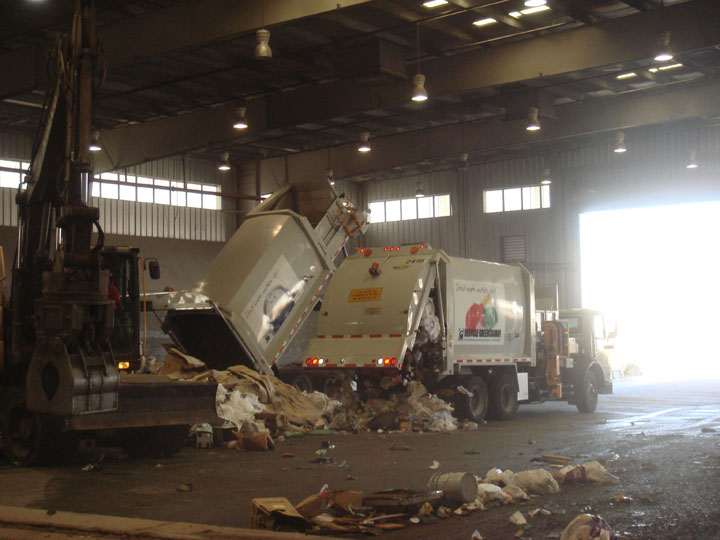
Yesterday morning I visited the City of Greensboro’s Waste Transfer Station, on a trip planned for new Orange County Commissioners. I rode in a van from Hillsborough with commissioners Pam Hemminger, Bernadette Pelissier and Steve Yuhasz, Orange County’s Solid Waste Director Gayle Wilson and Solid Waste Planner Blair Pollock, and reporters from the News and Observer, WCHL 1360 AM, and a student reporter and camera person from UNC. When we arrived at the station we were joined by Bonnie Hauser and Susan Walser of Orange County Voice and Forrest Covington, who is working on a video project with Bonnie Hauser. While at the site I took photos and video, and attached are two photos, one of a truck dumping trash inside the building and the other of trailers parked outside, with petroleum tanks in the background. Steve Yuhasz speaks with Jeri Covington in the second photo.

City of Greensboro Environmental Services Director Jeri Covington talked with us and answered questions about the city’s landfill and waste management history and the transfer station’s financing, construction and operations, then took us for a tour inside on the floor, where operations were slowed down for us to walk around. Like the proposed Orange County station, the two-story Greensboro station is entirely enclosed. Inside there was a thick dust in the air that clouded some of my photos, stirred up by the wind blowing in and by the constant motion of trucks and earthmoving equipment driving in and out, dumping and pushing trash across the floor. The smell was not as strong as I anticipated, but walking through the dusty interior I did get a vivid picture of how traffic, noise and airborne particles from an entire county’s waste would affect the ecosystem and watershed in southwest Orange County.

In selecting a site, Jeri Covington noted that they looked for property close to the interstate and near rail lines in an industrial zone. As we saw on our drive in, the station is close to an I-40 exit and and surrounded in all directions by petroleum tanks which Covington called “tank fields.” When it was built in 2005, the Greensboro facility’s cost of construction was $9 million, and the cost of the ten acre property, which Covington said was too small, was over $800,000. She described the station’s funding as a “hybrid,” explaining that they receive funds from city taxes and from tipping fees for taking trash from outside municipalities and companies. At the Greensboro station, garbage is dropped from the upper floor into tractor-trailers below and hauled to the Uwharrie Regional Landfill in Mt. Gilead, North Carolina.

The visit and the van ride were both informative. On the way to Greensboro I spoke with Pam Hemminger, and learned about her background, school board experience and new role as a commissioner. Riding back, Gayle Wilson and Blair Pollock shared their expertise on a broad array of waste management and recycling issues, answering Steve Yuhasz’s and my questions. Wilson discussed the future of the county’s collection centers on Bradshaw Quarry Road and Ferguson Road, one or both of which could close if a collection center were built on the Howell property near the proposed transfer station.

My purpose in visiting the station with the commissioners was to bring back information that would be useful to county residents. Photos, video and a description of the Greensboro station visit will be posted soon on the Preserve Rural Orange website. At our upcoming meeting on March 1st, I look forward to sharing more with you about recent developments in the waste transfer issue. Please feel free to contact me with questions or comments at: info@preserveruralorange.org

Who needs an argument?

As I was reminded recently, some folks can’t tell the difference between thoughtful disputation and just plain, ornery, contradiction. When I take a position contradictory to the established order, I always try to work from a reasoned basis. I also try to find the humor in what is sometimes a tense process.

Man: An argument is a connected series of statements intended to establish a proposition.
Other Man: No it isn’t!
Man: Yes it is! ’tisn’t just contradiction.
Other Man: Look, if I “argue” with you, I must take up a contrary position!
Man: Yes but it isn’t just saying ‘no it isn’t’.
Other Man: Yes it is!
Man: No it isn’t!
Other Man: Yes it is!
Man: No it isn’t!
Other Man: Yes it is!
Man: No it ISN’T! Argument is an intellectual process. Contradiction is just the automatic gainsaying of anything the other person says.

Funny stuff, easily applicable to real world issues. For instance, I’m looking for more reasoned debate on Carolina North and a little less reflexive contradiction.

Carolina North: Easthom – “Now is the time!”

Council member Laurin Easthom says “Now is the time” for the community to get involved with the planning for Carolina North.

Now is the time. Now is the time to comment on Carolina North, the largest development to ever hit the Town of Chapel Hill. The Town Council and UNC Trustees are meeting monthly to hash out a development agreement that will allow UNC flexibility and assurances in its development of Carolina North. If we come to an agreement by June on how Carolina North will develop, we may be done for years in decision making on how things are done. It’s time to wake up, and get active, and come to these meetings so that UNC can hear what you think.

Damn straight, especially if you serve on one of our Town’s advisory boards. The Carolina North train has left the station and is picking up speed, “Now” is definitely the time.

More here.

Trash Talk: Shall We Stand United? Rogers-Eubanks Community Says “Yes”!

I knew that the final siting of the solid waste transfer station might devolve into an “us vs. them” debacle – pitting neighbor against neighbor. Orange County is no stranger to inter-community bickering caused by waste-related issues.

From the beginning, as I made contact with leaders of various organized groups – the Rogers Road community, Hillsborough’s Orange County Community Awareness, Highway 54’s Orange County Voice – I asked that they look at those concerns they have in common and work together as a united front. Fortunately, the folks involved across the county, coming from different perspectives, have found common ground and, essentially, joined together to confront the challenge of managing our solid waste responsibly.

One example ? CEER’s Neloa Jones desire to mitigate community impacts as expressed in her Nov. 17th statement read to the Orange County Board of Commissioners:

Good evening Chairman Jacobs and Other Members of the Board.

My name is Neloa Jones. I am a resident of the Rogers-Eubanks Community, co-chair of the Coalition to End Environmental Racism (CEER), and a member of the Roger-Eubanks Neighborhood Association (RENA).

For 36 years, the Rogers-Eubanks Community has hosted two municipal solid waste landfills, two construction and demolition landfills, a hazardous waste collection site, a recyclables sorting and packaging facility, a mulch/compost site, and a 1/3 acre leachate pond that even the county believed threatened our groundwater.

For these reasons, my community certainly empathizes with ANY community that might also become a host community for solid waste, and I am here tonight to ask that the county GUARANTEE certain provisions and compensation to the community asked to host the waste transfer station.

As suggested in the U.S. EPA Waste Transfer Stations manual, these provisions and compensation might include independent third-party inspections and video monitoring of the facilities, eliminating 3R fees, “funding for road [and] utility improvements,” and “financial support for regulatory agencies to assist with facility oversight.”

Unfortunately, for its 36 years of service to the county, the Rogers-Eubanks Community has never received ANY compensation. We consider this treatment to be unjust and immoral; we do not want another community to receive similar treatment.

For many Rogers-Eubanks residents, our community represents the legacy of ex-slave ancestors who attempted to prosper as they established a community. It represents the legacy of ancestors who wanted to preserve the land to live on and pass to their children and their children’s children.

Our ancestors never envisioned a community blighted by pollution, deflated property values, and the loss of business opportunities. They never envisioned a community blighted by buzzards and vermin, the stench of garbage, and contaminated water. NO, as a member of the Rogers family–FIFTH-generation–I believe that this IS NOT what my ancestors envisioned. As CEER and RENA members, no, we cannot stand by and watch another community destroyed and its quality of life sacrificed. We hope the people of Orange County and our local governments will use the lessons of the past and probe their consciences so that they do what is right for Orange County. Finally, we should ensure that as we look to waste-to-energy and other waste disposal alternatives, we do not bring more technology and waste facilities to Eubanks Road.

Nov. 23: The History of Chapel Hill’s Dead Tree Media

The troubled News and Observer posted this reminder:

The Chapel Hill Historical Society will present The History of Print Media in Chapel Hill and Carrboro on Sunday from 3 to 5 p.m.

The featured speakers will be Don Evans, an editor and writer at The Chapel Hill News for three decades, and Kirk Ross, former managing editor of the Independent Weekly and co-founder of The Carrboro Citizen.

“Our event will look at the history of newspapers and print media in our towns and will surely spark a discussion about the future of newspapers here,” said Chapel Hill Historical Society Chairman Terry Barnett.

The program is free and open to the public and will be held in the lower level of the Chapel Hill Museum, 523 East Franklin St. Parking is available in the museum lot [MAP].

Chapel Hill has been blessed over the years with a variety of media outlets. Their evolutions and declines, reformations and restorations a harbinger of what comes next in journalism in the on-line age. Don’s (and formerly Kirk’s) Chapel Hill News has a ‘net presence via OrangeChat. Kirk is a pioneer – creating a newspaper, the Carrboro Citizen, on-line first then moving its content to the quaint dead tree distribution network.

Unfortunately I have a previous engagement on Sunday. This should be an interesting presentation where, I’m fairly sure, some curious back-stories of Chapel Hill will emerge.

Carolina North: Community needs to wake up and show up!

[UPDATE]

The Daily Tar Heel’s Emily Stephenson chimes in here (DTH ‘blogs). A story on yesterday’s poor turnout here.

[ORIGINAL]

Earlier today (Nov. 19th), UNC’s Board of Trustees approved the draft Carolina North design guidelines making the proposal official UNC policy.

This evening, the first in a series of informational/public feedback sessions on Carolina North was held. With the creation of the Carolina North development agreement well on its way, the Council’s explicit call to advisory boards to attend, if possible, and the aggressive schedule to meet next July’s commitment, I expected a fairly full house.

Crowded house? Not the case.

The meeting started with roughly two dozen citizens in attendance. By the time Jack wrapped his presentation covering UNC’s design intent the group of interested citizenry was down to 19. At the end of the Dr. Owen’s presentation, covering the development agreement process, only 17 non-staff/non-press folks remained. Of those, eleven were drawn from the “usual suspects” ( Fred Black, Joyce Brown, Fred Stang, David Godschalk, George Cianciolo, Lynne Kane, Mike Collins, Loren Hintz, Ed Harrison, Bob Henshaw, me).

Disappointing! As Carolina North’s development director Jack Evans noted this evening, the formal process for approval has begun. The first phase of Carolina North is on its way.

Chapel Hill residents need to wake up and show up.

Every resident will eventually be affected by Carolina North’s development. At least 5 advisory boards will be consulted on both the outline and details of the development agreement. Community groups like the Friends of Bolin Creek and Neighborhoods for Responsible Growth (well represented this evening) could play key roles in shaping the discussion.

There is quite a bit of work before the community. If we follow Pal Alto’s trajectory, the development agreement – which is, as Dr. Owens pointed out again this evening, essentially a binding legal contract – could swell to 200+ pages over the next 8 months (that’s 25 or more pages of detailed legal requirements per month – a heavy responsibility). Those pages will dictate development over a long period. Once set, unlike zoning ordinances, the ability to tweak conditions requires mutual agreement. Mistakes could be difficult to correct.

The community has a tremendous opportunity to shape the outcome at Carolina North. Both UNC and Chapel Hill’s Town Council agreed to involve the public at every point in the process. But, so far, Chapel Hill’s citizens have not turned out.

The negotiations between UNC and the Town will continue to accelerate. The momentum is building rapidly. My concern is that by the time citizens go into reactive-mode – recognizing missing elements in the plan, trying to wedge in protections beyond those outlined – the inertia will be too great and the time too short to significantly change course.

Now is the time for public concern. Now is the time for community involvement.

Because of the extensive impacts Carolina North will have on this community over the next several decades, I’ve asked Council to “bang the drum loudly”, to go beyond simply inviting the public into the process. We need to seek out folks, develop multiple avenues of engagement and draw them into the discussion. That said, at some point it comes down to whether our citizens want to shoulder their part of the burden and work on behalf of folks that will live here decades hence.

Community Oversight of the Planning Board

My previous posts tracking requests for information, feedback and general commentary to our Town staff and elected folks seem to be fairly popular.

I’m going to continue to post correspondence which might be of public interest.

The Town’s Technology Board (now defunct) was the first advisory board I regularly interacted with. The first meeting I attended was about six years ago (I was a lowly citizen then, not a member). I presented the group what I called a “technology manifesto” of proposed technology enhancements for the Town.

The “manifesto” outlined five major areas for improvement including cost saving initiatives, use of open source software, adoption of open standards, broadening community outreach via the Internet, tracking both the planning process and other relevant Town business processes, publishing Council and Town Manager emails, what is now called social networking sites for direct interaction between citizens and Town, WIFI to bridge the digital divide, public fiber infrastructure as an economic development differentiator, website accessibility, etc.

It was quite a list. The Technology Board seemed a bit stunned (or maybe bored) but, even so, they did me the courtesy of listening as I outlined my plan of action.

I continued working on those items when I became an official member of that board. Some of the initiatives have moved forward. Others languish. None have been completed.

One issue I brought forward was on-line video of Council and other important advisory board proceedings. Because of the sketchy minutes many advisory groups kept, I also wanted audio of all board proceedings.

When the Town lagged in their effort to put Council meetings on-line, I took it upon myself to upload (here) as many as possible. Finally the Town contracted with Granicus (which uses Microsoft’s proprietary technology) to do the same.

Now we have video (here) which is easily accessible for those folks running Winblows. Mac and Linux users are kind of cut out (see the problem with not using open standards?).

Anyway, long windup to another in a long line of re-requests. In this case, online video documenting the proceedings of our Planning Board (pretty common elsewhere, important when minutes lag Council approvals or don’t adequately capture debate).

Last week the cable-customer supported People’s Channel presented their annual report. As part of that report, they expressed an interest in doing more coverage of governmental events.

I sent this to the PC’s Director Chad Johnston Nov. 11th:

Hey Chad,

I’d like to follow up on Kevin’s comments last night.

I’m not sure if you are aware of my several year effort to get Council to broadcast advisory meetings, but I believe this is what Kevin was referring to.

In terms of priority, I have asked that the Planning Board be the first in line. As you know, the Planning Board’s decisions have significant impact on the community. Many other communities already broadcast their deliberations.

Do you think TPC could assist the Town in that effort?

Thanks

Here’s what I asked Mayor Foy the same day:

Kevin,

Since you brought the issue up last night. As you know, I’ve been calling for more extensive coverage of advisory board proceedings for years. Priority one, I believe, is broadcasting and posting video of all the Planning Board sessions. This is quite common elsewhere. Planning Board’s decisions have significant impact on the community. Beyond their process, which we could do a much better job explaining, zoning issues as a whole seem somewhat opaque to the wider community.

Televising their proceedings would go a long way towards involving our community at a point where their concerns can have the most impact.

I hope you will put this on a fast-track with Chad and company.

Thank you

To date I’ve had no response from either Chad or Kevin. I’ll update folks should I hear from them on what I think would be an excellent improvement to our governance process.

Chancellor Thorp on HWA Closure: Not until we have to…

UNC’s Chancellor Holden Thorp takes a postion (“Carolina North: A Glass Half-Full Perspective”) on Horace-William Airport’s closure.

One of the most vexing issues, though, has been the future of Horace Williams Airport. As you know, it occupies the heart of the Carolina North acreage. It’s the flattest part of the tract and, therefore, the best place to build Carolina North. So we have to close it.

Now, I realize it doesn’t take a lot of analysis to figure out that closing the airport is important for the future of Carolina North. But figuring out HOW to close the airport . . . that’s another story.

Ultimately, I think it comes down to this. The AHEC program is an extremely important asset to this University and to our state. Our doctors, nurses, other health professionals, and our MedAir pilots are as committed public servants as you will find. The work they do and the service they provide are fundamental to who we are as a university. And we are telling them that we have to close their airport to build Carolina North.

I have analyzed all the options, and I’m convinced that we really do have to close the airport to make Carolina North all that it must be. I’m equally convinced that we should fully support the airport authority authorized by the General Assembly as the best way to pursue creation of an airport in Orange County. It gives the county zoning authority, and it turns over the siting and development to a public body with greater expertise than we have.

For AHEC and MedAir, I think a move to RDU for the short-term is workable. But for the long-term, we owe it to our doctors to appoint the airport authority to see if there’s a better alternative.

We have said all along that we wouldn’t close Horace Williams Airport until we had to. With today’s challenging economic climate, we anticipate that funding for initial Carolina North construction likely will be delayed. Our state appropriation for planning and infrastructure for the Law School relocation to Carolina North is frozen, at least for now. And Alexandria Real Estate Equities, Inc., our partner for the Innovation Center, has put new projects on hold, although they have affirmed their interest in our project.

So, as I posted last night, the University maintains their stance that closure is contingent on Carolina North’s building projects moving forward.

I am disappointed that Holden continues to maintain that the only path to serving AHEC’s needs involves a new general aviation facility. This fixation makes no sense at this point and counters UNC’s own consultant’s recommendations to move AHEC to RDU.

Holden is “convinced that we should fully support the airport authority authorized by the General Assembly as the best way to pursue creation of an airport in Orange County. ”

Sure, the airport authority, with the sovereign powers the State granted it, is probably the best way to get an airport built in Orange County over local residents’ objections.

Where, though, is his concern for the Authority’s other duty – to factually justify the necessity of a general aviation facility? The Authority’s duty to “support the missions of the University of North Carolina at Chapel Hill or the University of North Carolina Health Care System” has to balance against the significant local impacts, the $60-100 million price tag, the infrastructure costs shoved onto local residents.

I applaud Holden’s willingness to engage the community in the discussion via his ‘blog. I wish other local officials took a lesson from him.

I already left him a comment on his post. I hope folks weigh in with their thoughtful and considered input.

Hat tip to Fred Black for highlighting Holden’s comments.

Comment Policy

Hey folks, thank you for reading my ‘blog.

I was getting a ton of comment spam over the last six months,so I had to restrict comments to those folks who registered. The latest WordPress has additional controls that should help throttle that nonsense.

I’m now relaxing CitizenWill’s commenting policy to encourage more reader involvement.

To comment, simply select a name and use a legitimate email address.

If you are new to CitizenWill, your first comment will require approval. After that, your comments will appear directly on the site.

Carolina North: Nov. 18th Meeting Notes

Tonight’s meeting (background) was well attended . Many of the folks attending were there to send the message “No Airport!”. Chapel Hill News reporter Eric Ferriri did a pretty good job covering that part of the meeting over at OrangeChat.

The Chancellor was missing in action. I think that is two of three meetings now.

The Council-Trustee sessions allocate two public comment periods, before and after the main meeting. Jim Ward, responding to tonight’s turnout, suggested doubling the time for public commentary from 10 to 20 minutes. I believe the 8 folks signed up had adequate time to get our points in (though I could easily spend a few hours going through the detail divergences in UNC’s proposals, ways to flesh out the development agreement, setting goals/metrics/methodologies to measure compliance, etc.).

After thanking staff for producing a nearly complete agenda a few days before this meeting (unlike the few hour lead times of the last two meetings), I took a few moments to ask some questions and add some suggestions to my earlier list.
Continue reading Carolina North: Nov. 18th Meeting Notes