Category Archives: ChapelHill

The Carrboro Channel: Streaming Video Tonight

Carrboro continues to beat lead Chapel Hill in innovation – whether it is Downtown music festivals, freely available Internet access or commitment to hands-on arts. In spite of the long effort by Chapel Hill’s now defunct Technology Board to bring video of public Council, Planning Board, forum, etc. meetings to the accessibility inhibited website, the Town is only now poised to deliver.

Carrboro isn’t waiting on us. From the Chapel Hill News timely ‘blog Orange Chat:

The town of Carrboro asks that viewers keep in mind there may be technical difficulties since it’s a test. Currently, only Microsoft Windows users will be able to watch the live stream.

You can connect to the stream at any time before or during the meeting by visiting the government page of the town of Carrboro’s Web site.

Meiling Arounnarath post Watch a live meeting, but not on the ‘tube’.

Now, longtime readers know I have a problem with using proprietary Microsoft-only technology for public records (Proprietary Public Policy: Chapel Hill Streaming Video Goes Live?) but I’m not worried – Carrboro’s IT staff generally hews to the open source way.

Lot #5 Development: “…up through the ground come a bubbling crude…”

Well, not quite “black gold” or “Texas tea” but it appears that more “refined trouble” is brewing under Lot #5 (MAP).

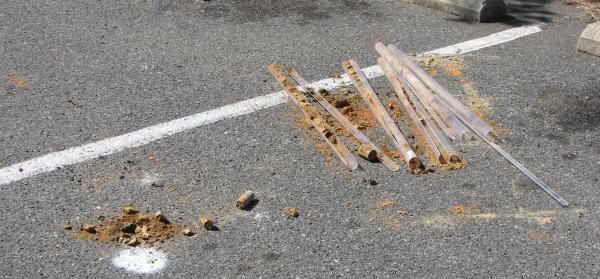
Chapel Hill’s taxpayers will have to wait for next week’s official lab confirmation but, as of today (Mar. 20th, 2007), initial field tests of some of the nearly 30 core samples show “interesting” signs of contamination.

Hazardous waste remediation involving the fractured geology below the lot could prove to be quite expensive – launching the total taxpayer commitment to just south of the $12.5 million of equity that RAM Development, the Town’s private partner, is contractually obliged to contribute.

Of course, RAM will easily recover their equity and make millions on the deal. The fine folks of Chapel Hill will get an expensive hole in the ground.


Folks started calling on the Council to pull their heads out of the sand and do this environmental assay over a year ago, well before entering final negotiations with RAM Development. Council members Jim Ward and Laurin Easthom, before voting against the Lot #5 proposal, strongly argued that the “known unknown” of contamination deserved evaluation before signing the deal.

Unfortunately, caution, that night, was overridden by the zeal for the deal.

Another expensive “known unknown” lurking in the wings has been the cost of digging two stories below Lot #5’s current grade. I work across Church St. and recall the difficulty the developers of my building had with “the ROCK”. “The ROCK” underneath Chapel Hill’s Downtown has been the bane of many a stalwart developer. UNC has spent millions over the last few years tussling with “the ROCK”.

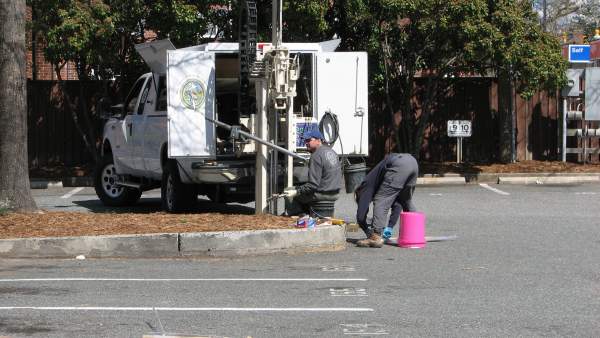
An incidental consequence of the technician’s drilling cores during this current environmental assay is a better understanding of the parking lot’s underlying geology. The optimism the Town showed – expecting to escape the vicissitudes of other Downtown developers – needs to be tempered by the measured reality of the last few days. It appears, again pending a final report, that “the ROCK” on the Franklin St. side of the lot is roughly 10′ below current grade tapering to 20′ on the Rosemary side.

If you live near Downtown, I suggest an early run to the store for ear plugs before blasting begins 😉

The HeraldSun Turns A Corner: Trouble on the horizon at lot 5

The HeraldSun’s editorial stance on Chapel Hill’s Lot #5 project has always been somewhat “peppy”.

Tom Jensen’s Chapel Hill Herald (CHH) columns have been singularly reflective of the papers ebullient attitude towards this troubled development. In spite of the narrowing scope – halving the size of the project – and escalating taxpayer commitments – keeping the cost the same, increasing the public outlay 15-fold, ignoring the potentially expensive hazardous waste remediation, discounting further cost increases – the message continued to be move forward at a reckless rate and let the details be damned.

Tom,a recent graduate of UNC, political insider, Sierra staffer and Chapel Hill Planning Board member looks forward to the day he can live Downtown:

On a personal note, one of the reasons I love this project is that I would like to live in it myself.

I don’t own a car and I commute by TTA to work in Raleigh every day. Lot 5 is about two minutes away from where I pick up the bus. It would be great to be able to walk right out of my house, catch the bus, and then come home at night and meet my daily needs within walking distance of my condo.

Right now there’s nowhere that meets both the niceness and affordability criteria I would need to see to live on Franklin or Rosemary Street.

Affordability, Tom, considering the $385-$415 per square foot price of the condos, is reserved for those qualifying for the affordable housing component. It might be tough to qualify if Councilmember Strom makes good on his statement that the bulk of these roughly 600 square foot affordable units will be used for families.

Today’s HeraldSun editorial takes a different, more cautionary tack.

Let’s hope they don’t find anything. Let’s hope the environmental assessment, being undertaken this weekend, on downtown parking lot 5 shows no problems at all.

Because if it doesn’t, there are very serious consequences.

Yes, it would be nice to think there is no hazardous material to remove, but with at least one known gas station sited on that lot, it isn’t likely. Serious? The price tag could run into the millions.

And from what I observed this weekend, digging a deep parking deck just got a lot more expensive.

The editorial continues with this interesting assertion:

It is the linchpin for the town’s attempt to reinvigorate downtown, to bring more people to live by the community’s historic core, to create a market for downtown businesses and to make sure the area remains the vital, throbbing heart of Chapel Hill.

As I’ve mentioned before, this project lacks a “communal” center – something like a grocery store – to both serve the residents of the complex and to draw in the thousands of walking distance residents noted in recent cautionary testimony before Council. The commercial component seems oriented towards boutique shopping – Sunglass Huts and Jumba Juice – over sustaining, locally-owned concerns.

Because that goal is so important, the town has been willing to accept a far-less beneficial deal to develop lot 5. What once was an arrangement last year with the private developer that would have cost the town under $1 million, now may cost more than $7 million — and that price could be going up.

We have noted in the past in this space that on balance, the increased financial liability for the town still was worth it. The ultimate benefit — to downtown and the entire community — would offset the increased cost.

It is nice to see a bit of concern about the value returned being somewhat in the ballpark of the value given – even if the editorials numbers are off by a factor of 2 on the low-end. The original investment was $500,000 with a more restrictive land deal – increasing to today’s $7.3 million with a real-estate giveaway. And, of course, the $7.3M figure doesn’t incorporate the true value of the property – commercial real-estate folks have quoted $5-$13 million conservatively, the probable high costs of environmental remediation, the slew of new expensive consultants to manage our Town’s end of the deal and another round of predictable increases (like having to deal with a huge rock under the lot).

But if the consultants conducting the assessment this weekend find evidence of possible environmental contamination at the site — and previous consultants had, in fact, found that kind of evidence — the town, as the owner of the property, would have to pay for any cleanup needed.

There’s no telling, at this point, how much that could cost, but the price tag could be significant, in the millions. If it is, that could jeopardize the entire project. If it is, that probably should jeopardize the entire project.

The town cannot afford — either literally or figuratively — to put excessive sums down the deep hole being bored this weekend at lot 5. Let’s hope it doesn’t come to that, but if it does, the town should be ready to cut its losses and head in a different direction.

Absolutely correct. On the cusp of expanding the Lot #5 moneypit I hope the majority of our Council reassess our citizen’s liability – drops the current deal – totes up the “lessons well-learned” and starts again.

Lincoln Arts Center: The Clock is Ticking

Nice summary of Chapel Hill’s Lincoln Arts Center’s problem locating a new home by Jesse James DeConto in today’s Chapel Hill News.

Sooner or later, the popular pottery program is going to have to leave its home at the Lincoln Center, the administrative office complex of the Chapel Hill-Carrboro City Schools on Merritt Mill Road. The school system is short on office space, and district officials have said that eventually they will have to reclaim the studio for offices and storage.

“The schools really do need this space at some point,” said studio manager Carmen Elliott. “They’ve been renting a lot of space for their workers.”

The studio has operated at the Lincoln Center for 30 years. The current lease will expire on Dec. 31. Elliott worries that losing the space will signal the end of the pottery program.

“It’s been a great, great place to be,” she said. “I’d really hate to see it fold.”

It has been more than two years since the incredibly loyal and enthusiastic Lincoln Arts Center family joined together to save this vital hands-on arts program. It has been more than a year ago that they presented one of the most moving citizen-led petitions I’ve ever witnessed to the Town’s Parks and Recreation Commission. And nearly as long ago that this band of dedicated art enthusiasts petitioned Council.

It has been nearly one year since the Chapel Hill News Editor Mark Shultz’s “Pottery Predicament”

Phyllis Swank’s latest sculpture looks like a cross between a heart and seashell, its waves inviting your fingers to gently grab hold. People have told her it looks like something from the ocean, but she hasn’t heard the heart reference before. She’s momentarily taken aback, because she was thinking about her nephew — who had been killed in an accident — when she molded it from a melon-sized piece of brown clay.

Schultz’s May 10,2006 Chapel Hill News editorial

Followed by last Fall’s renewed efforts to focus Council’s attention.

For all that upfront attention, this “little” program – having served 8500 young, old, autistic, rich, poor residents over 30 years – teeters on the edge.

Please contact our Council (CONTACT ) and let them know that hands-on arts is a vital to our community – that this unique 30-year old program deserves a new home in which to flourish.

Trash Talk: I Like Vinegar on My BBQ

The old Southern saying goes “You can catch more flies with honey than with vinegar.”

Then again, there’s nothing like a little vinegar or Tabasco to cut though the cloying fat of smoked BBQ.

An open e:mail to the Orange County Board of Commissioners:

On Tuesday evening, at the Orange County BOC meeting in Hillsborough it became glaringly apparent there was a complete failure of do diligence in the Waste Transfer Station site selection process. In fact there was no real process at all. Chairman Carey, 2 years of talking is not a process, it was just 2 years of talking and no basis for a decision.

Unfortunately if this failure is allowed to stand the people who will most directly carry the consequences and burden will be the working class African American community on Rogers Road, the same people who have carried the burden of the county’s landfill for 34 years. There is absolutely no way to deny that this failure to act professionally is in itself an act of environmental injustice. There is much irony in that Orange County is considered the most progressive county in North Carolina, and home to Senator Edwards and his Presidential Campaign which is centered around helping the “Other America”.

My anger was apparent at the meeting and still apparent in this e-mail, I make no apologies. I am not a politician or a policy wonk. Nor do I make a pretense of tactful persuasion. My wife’s parents lived their lives in north central Philadelphia and were 50 plus year members of the Zion Baptist Church which was led for many years my the late Reverend Leon Sullivan. When visiting my in-laws they would bring us to the church even though I am not a Christian. Listening to Reverend Sullivan was always an education and an inspiration. In my early twenties I remember Reverend Sullivan talking about personal integrity and professional integrity and that both were tied hand in hand. He told us that we can not claim to have one without the other. He was relating this concept from his involvement with American and international business executives and political leaders.

It became obvious in Tuesday’s meeting that the Waste Transfer siting process had , no professional integrity, no intellectual integrity, no moral or ethical integrity and formed no solid basis for any decision. Chairman Cary, in your e-mail response of 2/17/07 to my request of all the leaders of this community to take as stand on this issue, you said to quote:

“… it would be premature and unethical in my opinion for any elected official to respond to you as you have requested prior to considering all information which must be considered to make an informed decision on this matter.”

With all due respect, by calling for a vote on this issue on Tuesday you were violating your own stated ethical standard. It is clear The Orange County BOC nor anyone else for that matter has all the facts needed to make an informed decision. It is now in the open that the Orange County BOC has never directed anyone or any group to get all the facts.

It is also misleading that the BOC can only start “mitigation talks” to compensate the Rogers Road community after a site is chosen. The Rogers Road community has already earned that compensation through their 34 years of sacrifice. Why should they have to acquiesce to a Waste Transfer Station to receive compensation? Discussions can start whenever the BOC decides to do so.

It was also clear that Commissioner Foushee, Commissioner Jacobs and Commissioner Gordon were struggling with what they witnessed Tuesday night. Commissioner Foushee was the first to speak with eloquence and concern, articulating her distress on the deficiencies of the process to date. She expressed the desire to get this right. If an academic study were to be conducted on the right and wrong ways to site a waste facility as things currently stand Greensboro would be the case study of the right way and Orange County would be the contrasting case study on how get it all wrong. I am asking all the commissioners: Are you proud of where we are on this issue? Are you proud of how we got here? Is this an example of good governance?

If each of you abide the principle of tying personal and professional integrity together then you have no choice but to vote against siting the Waste Transfer Station on Eubanks Road. You have no choice but to restart the siting process.

David Richter

I published David’s earlier correspondence with Commissioner Moses Carey highlighting the lack of a systematic approach in selecting a waste transfer site. Since then, even knowing of this troubling deficit, Carey pushed for an immediate vote to solidify the choice of the Eubanks Road site.

But some sense prevailed during last week’s Orange County Board of Commissioner’s meeting as the other BOCC members responded to both the illogic of the current situation and to the many folks that showed up to ask for more prudence. They directed staff not only to do a more exhaustive evaluation but to incorporate a more multi-dimensional approach like the one I’ve previously suggested.

I’ve heard a few comments from folks that David is coming on a little too strong. I understand his passion.

The calculated lack of process was destined to produce one answer – an answer BOCC member Carey is obviously comfortable with – an answer extending the 34 years of ills the Rogers Road community has borne by decades.

That deficit is so glaring, the troubling consequences to the Rogers Road community so apparent, it is an injustice crying for redress.

And when the redress comes slowly, grudgingly, even a bit bitterly from our elected folk, well, a little bit of vinegar is quite excusable.

Lot #5 Downtown Development: Do you smell gas?

As we know, There are known knowns.
There are things we know we know.
We also know there are known unknowns.
That is to say we know there are some things We do not know.
But there are also unknown unknowns, the ones we don’t know we don’t know.

— Donanld Rumsfeld, Feb. 12, 2002, Department of Defense news briefing

Well we know that Rumsfeld was is a jackass.

What the majority of our Town Council didn’t want to know when they rushed forward on the Lot #5 juggernaut, was the extent of the hazardous waste remediation required to make the site suitable.

Oh, they knew that there had been at least one former gas station on-site.

And they knew that during a previous assay an environmental tech had taken an unauthorized sniff of the dirt that revealed gas fumes.

But rather than taking the prudent step of testing before committing to the Lot #5 boondoggle – making this all to known unknown known – to use a Rumsfeldian turn of phrase, the majority stuck their heads firmly in the sand and instructed the Town Manager to move ahead.

Kind of like Bush and Rumsfeld in Iraq. Jump first, measure the consequences later. And we know how effective that has been.

What’s the big deal?

Beside making a decision that has already undercut our Town’s moral authority to set the highest caliber of environmental standards it has exposed our taxpayers to a potentially stiff financial penalty.

The “rah rah” growth folks on Council like to say this ridiculously bad Lot #5 deal with RAM Development won’t cost the taxpayers one pretty cent – except for the hundreds of thousands for required consultants, disrupted city services, staff time, etc. – until the Town’s 161 parking spaces are complete.

The problem? Our taxpayers are on the hook for any hazardous waste remediation – remediation that will have to paid for now. The cost, considering the geology, could run into the multi-millions of dollars.

That’s millions of dollars out out of our taxpayers pockets, this year, for one huge mistake. Millions that won’t go to increasing our Town’s commitment to abating chronic homelessness or increasing social services. Millions that might mean the difference between having an aquatics center or losing our quality bond rating.

On a slightly positive note, it looks like some of our Council took my and others concerns to heart.

Most likely too late to squeeze of the deal without some kind of fiscal damage, Town is going ahead with the environmental assay they should’ve done first.

Good news? We’ll find out the broad outlines the environmental damage.

Bad news? We’ll have to start paying millions of dollars this year to cleanup the mess.

Worse news? If this initial assay isn’t done properly or is oriented to quell criticism rather than measure the extent of the true problem – well, the taxpayers of Chapel Hill better be prepared for the “death of a thousand cuts”. Not an unlikely scenario given RAM Development’s halving the scale of the project – keeping the cost roughly the same – and extracting a 15-fold greater financial commitment, $7.5 million so far, from the Town.

This cleanup, if it follows the trajectory of similar projects I’ve been part of, will probably cost quite a bit more than originally anticipated. It will be the gift that keeps on taking.

Hang on to your wallets folks, we’re in for a messy ride.

Parking Lot 5 to Close for Test Borings

The Town of Chapel Hill has hired a contractor to conduct environmental assessments of a site that is selected for a proposed $75 million three-section building complex combining condominiums, retail, and parking on Town-owned Parking Lot 5 in downtown Chapel Hill.

The environmental assessments, to be conducted by Environmental Consulting Services, Ltd. (ECS) will require closing the parking lot located between Franklin and Rosemary Streets at the intersection of Church Street.

Municipal Parking Lot 5 will be closed from 4 a.m. to 1 p.m. Saturday, March 17, from 6 a.m. to 9 p.m. Sunday, March 18, and 8 a.m. to 9 p.m. Tuesday, March 20. All vehicles must be removed. Accommodations will be made for individuals with leased parking spaces. Call the Town’s Parking Services Coordinator at 968-2835 for more information. Motorists may find available parking at the Rosemary Street Parking Deck, 150 E. Rosemary St., Municipal Lot 2 at 100 E. Rosemary St., or Municipal Lot 3 at 415 W. Franklin St.

The environmental assessment will include a geophysical study to determine if underground tanks are present, as well as up to 30 test borings of the soil. While the Town has conducted previous environmental studies, this week’s assessment will provide a more detailed examination of the soil conditions of the site. Engineers will evaluate and describe site hydrogeological conditions; determine the location, type and concentrations of contaminants; and determine the requirements for remedial action based on the applicable regulatory environmental guidelines.

Negotiations with Ram Development Co. are under way since the Council authorized Manager Roger L. Stancil on Feb. 12 to execute the development agreement. Issues for negotiation have included energy efficiency construction, parking for affordable housing, and environmental considerations. Reflecting its commitment to environmental stewardship, the Town has pursued additional information on the site’s environmental conditions as negotiations continue.

The Town has completed an earlier environmental assessment of the Parking Lot 5 site. Following this phase one study conducted by ECS on Aug. 18, 2004, engineers recommended a ground penetrating radar survey be performed to determine if underground storage tanks are located on the site. Next week’s survey will determine if such tanks are located on the site. ECS also performed work on Oct. 27, 2004, and April 13, 2005, for additional explorations to evaluate the depth to rock in Lot 5 as part of the design analysis for underground parking.

Citizens may review information on the Town website about the Downtown Economic Development Project at http://townhall.townofchapelhill.org/projects/dedi/

I’ll be looking forward to the timely release of these reports and plan to review them in detail.

I also will be calling on Council, as I have before, to stop any further movement on this project pending the results of these tests. To give our residents a chance to catchup and reflect on the consequences of “digging a deeper hole”.

Surely they deserve to know how much the hazardous waste remediation is going to cost before having their Council further the process.

My guess, based on the rushed, imprudent and unfortunate decisions the majority of Council have already made on this project, they won’t stop the juggernaut.

Lincoln Center Arts Program Needs a New Home

Karen Fisher’s Feb. 21st letter to the Chapel Hill News:

The Lincoln Arts Center has to find a new home or risk closing its door permanently. The Chapel Hill-Carrboro City Schools administrative offices will be expanding into the space that the Lincoln Arts Center pottery studio has leased for 30 years. Chapel Hill is in danger of losing this incredible self-supporting, community resource. All it needs to continue is a space adequate for hands-on artwork, preferably near a bus line.

The Lincoln Arts Center has provided classes for over 8,500 registered students. These students include school-aged children, senior citizens and all ages in between. The center serves students of all skill levels and abilities including students with special needs.

There is a sliding fee schedule that makes these classes accessible to citizens of many different income levels. Where else in Chapel Hill can such a diverse group of citizens find wonderful arts instruction and explore their own creativity?

There is no shortage of fine teachers and able assistants in the area, but where will they teach and inspire their students if the Lincoln Arts Center studio closes it doors? All other hand-on arts/pottery programs in the area are privately held and out of range for many of our citizens.

What does it say about our community if this program closes down for lack of space? Are we supporters of community-based arts? We certainly have some wonderful galleries and fine artists in our midst. Where else but at the community level do we nurture the creativity of our citizens?

Take action: Come to the next Chapel Hill Town Council Meeting on Monday at 7 p.m. and lend your support. A petition to find a new home for the Lincoln Arts Center will be presented at that meeting.

Take action: Write to Chapel Hill Mayor Kevin Foy (e-mail: kevinfoy@townofchapelhill.org or 405 Martin Luther King Jr. Blvd., Chapel Hill 27514 or telephone: 968-2714) and/or The Chapel Hill Town Council (e-mail: mayorandcouncil@townofchapelhill.org or 306 N. Columbia St., Chapel Hill 27516, telephone: 968-2845).

Absolutely eloquent Karen.

As of now (Mar. 16th, 2007) it appears that the Lincoln Arts Center is homeless and that this unique,self-supporting program is kaput by October unless Council finds it a new home.

I’ll be posting both those calls to save the only publicly supported hands-on arts program in Chapel Hill and further information as the story develops.

NCWARN to Shearon-Harris: Come on Baby Light My Fire! Not!

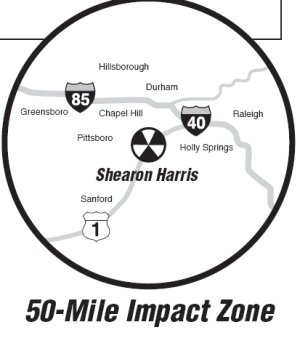
Following up on my Sep. 2006 post “Shearon-Harris Offline: Who tripped over the wire?”, the North Carolina Waste Awareness and Reduction Network (NCWARN) is holding another public hearing Mar. 22nd, 2007 on the 14 years of fire violations at the Shearon-Harris nuclear plant.

FIRE VIOLATIONS AT SHEARON HARRIS NUCLEAR PLANT


Thursday, March 22nd, 7pm
The Barn at Fearrington Village
Google MAP
NC WARN: (919) 416-5077, www.ncwarn.org
15-501 between Pittsboro & Chapel Hill

Public Hearing: New
Information on        legal action against the NRC
 Hosted by NC Senators Ellie Kinnaird and Janet Cowell, and other public officials

 (More on event…Click Here)[PDF]


(More on Harris Fire Violations…Click Here) 


What risks are posed by Harris’ 14 years of noncompliance with federal fire regulations?
Fire is a leading risk factor for nuclear meltdown. When will Harris be in compliance?
Implications of January’s NRC decision to rely on fire mitigation instead of defense against air attacks at US nuclear plants.

From NCWARN’s report:

Fire represents up to 50% of the risk for catastrophic accidents in the U.S. nuclear power industry. That risk calculation assumes fire regulations are being obeyed. Fire can cause operators to lose control of the nuclear reactor and its complex safety systems, leading to overheating of the reactor fuel and large releases of radioactivity. The U.S. Nuclear Regulatory Commission (NRC) has allowed the Shearon Harris Nuclear Plant in Wake County, NC, and others, to operate in clear violation of federal fire safety regulations put into place following a seven-hour fire at Alabama’s Browns Ferry plant in 1975, where only heroic action and sheer luck averted a catastrophic radiation accident.

Harris has been in violation of federal fire regulations since at least 1992, and ranks worst in the nation in at least two critical fire safety criteria. At Shearon Harris, commitments to correct the fire vulnerabilities have been made, then ignored, in a cycle of endless delay over the years, even as more violations continue to be discovered. A 2005 inspection became at least the 10th time Harris reported new violations, adding to a list totaling scores of unprotected components needed to safely shut down and cool the reactor in the event of a plant fire. Shearon Harris has already had several fires in its 19 years. One, called a “major fire” by an industry publication, was caused by an electrical short. It required 30 firefighters, and caused a plant outage lasting for weeks.

Trash Talk: Waste Not Methane, Want Not Energy – Additional SWAB Conversations

To try to get the conversation caught up to date (and put the notes in a format Google, Yahoo, etc. will index), I’m republishing the further conversations the Orange County Solid Waste Advisory Board (SWAB) has had on land fill gas utilization.

Current membership (as of January 2007) and contact list for the SWAB includes:

Contact List
Members
Name Representing Email Work # Home # FAX #
Jan Sassaman (Chair) Chapel Hill (A) janopus@nc.rr.com 933-1609    
Randolph Kabrick Chapel Hill (B) rkabrick@retec.com 484-2200 942-4062

484-8100
Albert F. Vickers Carrboro (B) alvickers@cleansites.com 656-5271 929-0502 929-0011
Linda Bowerman Carrboro (A)

lbowerman@mindspring.com

967-8571    
Vacant Hillsborough (A) Contact Donna Armbrister donna.armbrister@hillsboroughnc.org 732-1270 ext. 71    
Remus Smith Hillsborough (B)   732-3807 732-3807  
Bonnie Norwood Orange County (A)     967-4401  
Joe Clayton Orange County (B) jclayton@nc.rr.com 644-6981    
 
Commissioner Liaisons
Mike Nelson Board of County Commissioners mnelson@co.orange.nc.us      
Barry Jacobs Board of County Commissioners barry.j@mindspring.com 732-4941 732-4384 732-4486
 
UNC Liaison
B J Tipton UNC-CH btipton@fac.unc.edu 962-7251


962-8794
 
Staff
Rod Visser   rvisser@co.orange.nc.us 245-2308   644-3004
John Link   jlink@co.orange.nc.us 245-2300   644-3004
Gayle Wilson   gwilson@co.orange.nc.us 968-2885   932-2900
Blair Pollock   bpollock@co.orange.nc.us 968-2788   932-2900

From May 4th, 2006’s meeting [PDF]:

Landfill Gas

Wilson states that we are going to initiate a further study to examine two options for possible utilization of the landfill gas. One is to work with the University to determine if it is feasible [for use of the gas by the University] and if so what the economics would be of piping actual gas to Chapel Hill North. It’s probably not worth it if they’re not going to build anything there for six or seven years (as they will miss gas production peak). The other alternative is to consider providing energy for a cluster of government buildings on Eubanks Road, which would be the Animal Shelter, the Operations Center, possible transfer station and a school. In two to three months we’ll have that report and know if it’s a go or not. Economically an option with the University would make more sense and be less costly. They won’t have to worry about generating electricity, putting it on the grid, negotiating with Duke Power; they would clean up the gas a little and pipe it directly to a UNC boiler.

Sassaman asks what will be required for the collection system.

Spire states that [it will require] the wells, piping it altogether to a main header and depending how much it will have to be cleaned up, compressed and used to run a micro turbine or if we can clean it up less and put it in a pipeline to the University.

Wilson notes the industry is moving towards micro turbines and away from internal combustion engines which are noisier and tend to produce more emissions.

Smith asks what does a “well” look like?

Spire replies that a well is a hole dug into the trash that a PVC pipe is stuck into to draw the gas into using a vacuum pump. The wells are 18 to 24 inches in diameter. You can put a lot in and put lateral pipes to connect to vertical headers.

Wilson notes its likely gas will be extracted only from the south side, not the north side.

Spire notes that Greensboro’s landfill is already producing gas.

Norwood asks if there is anyway to gather information about the dangers of the installation?

Wilson states that it’s dangerous with a small “d”. It’s not like it is going to blow up 20 or 30 acres. It’s dangerous if you don’t know what you are doing. It’s possible that someone right next to the extraction point might be killed, but I don’t think it’s dangerous to the neighborhood.

Sassaman notes that this is not high-pressure pipeline gas. It is low-grade gas with moisture, CO2, other contaminants.

Pollock notes that the gas company does not want this gas in their pipeline.

From August 3, 2006 SWAB minutes:

Landfill Gas Study

Wilson states that the consultant is tentatively scheduled for the September 12th [BOCC] meeting to make a presentation on one half of the study that they are doing. They have been asked to do a study on providing energy for county facilities on Eubanks Road, which will potentially include a school, a new animal shelter, our operations center and possibly a transfer station. That part is done and will be presented at a future meeting. The other half of the study is to evaluate the feasibility of providing energy pipe line gas to Carolina North, the University facility. We have been instructed that before that study is done to meet with the University. We are in the process of setting up the meeting with the University.

Sassaman asks if the SWAB will get a chance to look at the study before it is presented on the 12th.
Wilson states that you are welcome to see the report.

The formal report was actually delayed (as reported by Wilson in October).

From the minutes of September 7th, 2006:

Landfill Gas Study

Wilson states that there is a landfill gas feasibility study looking at two potential possibilities. One is utilizing landfill gas to provide energy to a complex of local government facilities on Eubanks Road. That part of the study is complete.

The other option is providing energy to the University for their Chapel Hill North facility. That part of the study is underway. That report should be ready for the Commissioners in another month or so and will be shared with you all. The next step is once the report is complete the Commissioners will indicate a preference for one or the other and then the next step of more evaluation and measurement will happen.

Pollock asks if there will be consideration of making electricity but everything to be direct fire.

Wilson states that the University option is essentially cleaning up the gas and piping it directly to them. The other option has sub-options but is generating electricity.

From the minutes of October 5th, 2006:

Landfill Gas Study

Wilson states that I also met with Olver today regarding this project, regarding the option to power a cluster of local government facilities including school, Animal Shelter and our new facility on Eubanks Road or piping gas or generating power for Carolina North. The effectiveness of this is determined by when they will have something on the ground. If it is six or seven years out this is not a good option as we will be going down in gas production. Generally we’re venting gas; we flare gas from one wet well as there have been some special [odor] issues at that manhole. [CitizenWill: emphasis mine]

Kabrick asks is there a draft report.

Wilson replies not at this time. There are draft spreadsheets. The consultant is going to make some changes, take that to the University staff for comments and make a final report to BOCC and UNC and the BOCC will have to decide if they want to pursue one option or the other. The UNC option is break even, [the other is worse]. We can’t take advantage of the credits that a private developer could. The whole set of credits is complicated.

Kabrick asks if you have talked to UNC about the carbon reduction program that the Town has signed up for. This will be a good way to do something with greenhouse gases.

There might’ve been additional discussion post Nov. 2006 but those minutes are not online.

Side note: Minutes of meetings are an important source of information. A delay of months, especially in a discussion as critical as the trash transfer station, is unreasonable. That said, if the county staff are as overwhelmed by the workload as Chapel Hill’s Clerk’s office, then the delay is understandable – but not forgivable.

But it isn’t the folks doing the work that need forgiveness, it is the job of our elective officials, especially those banging their chest about transparent open governance, to provide sufficient manpower and resources to get the job done.

Given that, as a frequent consumer of our public records, and someone that thinks our diligent Clerk’s office needs more help, I’ll be asking Town Council this budget season to allocate sufficient resources for the timely production and publishing of written, audio and video records.

Trash Talk: Waste Not Methane, Want Not Energy, A Few Examples

I quoted in my post Trash Talk: 1 Megawatt of Waste Not Methane, Want Not Energy… a February, 2006 GeoTimes report titled Recovering Landfill Gas for Energy. Two of the authors, Amarjit Riat and Wayne Blake-Hedges work just North of us at Virginia’s Fairfax County I-95 landfill complex [MAP & INFO]:

Riat, a professional engineer, is chief of the I-95 Landfill Complex in Fairfax County in northern Virginia, and has 20 years of experience in construction and management of sanitary landfills. Blake-Hedges is senior engineering technician for the I-95 Landfill Complex, and has 16 years of experience in construction, operation and maintenance of landfill gas systems.

What struck me about this article was the breadth of experience Fairfax County developed in implementing their land fill gas recovery system – a system first implemented 17 years ago.

The landfill gas extraction system in Fairfax County started in 1989, to keep landfill gas from migrating offsite to a neighboring prison complex (Lorton Youth Center) and for future beneficial use of the gas. The original 27 exterior passive vents were converted to extraction wells, including seven interior extraction wells. The seven interior wells were meant to serve as enrichment wells, to ensure that the gas composition had enough methane to allow the gas to be burned in an incinerating flare. On startup of this system, the flow of gas was considerably greater than anticipated, with flows averaging 700 to 900 cubic feet per minute. The county awarded a contract for landfill gas utilization to Michigan Cogeneration Systems, Inc. (Michigan Cogen), in 1990, when it began construction of its first landfill gas-to-electricity plant. The plant went online in December 1991. This first plant utilized 1,150 cubic feet per minute of landfill gas to generate 3 megawatts of electricity for direct sale to Dominion Virginia Power, the local electrical utility. The plant houses four generator units, each capable of producing 800 kilowatts of electricity. Approximately 200 kilowatts are used by the plant, leaving a 3-megawatt net output. Subsequently, the I-95 landfill began expanding its landfill gas collection system and piping to deliver gas to the new landfill gas-to-electricity plant.

Building upon their initial success, Fairfax has expanded their utilization of recovered gas and continued to upgrade their facility as recently as 2005.

In 1992, Michigan Cogen began constructing a second 3-megawatt electrical generation facility. This plant became operational in January 1993, and is essentially identical to the first plant. Like the first, it is also solely fueled by landfill gas. This system consisted of 75 additional interior landfill gas extraction wells, 22 horizontal collection trenches and collection piping.

In May 1997, Michigan Cogen began operating its third landfill gas utilization project. This facility compresses the landfill gas into 10 pounds per square inch, removes the majority of moisture and then delivers the dry gas to the Noman Cole Pollution Control Plant for use in sludge incineration. In an afterburner process, the gas cleans up the emissions from sludge incineration.

This landfill gas replaces natural gas previously purchased from Washington Gas. Instead, pipelines deliver gas directly from the I-95 landfill to the Noman Cole Pollution Control Plant. Landfill gas utilization by the pollution control plant is extremely variable and is based on the amount of sludge incinerated and the moisture contained in the sludge, but averages between 300 to 1,400 cubic feet per minute.

In March 2005, five standard natural gas infrared heaters were retrofitted and installed in the maintenance building of the I-95 landfill. These units replaced two existing propane-fired forced air heaters and tapped the existing pipeline that delivers landfill gas to the Noman Cole wastewater facility. A simple treatment system was installed to remove any remaining moisture and contamination. After treatment, the gas is delivered to the heaters through a stainless steel piping system. The radiant heaters use a maximum of 30 cubic feet per minute of landfill gas.

An interesting factoid they present is that “A 1-megawatt electric power plant working on an internal combustion gas engine needs a sustained flow of about 350 standard cubic feet per minute of landfill gas.”

As I noted before, based on SWAB member Randy Kabrick’s 500,000 cubic feet of methane being out-gassed from our “older”, less productive landfill into the atmosphere daily, our county is currently wasting at least 1 megawatt of electrical generation capacity.

Worse, methane as a greenhouse gas is considered to be more harmful than CO2.

Methane is about 21 times more powerful at warming the atmosphere than carbon dioxide (CO2) by weight (see box below). Methane’s chemical lifetime in the atmosphere is approximately 12 years. Methane’s relatively short atmospheric lifetime, coupled with its potency as a greenhouse gas, makes it a candidate for mitigating global warming over the near-term (i.e., next 25 years or so).

EPA

Worse yet, the “21 times more powerful” is considered by some to be a gross underestimation as the NASA reports Methane’s Impacts on Climate Change May Be Twice Previous Estimates.

Of course, the benefits extend beyond displacing “outside the county” sources of energy and mitigating gas releases:

Using landfill gas for energy is a win-win opportunity. Landfill gas utilization projects involve citizens, nonprofit organizations, local governments and industry in sustainable community planning, and they create partnerships. These projects go hand in hand with community and corporate commitments to cleaner air, renewable energy, economic development, improved public welfare and safety, and reductions in greenhouse gas emissions.

Directly using landfill gas to offset the use of another fuel (natural gas, coal and oil) is occurring in about one-third of the currently operational projects. This direct use of landfill gas can be in a boiler, dryer, greenhouse or other thermal applications. Innovative direct uses include firing pottery and glass-blowing kilns; powering and heating greenhouses and an ice rink; and heating water for an aquaculture (fish farming) operation. Industries currently using landfill gas include auto manufacturing; food processing; pharmaceutical manufacturing; wastewater treatment; consumer electronics; and paper and steel production, just to name a few.

Generating energy through the landfill gas projects provides many environmental benefits. The projects assist in destroying methane, a potent heat-trapping gas, and offset the use of nonrenewable resources such as coal, natural gas and oil. They help reduce air pollution, and the landfill gas emitted from decomposing trash is a reliable and renewable fuel.

The benefits from the I-95 landfill project are approximately equal to any one of these: removal of emissions equivalent to 50,000 vehicles, planting 72,000 acres of forest, offsetting the use of 1,300 railcars of coal or powering 3,800 homes.

The technology is also cost-saving. The savings in fuel costs are approximately $500,000 annually from the landfill gas use at the Noman Cole Pollution Control Plant and $5,800 from use of landfill gas for heating the maintenance building at the I-95 landfill.

This from folks that have decades long experience with this technology. The complete Feb. 2006 GeoTimes article is here.

Trash Talk: 1 Megawatt of Waste Not Methane, Want Not Energy, April’s SWAB Report Reveals Opportunity

To flesh out my earlier post “Trash Talk: Waste Not Methane, Want Not Energy” here’s a few comments from the April 6th, 2006 Orange County Solid Waste Advisory Board (SWAB).

There’s a few inline comments demarcated by [CitizenWill:…].

Landfill Gas Preliminary Report (discussed after item 1)

Tipton [BJ Tipton – member ] states that other than what was in the newspaper I don’t know a lot about what is going on. I just wanted to get the update.

Wilson [Gayle Wilson – OC staff] states that a presentation was given at the Assembly of Government’s meeting March 30 regarding this. Back in 1997-98 an EPA representative, myself and another staff member met with UNC Energy Services officials who were in the process of designing a fourth boiler (at UNC) and that was when they decided to look at modifying the boiler to use landfill gas. The University never formally responded.

Over the years the use of landfill gas at Chapel Hill North has come up. Phil Barner of UNC facility services called at the end of October early November and stated as they were talking about Carolina North they wanted to know about using landfill gas. I explained that we had a consultant do a report and would be glad to send it to him. After the report was sent in February, I didn’t hear anymore about it until a couple of weeks ago.

Then we got a letter from Carolyn Efland at UNC about landfill gas.

Now there appears to be competing interest in landfill gas. Some of the Commissioners are interested, if it’s feasible, in powering the new Animal Shelter, a new elementary school to be developed on Eubanks Road, our Operations Center and possibly the transfer station. The University has some interest as well. We are in the process of discussing further work with our consultants to do an additional evaluation regarding each of those potential uses. We know that we have gas, but if Carolina North isn’t coming on line for another six or seven years it won’t be worth it.

There are no partners imminent, like next June.

Sassaman [Jan Sassaman – member] states that the gas would have to be used, you can’t store it.

[CitizenWill: Don’t understand this comment as the gas can be converted into methanol or liquid natural gas or propane, etc.]

Smith [Remus Smith – member] asks if the landfill was closed tomorrow how many years would it take to produce gas?

Wilson states that gas worthy of recovery – 12-15 years of time left.

Tipton states that the report talks about the flow.

Wilson states that there are two landfills. The old one on the north is down the [gas production; it started in 1972] curve. The one on the south side isn’t half way up the curve. It has some good stuff coming from it now, but it will not produce for a long period of time [because it’s small].

[CitizenWill: Below we find out this “good stuff” is being vented!]

Kabrick [Randy Kabrick – member] asks if it is being flared now?

Wilson states that we are passively venting it. We have one flare at a central point. I have been resistant in the past because I didn’t want to scare the neighbors lighting up the landfill like a birthday cake. Now we are going to take another look at it even though we are below the regulatory threshold for recovering it.

Kabrick estimates 500,000 cubic feet a day are vented.

[CitizenWill: 500,000/day is roughly 350 cubic feet per minute. This article from GeoTimes points out that “A 1-megawatt electric power plant working on an internal combustion gas engine needs a sustained flow of about 350 standard cubic feet per minute of landfill gas.” So, we’re pissing away from this small, old landfill 1 MEGAWATT of electrical generation capacity.]

Wilson notes that the biggest single cost of recovery is the network of piping that must be installed and for an active landfill it’s more difficult until it’s closed.

Spire [Paul Spire – staff] notes that there is no infrastructure for recovery on the south side now at all and there are problems with putting this gas into the pipeline; the gas company doesn’t want it.

Wilson notes that [unlike Duke Power] the gas company is not required to accept landfill gas.

Tipton asks when will this group take any action on this?

Wilson states that I plan to keep you all apprised of any reports. If you all have any input it would not be out of line to make a recommendation. You will be hearing more about it in the next six months.

As I noted above, we are currently venting from the smaller, older (1972) landfill enough gas to drive a 1 megawatt electric power plant. 1 megawatt of discarded capacity seems like a profligate waste to me.

Imagine what we could do with the “newer” landfill.

Imagine if we used fuel cells with land fill gas [PDF] instead of internal combustion (more expensive upfront but the lack of nasty byproducts make it worth considering).

Imagine if we positioned our county to be more self-sufficient, reduce dependence on Duke Power’s coal-fired misery and generate some positive cash flow to boot!

Is that the Orange County we live in?

iRack

Another back and forth between Orange County Democrats over the Iraq debacle, local Representative Price’s efforts to scale it back and the party’s local leadership communicating that effectively (OrangePolitics Art on Weaver and Nudge Price, No More War Funding).

On the cusp of Bush’s Iraq “surge” the moment has come for the Democratic Party, and our local Representative David Price (contact), to make a stand.

This far and no farther, if for no other reason than the selfish desire to preserve what shred of credibility remains with their party’s leadership.

As I noted, Iraq 2007 has been quite bloody for civilians as exemplified by these individual incidents:

  • 01/16/07 100 killed, 245 wounded
  • 01/22/07 75 killed, 160 wounded
  • 01/30/07 38 killed, 100 wounded
  • 02/01/07 60 killed, 150 wounded
  • 02/03/07 120 killed, 340 wounded
  • 02/12/07 90 killed, 190 wounded
  • 02/18/07 60 killed
  • 03/06/07 120 killed, 200 wounded

The coalition casualties continue to mount.

In Iraq:

There have been 3,451 coalition deaths — 3,193 Americans, two Australians, 134 Britons, 13 Bulgarians, six Danes, two Dutch, two Estonians, one Fijian, one Hungarian, 32 Italians, one Kazakh, three Latvian, 19 Poles, two Romanians, five Salvadoran, four Slovaks, 11 Spaniards, two Thai and 18 Ukrainians — in the war in Iraq as of March 12, 2007, according to a CNN count.

CNN

In Afghanistan:

There have been 536 coalition deaths — 367 Americans, one Australian, 52 Britons, 45 Canadians, three Danes, three Dutch, nine French, 18 Germans, nine Italians, one Norwegian, one Portuguese, four Romanians, one South Korean, 20 Spaniards, two Swedes — in the war on terror as of March 12, 2007, according to a CNN count. Below are the names of the soldiers, Marines, airmen and sailors whose deaths have been reported by their country’s governments. The troops died in support of the U.S.-led Operation Enduring Freedom or were part of the NATO-led International Security Assistance Force (ISAF) in Afghanistan.

CNN

Compromised beyond reason, the vastly weakened Democrat-sponsored legislation creeps through Congress.

Pelosi also fielded criticism from lawmakers for removing language from the bill barring military action against Iran without congressional approval. She said the issue would be addressed in future legislation.

“We’re having folks expressing every doubt, every reservation, every aspiration they have for this bill,” said Rep. Xavier Becerra, D-Calif., another supporter.

In a bid to broaden its appeal, leaders stripped the Iran requirement and omitted language favored by several liberal members that would have specifically prohibited funding of military operations after fall 2008.

While the liberals said this threat would help enforce the deadline, Democratic leaders viewed the politically charged language as unnecessary.

The measure provides nearly $100 billion for two wars, including more money than Bush had requested for operations in Afghanistan, and to address what Democrats called training and equipment shortages. House Republicans say they will work to sink the measure, and the White House threatens a veto.

USA Today

No withdrawal by 2008. No restrictions on an Iranian adventure. $100 billion for “readiness training and equipment” on top of the $540+ billion already ear-marked for 2007/2008 (this with the US already accounting for 48% of 2006’s total military spending).

Price should say “No deal”.

UNC’s Carolina North Lurches Ahead

[UPDATE] Allison Gunn posted the same notice over on OP, with this additional note:

“For further information about campaigns to alter the development, see the Friends of Bolin Creek website: www.bolincreek.org” .

Also, I contacted Tiffany Clarke to see if they could video the proceedings. She’s currently looking into that – maybe the folks at the People’s Channel could lend a hand?

[ORIGINAL]

I haven’t been posting much about UNC’s Carolina North project (note: new website:carolinanorth.unc.edu) but that doesn’t mean I haven’t been keeping an eye on recent developments.

For instance, reviewing in detail the Final Report of the UNC Leadership Advisory Committee [PDF] which will supposedly inform UNC’s development plans.

Of course, UNC might take advantage of Town Council’s recent leap from the environmental high ground, complete crushing of citizen’s concerns and rush to sprout 120′ to 135′ buildings Downtown to scale their plans upward (or downward in the environmental case).

The community will have an opportunity to review and comment on UNC’s vision over the next couple months starting March 27th (I’ll be in Nashville, unfortunately).

UNC’s outreach here is a notable improvement over years past – at least at the presentation level. It will be interesting to see how they incorporate the general community’s feedback as the project progresses.

Folks, the clock is ticking on this – the UNC Board of Trustee’s are rushing to a decision next October – so please weigh in now so our community can get the best result.

The University will host a new series of meetings about Carolina North for the campus and local communities on the last Tuesday of each month through May, beginning Tuesday, March 27.

You are invited to attend one of two sessions on March 27. The first session will be at 3:30 p.m., Room 2603, School of Government, Knapp-Sanders Building. The presentation will be repeated at 5:30 p.m. in the same location. Parking is available in the Highway 54 lot and Rams Head deck. The School of Government parking deck is available only for the 5:30 p.m. meeting.

University representatives will present potential uses of Carolina North and three conceptual approaches to its development. Attendees will have opportunities to ask questions and share comments. The feedback will help the university as it develops a concept plan for the UNC-owned property.

The conceptual plans that will be presented draw on the guiding principles developed by the Leadership Advisory Committee for Carolina North, an ecological assessment of the property and sustainability strategies.

At the same time the university is working on its plans, several supporting studies are under way or planned involving the campus and various government and community entities. Topics include transit, transportation and fiscal impact.

University officials believe Carolina North, the 900-plus-acre tract located about two miles north of the main campus in Chapel Hill, represents an unprecedented opportunity to develop a mixed-use academic community that will benefit the campus and the community.

The university’s Board of Trustees has directed the administration to submit a development plan for Carolina North to local governments by next October.

For more information about Carolina North, go to the website, http://carolinanorth.unc.edu.

Tiffany Clarke
Carolina North
304 South Building, Campus Box 4000
Chapel Hill, NC 27599-4000
Phone 919/843-2025
Fax 919/962-1476

Mar. 25th: Community Gang Awareness Presentation

“An ounce of prevention is better than a pound of cure.”

During last year’s WCHL 1360 [mp3] forum I suggested our community would be better served by allocating our tight police resources more to gang awareness and remediation than parading (or Segwaying) up and down Franklin St.

Sometime soon after thhe Police Department was awarded a $37,482 grant from the Governor’s Crime Commission to address gang activity. The Town matched the grant with an additional $12,494. The funds were to be used “to pay overtime costs for additional patrols in the downtown district and residential neighborhoods that have experienced gang-related activity.” Further, “officers will receive additional training in gang recognition, and will use this knowledge to deliver awareness materials to local schools and community groups.”

When I learned from one of our local law enforcement leaders that the funds didn’t cover all the attendant expenses, I asked one of our elective leaders to look into boosting the fund by $15,000. That didn’t happen but I believe additional funds are forthcoming in this year’s budget (I’ll keep an eye out as the budget develops).

As far as community education, Officer Mitch McKinney, of the CHPD, will present a gang awareness seminar this Mar. 25th.

“Forewarned is forearmed”.

The Town of Chapel Hill, Sunrise Rotary, and the Chapel Hill/Carrboro YMCA are sponsoring a gang information presentation from 1:30 to 5 p.m. Sunday, March 25, in the auditorium at East Chapel Hill High School.

This presentation will include an informative session on the status of gang activity in our community and will feature prevention strategies for parents and caregivers. The featured presenter is Officer Mitch McKinney of the Chapel Hill Police Department. Officer McKinney has attended extensive training on gang activity and is a popular presenter on the subject.

Representatives from a variety of area youth-services providers will be on hand to answer questions about their programs and to distribute information.

The Community Gang Awareness Presentation is free and everyone is welcome. Light refreshments will be offered.

You can learn more at www.chcymca.org.

For more information contact Officer McKinney at 919-968-2760 or mmckinney@townofchapelhill.org.

Municipal Networking: St. Cloud Soars Above Chapel Hill

As longtime readers and local voters know, I’m a strong advocate for bringing community-owned information infrastructure to Chapel Hill. Simply, to create a truly free new Town Commons benefiting our citizenry.

I’ve been working the issue now for over three years – banging the drum of strategic economic stimulus, social improvement – bridging the “digital divide” – and governmental innovation.

Local naysayers, like Councilmembers Strom and Kleinschmidt, continue, at least for now, to impede a tactical approach to building up Chapel Hill’s information infrastructure.

I’m a results oriented guy. I like to think that these folks, when faced with success after success, will eventually join in and seize this cost effective opportunity to kick start a key economic driver for Chapel Hill’s healthy future.

To that end, I’ve provided example after example, here and abroad of how a municipal network catalyzes a community’s innovative drive.

Two years ago I started talking about St. Cloud, Florida’s plan to provide free and ubiquitous connectivity to their community of 8,500 households.

Sep. 11, 2006, just prior to asking Council, again, to get the muni-networking ball rolling, I posted on St. Cloud’s wildly successful six month anniversary (Municipal Wifi: St. Cloud on Cloud Nine).

“So let the naysayers and talking heads let fly, but the little secret that is secret no more is that the results of a carefully planned and deployed municipally owned system delivered free to the citizens as a public service is actually the most successful, beneficial and effective model in existence.”

So says Jonathan Baltuch, who help found MRI, a consultancy specializing in planning economic development strategies for municipalities.

March 6th, 2007 marked St. Clouds’ community-owned network’s first year anniversary.

How are they doing?

MuniWireless says One year later, St. Cloud citywide Wi-Fi network shows impressive results:

St. Cloud, Florida’s network has received so much press because it is one of the few city-funded, city-owned networks in the US and it provides free Internet access to residents and businesses. Although the city owns the network, it has outsourced operations and maintenance to HP.

Jonathan Baltuch, founder of MRI, the consultant to the city, says: It is therefore fitting that at this year’s Muniwireless conference in Dallas the Cyber Spot celebrates its first anniversary on March 5, 2007. Being a pioneer with the first municipal owned system of its kind (although dozens of other communities are following suit), the Cyber Spot was immediately the subject of attack by the incumbents who were terrified by the prospect of communities taking back their digital rights. All throughout this year, while rumors and misinformation flew across the net fueled by various dubious sources, St. Cloud went about its business of providing its citizens with a premium quality service that saved the residents millions of dollars, eliminated the digital divide and created economic, educational and social opportunities for the citizens of the community.

Another by-product of this effort is that the city collected a comprehensive database of real world statistics and system information on the network.

Baltuch adds: The uptake rate of 77% is impressive when you consider that fee-based networks are attempting to reach uptake rates of about 20%. Incumbent broadband providers of cable and DSL rarely break 30% in any area after many years in the market. If the goal is true digital inclusion then reaching 20% – 30% in a community is unacceptable. This is why municipalities should be directly involved in providing this alternative service, hopefully for free, but at minimum for an extremely low cost.

Indeed, those who say that a municipally owned broadband network can never deliver good service are simply wrong. Many of the critics of municipally owned broadband mischaracterize the networks as being run by city employees who have no experience in delivering broadband service. In reality, most cities that fund and own the network, outsource the deployment, operations and maintenance to private companies. St. Cloud’s partner is HP.

At the end of 2006, Novarum, an independent wireless testing company, surveyed cellular and Wi-Fi broadband networks across the US. They ranked St. Cloud’s network no. 1 (and the only one with 100% service availability) ahead of Sprint, Verizon, AT&T, Earthlink and many others.

Why St. Cloud must be breaking the bank to provide this level of service! Afraid not:

The Capital expense was funded through the local economic development fund. The annual operational expenses are funded through the internal savings to City operations, which exceed the annual cost of operations.

That is the same argument local advocates have been making all along.

We could’ve been St. Cloud. We could’ve, and can still be, a competitive contender in the networked world.

You think Chapel Hill is safe? St. Cloud is in Florida – too far away to snatch North Carolina mind share.

As reported in today’s MuniWireless Greenville, North Carolina rolls out downtown Wi-Fi hotzone

The size of the coverage area is 1.3 square miles (3.3 square kilometers). It encompasses City Hall and the Pitt County Courthouse. This area is home to many businesses and the town commons where concerts are held in the spring and summer.

If the city decides to roll out a network that covers the entire community the area of coverage will be 31 square miles (80 square kilometers), and the initial cost estimate is approximately $2.5 million. The cost of the test bed is $51,000. It utilizes an existing Internet connection of 6mb down and 1mb up. The systems integrator/ISP is WindChannel out of Raleigh, NC and they are installing a Nortel Networks solution using 7220 access points and a 7250 centralized controller.

Greenville.
North Carolina.
Home of East Carolina University.

Eating Chapel Hill’s lunch.