Category Archives: OrangeCounty

Airport Authority: They Did What?

Here’s the specific sub-section of Senate Bill 1925 authorizing the creation of the Airport Authority.

The heart-rending bit, at least to me, is 116‑274, “General powers.”

(a) An authority created under this Article has all powers that a city or county has under Articles 1 through 7 of Chapter 63 of the General Statutes and, in regard to financing capital expenditures and operations, shall have such powers as are delegated to or conferred upon the constituent institutions or the University of North Carolina Health Care System. Notwithstanding other provisions of law, both regulations adopted by an authority under this Article and development regulations adopted by a county or municipality under Article 18 of Chapter 153A or Article 19 of Chapter 160A of the General Statutes shall be applicable to land owned by and the approaches to land owned by an authority created under this Article. In the event the regulations conflict, the more restrictive regulation applies.

UNC-CH has been granted sovereign powers normally reserved to municipalities. Setting this precedent, even in what appears to be the constrained case of building an airport to support NC-AHEC, carries terrible portent.

PART IV. ALLOW THE UNIVERSITY OF NORTH CAROLINA TO CREATE AN AIRPORT AUTHORITY

The rest after the fold:

Continue reading Airport Authority: They Did What?

Airport Conundrum: Southwest Orange County Community Wonders Why

Sponsored by southwest Orange County residents Tony Blake, Walt Lobotsky, Clifford Leath, Deonna Angelillo, and Susan Lombardo, tonight’s community meeting (WEBSITE) discussing the siting of a new UNC airport, was packed. Roughly 270 folks, from all around the county, attended the meeting to find out the latest on UNC’s (and now, as reported, Orange County’s economic development director Broadwell’s) plans to build a general aviation airport.

UNC’s original reason for creating a new airport was to support the NC-AHEC ( North Carolina Area Health Education Centers Program).

UNC’s director for Carolina North Jack Evans reaffirmed during last Thursday’s joint meeting between UNC and Chapel Hill’s Town Council (discussing a framework for approving Carolina North’s development), NC-AHEC’s current base at Horace-Williams airport (HWA) will be closed when the new Innovation Center is complete (2 years or so). Last week, Bruce Runberg, UNC’s Associate Vice Chancellor for Facilities Planning and Construction, said that a $2 million contract has been let to build hangars at RDU to “temporarily” house the program. Execution of that contract is contingent on a few factors, money, it appears, isn’t one.

Supporting AHEC, as folks and local media drilled down to the nitty-gritty, seems to have been just a smokescreen as, now, it appears that a much more extensive project – supporting well-heeled alumni, UNC corporate clients, AOPA members, local pilots and some vague mix of commercial interests – with a bigger facility is in the offing. To justify this vast extension, UNC has suggested great public benefit – to the tune of millions. No downside – environmental, community or other – has been mentioned (it’s all roses).

As CitizenWill readers might remember from previous comments, I found UNC’s consultants Talbert & Bright’s 2008 report of an economic impact of $40 million to $53 million a year ridiculous and near insulting to our community’s intelligence.

I’ve asked (letter here) the Orange County Board of Commissioners to appoint me as one of their three community representatives to UNC’s new Airport Authority to help bring objective standards to any decision on building and siting – if necessary – an appropriately sized facility for the originally constrained purpose.

I have a number of reasons, one of which, as the Chapel Hill News recently reported, was the terrible precedent of granting open-ended power of eminent domain to a University:

Will Raymond, a former candidate for Town Council, says the decision to form an airport authority was “a terrible mistake by our legislature.”

“Setting this precedent, for reasons good or bad, will probably make policy interactions with UNC-CH more difficult in days to come,” he said in a letter to the Orange County commissioners. “Essentially, the legislature has issued UNC a huge hammer, with the power of eminent domain, that I believe should be reserved exclusively to elective government.”

Are we to think that this power will be reserved only for UNC-Chapel Hill?

Beyond maintaining due vigilance, as a member of the Authority, in the exercise or threatened exercise of the awesome power of “public taking”, I will do my best to document the Authority’s deliberations, publish as much of the supporting documentation as possible and provide an analysis, of course from my own viewpoint, of the progress being made. More importantly, I will work to be a conduit for the wider community’s concerns about the process, the suitability of sites and other relevant issues. I’m sure that both the appointed elective officials and UNC officials will do the same, but I know I can provide community perspectives that I know will be distinct from theirs.

Here are some notes from this evening’s meeting.

Deonna Angelillo made initial introductions and a few comments, noting “no curtains in our neighborhood” and she wants it to stay that way. Her house is on the end of the site H runway.

Clifford Leath, whose 40 acre horse farm is on that runway, led off with a quick summary of recent history. While discussing strategy he said “we’re really fighting the state of North Carolina”, not local governments. Expressing incredulity, he outlined the 2005 estimated cost of $35M to develop site ‘H’ – a figure he and others felt underestimated both today’s costs and the required build-out of infrastructure – road-widening, electric, etc. Suggesting that the second Talbert/Bright study was commissioned “by a misguided planning person”, he emphasized that an objective analysis needed to be done.

A sentiment that was shared by others throughout the evening was “there’s certainly a hidden agenda here and it is not AHEC”. He said he had contacted a number of officials with little response though the UNC System’s Erskine Bowles did tell him that “no site was preferred”. He ended up his presentation expressing a lack of confidence in the proposed Authority’s decision-making process as the community will be represented by only 5 of the 15 members (the rest being UNC related).

Tony Blake, a volunteer fireman with an impressive command of both the history and breadth of the airport drama, went over some of the political dimension of the issue. “This all started as a bill introduced by Verla Insko and Bill Faison”. Later in the evening, it was suggested someone run as a write-in against Faison to “get his attention”. Tony got to the crux of his community’s problem – “they have eminent domain – they can set the price and take the land”. Echoing Clifford’s concern, he said “they’ve stacked the board, they have 2/3rd majority”. He went on to show that by creating this Authority our local legislators – Insko, Faison and Hackney, have bypassed the county’s.

“This is not politics, this piracy!” was his call to arms. “They are going to take land here and we have to let them know that it is” not acceptable.

Tony went on to say he thinks there is a window of opportunity to shutdown creation of Authority. Failing that, that the legislature directed the Authority to “find that the airport is critical to the operation” of AHEC. One avenue of defense was to challenge the necessity of building a $35-50 million general aviation airport when a $2 million hangar at RDU would suffice. They “don’t need to reinvent the wheel with a county airport”.

Tactically, he said, “each site needs to tackle its own specifics.” Building on the strength of community, he challenged his gathered neighbors to work with all the affected communities. “If site 9 has a petition, then site H needs to sign it.” Yes, he said, each site needs to build a case – environmental, social, just a bad idea – in order to “convince the university that this [building vs. using RDU] is a bad idea”.

His final strategy? Attack the granting of eminent domain powers. It was a bad idea – “that it is a sword poised above our heads” – “ultimately we need to get this law repealed…..”

Finishing he said “we need to get our message out there” – “not the lipstick on the pig that is their spin on the airport”.

The next speaker, Laura Streitfeld said “the idea that our land would be taken for the benefit of the few” was disturbing but that the fight can’t be just about NIMBYism (Not In My Back Yard). “It’s pretty clear that nobody wants it in their backyards, but that isn’t too different than anyone else”, she said but went on to argue that the issues – the grant of eminent domain, multi-county environmental consequences, waste of tax dollars, etc. – went well beyond the local scope of site H. She also said she would “stand in front of the bulldozer” to stop that site from being developed.

Bonnie Hauser, representing a group called “Orange County Voice” (more here) said “our goal is to repeal this eminent domain law.” “We are fighting this as an overarching act” of abuse of eminent domain. And that “We don’t understand why UNC is doing economic development plans for Orange County”.

Neither do I, except as a strategy to get Federal dollars. The utility of this general aviation airport has to be justified with benefit to the wider community in order for Federal grants to be approved.

Judith Wegner, former UNC Law Dean and current member of the Orange County Planning Board, called on the assembled citizenry to ‘write Bill Faison” ( Billf@ncleg.net [ 919-715-3019 ] ) noting “he is running unopposed.” “We should run a write-in candidate” to oppose Faison because “everyone should ask ‘Why are we doing this?””.

She also asked folks to send on specific impacts to the Orange County Planning Board (CONTACT HERE) because “we need to document it…for planning board.”

There were a number of comments and questions from the crowd. A woman stood up waving a copy of a UNC publication (didn’t quite catch the name) pointing out how commercialized Dr. Roper’s UNC Healthcare has become these last few years (here’s what I said about that on the appointment of Rev. Seymour as UNC Healthcare’s ombudsman in 2006).

“UNC has turned into a corporate entity”, she said, reeling off the corporate influence on UNC Healthcare, “How many of the corporate execs have jets?” “How many AHEC doctors”? I don’t know how many are used by corporate execs, but as a neighbor of HWA, I can assure you that jets are not uncommon.

One resident asked about UNC’s research property, which abuts one of the proposed sites. He said that he had heard a “secret lab” with hermetically sealed doors had been buried 80 feet below the surface. He wanted to know if that had anything to do with the proposed airport site.

Fred, a pilot, said he had worked with the former HWA flying club for four years and, in his experience, AHEC “are fools.” He suggested that “there is a lot of undeveloped land that the county could use that doesn’t involve stealing it from people who have lived here for generations.”

A great question concerned the spread of UNC’s airport into the surrounding community.

It had been noted ealier that the language of the bill authorizing the creation of the Authority could be interpreted broadly enough to justify, at least in the Authority’s eyes (and maybe with the rah-rah approval of Orange County’s economic officer), the taking of surrounding property to support commercial activity at the new airport. In that citizen’s words, the powers conferred “to expand as they saw fit.”

This prompted Tony Blake to observe that instead of the hotels and restaurants the Talbert/Bright study envisioned, the outcome would be more akin to Burlington’s experience – “a wasteland”. Trucking companies and other undesirable commercial uses not very complimentary to the rural way of life.

The airport wasn’t the only topic discussed. At the end of the evening, a resident living off Hwy 54 brought up the siting of the new solid waste transfer station. I hope to ‘blog more on my conversations with Hillsborough’s widening opposition – whom are having a meeting Oct. 2nd, 7pm at the Hillsborough United Church of Christ, corner of Old 86/Davis Rd. In his case, he was concerned about the 4 sites west along Hwy 54.

The gentleman next to me, a former manager in Chapel Hill’s public works, pointed out that Chapel Hill’s garbage trucks were geared in such a fashion that long-distance hauls will burn fuel outrageously, thus be prohibitively expensive (I sent an email to Howard Harvey, Chapel Hill’s Solid Waste Superintendent asking about this – I’ll post his response).

There were many other great comments, questions and observations and some very encouraged folks. It was heartening to see a community pull together to challenge UNC, our local legislators and the State of North Carolina to justify, objectively and with clarity, the reasons for moving forward.

Transfer Site: Sept. 16th Live ‘Blog

[UPDATE]
The meeting started out with a set of criticisms, especially from Barry Jacobs, about the consultant’s work product and process. “This is not the process we agreed to…” sums up the majority’s concerns.

I called for a reworking of both the process and the criteria used to determine the siting of the transfer facility, including suggesting a “matrix decision” process (Trash Talk: Systematic Is The New Watchword). As such, I agree that this wasn’t the process the BOCC wanted or asked for. I understand that during the summer it is more difficult to track progress of ongoing projects. That said, the BOCC knew that this particular issue required more oversight than usual and should have been prepared for substantive process this evening.

Nice if they had “got it done”, as one public commenter said.

In any case, it appears that the Eubanks road location is slated to be bumped on community concerns putting Hillsborough’s sites squarely at the top of list. It will be interesting to see how that discussion plays out.

Here (“Rogers Road Community:A Unified Front”) is a collection of background information.

[ORIGINAL]

Starting in the middle with community input.

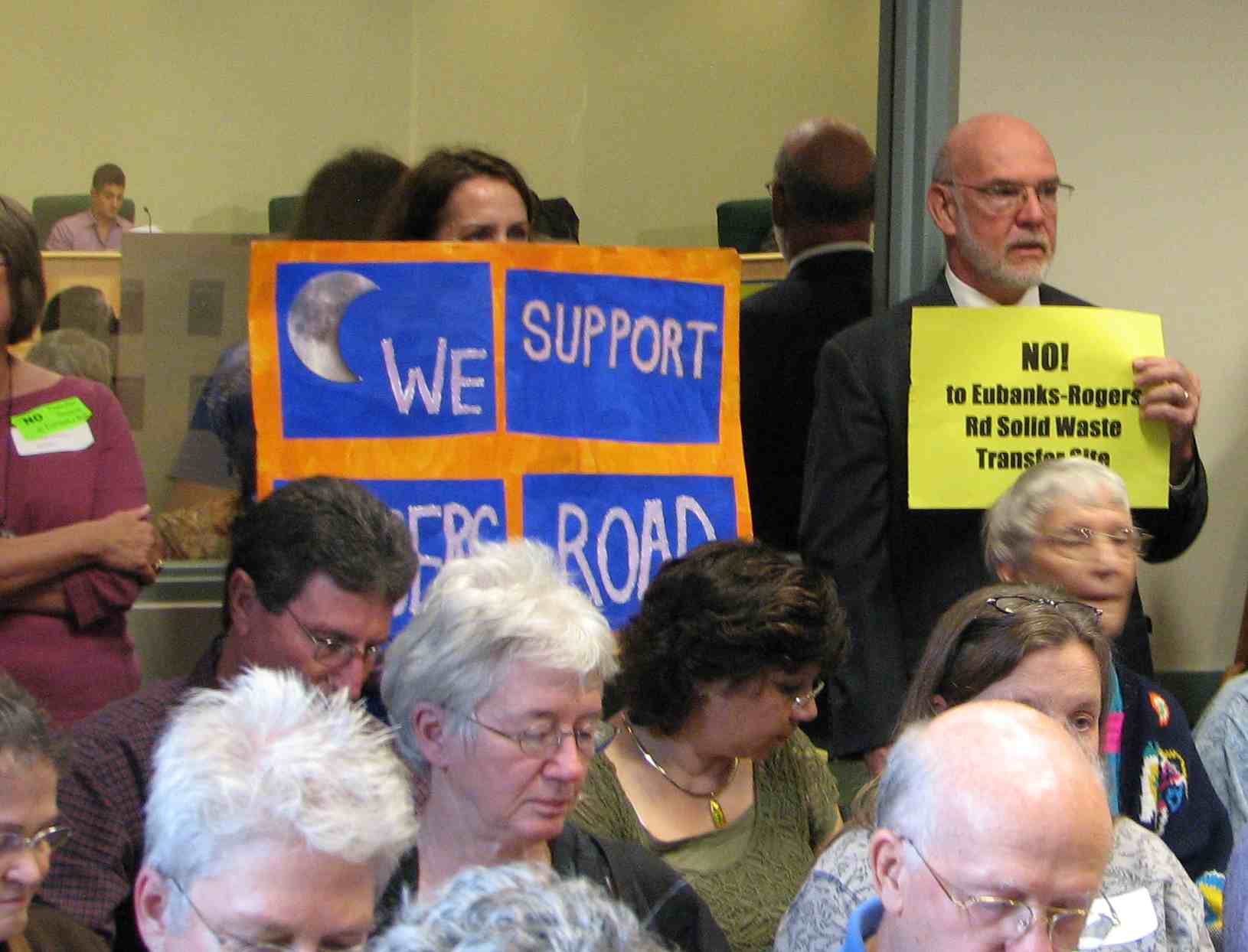
First, room is packed to the point the fire marshal has asked that folks move out into the hall. Haven’t seen this many folks in the room in quite awhile…

Using the matrix decision process I suggested last year (Trash Talk: Systematic Is The New Watchword), the BOCC just agreed to apply the community criteria to the selection of a site from the top ten. Eleven sites were winnowed out of hundreds based on exclusionary and technical requirements. One of those was dropped because of an existing preservation agreement.

First up Rev. Campbell steps up and hands the BOCC two stacks of comments – each the size of a NY City phone book – and says “here’s some community comment” to get us started.

Next is Rev. Eaton (James B. corrected me, that was “Pastor Rick Edens from the UCC church on Airport “), calling on site #4, the existing Eubanks site, to be dropped.

UNC environmental graduate says that NC is the only state which has studied siting waste management and that, in general, those with little political power get stuck with the garbage.

Neloa Jones points out that if Federal EPA guidelines for site selection had been followed that Eubanks would have never made it to the list of ten. She asks that ALL the criteria be applied before any of the sites be eliminated but then continues by citing the relevant guidelines underlining that Eubanks Site #669 be eliminated. She finishes by saying “vote tonight”, “let it end tonight”.

Rev. Campbell is back. He handed in 340 community criteria comment forms. “36 years” is enough. 36 years of tainted ground water, unsafe roadways, etc. means there is no social justice for this community – in fact for all the citizens of Orange County. He calls on the BOCC to protect all residents – to protect their environment – to protect their rights. “Make the right decision. Remove site #669”.

Mike Gerry – Hillsborough board member – asks why two of the top sites are in the Eno River Economic development zone. Was quite concerned that his committee is just now finding out about those site selections. Wishes they had been involved earlier in the process.

I suggested earlier (2035: Orange County’s Garbage Center of Gravity) that these sites would actually function as an economic resource going forward. Not only being sited in a zone already set aside for commercial development, both sites are close to rail access.

Another representative from Hillsborough is pointing out that the two top sites (based on the exclusionary and technical criteria) will negatively impact Hillsborough’s development. You think that these sites aren’t in somebody’s backyards back “this is in Hillsborough’s backyard”. A backyard that Hillsborough already has planned to develop for its economic well-being.

Nate – environmental engineer with extensive background in site selection. In professional opinion the county’s consultants used subjective criteria in scoring Eubanks in an effort to depress its chances. First example – transit access on Eubanks should score higher given I40 access and existing road improvements. Second, existing site improvements on Eubanks makes it more technically superior than the score indicates. Third, existing perception that the 2011 closure will bring “a pristine meadow”, that isn’t the case. He’s trying to make the case that the technical and exclusionary criteria were biased and not objective in order to create a political excuse to remove Eubanks.

Unfortunately some folks are trying to drown this citizen out. His comments show that he hasn’t been following the story as closely as he maybe should to apply his professional opinion. He finishes by addressing the environmental justice consideration by calling on the BOCC to provide tax breaks, development funds, etc. to reward those neighborhoods. Of course, this means he doesn’t know that promises made to these neighborhoods have been ignored for over 36 years.

Jim Ciao – local developer for Waterstone – who is developing neighborhoods near site #573. They put $28 million into economic development where the OC and the BOCC asked them to put it. Is afraid that #573 will negatively impact their development.

Two more Hillsborough citizens pipe up that the entrance to Hillsborough shouldn’t be blighted by trash trucks. Jo Soulier says she doesn’t want to tell visitors that “instead of using Google to find Hillsborough just follow the trash trucks.”

Rogers Road resident Ken Meardon gets up to respond “to the lady who was concerned about following the trucks…imagine telling [folks] to follow the trucks to your house as I have these last 36 years.”

Kevin Wolff steps up and reiterates his opposition to the Rogers Road site. Asks that the commissioners begin to consider keeping our trash in county and not dumping it on another community. He points out that the costs for transporting our trash problem is only going to increase and calls for a resolution that will economically address our waste now and in the future.

Barry Jacobs wraps the session by reiterating that the community criteria will be applied by the next meeting and the final slate will be ready for community discussion.

Final tally – at 6:30pm the fire marshal counted 184 folks at the meeting.

[UPDATE Matt Dee’s N&O report here. ]

Trash Transfer Site: And then there were seven?

Quick reminder about tonight’s Board of Commissioner’s working session on siting the Orange County trash transfer station – 5:30PM at the Southern Human Services Center [MAP] (agenda).

I continue to be concerned about the process – including the criteria – but hold out hope that a good result will eventually be crafted. More on tonight’s meeting here (OC), here (DTH), here (HS – registration still required!!!) and here (CHN).

From Neloa Jones and Sharon Cook:

Dear Friends,

Our Orange County Commissioners are getting closer to selecting a site to build a county-wide trash transfer station. Please support the Eubanks-Rogers Road neighborhood in their effort to remove Eubanks Road as a potential site for this new facility. Eleven potential sites have been identified. Most of the other sites are west of White Cross Road along Highway 54 or off of the I-40 and Old 86 intersection.

This attachment shows all of the potential sites [SEE GRAPHIC]. Every current and future garbage truck in the county will travel the selected route to the waste transfer station. From there all the trash will be dumped and loaded onto extended semi-tractor trailers for shipment out of the county.

Please show your support by attending the Orange County Commissioners’ Work Session on Tuesday, September 16th at 5:30 p.m at the Southern Human Services Center on Homestead Road (back behind the new Senior Center.) Please come, even if you will arrive late.

There are so many reasons why Eubanks Road is NOT the best place for this new facility, including:

– the opening of Morris Grove Elementary School and the school buses and families who now use this route on a daily basis;

– the future middle school and county park near Morris Grove;

– the continuing residential and business developments along Eubanks Road;

– and most importantly, the fact that the Eubanks-Rogers Road neighborhood has hosted our county’s trash facilities for the past 35 years!

If there is simply no way that you can attend the meeting on Tuesday, September 16th, please send an email to our county clerk at dbaker@co.orange.nc.us and ask her to forward your comments to each of the County Commissioners, and to include your comments in the public record.

Many of your neighbors in the Eubanks-Rogers Road have been working very hard to prevent our area from becoming the permanent trash center for the county. Please give them your support at this critical time in the decision making process. For more info about the issue, google Orange County, NC Waste Transfer Station.

I have carved out more time for civic activities of late. As part of that, I’ve thought about applying for Chapel Hill’s open position on Orange County’s Solid Waste Advisory Board. A recent shift in that Board’s leadership holds out some hope for not only a reasonable outcome on the trash transfer site but a new look at managing our county’s future waste stream in an ecological and economically sustainable fashion.

Joining the Air Force – Authority

As noted by Chapel Hill News Editor Mark Schultz here [OrangeChat] and here [N&O], I’ve asked the Orange County Board of Commissioners to consider appointing me to the new UNC Airport Authority (more on that here [UNC News] and here [N&O]).

Dear Commissioners,

I’m asking for an appointment to UNC’s new Airport Authority.

As a long time resident of Orange County, a citizen that has lived within a stones throw of Horace-Williams Airport (HWA) these last 15 years, a member of two Town committees interfacing with UNC on both HWA and Downtown issues (Downtown Parking Task Force), a close observer of UNC’s Carolina North planning process and frequent participant over the last 8 years in UNC’s community outreach programs, I bring a set of qualifications that I believe will help our community deal successfully with this issue.

Beyond my participation in Town and Gown relations, I’m quite familiar with the proposed sites that have been floated over the history of this issue. I also know residents affected by some of the proposed sites – notably those on the Alamance-Orange line.

As you know, I’ve also maintained a deep interest in our County’s environmental and economic sustainability and, again, believe I could bring a necessary perspective that will satisfy our citizens.

Finally, I want to be clear on my public concerns about UNC being granted, even if indirectly, sovereign powers.

I believe this was a terrible mistake by our legislature. Setting this precedent, for reasons good or bad, will probably make policy interactions with UNC-CH more difficult in days to come. Essentially, the legislature has issued UNC a huge hammer, with the power of eminent domain, that I believe should be reserved exclusively to elective government.

The consequences of this decision, unless the legislature moves to narrow the powers and limits their use to this “one-off” situation, will be far-reaching. I hope that our legislature revisits this granting of eminent domain and, if they decide to maintain their decision, inject greater community oversight and participation in that process.

That said, I am prepared to join with UNC, local officials, other citizens, to craft the best solution possible for both Orange County and UNC-CH.

Thank you for your consideration…

I further said on OrangeChat:

One reason I applied was to work to bring community input directly into the process. If you are familiar with my website citizenwill.org, you know that I try to bring concentrated research to bear in order to help our community make fact-based decisions on issues. Other than my background working on local boards , having already been involved in plotting HWA’s future, I think one of my strongest qualifications is this desire to integrate broader community awareness and participation in vital issues.

If appointed, I will do my best to document the Authority’s deliberations, publish as much of the supporting documentation as possible and provide an analysis, of course from my own viewpoint, of the progress being made. More importantly, I will work to be a conduit for the wider community’s concerns about the process, the suitability of sites and other relevant issues. I’m sure that both the appointed elective officials and UNC officials will do the same, but hopefully I can help provide community perspectives that I believe will be distinct from those.

A note on what that N&O article.

I said I thought granting the UNC, through the Authority, eminent domain power is a “terrible mistake”. Guess you could conclude that an Authority without this power lacks authority but I don’t believe this to be the case. If UNC is going to construct a new airport, we do need a framework within which the community can participate in the decision-making process.

I want to be one of our community’s representatives within that framework.

OrangePolitics 3.0: Already a Rocky Start?

As probably most readers of CitizenWill know, I decided to stop posting on locally owned OrangePolitics (OP) for many reasons:

  • an escalating and stifling intolerance of valid though different viewpoints,
  • the site’s authors acting as surrogates for political allies who didn’t have the courage to engage the community directly in an honest, fact-based and open manner
  • and an unwillingness on my part to work hard in “building the brand” of a site that advertised one thing – engaging the wider community in an informative discussion of local “progressive” issues – and delivering another (what I said below the fold).

In many ways, my disappointment in OP comes from the narrowing of that initial promise – to engage the wider community – into a sometimes almost reflexively dismissive platform pushing a particular agenda.

I have no problem with OP’s owner pushing a particular agenda – that is what my site – CitizenWill.org – does. I do have a problem with any claim to being an open and transparent forum for community-wide discussion.

For all that, the site, its owner and commentators have sometimes broadened the discussion of local issues. On occasion, “leakage” – the coverage of particular issues by the local media – occurred because of those discussions. These basic contributions not only informed but stirred debate and even action.

But those wins don’t justify the failures. In November I said I hoped that the next generation – OrangePolitics 3.0 – would represent a change of course –

“Reform is in order and I truly hope that the promise of 2003 becomes the reality of 2008.”

Today, Ruby and company will meet to presumably chart out that new course for “OrangePolitics 3.0” at a “Winter Happy Hour” ( 6:30pm, FUSE).

Following up on my previous comment, I suggest one topic of discussion be how to stick with a reality-based perspective.

Unfortunately, if this recent post by Ruby is any indication of 3.0’s direction, well, the new OP is already off to a poor start:

Here’s a preview of the new “Hall of Fame” function that makes a bunch of stats public on OP 3.0:

Top 10 commenters of all time:
Ruby Sinreich 1359 items
WillR 821 items
Dan Coleman 609 items
Tom Jensen 380 items
Mark Chilton 344 items
jehb 161 items
Mary Rabinowitz 154 items
johnk 125 items
ethan 50 items
admin 42 items

In my “farewell to OP” message, I mentioned the almost 3,000 comments/posts I made over the lifetime of OP. That estimate was based on a dump of the current OP website – showing roughly 2263 comments from 2003-2007 plus some notes I made in 2004 of missing comments from an early accidental purge of OP.

While I made a wide “guesstimate” of those early days, I’m comfortable with what OP currently reports – that I made thousands of comments.

In fact, based on my analysis of OP circa Nov. 5th, it appears I made :

  • 28 comments on stories posted in 2003
  • 178 comments on stories posted in 2004
  • 520 comments on stories posted in 2005
  • 876 comments on stories posted in 2006
  • 661 comments on stories posted in 2007 (slacking off?)

Or 2263 comments over 459 posts (threads of discussion). The particulars are listed below my “farewell”.

When someone contacted me about Ruby’s comment (a longtime OP lurker that thought there was an “undercount”) I notified Ruby of this striking discrepancy.

Why? Not because I felt any personal slight but because I thought Ruby would want to analyze the delta and fix her software. I’m sure an analysis of other commentators would show a similar miscount. Unfortunately, to date, there’s been no comment on those erroneous numbers.

Does it matter if my or any other posters contributions were off by a factor of two or more?

Not if this was just a software glitch but if this is an attempt to shape the past to forge the future, well, probably not the best start for a reformed OP. I’ll wait to see if the number of comments carried forward into 3.0 are reflective of the actual discussion carried out on OP over these last 4 years,

As I said before, I hope OP 3.0 sheds the mistakes of OP 2.0 and evolves into its initial promise – an open, honest, informative and inviting forum for discussion of local issues.

I’ll be on the sidelines encouraging the success of 3.0. Good luck folks! And do yourselves proud – try to hit one out if the ballpark.

Continue reading OrangePolitics 3.0: Already a Rocky Start?

UNC Carolina North: How Innovative the First Step?

I’ve said I understand why UNC feels compelled to push forward it plans for the Carolina North Innovation Center but I still want to see a master plan that incorporates this project, its supplementary infrastructure and the results of the on-going transit, fiscal equity and environmental studies before one concrete block is laid.

Timing is important as is soliciting continued community input.

My hope is that UNC, the three local government entities, other local stakeholders and the wider community will use the Innovation Center approval process as an opportunity to create a structured framework for further sustained negotiations on Carolina North. While committees like the Horace-Williams Citizens group have helped define some of the principles we want to see the project adhere to, an intermittent process, whose existence is subject to the whims of the Mayor, will not serve our citizens well.

From the outset, we need to create a flexible framework for open and inclusive discussions on Carolina North. As opportunities and obstacles arise over the first fifteen years of Carolina North’s development, how else will we address these challenges?

UNC is giving the community a chance to meet with both their staff and that of their developers, Alexandria Real Estate Equities (whose on-line presence could use a serious upgrade) to see how innovative their cornerstone project – the Innovation Center – will be.

Dear Friends and Neighbors,

The University and Alexandria Real Estate Equities, Inc. are planning the Carolina Innovation Center on the Carolina North property at the corner of Martin Luther King, Jr. Boulevard and the former Municipal Drive. The Innovation Center will provide an environment where innovation-based companies affiliated with the University can turn laboratory concepts into viable businesses.

The design process for this building is in its early stages. I hope that you can join us on Thursday evening, November 29, from 5:30 to 7:00 p.m. at the Robert and Pearl Seymour Center at 2551 Homestead Road for a community meeting on the Innovation Center. Representatives from UNC, Alexandria and the architect for the building will present preliminary sketches of the building design.

We have submitted a concept plan for the Innovation Center to the Town of Chapel Hill. The Town Council is currently scheduled to consider that concept plan at its January 23, 2008 meeting.

We look forward to meeting with neighbors and community members to answer your questions and to listen to your ideas. You can learn more about the Innovation Center in an article from the University Gazette here .

We hope to see you on November 29. As always, feel free to contact me if you have any questions. If you are a neighborhood or community contact, please forward this to your group or others who may be interested.

Best,

Linda

Linda Convissor, Director of Local Relations
Office of University Relations
University of North Carolina at Chapel Hill
Linda_Convissor@unc.edu
CB# 6225
Chapel Hill, NC 27599-6225
919-962-9245
919-843-5966 (fax)

Election 2007: Friends of Affordable Housing Questionnaire

X-Posted from my campaign website.

I hadn’t heard of this organization prior to this election but they appear to have been active for the last 10 years.

Friends of Affordable Housing is a non-partisan Political Action Committee that has been active in selective elections within Orange County during the last 10 year. The organization was first organized to support the Orange ballot for Affordable Housing Bond Money. The committee has also periodically sent questionnaires to candidates running for Orange County Commissioner and Chapel Hill Town Council.

Core members of the committee felt the residents of Chapel Hill should have the opportunity to know the positions of the various candidates running in 2007 for Chapel Hill Town Council. The Committee felt the relocation of the IFC, the transition to more attached multi-story housing, the opportunity for more affordable housing in Carolina North, and the possibility of selective use of “payment in lieu” of affordable housing units were issues of significant concern for Chapel Hill residents. The committee members are all long standing residents of Chapel Hill. The four review committee members have extensive executive committee experience in non-profit boards including the IFC, Habitat for Humanity, Dispute Settlement Center, YMCA and various Orange County boards including the Commissioners Committee on Affordable Housing. Committee members have also consulted with staff members of several of the Affordable Housing providers.

The NC Board of Elections has informed us that Friends of Affordable Housing does not have to register as a formal PAC for the 2007 election because we will not be raising money to support a specific candidate or issue.

They weren’t active in the 2005 race even though there was a slew of known affordable housing related issues before the Council.

Dear Candidate:

As you know, initiatives to increase the stock of all types of affordable housing in Chapel Hill have been an election issue for many years. In order to give Chapel Hill residents a better understanding of your position on this critical subject, Friends of Affordable Housing has developed a 7-item questionnaire asking you to address some of the current issues.

A review committee of the Friends of Affordable Housing will review your responses and may endorse specific candidates prior to the November election. Your comments will also be made available to the general public.

Thank you for your cooperation; we look forward to hearing from you.

Sincerely,

The review committee: Natalie Ammarell, Rev. Richard Edens, Susan Harvin ,Richard Leber

They obviously understand that maintaining and expanding affordable housing opportunities will require even more attention of the new Council than the last two years.

Here are my answers to their questions.


Friends of Affordable Housing Questions for Chapel Hill Mayor and Town Council Candidates

1. Please describe your commitment to creation of affordable housing initiatives in Chapel Hill.

I’m dedicated to continuing our Town’s commitment to providing affordable housing in Chapel Hill.

We need to re-evaluate, though, our current initiatives, our capability to manage our affordable housing stock and to rebalance the types of housing we’re currently providing.

With that, we also need to adopt fiscal policy that helps folks keep the most affordable housing they have – their current homes. We’re already seeing a trend of long-term residents, after decades of contributing to our community, being “shown the door”.

Those just starting out, can’t even get their foot in the door without substantial incomes.

Finally, we need to make sure our Town’s growth policies align with our housing goals.

RAM Development, the Town’s private partner on the Lot #5 boondoggle, is proposing to replace the somewhat affordable apartments with hundreds of big-ticket condos. Developments that displace existing affordable housing stock, like Hillsborough 425, are part of Chapel Hill’s future.

We need to make sure, though, that we anticipate the consequences of those displacements.

2. Please give your opinion about the actions taken by Town Council in the last 4 years to increase the stock of affordable housing in Chapel Hill.

I commend the Council for their intent. I applaud their successes. But, we could’ve done better.

Too much in lieu money, not enough square footage. Necessary reform in managing our housing stock or being able to adapt to changing conditions left undone for too long. Opportunities like Roger Perry’s %30 offer at East 54 or Greenbridge’s Northside neighborhood in-fill proposal missed. Rebalancing the kind of housing we offer, not adequately addressed.


3. Given the current impasse with the County, what would you do as a Town Council member to proactively advance the effort to find a new site for the IFC Men’s Residential Facility?

a. Would you oppose locating the facility in certain parts of town (e.g., downtown; near Seymour Center)?

I would like to see the IFC split the food service and the shelter functions. As far as the Men’s Shelter, our Town – if a leadership vacuum exists at the county level – has a responsibility to manage this process. I believe the Town should work with the IFC, proactively, along four basic thrusts.

One, develop criteria that incorporates both the IFC’s requirements for just the shelter component and our Town’s goals for development, transit and neighborhood preservation.

Transit opportunities, accessibility to health and other social services are a few of the criteria I would suggest.

Two, once we have the mutually developed criteria, find the site that best suits our joint needs. Our community needs to be involved in both the development of relevant criteria and the selection of the site.

Locating on Homestead makes sense, especially over Eubanks or Millhouse but there might be better sites based on the decision matrix the IFC, other interested parties and the Town develops.

Three, our Town could provide some logistical support to the IFC in developing a task list to move the shelter.

The Chamber asked me if I’d support pulling the IFC’s lease on the existing shelter location. No way I did say that our Town should help develop a punch list of items with specific performance goals and a timeline to hold the IFC to – but taking a punitory tack is – in my estimation – a poor strategy.

Four, we need to bring our community into the process early, educate the public on the relevant issues and, proactively, publish a guide on how the Council will measure the success of this project. If Council affirms, as I believe we’ll be able to do, that the population at the Men’s Shelter will not increase criminal activity in surrounding neighborhoods, we should already be prepared to assess that activity and report back if reality matched our projections.

4. What new programs do you envision to increase the stock of affordable homes in Chapel Hill?

a. Do you think priority should be given to one type of affordable housing (e.g., transitional housing, special needs, rentals, small condo’s, larger owner occupied detached homes) over another?

We need to rebalance our housing stock based on a few criteria. First, what is the most diverse kind of stock we can reasonably manage using existing resources? Second, look at partnering on denser developments like Raleigh’s Carlton Place (I wrote about this development here: http://citizenwill.org/2007/03/21/raleighs-carlton-place-a-downtown-affordable-housing-commitment-worth-emulating/ ). Third, like Carlton Place, re-evaluate rental housing within our current mix.

b. What type of affordable housing should be built in Carolina North and on the Greene Tract?

I would like to see affordable housing developed on the Greene Tract that is akin to that of the Homestead Park neighborhoods. I would also like the housing to be on the eastern side of the tract to integrate into those neighborhoods, take advantage of existing and new amenities, be closer to existing transit, take advantage of new transit capabilities (depending on what happens at Carolina North) and avoid damaging some of the more ecologically sensitive areas.

The University has suggested that housing on Carolina North will be market driven. I would like to see a mix of units that parallels the stock that UNC commissions.


5. In the last year, Town Council has approved three mixed-use developments: 54 West, Greenbridge and Ram’s Lot 5. Under Chapel Hill’s Inclusionary housing policies these developments will generate almost 100 affordable one and two bedroom condo units. However, these units will not serve lower income families with children.

a. In your opinion, do current policies provide the types of affordable housing that are really needed? If not, what should be changed?

As you might be aware, I’ve been critical of the Town’s Lot #5 development for a number of reasons. The project is fiscally irresponsible, the original affordable housing stock was not family friendly, the affordable housing parking was off-site (second class citizens), the condo fees were steep and not capped, the condo units – especially the larger ones – will most probably server the student community, measurable energy efficiency and environmental standards were dropped, and on and on. You can read my web site – citizenwill.org – for a detailed discussion on these and other Lot #5 ills.

For all my criticism of the majority of the Council’s decision to take on this money pit, I am happy that Cam Hill did accept my recommendation to resize some of the affordable units to accommodate families. Will families find them inviting? I’m not sure.

Considering Lot #5’s location, I’m quite concerned that the Council never took my call to look at affordable living as well as affordable housing seriously. What is the cost of living in one of these units if you should be on the lowest economic rung of those that can purchase a unit? Will the economics of that location end up making this housing more transitional in nature than was originally anticipated?

The units at East54 strike me as being more family friendly. I was encouraged, at least until the Harris-Teeter moved, that a mix of services were within easy reach. I was discouraged though by the Landtrust’s assessment that these units would be transitional in nature. And, of course, continue to be concerned we couldn’t take advantage of the developers offer to build %30 affordable housing.

With Greenbridge, I believe our philosophy of integrative units, a good goal, interfered with an excellent opportunity to acquire more square footage. The rejection of the proposal to build family units within an existing adjacent neighborhood was disappointing. Our Town policy should be flexible enough to adapt to exceptional opportunities that don’t diverge greatly from our housing goals.

b. Can Chapel Hill’s Inclusionary housing policies be utilized to generate affordable rental housing? If you think so, please explain how such rental housing would be managed and maintained.

From my understanding, the existing inclusionary policies don’t align with encouraging development of rental housing. As the inclusionary zoning process continues, we need to make sure rental becomes more of an option.


6. Many affordable homes are “aging” and will require significant maintenance. Is it appropriate for public funds to be used for long-term maintenance? If so, what sources of funds should be used?

I’m interested in the proposal for a rotating loan fund to assist folks in maintaining their properties. This loan fund, if created, needs to come from monies outside the general fund. I would not support additional Town debt – via bonds or other mechanisms – to fund this loan program.


7. Do you think “payment in lieu” of affordable housing construction should be accepted from builders? If so, what guidelines should be used and how should these funds be used?

Over the last five years, my sense is the Council is accepting way too much in lieu monies over square footage. We’re asking developers to create housing. Housing built now will not only help relieve some of our current demand but also be cheaper than housing built 5, 10 , 20 years out.

If we ask for housing, we should get housing.

Delay is not our friend. Easy money also erodes are discipline. Square footage over in lieu money should be our guiding principle.

Election 2007: Neighborhoods for Responsible Growth

This year the NRG decided to vet the candidates via email. In 2005 they held interviews and presented the audio responses. Trying to be thorough, I went a bit overboard this year. Figuring no one would want to wade through 10 pages of answers, I tried to boil down this final response to the NRG.

In its Comprehensive Plan, Chapel Hill is committed both to denser urban development and to protection of existing neighborhoods. Do you see any conflict between these goals and what do you feel is the best way to achieve them?

There are trade-offs, thus conflicts between the goals of high density and neighborhood protection.

To start, in any discussion of density we need to establish the limits of growth. I’ve been using the concept of “carrying capacity” as a guide.

Carrying capacity is a multi-dimensional evaluation of an ecosystems ability to maintain a particular population. In biology, this usually means water, food and habitat. In Town, we need to add, for instance, the ability for to maintain a diverse and healthy socio-economic balance within our community. We all can’t live in million dollar condos or pay an extra couple hundred bucks in taxes each year.

We don’t currently assess density to that level of detail. I believe we should at least start thinking within those terms as it will help us create a more sustainable outcome.

Another general problem with our comprehensive plan is that our process for upgrading our goals as our understanding improves is broken.

We need to implement a continuous review process, as suggested by the former chair of the Planning Board, to review our goals in light of achievements to-date, successes and failures. Not only do we need to be more nimble in managing our Town’s comprehensive plan, we need to be much more inclusive in drawing upon our community’s expertise.

Three recent omissions in our planning process provide examples of where we need to improve.

Continue reading Election 2007: Neighborhoods for Responsible Growth

Morris Grove Elementary School

Mia Burroughs is reminding folks that they have until October 31st to help name the Chapel Hill-Carrboro Schools (CHCCS) newest elementary school out on Eubanks Road, near the Rogers Road neighborhood

The newest school is located adjacent to the former Morris Grove elementary school, a school created to serve the educational needs of the local black community.

The Morris Grove school was created in the late 1800s by Morris Hogan, son of a female slave and her owner. A farmer and local statesman, Hogan put his own land and money into the one-room wooden schoolhouse. The state paid the salaries of two instructors, who, depending on the decade, taught six, seven or three grades.

Patrick Winn, Chapel Hill News, Feb. 10th, 2007

Morris also had a long-standing passion for education as a passport to a better life for his own and other black children. Yet in the late 1800s, the Orange County school board had few funds for school construction and operation. To fill the void, the board sanctioned the opening of many simple, usually one-room, segregated schools that were built and operated by local individuals or groups.

Morris won permission to create the Morris Grove Elementary School, using his own land and funds, at what is now 402 Eubanks Road. It is remembered as a simple frame structure with only pump water, outdoor toilets and a Spartan interior heated by a wood stove in cold weather. Instruction for six grades was taught by one teacher. The school probably stayed in operation from the 1880s to the 1920s, until tax-based public schools took over. All of the Hogan children and some of the grandchildren attended it.

Doug Eyre, Chapel Hill News, Nov. 17th, 2006

Naming the new school Morris Grove would not only honor a slice of our community’s history but serve as an excellent educational reference point for students. Even in the supposedly progressive environs of Chapel Hill, we’re still working to bridge historical divides.

And only knowing where you’ve been can you get where you are going.

Please cast your vote in favor of Morris Grove by answering this CHCCS online survey.

Election 2007: League Of Women Voters Forum

A big thank you to the local chapter of the League of Women Voters for an excellent forum this evening. Vicki Boyer, who occasionally posts on OrangePolitics kept the show moving along with a variety of audience questions.

Unlike the Sierra Club forum, the environmental and social justice issues surrounding our neighbors out on Rogers Road (of which I have spoken about numerous times) got a fairly decent airing. The $8 million Downtown Development boondoggle merited one round.

The forum’s format, a round of answers with some opportunity for give-and-take, suited tonight’s questions. I hope the public and the local media take some time to mull over our responses.

There were a few surprises from the non-incumbents: Kevin Wolff bringing up voter-owned elections, Penny Rich suggesting punishing Downtown landlords who wouldn’t fill their storefronts, Matt Czajkowski’s excellent point that Chapel Hill has become introverted.

Of course, the incumbents tried to take credit for all the successes over the last four years while trying to dodge any responsibility or account for any of the mistakes.

Some of the successes – hiring an economic development officer, developing a strategic economic development plan, the Town’s new fiber network – were issues I brought forward first.

As far as surprises from the incumbents, I appreciated Mayor Foy’s complementary observation that I have an eye for efficiency.

Jim Ward’s bit of criticism (Incumbency Is Not Enough or Nineteen Seconds Is Too Long) about the 19 seconds I went over my time on one response provided some humor.

And Cam Hill, one of the negotiators on Lot #5, quoting a citizen outlay about $1 million short of the actual figure (CHN). I’ve been up since 6am and can understand a fumble –
hope fatigue explains his sloppy accounting.

The League graciously allowed me to assist them in posting tonight’s video on the web.

I’m preparing for upload now and expect the full video to be available by tomorrow evening (I’ll post a new article when it’s done).

Oh, and the Sierra Club has since declined my offer to post their forum on the Internet. They plan to do it themselves. I’ll keep an eye on their progress and will announce its availability.

Election 2007: Recycle, Reuse

Recycle and reuse are two environmental principles our local community follows fairly well. In that spirit, I believe our citizens will appreciate my putting frugality over novelty.

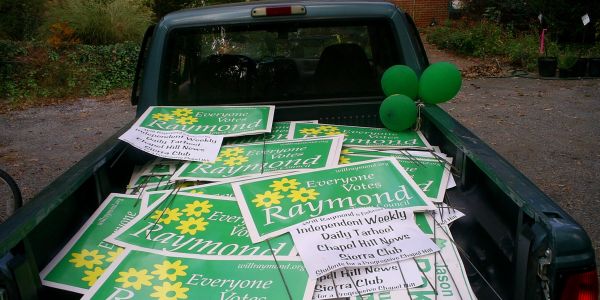
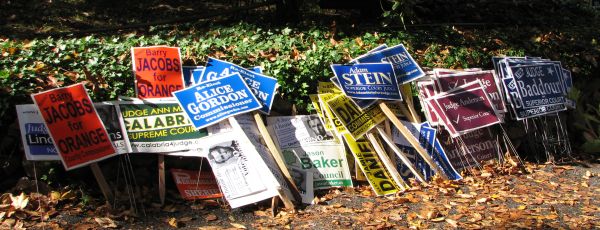
Signs are sprouting up around Town. Several of mine, it appears, were saved by some of my 2005 supporters and trotted out a little early. Thanks folks for showing some early enthusiasm.

My specialty, since 2001, is to round-up campaign signs after the election. No reason to clutter our road-sides after the deed is done.

In 2005, as I wrote here, I managed to pickup all but two signs of my signs by 7:21 am the day after the election – the final two by 9:30am.

I said then:

Why the quick pickup?

I said early on in my campaign, win or lose, my signs would not linger throughout our Town.

If there’s one discriminator the electorate takes away from this election, I hope they recall that I said it, then I did it.

I said it and then I did it. If you look at my activism on behalf of our community, you’ll see a clear track record of “walking my own talk”.

In 2006 I managed to pick-up over 2,000 signs (and several bags of adjacent litter – unfortunately, I’ve already filled two this year!).

Every year I offer to pickup any candidate’s sign and, once again extend that offer to everyone – my colleagues in the Town Council race – Carrboro races – the school board (contact signs AT citizenwill.org ).

It’s a fun way to do my part to keep our community attractive.

A common question I get is “Who designed your sign?”

I actually did, using a variety of free software tools – including GImp (Gnu Image Program) and OpenOffice. These are the kind of tools I’ve been asking our Town to adopt for the last six years. Using OpenOffice, for instance, would save hundreds of thousands in Microsoft licensing fees, something our Council is well aware of, something our Town continues to drag its feet doing.

Rogers Road Community’s Petition for Redress

Kirk Ross posted Neloa Jone’s request for governmental redress (“the setting right of what is wrong”) over on the Carrboro Citizen’s ‘blog:

The Rogers-Eubanks “Coalition to End Environmental Racism” (CEER)

Background

For nearly one hundred and fifty years, African-American families have lived in what is now known as the Rogers-Eubanks Community. In the late 1800s, Rogers Road was a wagon-track through black-owned family farmland and sawmills that stretched from Homestead to Eubanks and Millhouse Roads. There was once a school on Eubanks Road, Morris Grove, founded by a former slave, for black children not allowed to attend school elsewhere. As decades passed, this land was passed down to children, to grandchildren, to great-grandchildren, and in some cases, to great-great grandchildren. Some land was lost to debt, some simply sold. However, African Americans continued migrating to this community; they purchased land and established homes. Today, this community is a predominantly low-income neighborhood, but it remains socially cohesive and culturally rich in spite of the solid waste facilities that have worked to destroy it.

In 1972, when the Town of Chapel Hill decided to use 120 acres of land on Eubanks Road for the first landfill—this was a thriving community, and it was strongly opposed to having a landfill near them. However, Mayor Howard Lee convinced this community to accept the landfill for ten years, promising that afterwards no other landfills would be opened near them and a park and other basic amenities would be provided when the landfill closed.

That was 35 years ago.

And inspite of the fact that Orange County prides itself on being aggressively opposed to social and environmental injustice, it has refused to honor decades of broken promises made to the Rogers-Eubanks Community. Local governments continue to expand solid waste facilities in this area: since 1972, two municipal solid waste landfills have been opened; two industrial waste landfills have been opened. We have yard and hazardous waste collection sites, recycling and garbage drop-off centers, a Materials Recovery landfill (MRF), and let’s not forget about that toxic, smelly leachate pond (1/3 of an acre) right next to Mrs. Gertrude Nunn’s property. The newest proposed addition to these ever-expanding solid waste facilities is the transfer station. And even though some people believe that closing the landfill and building a transfer station will improve conditions in the community, WE contend that it will not. Along with the transfer station, garbage collection trucks, and 18-wheelers we will still have the vermin, the stench, more air pollutants, and more noise. We will also have increased traffic that poses increased danger to our children and other citizens.

So our question tonight is this: why are low-income communities and communities where people of color live always the most vulnerable to solid waste facilities?

The National Environmental Justice Advisory Council has concluded that “WTS are sited disproportionately in areas adjacent to poor communities and communities of color.” The New York Times recently reported that “low-income communities . . . shelter most of America’s polluting facilities”; African Americans are “79 percent more likely than whites to live in areas where air-pollution levels pose health risks.” Professor Robert Bullard of Clark Atlanta University contends that “the people who live closest” to waste facilities are those “who have the fewest resources,” but that “doesn’t mean [they] should be dumped on.”

On March 3, 2006, the Solid Waste Advisory Board (SWAB) passed a resolution recommending that the transfer station be located on Eubanks Road. Why? Because Eubanks Road is convenient, because the County can put the transfer station here cheaply, because the County will be saved the hassle of having to search for another site, AND because there was a GOOD chance that THIS community that has been dumped on for 35 years would not object TOO LOUDLY. On March 27, 2007, the Orange County Board of Commissioners voted unanimously to accept this recommendation from SWAB to locate the transfer station on Eubanks Road.

What we are asking for tonight?

This community wants Orange County to stop dumping garbage and toxic waste in their backyard.

The Rogers-Eubanks “Coalition to End Environmental Racism” (CEER) supports this community in its demands for environmental justice. And these are our demands:

• We want you to eliminate immediately the Rogers-Eubanks Road Community as a site for the proposed solid waste transfer station.

• We want you to halt all solid waste activities in this community no later than November 2009.

• We want you to honor the promises made to this community over the past 35 years for having endured the negative impacts of having garbage dumped in our backyard.

• We want you to address quality of life issues immediately by providing this community with municipal water and sewer services and other community enhancements to ensure the health and safety of the residents.

All of us here tonight have a lot of work to do, and we are certain that having heard us tonight, you will do what’s right and bring environmental justice to the Rogers-Eubanks Community. Thank you.

Rogers Road Community: Honor the Promises!

Speaking on behalf of her neighbors, Neloa Jones made an unprecedented plea to the Orange County Assembly of Governments to “honor the promises!”


Direct link to video.

I cannot do justice to Ms. Jones passionate eloquence in trying to condense her statements but if I was forced to summarize, I would simply say her and her neighbors are demanding deeds and not words.

Election 2007: Sierra Club Interview

X-Posted from Will Raymond for Town Council 2007:

The local Orange-Chatham Sierra Club participates in the local election process two ways: endorsing candidates and sponsoring a forum.

Last Sunday, Chairman Bernadette Pelissier, Political Chair Loren Hintz and member Matthew Scheer interviewed me on behalf of the Sierra Club to determine if I qualified for an endorsement.

Questions spanned local zoning policy, a discussion of good and bad infill, personal commitment to environmental protection and Carolina North.

Folks that read CitizenWill already have a good idea about where I stand on many of these issues.

Surprisingly some issues, like local waste management, the trash transfer station and Rogers Road community’s complaints, our storm water utility policy or in-town open space preservation didn’t make the list. Of course, you can only fit so much into a 45 minute interview.

I appreciate these members taking the time to review my thoughts on Carolina North, zoning policy, pragmatic carbon reduction strategies, transit, etc. (I tried to cram way too much into my answers and digressions).

The Chapel Hill forum takes place next Tuesday, September 25th, 7-9pm at the Chapel Hill Town Hall. The event will be broadcast on our local public access channel.

In 2005 I did secure the local club’s enthusiastic endorsement. Here’s what they said two years ago:

Will Raymond has been one of the most outspoken and effective citizen activists in Chapel Hill in recent years. We look forward to him using his talents to advocate for the environment as a member of Town Council. In particular we are excited about his initiatives to promote energy efficiency in town buildings. He will also work to protect lesser known creeks in the Chapel Hill area and to minimize the number of single occupancy vehicles causing air pollution and traffic congestion at Carolina North.

We strongly encourage Sierra Club members and any residents of Chapel Hill who care about the environment to support these four candidates in the November 8th election. They are the best hope for a Town Council that will always make reducing environmental impact a top priority as Chapel Hill grows bigger.

We’ll know by mid-October if the work I’ve done since – on Carolina North, as a member of the Horace-William’s Citizen Committee sub-committee on environment, tracking and publicizing the landfill/transfer site problems on Rogers Road – will secure an endorsement in 2007.