Tag Archives: Government

Chapel Hill Transit: A %1 Solution

Local transit activist Ellen Perry posted a heads up Car Free Day 09/22 on local ‘blog OrangePolitics.

On Friday, September 22, residents of Carrboro and Chapel Hill will for the third straight year join millions of others around the world in celebrating World Car Free Day, leaving their cars at home and using other means of transportation instead.

Residents of Orange County who formally pledge to go Car Free or at least Car Lite (reduced car use) for September 22 will be entered into a drawing for prizes that include Amtrak tickets to Washington, DC & New York, a new bicycle, gift certificates for Squid’s, Spanky’s or 411 West, and more. Anyone can pledge on-line at www.gocarfree.com pledge forms that can be mailed will also be available in the Chapel Hill News and Chapel Hill Herald over the next three weeks.

Prizes will be drawn at a Car Free Day celebration to be held on the lawn of Weaver Street Market from 5:30 pm to 7:30 pm on Friday, September 22. Celebrants will find information about public transportation, local biking and walking opportunities, and how to create communities that are less dependent on cars. The Village Project will show their designs and models for transit-oriented, walkable communities on the lawn, and Chapel Hill Transit will demonstrate how to load bikes and wheelchairs onto buses at the Fitch Lumber parking lot (309 North Greensboro St.).

The post spawned an interesting thread, including this comment by GeorgeC (George Cianciolo – former Chair of Chapel Hill’s Transportation Board, current member of UNC’s Carolina North LAC, the Planning Board, Design Commission and probably a few others 😉 ) on how to increase our transit resources:

Current contribution to CHT:

CH (taxes): $2,583,000 21%
UNC: 4,674,000 38%
Carrboro: 861,000 7%
sub-total: $8,118,000
add another $4,200,000 in federal & state monies, etc.
total: $12,318,000

CH’s contribution of $2,583,000 from taxes is 9.7% of what it collects in property taxes ($2,583,000 / 26,631,000). If we increased the transportation tax portion of property taxes by 10% we would increase the total property tax bill by 0.1 X 9.7% = 0.97%. Since CH taxes amount to roughly 1/3 of a citizen’s total tax bill (county taxes & school taxes comprising the other 2/3) this increase would amount to about a 1/3 of one-percent increase in CH property taxes. Thus, on a $3000 property tax bill the increase would amount to about $9.60.

Now, if all the transit partners increased their contributions by 10% as well, we would realize:

CH: $258,000
UNC: 467,000
Carrboro: 86,000
$811,000 new funds

This $811,000 would buy us an additional 14,000 hours of service. On existing routes we could add 4 hr/day for 12 routes for 6 days/week for 50 weeks. Or a number of different scenarios. But remember, you could only increase service on nights & weekends unless you spring for additional buses for use during the day when equipment is currently maxed out.

By the way, the town’s Transportation Board has two vacancies, application and more information on joining here.

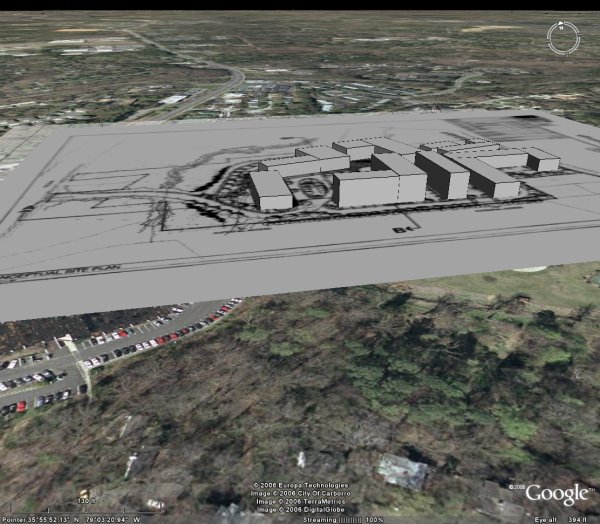
Hillsborough425 aka “The Residences at Grove Park”

Plenty of kudzu, not much of a grove.


HeraldSun covers some of the issues with RAM Development’s strangely renamed condo-blivium project “The Residences at Grove Park”. I’ve already commented on Council’s need “to be as Caesar’s wife” in handling this project’s approvals in light of their existing relationship as co-developers with RAM on the $100 million downtown redevelopment project.

More to come on the project….

Deeds, not words shall speak me….

Prolific local blogger Bora Coturnix reveals the back story to the recent CitizenWill post North Carolina Diktat: Thou Shalt Pledge Allegiance.

His son was the young student, armed with the courage of his convictions, who calmly asserted his Constitutional right to not be compelled to affirm that which he doesn’t believe.

North Carolina’s motto, roughly translated, is “Deeds, not words.”

Many of the worst scoundrels of recent history have falsely pledged to support and maintain our Constitution. False pledges of allegiance and broken oaths of fealty are part-n-parcel of their way of doing business. Their deeds, though, contradict their words.

Yet many continue to put faith in mere words. I’ll put my faith in demonstrable deeds (like, as Bora points out, Paul Leubke’s lone dissent).

As famed champion of free speech Supreme Justice Learned Hand notes “Liberty lies in the hearts of men and women; when it dies there, no constitution, no law, no court can save it; no constitution, no law, no court can even do much to help it.”

In a week so far filled with false patriotic platitudes, it’s encouraging to see the spirit behind the words of our Constitution firmly lodged in the hearts of our youth.

Bora, please thank your son for “walking-the-walk” – putting deeds to words – in pursuit of a little liberty.

Municipal Wifi: St. Cloud on Cloud Nine

So let the naysayers and talking heads let fly, but the little secret that is secret no more is that the results of a carefully planned and deployed municipally owned system delivered free to the citizens as a public service is actually the most successful, beneficial and effective model in existence.

So says Jonathan Baltuch, who help found MRI, a consultancy specializing in planning economic development strategies for municipalities.

What naysayers? Those critical of St. Cloud, Florida’s deployment of a municipally-sponsored, tax-supported but externally managed citywide high-speed Internet service. After just 6 months, with %77 uptake this public service project is well on its way to providing %100 of the St. Cloud community with ubiquitous Internet access. Amazing for a community lacking Chapel Hill’s built-in audience of academic, entrepreneurial and professional communication consumers.

…championed by former Mayor Glenn Sangiovanni, [the service] was viewed from day one as an economic development project. Through the process it flourished with the realization that this one project benefited many different stake holders.

The City saw the opportunity to enhance public services and dramatically reduce the cost of delivery. The digital divide gap would be drawn much closer, creating universal opportunities for the community, small businesses would benefit from improved connectivity and reduced cost, educational institutions would be able to enhance learning and visitors would have more opportunities and choices.

Not to mention providing unique services, like ambulance telemetry, enhanced first responder support, filing in-field inspection reports or a better real-time passenger information system instead of Chapel Hill’s expensive and flawed NextBus deployment.

I’ve held up St. Cloud as a model (“Wifi for a few dollars less…”) for what we could do in Chapel Hill. That is if we had the leadership and foresight to forge ahead.
Continue reading Municipal Wifi: St. Cloud on Cloud Nine

Gangs of Chapel Hill

Last year, unlike most other Council candidates who wanted to reactively deploy our additional police resources downtown in a show of force that was more “feel-good” than strategic, I called for enhancing our forces expertise in “gang management”.

For the last few years, gangs, mostly from outside our community, have been involved in some of the worst incidents our force has faced. While it’s speculated that the recent Avalon shooting might be gang related, we know for sure that the shootings during this years After Chill (after Apple Chill) were associated with gang activity. Developing expertise now would be both tactical and strategic.

Well, earlier this year we put the extra-forces downtown sans gang management support. Troubling.

The good news is that as of today “the Chapel Hill police will focus on developing gang expertise among certain officers.”

Chapel Hill’s Capt. Chris Blue says that while we don’t have an epidemic, just, to-date, a presence, the force will take steps to pro-actively address the gang issue. I met Capt. Blue during this Spring’s WCHL Downtown discussion (where I once again brought up the gang issue) and was impressed by his desire to “work the issue”.

More from today’s N&O.

Five Long Years

Perhaps the sentiments contained in the following pages, are not YET sufficiently fashionable to procure them general favour; a long habit of not thinking a thing WRONG, gives it a superficial appearance of being RIGHT, and raises at first a formidable outcry in defense of custom. But the tumult soon subsides.

Time makes more converts than reason.

As a long and violent abuse of power, is generally the Means of calling the right of it in question (and in Matters too which might never have been thought of, had not the Sufferers been aggravated into the inquiry) and as the King of [America] hath undertaken in his OWN RIGHT, to support the [Congress] in what he calls THEIRS, and as the good people of this country are grievously oppressed by the combination, they have an undoubted privilege to inquire into the pretensions of both, and equally to reject the usurpation of either.

Thomas Paine (abridged) – Common Sense, Philadelphia, February 14, 1776, 3rd edition

Five long years of depredations to both our Constitutional freedoms and to our Nation’s good standing, one may hope that Time makes more converts than reason, for reason alone has not yet won the day.

Practicing “moral mischief”, the President’s men, steeped in treachery, subscribing to ” professional belief to things they do not believe”, have “corrupted and prostituted the chastity” of our nation’s mind and prepared our country for the commission of heinous crimes antithetical to its founding spirit.

Leading up to this anniversary, confounding all good sense and common reason, our mad-ministration continued to lie about their call to war, to justify cruel and unusual punishments, to undercut or abolish acts under which they might eventually be punished, to pervert the course of justice – all in an effort to tighten their grip on their dissipating power.

Today, a day we should honor the sacrifice of our citizens by celebrating the highest ideals of democracy, our President shamelessly wrapped himself in an ash stained flag – and feebly tried to resurrect his waning fortunes by justifying his race towards tyranny in pursuit of the noblest of causes – freedom for all.

Yet, returning true to form, our modern-day Janus once again condemned those that rightfully question the accelerating mischief, misery and death he and his ruling party have caused. Forgetting a previous President’s admonition that those who question power are indispensible, “for they determine whether we use power or power uses us.”

His and his cronies’ calumny should not, must not, stand.

Yet, in the last five years, as the 4th estate floundered and the electorate wavered, so many slights – large and small – have gone without due reckoning. Weariness melds with a sadness borne of watching our hard-earned freedoms and worldwide goodwill slip so easily beyond our nation’s grasp.

Fortunately, the deepest and darkest of shadows serve to concentrate our attention on the merest flickers of light

Yes, what my generation earned too lightly, we’ve esteemed too little. But now we’re blessed with a clear distinction and sharp contrast between two futures: a declining fascist state of Amerika or “a future in which our country will match its military strength with our moral restraint, its wealth with our wisdom, its power with our purpose.”

Remembering that “those who expect to reap the blessings of freedom must…undergo the fatigue of supporting it”, to honor this day, I’ll continue to try to be Paine’s man that “smiles in trouble”, “gathers strength from distress” and “grows brave by reflection”.

NC’s Mental Health Crisis: Penny-wise, Pound-foolish

A nice thread on NC’s deteriorating public mental health infrastructure is developing on local bulletin board SqueezeThePulp spawned by a discussion of the recent murder and ensuing non-fatal shooting at Orange High School by an arguably deranged individual:

Anita Badrock, says

Another problem here is the state’s attempt to restructure mental health services provided by state funds, and the resulting holes in the safety net. The taxpayers of this state need to educate themselves about how the proposed “privatization” of mental health care has resulted in some of the sickest and most needy of the mentally ill not getting the services they need.

I am generally a private sector champion, but it isn’t working with respect to delivery of mental health services to the poor. Talk to anyone who works at OPCMH and ask them what impact the state’s decisions have made in their abilty to care for their clients.

Fred Black, fresh from this morning’s NC Chamber of Commerce sponsored Legislative breakfast says “both Sen. Kinnaird and Rep. Insko emphatically made this point and said that even with what was done in the recent short session, they believed it just scratches the surface.”

Good to hear that Fred… and to see discussion continuing on this thread.

Carolina North: Moeser Tirelessly Seizing Future Territory

The October 1st, 2007 can’t come soon enough for some of UNC’s Board of Trustees. Yesterday, Chancellor Moeser once again disingenuously affirmed the absolutely critical role Carolina North’s development plays.

Important? Maybe. Critical? How can we assess that before we see a real evaluation of its business, educational and community-oriented impacts?

Leaning on previous assertions of broad economic impacts, Moeser talked of his administrations “tireless” pursuit of Carolina North’s rollout – including the appointment of Dean Jack Evans (Moeser somehow omitted mentioning Evans’ $208,000+ per year salary). At least Evans’ sees this not as territory to seize but more of a potentially futile intellectual exercise.

Our engagement with the state will be greatly enhanced by Carolina North, our 21st Century living-and-learning community. We will pursue this project tirelessly. It is absolutely critical to our future. We want this new campus to be a national model for sustainability, addressing the long-term needs of the University for accelerated transfer of our new knowledge into the economy, housing for faculty and staff, and new collaborations with the private sector.

A Leadership Advisory Committee of community, state, and University representatives is recommending guiding principles for building Carolina North. Last month, I appointed Professor Jack Evans as executive director of Carolina North. Our trustees have directed us to submit our zoning and development plan applications to local governments by October 1st of next year.

We want the Carolina North campus to have an aesthetic quality that will draw people to it and enhance the communities surrounding it, just as the main campus has for two centuries. We believe it can do all of that at the same time that it advances our missions of teaching, research, and public service.

Carolina North: Crawford-Brown’s Counter-principles

Rather than expanding upon the published principles created by Chapel Hill’s (now defunct) Horace-Williams Citizens’ Committee (HWCC) or integrating their newer environmental recommendations (which I championed), UNC’s green representative to the LAC (UNC’s Leadership Advisory Committee) offers a counter-proposal.

Why? Why follow Chancellor Moeser’s lead and continue butting heads?

To: LAC (9-3-06)
From: Doug Crawford-Brown
Re: Environmental Principles for Carolina North

I’ve taken a stab at a few principles at the end of this memo, related to environmental issues we raised in our last meeting. Before giving the wording on those principles, I want to take a moment and explain how I reasoned towards them.

1. I assumed that these should be principles, not goals or strategies. I take a principle to be a statement about a core value we want Carolina North to reflect; a goal to be a measurable characteristic that will let us know whether we have satisfied a particular principle; and a strategy to be a statement of the way in which we will reach that goal.

2. Then I assumed that we are talking here about environmental issues, and not growth per se. There are legitimate reasons to control growth, but if we want the latter, we should just say it rather than couching it in environmental standards. So I have tried to design these principles based solely on their impact on core environmental concerns.

3.Then I assumed that principles need to be applied to all sectors of our community at some time. Still, Carolina North has some unique features: (i) it will be a large change in the infrastructure of our community, giving us an opportunity to affect that infrastructure significantly in one grand step; (ii) it is being built by a university with immense intellectual resources to solve problems of sustainability – the Chancellor has provided us leadership in that regard; (iii) it will be built in part by the State, which has resources to stimulate the market for sustainable designs; and (iv) it can provide a template for what we need eventually from all sectors of the community.

Here is my wording for a broad environmental principle, followed by more specific ones.

First Environmental Principle: Carolina North presents a unique opportunity to meet the mission of the University of North Carolina at Chapel Hill while providing a model for environmentally sustainable community design reflecting reasonably anticipated environmental goals over the next 50 years. Carolina North will therefore be an examplar of sustainability in the sense that if the entire community of Chapel Hill and Carrboro adopted the design and operational practices embodied in Carolina North, this community would be environmentally sustainable.

Then we need a principle concerning what we mean by “environmentally sustainable”, which can be a vague term. I assume that “environmentally sustainable” communities produce impacts that preserve specific conditions of the environment and public health above some level we would find acceptable as a long-term condition of life.

Second Environmental Principle: When added onto the baseline (2006) environmental conditions of the community, Carolina North will produce sustainable levels of criteria air pollutants and air toxics; emissions of carbon dioxide; carbon absorption capacity of the land; amount of land available as species habitat; amount of open land for human recreation; protection of water bodies; generation of waste; and quantity of water flowing off surfaces as run-off. “Sustainable” here means that each of these conditions and their implications for public health would be acceptable as a permanent feature of life in the community.

The community already is near natural or legal limits for some of these conditions. Important examples are ozone (related to emissions of nitrogen oxides and volatile organic compounds); carbon dioxide emissions (related to climate change and the town-gown Carbon Reduction pledge); run-off of water during storm events (related to impervious surfaces); and watershed protection (related to flow of sediment and nutrients into local streams and rivers). The challenge here is in (i) bringing about these community-wide improvements without placing the burden solely on Carolina North, (ii) considering the “net” impact of campus activities, with improvements elsewhere by the University in part “offsetting” the effect of Carolina North (much as a cap-and-trade program allows), and (iii) ensuring that Carolina North does not consume all of the “buffer” between existing conditions in the community and the natural or legal limit. Fortunately, meeting the CRed pledge will have the follow-on effect of keeping ozone precursors neutral, and current water practices in campus construction will ensure that the storm-water and loading conditions are met at Carolina North.

Third Environmental Principle: Carolina North and related off-setting measures will produce no net increase in emissions of precursors of ozone, no net increase in vulnerability of the community to storm-water events, no net increase in loading of sediment and nutrients into local streams, and a continued ability to meet the carbon dioxide emissions reduction goals established by the university under CRed. “Related off-setting measures” means improvements to the existing campus and/or university support of community-wide programs targeting these four environmental conditions.

Finally, we have the other environmental conditions specified in the Second Environmental Principle. For these conditions, there is some “buffer” left for development, meaning the community is not yet at any of the relevant natural or legal limits on these conditions (although we are approaching them rapidly). For these conditions, the principle adopted should reflect the desire to avoid having Carolina North consume this “buffer”, which would prevent other forms of growth from occurring in town if the community desired.

Fourth Environmental Principle: With respect to all other environmental conditions, Carolina North will leave a “buffer” to accommodate development elsewhere in the community. “Buffer” means that the incremental effect of Carolina North on all relevant environmental conditions, when added onto existing baseline conditions, will allow for reasonably anticipated future development elsewhere in the community without the community exceeding natural and/or legal limits on these conditions.

Where to start?

I appreciate Crawford-Brown’s acknowledgment “that Carolina North presents a unique opportunity to meet the mission of the University of North Carolina at Chapel Hill while providing a model for environmentally sustainable community design”.

Diluting UNC’s responsibility by lumping in the whole community (“Carolina North will therefore be an examplar of sustainability in the sense that if the entire community of Chapel Hill and Carrboro adopted the design and operational practices embodied in Carolina North” strikes me as a precursor to a good old-style greenwashing.

For instance, what is reasonable and acceptable, as in his call for “reasonably anticipated environmental goals over the next 50 years” and his tautology that the standards applied to Carolina North simply be “acceptable as a long-term condition of life”?

Of course we don’t want a multi-billion dollar, taxpayer-financed, State project that’s inimical to life, do we?

The continuing tenor – his suggestion of applying “pollution reduction credits” accrued elsewhere to balance environmentally questionable development practices or working within a “buffer” that’s measured not by environmental best-practices but by our State’s rather weak legal requirements – makes we wonder if UNC’s current administration has positioned Crawford-Brown as more an apologist/whitewasher than a champion for world class green development.

Carolina North: My Own Words? A Recap of My Aug. 24th Environmental Request to the LAC

According to the online minutes [PDF] of August 24th’s Carolina North Leadership Advisory Committee meeting, this is what I asked for…

Will Raymond, citizen of Chapel Hill, former member of HWCC: Speaking on own behalf. Wants to talk about the environmental assay, which was an issue brought up by HWCC. Like what BioHabitats is doing, but it’s not extensive enough/not a true environmental assay that UNC would be capable of doing. Want University to look at this property as a science experiment; are performing a major experiment on it. Look at it the same way you look at 100 acres in the deep jungle: looking for champion species of trees, real counts of flora and fauna, on/off-site evaluations of air pollution. No good hydrological studies/no good on-off site air studies. Want the committee to do that, but put as a core principle continuous monitoring after the fact.

Troubled: Dean Evans referenced the minimum specs of the state; that concerns me; want to shoot for the stars, as George said. Should have world-class goals. University is capable of doing that. No one player should bear the burden? There is no other player that is building a community/development the size of Hillsborough in Chapel Hill. Unique project deserves unique environmental assay to determine the baselines.

Two minutes is not much time to cover a fairly extensive and somewhat nuanced perspective on the incredible environmental potential Carolina North’s development presents our State.

Many other great quotes highlighting Evan’s subtext throughout the minutes….

Next meeting is September 7th at the Friday Center.

UNC’s Moeser Prefers Butting Heads Over Carolina North…

One would assume UNC’s Chancellor Moeser prefers confrontation over collaboration – at least that’s what I think based on his choice of sports metaphors.

Along those lines, Chapel Hill News’ Mark Schultz chose an apt title, University puts on its game face, for my second CHN My View column.

Forming up across the slippery turf, the ragtag home team awaits the strong-arm tactics of a well-fortified offense. The ball is snapped. Team coverage failing, Broun dances, weaves, slips and fumbles the ball.

Timeout.

Under pressure, Coach Moeser watches the irate boosters, big-money guys, circle overhead. Yelling over the bellicose boosters’ truculent chants of “Take it to the goal,” Moeser leans forward into the huddle.

“Look boys, three points, four minutes, there’s plenty of time to turn this game around.”

As the team spreads onto the field, two heavyweight alums, Carter and Burnett, charge the bench. Sounds like they’re reminding the coach of his duty to build a grand legacy.

Responding to the barbs, the coach turns to his deep bench, looking for a solid, conservative, steady player to replace the current quarterback. “Evans. He’s got the background, the connections and, by gosh, he’s a true believer.”

Football in early August? No. Instead, unfortunately, UNC’s never-ending development games.

With the recent two-year appointment of “quarterback” Jack Evans, 10-year veteran Council-member Pat Evans’ husband and longtime Kenan-Flagler business dean, Chancellor James Moeser has signaled a troubling return to a historically failing strategy.

Moeser’s characterization of Evans’ role sets up a fake reverse. “On offense, he’ll try to help devise a plan for Carolina North that meets both university needs and community demands.”

On the other side of the ball, “Evans should be adept at reading the defense.”

Community demands? Reading the defense? A revealing and polarizing choice of words.

Centrally located, rivaling Hillsborough in scale, Carolina North is a huge project. Few residents will not feel its impact. Done right, the project could be the genesis of incredible academic and economic progress. Done wrong, our community will have a noisome blight, our taxpayer’s a terrible money pit.

Yes, Moeser is under pressure from an impatient UNC Board of Trustees. “Let’s fish or cut bait here,” as trustee Tim Burnett said in May just prior to the BOT setting an arbitrary October 2007 deadline for completing this critical phase of the process. Burnett claims he doesn’t “see how we can have the luxury of talking anymore. We’ve got to come up with a plan.”

What about UNC’s Leadership Advisory Committee? At a luxurious cost of $208,210 per year, what role does the high-stepping, hard-charging “quarterback” play? Made up of distinguished faculty, administrators, trustees, a few local elected officials and their representatives, the advisory committee has already advanced the yardstick. With the adoption of a number of key environmental, transit, financial and sustainability guiding principles as outlined by Chapel Hill’s Horace Williams Citizen’s Committee (of which I was a member), they’ve cleaved to their founding charter and taken “the first and most important step” of developing “the guiding principles for the physical development of Carolina North.”

A shame, then, that some of the trustees are falling back on the “same old, same old” pattern of conduct such as a thinly veiled threat, reminiscent of Sen. Tony Rand’s 2001 reprisal, to legislatively remove Chapel Hill’s zoning authority.

When Moeser officially announced the advisory committee’s formation, deep in December, some longtime UNC observers felt this was yet another attempt to create a false sense of community approval. “We’ve been down this road before” was a common refrain.

Yes, sometimes you need to look back to move forward. UNC’s recent handling of campus development is certainly rife with insensitivity, subterfuge and BOT upsets. Hard-won trust is easily lost. Even so, I asked folks to shed their mistrusts, start anew, and help forge a common vision of Carolina North’s future.

For most every early fumble — Chairman Ken Broun’s desire for secrecy, town’s disinterest in outside presentations, UNC’s unwillingness to field questions — there’s been incremental gains. Carolina North’s 17,000 parking spaces: off the table. Chapel Hill’s sovereign right to manage zoning: reaffirmed. A fairly thorough environmental assay, suitable for establishing a longitudinal baseline of the Horace Williams property: promised.

I’m not Chapel Hill’s defensive linebacker. I want to see a world-class Carolina North centered on “green technology.” For that, UNC’s leadership must break its habitual worldview of “us” and “them.”

Chancellor Moeser let me suggest a change of sports metaphors. Not football. Golf. Specifically, “scramble” golf.

Playing “scramble” rules, everyone is on the same team. Each player takes a stroke. The team moves on to the best shot and plays from there. Essentially, everyone contributes and excellence is reinforced.

A bit more rewarding, I believe, than butting heads.

Weaver St. Market Lawn: The Story So Far….

Now that the initial uproar over Carr Mill Mall’s management’s rather strained decision to implement new restrictions on public access to Weaver Street Market Lawn [MAP] has quieted down a bit, I thought I’d put together a quick recap covering the last couple weeks of letters, posts and comments.

The Wiki Roots wiki has a timeline and suggested next steps under the Moving with Footloose Bruce category. Issues of WSM strategy, customer safety, “community spaces” and potential racism are covered. Local activists Michal and Brian also posted a five point open letter in response to Weaver Street Market manager Ruffin Slater’s and Carr Mill Mall’s Nathan Milian’s joint proposal, the “Live on the Lawn” performance program :

First, while we are not interested in accusing individuals like Nathan Milian of racism, to the best of our knowledge, to this day the only people who have been banned, and asked not to dance are African American. Regardless of the intention of individuals involved, this is defacto discrimination.

Second, beyond racial discrimination, we believe that Carr Mill Mall is treading on dangerous ground when they begin to differentially allow people who look and act a certain way to dance….

Third, we support Carr Mill Mall’s efforts to ensure public safety and a convivial atmosphere for its tenants and customers…

Fourth, the fact that the WSM lawn happens to be private property does not negate our constitutional rights….

Finally, while we understand that private property is something Americans hold very dear, we also recognize that it is the community that ensures the right to private property and that sustains whatever economic value such property might hold. We feel it is no small matter that the banning of these individuals is one among a number of steps Carr Mill has taken to rid the lawn of its role as the functional commons of Carrboro. Thus, we want to pose the question about how far we are willing to allow the rights of single and corporate property owners to override the collective good of the community from which they benefit.

The Chapel Hill News asked their readers what they thought and got a range of responses:

  • A call to Get the crazies off the lawn from Lucinda Poole

    I think it’s an eyesore all those hippies and children running around dancing and loitering in Carrboro. I never feel comfortable walking anywhere close to the lawn at Weaver Street. Maybe what the manager at Weaver Street realizes is he possibly could change his clientele. Hooray, the normal people take over Carrboro. Start a commune somewhere out in the country and dance under the stars and moon until your heart’s content. Just don’t make me have to witness it.

  • An observation that Impromptu act is not performing from Lyle Lansdell

    The “dancing man” should not have to apply to perform. He wasn’t performing. He wasn’t playing to an audience. He was simply expressing himself. Children burst into dance. Would you tell them to apply for a slot?

  • A tempered appreciation by Donna Kaye of the role Weaver Street Market has played

    Personally, I would lean towards allowing creative and self-expression on the lawn. However, there are legitimate concerns on the other side as well. I do wish Carr Mill management had engaged the community first with a question like, “How can we maintain the ability for people to express themselves creatively in this space, while at the same time, promoting safety and access to parking for all the businesses in Carr Mill Mall?” This way a policy could have been developed with community buy-in that would have forgone the current public wrath of what appears to be a unilateral decree.

  • Ken Brooks felt we’re giving away our freedoms bit by bit

    This is just another example of something that is terribly wrong with our nation lately. While fighting for freedom abroad, we are losing it by inches at home. And we are doing it to ourselves.

    Every complaint, every accident becomes a cause for action; every action takes away a little more freedom. Nobody has the courage to say to the complainers, “Peace!”

Folks commenting on the local bulletin board SqueezeThePulp [STP] tended to lean towards supporting Carr Mill manager Nathan Milian posting under topics like:

  • Spot the Looney: Private Property and Carrboro Cheerleaders celebrating Art “bought me an election” Pope’s noise machine, the John Locke Foundation’s, commendation of some STP posters’ wit.
  • Paul Newton’s prohibition covering Lunatics on the lawn: No dancing allowed in my front yard which temporarily pushed discussions of burning mulch piles aside and spawned a short voyage to South Park.
  • Followed by a movie-oriented theme of “Footloose ED” or “Dancing with Bricks” which had Carrboro dogfood baron Frank Papa warning

    if people continue to “protest”, and continue to ignore Mr. Slater’s pleas for sanity, then Carr Mill Management will simply forbid any and all use of the “lawn”.

    Noting that

    It’s been threatened before several times with the most recent that I’m aware of is when Mark Chilton was talking about closing that block of Weaver St. to car traffic. That is truly a *terrible* idea, and it would hurt business to such an extent that from what I understood (purely rumor), Nathan told Mark that if Mark proceeded with trying to close down Weaver St. to car traffic even one day a week, that everybody would be forbidden to use the “lawn”, making closing Weaver St. a moot point.

    This thread also yielded a bit of “rope-a-dope” between columnist Brian D. Voyce and OWASA board member TerriB.

  • Rounding out the STP threads “Seize the Lawn” aka “The Party’s Over” had a much higher signal-to-noise ratio (even with Brian Voyce’s and Melanie See’s back-n-forth palaver over drinking on the lawn). Several posters echoed my warning that using the government’s power of eminent domain was a non-starter and would only serve to harden Carr Mill Mall’s heart.
  • 2005 Carrboro Board of Alderman candidate (and 4th place finisher) Katrina Ryan opined

    I just think that it is important to know what we are really discussing. We are not talking about defending the right to free speech. There is no right to free speech on someone else’s private property.

    and further imagined

    that the ” influential visitor” who saw Bruce dancing with bricks was one of the owners, in from Maryland. Let’s imagine that he was also a strict Baptist or a Mormon, who have religious prohibitions from drinking or dancing. Whose first amendment rights do we defend in this case, Bruce’s right to free speech, or the owners freedom of religion? Or, maybe he is just a liability attorney, whose immediate reaction to “dancing with bricks” would be “Get that guy outta here….what if he hits somebody’s kid ?”

    For the most part, the owners of Carr Mill have been the gracious hosts of Carrboro’s social scene for a decade, and the behavior of the dancing dissidents seems a bit ungracious and ungrateful, IMHO.

  • Gracious? Kind of debatable. She did suggest, as others have, a mediated settlement starting with a conversation with Carr Mill Mall’s owner. If that didn’t work, she propsed

    a ballot referendum that provided for a prepared meals tax and a downtown business district tax to fund the purchase of the lawn, provided the owners were amenable. ( I specify these to funding sources since restaurants and downtown businesses benefit disproportionally from the presence of lawn patrons) Let the voters decide.

    Interesting idea, though it introduces another set of potential restrictions, regulations and concomitant demands of public investment.

  • The referendum proposal didn’t seem short term enough for AndrewN who said a ”
    consumer boycott is a more reasonable first step”.

    That left Melanie See with a

    thought rolling around in my head for days…is it possible that the boycotters/protesters are really angry about something ELSE…and taking it out on CMM? The response seems…disproportionate. I mean, there are people starving, dying, and several wars going on…not to mention the erosion of TRUE civil liberties…

    Seriously, what the HECK? I know of NO constitutional right to dance on someone else’s lawn. In fact, if a group of people showed up (uninvited)to dance on AndrewN’s lawn, or Randee Haven-O’donnell’s lawn, ar Jacquie Gist’s lawn…I bet they’d be less than pleased.

Yes, Melanie, there’s more going on here than an “influential visitor” initiating a cascade of poor business decisions by Carr Mill Mall’s management.

A much more heavily traversed local ‘blog, OrangePolitics [OP], served as a clearinghouse for both information and calls-to-action.

I found it odd that among all the posts and comments no one made a connection between RubyJi’s privately-owned de facto ‘net-based Town Commons, the criticism she’s received over the years for her seemingly restrictive policies on OP access and the Weaver Street Market Lawn debacle. There is a kind of resonance I hope to explore further.

Rather than trying to recap OrangePolitic’s seven threads, with their nearly 400 comments made from July 28th to September 4th, I’ve listed the posts titles.

Here’s a few representative comments from just one thread documenting the initial reaction of the OP community.

  • Starting July 27th, Graig Meyer questioned the logic

    Did Milian seem to think that Bruce and the hoopers actually hurt Carr Mill Mall [CMM] business somehow? I can’t believe that would be true. It seems to me that they are a part of the aesthetic that makes WSM and CMM the hub of Carrboro social and economic activity. I’m willing to let the guy see the error of his ways, but I just want to know what his logic was in the first place.

    July 30th 2005 Carrboro BOA candidate Catherine Devine reflects on Milian’s track record citing his opposition “to the open air market slated to benefit WCOM starting in September, fearing that its patrons will sully his pavement every Saturday.”

    Tenant and local businesswoman Casey Schlatter commented August 1st on how the “Bruce issue” blind-sided her:

    As an owner of The Original Ornament in Carr Mill Mall, I can say that what you read in the paper was exactly the first of what we, as merchants, heard about Bruce and his “dancing problem” on the Weaver Street Lawn. There has been mention to some of the mall businesses that there could be a boycott of the shops for this action taken by Nathan. Please know that we do not want people to take that out on us; it would hurt the small group of businesses in a way that would have nothing to do with Nathan. We pay rent to Nathan but, unfortunately, have never had much say in other matters related to the mall.

    elizabeth liptzin, was “appalled by the entire situation with Carr Mill Management’s recent decisions” but agreed

    “that anger & frustration shouldn’t be taken out on the mall tenants. Meanwhile everyone, tenants and all, should be allowed to constructively contribute their opinions to the management–AND BE HEARD..”

    A longtime North Carolinian she

    grew up locally, watched this town evolve, and appreciate the variety of elements that converge to make it what people love so much–yet, we can love something to death. If the management has some true gripes, they should be responded to as such, but the management has to be clear about problems per se instead of singling out individuals (especially on the basis of appearance) that aren’t doing anything wrong.

    Elizabeth became quite a prolific commenter on OP.

Other new media outlets, such as The Carrboro News, have covered the lawn issue from a community-based perspective.

Speaking of media outlets, I’ve been invited to publicly ruminate on events to-date on local community radio WCOM tomorrow:

Our guests will be: Mark Chilton, Will Raymond and Bruce Thomas, himself.

We will be examining the issues and the personalities. Is this a storm in a teacup, or the perfect storm for Carrboro? Is everything what it seems to be? And is everyone whom they seem to be? You know, the usual ESP stuff…

Tune into WCOM 103.5 FM, next Thursday, between 9am and 10am. Listen online at: www.communityradio.coop Call in with a question to: (919) 929-9601. Or leave a question here, or send it to us at: theespteam@yahoo.com

Happy listening and happy blogging!

Geoff Gilson “The ESP Show” Thursdays, 9am-10am WCOM 103.5 FM

Finally PLEASE NOTE that member/owners of the Weaver St. Market Co-op are eligible to run for the WSM board of directors this October. If you want to alter the boards’ stance on the lawn, consider submitting an application NO LATER THAN SEPTEMBER 19th AT 9PM.

Funny thing, while that application isn’t available online, the ridiculous Licensed for the Lawn application is….

Festifall’s Annual Rock Hurl Called Off

Thanks GeorgeC for the pointing out this story in today’s News and Observer:

The manager of the new Franklin St. luxury hotel that’s squatting on top of the old bus station, thinks Chapel Hill’s annual Festifall event will create a “a bad situation” because it’ll cut access off to what will be, this October 8th, an empty hotel. He also worries that the fire department will not be able to respond adequately, so he’s asked for the event to be moved away from the hotel.

The manager, Mr. Donaldson, cited two recent events – a break-in at Patio Loco (16 bottles of tequilla lifted) and a broken window at a local Chinese restaurant – for prompting his request for a copy of the festivals security plan.

“I have not gotten any answer back from anyone,” he said. “It happens a lot around here, it seems.”

Ouch! He goes on:

“We do have a $14 million building that does have lots of glass on the front of it,” Donaldson said.

Guess the town needs to call off the annual rock hurl and kaber toss.

Kidding aside, Donaldson obviously has conflated the problematic, recently cancelled, Apple Chill with Festifall. The character and size of the two events are quite different. During the event, I’ve never seen access to the rear of the hotel, where the parking lot is located, cut-off. Quite frequently, the fire department parks adjacent to the property.

Maybe he’s confused because he hasn’t attended either event? Is he very familiar with the Franklin St. locale in general?

From the same story, Mayor Foy said “he welcomes the hotel’s input on downtown events but stressed that the town’s concern is for serving the community as a whole.”

A good sentiment. Unfortunately, the pressure to sanitize or “Southpoint” Franklin St. will only increase as big development money flows in from out-of-town. Will RAM Development be “surprised” to find a Festifall on their new plaza?

Redevelopment downtown was meant to bring positive change without overwhelming the character and traditions of Franklin St. As we move forward on the Town’s joint private/public development project, we need to build in an expectation that Franklin St. , Rosemary St. and the environs surrounding will continue to be “real” places.

Open Source Software: Good enough for Croatia, good enough for Chapel Hill

As a citizen, I came to my first Chapel Hill Technology Advisory Board meeting with a list of technology-related propositions that would help our town increase transparency while improving operational effeciency. Part of my proposal hinged on the use of open source software (OSS) – software that is flexible, reliable, transparent, “evergreen” and, based on selecting the proper open licensing, always in the public domain.

Various U.S. and European Union jurisdictions have whole-heartedly adopted both open-standards and the open source software (OSS) that supports those formats. For instance, Massachusetts’ is requiring use of Open Document (ODF) formats for longterm document retention.

Under my initiative, our citizen-owned information assets – the town’s geographical, environmental, financial, governance [minutes of meetings, etc.] records – would remain free and forever unencumbered by proprietary format and software restrictions.

Oh, and it would save us taxpayers a chunk of bucks – like the $253,000 our town unnecessarily spent on Microsoft Office license renewals (we could’ve doubled some of our town’s social program outlays on that savings alone).

I had some success, both before and after I joined the town’s Tech Board, getting limited Council adoption of a few open governance proposals. Open source adoption was a tougher nut to crack as both top town management and some IT staff were highly resistive to change.

Today’s Newsforge carries an article on Croatia’s adoption of OSS.

Last month the Croatian government adopted an open source software policy and issued guidelines for developing and using open source software in the government institutions. The Croatian government is concerned that proprietary software leads to too much dependence on the software suppliers. Open source software will make the government’s work more transparent, according to the government’s document, entitled “Open Source Software Policy.”

The document includes the following guidelines:

  • Government institutions will choose and/or develop open source solutions as much as possible, instead of using closed source alternatives.
  • The government will support development of closed source solutions that use open standards for protocols and file formats, and which are developed in Croatia.
  • The government will support the use of open source programs and open standards outside of its institutions.
  • The government will support the use of open source solutions in educational institutions; both closed and open source solutions will be equally presented to students

Domagoj Juricic, deputy state secretary at the Central State Administrative Office for e-Croatia and the leader of this project, explains what made the government publish the policy: “The use of information technology in government administration bodies is increasingly becoming important. So far, most of the software we use is proprietary software, so we cannot modify or complement it, or link software from different vendors. These software products impose rigid commercial conditions of use and limit our possibilities. In this way, government administration bodies may be led into a dependent position on the supplier of the software. This could lead to closed information systems, which make the success and efficiency of our eAdministration project more difficult.

Beyond efficiencies, adaptability, etc. Croatia desired control of their information assets:

“The state administration bodies create and exchange a lot of electronic documents,” Juricic says. “There is a great danger that documents cannot be opened and presented in readable form after a certain time, because we don’t have the licence anymore of the proprietary software, or the vendor can seize support of the old types of documents. Therefore we require the state administration bodies to use open standards for creating electronic documents.”

Now, while the Council, which nearly unanimously and quite precipitously, ditched our Technology Board, the necessity for implementing open standards, adopting agile technology-enhanced work processes, using the ‘net and ‘net-based tools to improve transparency and increasing productivity have not gone away.

The citizen chorus is gone but the song remains to be sung. Supposedly the Council will redress this issue come Fall.

And, yes, like many things in life that are worthwhile, implementing these changes can and will be difficult. Croatia’s government realizes that, so should we.

Kosturjak warns against euphoria with the policy. “Although the Croatian open source community is very positive about the open source software policy, we’ll see how serious the Croatian government is when the next step comes: the implementation of the policy. This will not be easy, as there are obvious practical problems. For example, most of the government bodies have now proprietary technologies together with proprietary file formats implemented in their IT systems. Migration to open standards and open source software can be technically difficult and painful. From the non-technical point of view, this is also a political and financial issue. We (the open source advocates) hope that the Croatian government will have the strength to actually implement the open source policy. Until that moment, the policy is just like an unsent letter.”

Carolina North: Evans Conducting an Intellectual Exercise?

“the book says, we might be through with the past, but the past ain’t through with us.”

Dr. Bergen Evans, The Natural History of Nonsense as bowdlerdized in the fantastic movie Magnolia

UNC’s current Moeser administration likes to announce major modifications to their developmental plans and strategies either in the deep doldrums of summer or the chilly recesses of winter. True to form, the administration and Board of Trustees modified their stance on the current collaborative process, embodied by the UNC Leadership Advisory Committee, while our community took their summer break

Starting out at May 26th’s board meeting, a couple UNC-CH Trustees unleashed a few impolitic bon mots:

“I think what the town should interpret out of that is there is a very strong sense of urgency about Carolina North and it is time to deal with Carolina North..The time for talking about it and trying to build consensus is coming to an end.

Trustee and local developer Roger Perry, N&O, May 26th, 2006

This precipitous expression of irritation from local land baron Perry came after just a handful of LAC meetings. Trying to avoid the same kind of historical missteps UNC has made with previous community outreach efforts, the LAC spent those meetings establishing groundrules, process and goals. Luckily the talk continued. As of today (Aug. 20th), the LAC, after relevant discussions, has accepted a number of key principles created by Chapel Hill’s recently disbanded Horace-Williams Citizens Committee (of which I was a member – of which I believe had much more work to perform).

“I believe the voices that choose to be the greatest obstacles to this at the moment will be the voices that have the least impact, in the end, I believe it will be taken from our hands at some point by the leadership of this state.”

Trustee Rusty Carter, Herald Sun, May 26th, 2006

Carter’s remark echoes Senator Tony Rand’s 2001 threat to remove Chapel Hill’s zoning authority over the University. Beyond zoning, the town has very limited means to corral University developmental malfeasance. Even with it, the town could barely mitigate travesties like UNC’s encroachments upon the Mason Farm Road neighborhoods.

“It is our intention to move forward with the momentum of Carolina North…We would like to see this committee be a very active part of it, but if they choose to spend the next year not arriving at any definitive parameters, we are going to continue our momentum. That’s not out of any sense of animosity; it’s out of a sense of practicality and obligation.”

Trustee Rusty Carter, June 1st, 2006 Daily Tar Heel

What’s missing, for Carter and some of his fellow trustees, it appears is BIG MO! Wasn’t BIG MO coined to describe the momentum football teams need to build up to crush their opponents?

Chancellor Moeser recently appointed Dean Jack Evans, husband of 10-year veteran council member Pat Evans, to a two-year, $208,210 per year, position as “quarterback” to drive the Carolina North project forward:

“What we need, and what we have in Jack Evans is a quarterback, someone who will be calling the signals, actually planning and coordinating the planning of all of our team — leading that team to make sure that this project continues to move forward,” Moeser said today.

Chancellor Moeser, N&O July 27, 2006

With the selection of his new quarterback Moeser signalled a change of strategy.

Two teams now: offense – heavyweight UNC and defense – the local, as Moeser says, “wary” community.
Evans, former Dean of UNC’s Kenan-Flagler business-plex – current representative to the NCAA/ACC, will earn his pay pushing for completion of a project whose underpinnings and goals are suspect.

And he’ll be hellbent to do it.

“Whether or not it’s Jack Evans in this role or somebody else, there is a role for someone to state the urgency and importance of this…”

I understand the importance, the Mayor and Council understand the importance, the folks “wary” of the direction of this project, all of us, understand the importance of this project.

Many of us will be living with and, as NC taxpayers, paying for, the consequences of Evans’ two years of quarterbacking for decades to come. Our concern is not born of ignorance of the project’s greater importance to the wider fortunes of our State but of a healthy respect for the adage that “Haste makes waste” and the waste it will make is of our cherished town.

Time to put away the plaintive wail that the citizens of our communities DO NOT UNDERSTAND THE IMPORTANCE of the Carolina North project. This continued claim, quite frankly, is pure-T, grade-A horse shit.

What does Evans think of the current process? Last May he suggested the strong possibility that the effort will end up accomplishing nada:

Evans said he saw two possible scenarios from what Strom was saying. In the first, the committee reviews the list of principles to find those principles on which there is disagreement. After discussion of those disagreements, the committee will find those areas that may not be able to be reconciled, if there are any. Under the second scenario, the committee would merely identify those areas of disagreement without attempting to remedy them. “I hope that is not what we are doing,” Evans said. If that is the case, he said, the committee would merely be conducting an “intellectual exercise” without any real promise of accomplishing anything.

Dean Jack Evans, UNC Gazette, May 06, 2006

The town’s representatives and the Mayor has always made it clear that their participation was not a negotiation but a dialogue (more like multi-logue considering the 4 sets of representatives). Unfortunately, it looks like the LAC’s efforts are being superseded by the new “offense”.

Is it going to be “50 yards to the goal line – hard-charging Jack, his band of trusty trustees, pressing forward – crushing the weak defense”? Hard to say.

Beyond what happened over the summer, there’s Evans’ recent letters and this week’s LAC meeting (August 24, 2006, at 4 p.m. in the Redbud Room of the Friday Center) to help deconstruct Moeser’s tenor.

I’m also trying to wrap my head around Evans’ claim that “the space crunch on the main campus means Carolina North will have to accommodate academic needs.” (Whoa there Trigger! Moeser has always emphasized research and living only, discounting academic usage – which made some sense considering the nearly incredible [and expensive] increase in space on Main Campus since he became Chancellor).

Over the next week, I’ll be ‘blogging a series on CarolinaNorth: Evans’ New Principles, Specifications, Outcomes in an effort to understand and predict UNC’s future directions.

If you can’t wait or wish to do your own analysis, here’s some primary source material:

[UPDATE:]

Evans’ “counter-offer” is a reflection of the proposals on the table – proposals based on the guidelines developed by the Horace-William’s Citizens group (of which I was member). The principles and a schematic chronology of their development is here. (Thanks for the tip Barnes).