All posts by WillR

March 28th: A Self-Advocate Path to Being Well, Feeling Fit

Carrboro’s self-advocate leader Ellen Perry told me that March 28th’s “Be Well! Feel Fit!” meeting would be a great introduction for those folks interested in positive, self-directed change.

Ellen is part of the “Self-Advocate Leadership Network”, a project under the auspices of the Human Services Research Institute (HSRI.org):

The Self-Advocate Leadership Network (SALN) is a team of self-advocates and their allies who will travel anywhere to prepare self-advocates to play a leadership role in shaping developmental disabilities systems to promote self-determination, community integration and participant-driven supports.

Who is a “self-advocate”? “A self-advocate is somebody who has a disability and speaks up for themselves.”

Be Well! Feel Fit! Peer Connections, A Way to Wellness

Healthy living is more than eating your spinach, carrots and Brussels sprouts!!!

Healthy living is about…

  • Doing things that make you happy – like swimming, art or cooking classes.
  • Being in good health – both physically and emotionally.
  • Learning how to be safe in intimate relationships.
  • Making new friends.

Who decides what what I do?

In the Be Fit! Feel Fit! program you decide what you want to do.
You can choose to lose weight, learn a new art or craft or learn how to be safe in a relationship – it’s up to you.

What does the Be Fit! Feel Fit! program do?

We try to match you up with resources in your community and support from your peers to help you achieve your health and wellness goal.

The meeting is at Carrboro’s Town Hall, 301 W. Main Street (MAP).

  • 5:00-7:30 pm for NEW members
  • 5:30-7:30 pm for existing members

For more information contact Ellen Perry ( 919-942-5602 ) or Danielle Doughman ( 919-962-4029 ),

A Matter of Process: Greenbridge and Council’s Devolving Standard of Public Review

I haven’t been reticent in my criticism of the process Council used recently to manage the approvals for Greenbridge, the environmental uber-project and possible end of the traditional Northside neighborhood. Adopting a new zone, TC-3, developed and refined during the months bridging Thanksgiving to Christmas, within the context of Greenbridge’s approval ill-served our citizens.

Claims, most notably by Bill Strom, that Greenbridge’s TC-3 is somehow unique (video coming soon) and folks won’t have to worry about another use will be tested all too soon.

Most of the Council members are aware of the public discussion and scrutiny of the 90′ limit and 1.97 density ratio. Unfortunately, the minimal opportunity citizens had to respond within the public hearing process didn’t reflect those hard learned lessons. Only two citizens spent any of their 3 minutes of public comment suggesting the impropriety of making a major change to Downtown’s future geography within the narrow context of Greenbridge. Doubling the density, raising the height limits by %30, with the SUP establishing a height precedent fully %50 above the previous 90′ will carry serious consequences for “human scale” Chapel Hill. Now that door has been opened, does anyone truly believe developers on our doorstep will not press for even more consequential change?

I recall Sally Greene, prior to being elected to Council, making numerous appearances before Council on OI-4 (the most probable zone for Carolina North) counseling not only greater public outreach but public education. She argued process, process, process and was obviously aware that a significant change in public policy demands a significant effort to build understanding.

Yes, the effort to build understanding can also build opposition. One might argue that the best “political” strategy “playing the approval game” is to keep your head down, limit public understanding and bull on through. Good strategy for a “player”, maybe, but terrible public policy.

Tonight, the Chapel Hill News’ breaks the story, on their ‘blog OrangeChat, that the son of one of our Council members sought to represent the developer of Greenbridge.

Sometime last fall, the son of Town Council member Bill Thorpe approached the developers of the Greenbridge condominium towers and offered to work as their public relations consultant.

Thorpe said his son, William Thorpe Jr., is a grown man and did not consult him before making the pitch.

UPDATE:
From today’s followup in the N&O

Thorpe said his son, William Thorpe Jr., is a grown man and did not consult him before approaching the developers. Thorpe said he only heard rumors that his son had asked for a $40,000 consulting fee.

“He was trying to get a contract with them, but I haven’t done anything with them,” Thorpe Sr. said this week. “It had nothing to do with me.”

Yes, we’ve seen our share of national problems with relatives representing interests before their elective relations but certainly this doesn’t rise to that level. Bill spoke of his son during the 2005 election, I don’t recall his saying he did PR. In any case, Bill made it clear his involvement was nothing to be troubled by: “I ain’t got nothing to hide,” Thorpe said this week. “I can tell you right now, I have not asked anybody for no money.”

[UPDATE] GeorgeC over on OPsays the Mayor and Attorney reviewed this, not the Council, yet the article and post both say “Foy said the council did not pursue the matter further…” Now, was that the Mayor using the royal “We” or did the Council know? I’ll ask either the reporter or a Council member next time I see them. If this was the Mayor acting as the lone “decider”, well, that’s a bit troubling in itself.

[ORIGINAL]
The Mayor and Council, it appears, reviewed the issue on discovering it:

Mayor Kevin Foy learned of the situation before a public hearing on the downtown condo project Jan. 17 and asked Town Attorney Ralph Karpinos for advice.

Foy said the council did not pursue the matter further because Thorpe Sr. was not personally involved. Foy said he believed that his colleague’s hands were clean in the matter.

That January 17th meeting was a key public hearing for Greenbridge.

This is most troubling. I can accept Bill Thorpe’s assertions about his son’s involvement. I can appreciate Council and (?) the Mayor responding immediately with a legal consultation and review.

What I can’t understand, and will not accept, is the absence of public disclosure.

Yes, the appearance of impropriety can sting. Trying to mitigate the possible embarrassment and pain of a friend and colleague is laudable. But these are public servants. Many of these Council members, one time or another, during elections or otherwise, have pledged to increase openness and transparency within our local governance. They (?) The mayor had an obligation to reveal, for Bill’s sake, in as tactful a fashion as possible, this story and not leave it to the 4th estate (Chapel Hill News)

The process of openness and transparency must be consistent to be reliable. The public trust demands and deserves disclosure.

And yet another lapse in judgment related to a development deal.

CarrboroCitizen: Better Late

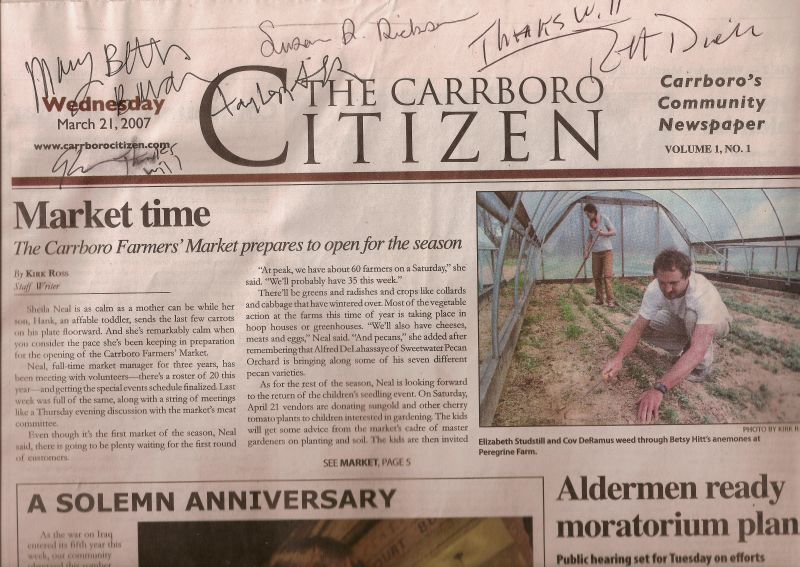
I bumped into the new CarrboroCitizen’s Taylor Sisk and Kirk Ross this morning at Carrboro’s Weaver St. Market. “Where’s the paper?”, I asked. Kirk said that more than 20 folks had already called him asking the same question “Where’s my paper?” Well, they had a few bumps on the road to their premier issue. All’s well, though, as the first content ladened and ad packed edition hit the bricks.

By 3:28pm the papers started appearing around Carrboro – at “the Weave” (inside by the cash registers), at the Orange County Social Club, hand-delivered by Mary Beth to her customers, tossed in the drive of the first 18 home subscribers (all signing up early by “word of mouth”).

I like the CarrboroCitizen’s home delivery model – “don’t ask, don’t get”. The first few times I called Ted Vaden, who ran the Chapel Hill News, was to complain about the 3 or 4 copies of each edition showing up in our drive. We lived on the corner of Wyrick and Barclay, sharing a house with another apartment. For some reason the U-shaped drive attracted multiple deliveries – one of which was sufficient (my neighbors usually pitched the paper directly into the recycling bin or, rarely, used it to scrape up the dog poop along Barclay). I thought about that when I was writing the “My View” column for the Chapel Hill News: just how many of my columns went straight to scraping poop up off the roadway?

What a year for Kirk Ross, the editor of the CarrboroCitizen. I’d run into Kirk a few times over his many years in Town, and though he is a friend of my brother Steve, never really talked with him at length. That changed last year when we both camped out at my brother’s house during SxSWi 2006. Over the week we talked about new media, citizen journalism, citizen activism, developing a brand as a journalist, leveraging the wisdom and interests of the community to better our community, newspapers – living, dying, lost and in-limbo, music, Austin’s “scene”, BBQ Texas-style, politics (lots and lots of politics – local, state and national) and, along with ae [arsepoetica] and her boy-toy db, the incredible Las Manitas.

Coincidentally, it was that same week that CitizenWill really got started.

I think he was casting about for a new direction, a new vibe. I had a few conversations with him since about his developing “brand”. Over the last year he’s traveled the State reporting back via the Cape Fear Mercury, kept his finger on the fibrillating pulse of our somewhat nutty North Carolina legislature via his Exile On Jones Street ‘blog, continued to publish at his former gig – the Indy – and, now, not only help create a new Carrboro newspaper from scratch but inverted current conventional wisdom – using the paper’s ‘net content to deliver a physical product.

Wow! A bold experiment worth the support of the Carrboro community. Congratulations and good luck guys, the news keeps on rolling and you only have 147 hours, 21 minutes until the next edition is due.

Raleigh LEDs the Way

Comparison in life, I guess, is inevitable.

Hey, even if there’s a tiny bit of vanity bragging about Chapel Hill – “look how smart I am to live in the Southern slice of Heaven” – I probably indulge in it as much as anyone else. Folks brag about how progressive, sensitive to civil liberties, environmentally conscious our Town is in spite of examples to the contrary.

For instance, not too long ago Council member Kleinschmidt suggested Wilson and Rocky Mount were not quite up to Chapel Hill standards yet those communities underwrite more than a hundred hands-on arts programs and have built facilities to support the arts in general. On the other hand, progressive Chapel Hill’s one hands-on arts program teeters on the brink of extinction.

Civil liberties? Chapel Hill leads the way much of the time with the occasional incredible lapse.

Environmentally conscious? Many times with, again, some unfortunate glaring exceptions.

Besides noting Council’s leadership faux pas, Jim Ward recently pointed that even the simplest of energy saving efforts – using efficient light fixtures at Town Hall – never get very far.

Raleigh, though, is making a bold commitment to reduce energy and save some bucks in the process

Last week, the City of Raleigh announced a plan to possibly use light emitting diodes (LED’s) to light city streets throughout Raleigh.

Although more expensive initially, compared with regular lights, LED’s last much longer and use much less electricity. According to city, some LED’s may last as much as 20 times longer than regular incandescent lights.

At a city hall news conference on Friday, Mayor Meeker and the CEO of Triangle-based LED maker Cree, Inc. announced a partnership to perform a cost-benefit analysis to possibly replace as many city lights as possible with LED’s.

The city says that the mayor hopes that the “LED City” initiative will serve as a model for other cities that are considering implementing energy-efficient measures.

“The City of Raleigh is willing to set the pace and invite other municipalities to join in developing energy-efficient civic centers,” Cree CEO Swoboda said. “This leading edge effort is undoubtedly an important driver in LED adoption within the United States.”

Raleigh Chronicle, February 19, 2007

I own shares in Cree. That said, they have a great product that, at least I think, will shake up the world one day.

Raleigh Mayor Meeker said that it is “sound fiscal and environmental stewardship” to investigate the application of LED’s “as broadly as possible.”

The analysis on how LED’s can be used will be performed over the next 18 months, says the city.

In his comments, Mayor Meeker said that there may be “substantial potential savings from converting the City’s more than 33,000 streetlights to LEDs.”

According to the city, Raleigh spends more than $4.2 million annually for electricity to power the streetlights and estimates that 30 percent of its energy costs are for lighting.

According to the city, Raleigh electric provider Progress Energy says the floor equipped with LED lights will use over 40 percent less energy than the standard lighting system and will actually provide better lighting.

Raleigh Chronicle, February 19, 2007

Fixing Chapel Hill’s policy of using inefficient, poorly sited, streetlight fixtures kick started my life as a local concerned citizen. Six years ago, and occasionally since, I’ve asked Council to revise our current lighting policies, direct Duke Power to install more efficient fixtures and adopt the standards developed by light pollution experts for the International Dark-Sky Association.

Better, longer lasting lighting that operates much more efficiently at a cheaper cost when amortized over its extended lifetime.

Seems like an easy decision to me. We should take Raleigh’s invitation to participate.

Raleigh’s Carlton Place: A Downtown Affordable Housing Commitment Worth Emulating

I’ve followed the ins-and-outs of Raleigh’s Carlton Place before the Wallace Deck/Lot #5 developments took flight.

64 of the 80 units – ranging in size from 800 to 1200 sq./ft. – are priced so those making %60 of Wake County’s median income can afford one.

Market rates aren’t too shabby either (market/affordable): 1 BR/1 BA $700/$550 or less, 1 BR/1 BA (with Den) $750/$570, 2 BR/2 BA $875/$600, 3 BR/2 BA $1,100/$670.

Located at the intersection of E. Davie Street and S. Bloodworth Street, less than two blocks from Moore Square, City Market, and the Exploris and Moore Square Museums Magnet middle schools. Its central location provides residents with easy access to all of downtown’s employment, shopping, professional services, public transit, and cultural and recreational opportunities.

Amenities found at Carlton Place include on-site management and maintenance; a variety of one-, two- and three-bedroom floor plans ranging from about 800 to 1200 square feet; a fitness room, business center and laundry room; walk-in closets; washer and dryer hook-ups; cable television and Internet connections; a picnic area and tot lot; and private, off-street parking.

In addition to the on-site amenities, the project was built to include green design elements that help make it an environmentally friendly and cost-effective place to live. Among the green features of the project are: Energy Star appliances; high efficiency heat pumps; low-VOC carpet and paint; carpet padding made from recycled materials; pervious concrete; and native, drought-resistant plants for landscaping.

Off street parking? Are they nuts?

By contrast, the Lot 5 development offers compact affordable units: “21 one-bedroom units be provided in the project, with a square footage averaging 643 square feet.” Qualification starts at %80 of the regional salary (little less than $50K), with the purchase price set accordingly (to what someone earning $50K/year could “afford”). Condo fees capped at %1.5 of that sales price of the affordable units plus utilities.

Of course, folks will “own” their apartment on Lot #5 while those at Carlton Place will only rent. Chapel Hill’s condo owners, then, will experience a modest growth in equity and see a return on their investment (minus the %1.5 yearly fees) while those in Raleigh don’t.

Ownership is supposed to also reduce unit churn – a favored attribute over apartments – an attribute that appears to be unique to Lot #5 as our local affordable housing advocate Robert Dowling noted when commenting on “Mr. Meadowmont” Roger Perry’s new East 54 (University Inn) project:

Meadowmont developer Roger Perry is planning a major project that challenges the town’s inclusionary affordable housing model.

In exchange for the town’s approving high density — half a million square feet on 11 acres — Perry is offering to double the town’s requirement: 30 percent affordable housing, or 60 out of 200 condos.

Robert Dowling, executive director of the nonprofit Orange Community Housing and Land Trust, praised the idea. But he urged the Town Council to reject it. Dowling said the flood of condos would be harder to manage because condos are smaller starter homes that few people would live in for very long.

Lower-cost condos criticized The News & Observer February 17, 2007

Perry’s East 54 units “one- and two-bedroom units would range in size from 700 to 1,000 square feet and would be priced somewhere in the low $100,000s”.

Bigger, cheaper but will churn faster than those condos on Lot #5? Doesn’t compute.

Back to Raleigh, the taxpayers’ outlay was at least 5-fold less than our taxpayers, $1.5M to our $7.5M.

A $1.5 million loan from the city and county helped the non-profit housing company, DHIC, develop a $10 million project. Apartments are available to families earning 60 percent of the median income. In Raleigh, that’s $43,000 for a family of four.

WRAL, Feb. 26th, 2007

Larger, cheaper units with on-site parking, no condo fees, many amenities without creating a slew of publicly financed million dollar condos? That computes.

What about that housing cost disparity?

“It’s so important for downtown to give opportunities for multiple classes to help build a life in downtown,” said Kris Larson, deputy director of the Downtown Raleigh Alliance.

It allows people who work in the service industry downtown to live downtown.

“If only people who can live here have to buy a $350,000 condo, what kind of community is that, it’s not very diverse or vibrant,” said Natalie Connell, of DHIC.

WRAL, Feb. 26th, 2007

Vibrancy. That also computes.

What kind of mix of residents will live in our publicly underwritten Lot #5? Well-to-do students, young professionals, retirees that can drop between $300,000 and $1 million plus on housing?

Raleigh designed in diversity and environmental sanity from the start with their Carlton Place project, as the ‘blog Raleighing reports (Carlton Place Opens With Fanfare):

Eight of the units are set aside for, and affordable to, persons with disabilities. Additionally, 4 units are fully accessible to people with mobility impairments, including curbless showers. One resident benefiting from this is Raleigh native and reigning Ms. Wheelchair North Carolina, Ms. Kelly Woodall.

Carlton Place also received a grant from the Home Depot Foundation to incorporate “Green” elements in the design of the development. Carlton Place features Energy Star appliances, low VOC paint and carpet, pervious concrete, low flow plumbing, and solar reflective roof membranes.

According to Gregg Warren, Executive Director of DHIC, the first residents are employees of The City of Raleigh, Wake County Public Schools, Blue Cross Blue Shield, Capital Area Transit, retail businesses, state government, and Wake Med. Many are now able to walk to work. DHIC is also the developer of Murphy School Apartments and the Prairie Building in downtown Raleigh.

End of the day? If increasing Downtown’s population, diversity and vibrancy in a sustainable, environmentally sound fashion is your goal, Raleigh’s Carlton Place suggests some solutions.

The Carrboro Channel: Streaming Video Tonight

Carrboro continues to beat lead Chapel Hill in innovation – whether it is Downtown music festivals, freely available Internet access or commitment to hands-on arts. In spite of the long effort by Chapel Hill’s now defunct Technology Board to bring video of public Council, Planning Board, forum, etc. meetings to the accessibility inhibited website, the Town is only now poised to deliver.

Carrboro isn’t waiting on us. From the Chapel Hill News timely ‘blog Orange Chat:

The town of Carrboro asks that viewers keep in mind there may be technical difficulties since it’s a test. Currently, only Microsoft Windows users will be able to watch the live stream.

You can connect to the stream at any time before or during the meeting by visiting the government page of the town of Carrboro’s Web site.

Meiling Arounnarath post Watch a live meeting, but not on the ‘tube’.

Now, longtime readers know I have a problem with using proprietary Microsoft-only technology for public records (Proprietary Public Policy: Chapel Hill Streaming Video Goes Live?) but I’m not worried – Carrboro’s IT staff generally hews to the open source way.

Lot #5 Development: “…up through the ground come a bubbling crude…”

Well, not quite “black gold” or “Texas tea” but it appears that more “refined trouble” is brewing under Lot #5 (MAP).

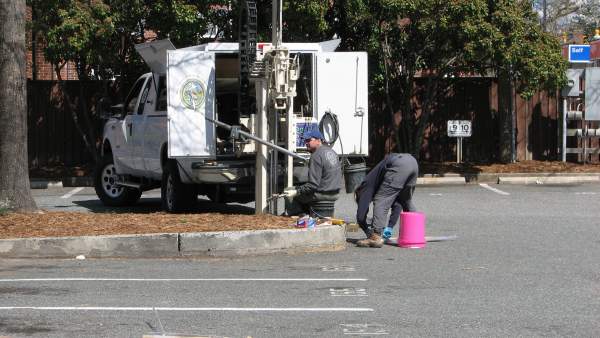
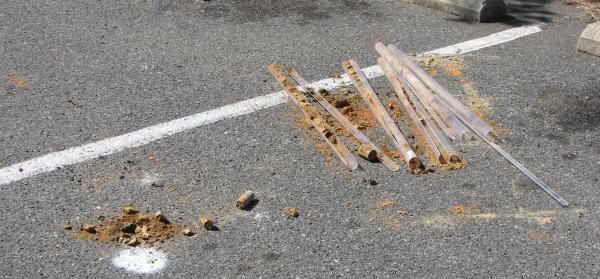
Chapel Hill’s taxpayers will have to wait for next week’s official lab confirmation but, as of today (Mar. 20th, 2007), initial field tests of some of the nearly 30 core samples show “interesting” signs of contamination.

Hazardous waste remediation involving the fractured geology below the lot could prove to be quite expensive – launching the total taxpayer commitment to just south of the $12.5 million of equity that RAM Development, the Town’s private partner, is contractually obliged to contribute.

Of course, RAM will easily recover their equity and make millions on the deal. The fine folks of Chapel Hill will get an expensive hole in the ground.


Folks started calling on the Council to pull their heads out of the sand and do this environmental assay over a year ago, well before entering final negotiations with RAM Development. Council members Jim Ward and Laurin Easthom, before voting against the Lot #5 proposal, strongly argued that the “known unknown” of contamination deserved evaluation before signing the deal.

Unfortunately, caution, that night, was overridden by the zeal for the deal.

Another expensive “known unknown” lurking in the wings has been the cost of digging two stories below Lot #5’s current grade. I work across Church St. and recall the difficulty the developers of my building had with “the ROCK”. “The ROCK” underneath Chapel Hill’s Downtown has been the bane of many a stalwart developer. UNC has spent millions over the last few years tussling with “the ROCK”.

An incidental consequence of the technician’s drilling cores during this current environmental assay is a better understanding of the parking lot’s underlying geology. The optimism the Town showed – expecting to escape the vicissitudes of other Downtown developers – needs to be tempered by the measured reality of the last few days. It appears, again pending a final report, that “the ROCK” on the Franklin St. side of the lot is roughly 10′ below current grade tapering to 20′ on the Rosemary side.

If you live near Downtown, I suggest an early run to the store for ear plugs before blasting begins 😉

Lot #5 Development: Two Pictures 1,000 Words Apart

Looks like this will be the last Spring I watch these trees bloom…


and the last year I’ll see Chapel Hill’s Downtown signature church steeple from the second floor roost of where I work.


Cline Associates Concept Plan Drawing for Lot #5


Corner of Church St. and Frankin St., Chapel Hill, NC – Mar. 18th, 2007 [MAP]


Not quite “Where’s Waldo?” but, to twist a phrase from Sesame Street, one of these things is not like “reality”.


I remember when many of these trees were planted, have watched them develop over the years. I wonder how long I’ll remember their flowering? The memory of those wonderful gateway trees to University Square and along Franklin, since replaced by the green poles of the Church St. signal lights, are still firmly rooted in my mind, maybe these too will persist.

The HeraldSun Turns A Corner: Trouble on the horizon at lot 5

The HeraldSun’s editorial stance on Chapel Hill’s Lot #5 project has always been somewhat “peppy”.

Tom Jensen’s Chapel Hill Herald (CHH) columns have been singularly reflective of the papers ebullient attitude towards this troubled development. In spite of the narrowing scope – halving the size of the project – and escalating taxpayer commitments – keeping the cost the same, increasing the public outlay 15-fold, ignoring the potentially expensive hazardous waste remediation, discounting further cost increases – the message continued to be move forward at a reckless rate and let the details be damned.

Tom,a recent graduate of UNC, political insider, Sierra staffer and Chapel Hill Planning Board member looks forward to the day he can live Downtown:

On a personal note, one of the reasons I love this project is that I would like to live in it myself.

I don’t own a car and I commute by TTA to work in Raleigh every day. Lot 5 is about two minutes away from where I pick up the bus. It would be great to be able to walk right out of my house, catch the bus, and then come home at night and meet my daily needs within walking distance of my condo.

Right now there’s nowhere that meets both the niceness and affordability criteria I would need to see to live on Franklin or Rosemary Street.

Affordability, Tom, considering the $385-$415 per square foot price of the condos, is reserved for those qualifying for the affordable housing component. It might be tough to qualify if Councilmember Strom makes good on his statement that the bulk of these roughly 600 square foot affordable units will be used for families.

Today’s HeraldSun editorial takes a different, more cautionary tack.

Let’s hope they don’t find anything. Let’s hope the environmental assessment, being undertaken this weekend, on downtown parking lot 5 shows no problems at all.

Because if it doesn’t, there are very serious consequences.

Yes, it would be nice to think there is no hazardous material to remove, but with at least one known gas station sited on that lot, it isn’t likely. Serious? The price tag could run into the millions.

And from what I observed this weekend, digging a deep parking deck just got a lot more expensive.

The editorial continues with this interesting assertion:

It is the linchpin for the town’s attempt to reinvigorate downtown, to bring more people to live by the community’s historic core, to create a market for downtown businesses and to make sure the area remains the vital, throbbing heart of Chapel Hill.

As I’ve mentioned before, this project lacks a “communal” center – something like a grocery store – to both serve the residents of the complex and to draw in the thousands of walking distance residents noted in recent cautionary testimony before Council. The commercial component seems oriented towards boutique shopping – Sunglass Huts and Jumba Juice – over sustaining, locally-owned concerns.

Because that goal is so important, the town has been willing to accept a far-less beneficial deal to develop lot 5. What once was an arrangement last year with the private developer that would have cost the town under $1 million, now may cost more than $7 million — and that price could be going up.

We have noted in the past in this space that on balance, the increased financial liability for the town still was worth it. The ultimate benefit — to downtown and the entire community — would offset the increased cost.

It is nice to see a bit of concern about the value returned being somewhat in the ballpark of the value given – even if the editorials numbers are off by a factor of 2 on the low-end. The original investment was $500,000 with a more restrictive land deal – increasing to today’s $7.3 million with a real-estate giveaway. And, of course, the $7.3M figure doesn’t incorporate the true value of the property – commercial real-estate folks have quoted $5-$13 million conservatively, the probable high costs of environmental remediation, the slew of new expensive consultants to manage our Town’s end of the deal and another round of predictable increases (like having to deal with a huge rock under the lot).

But if the consultants conducting the assessment this weekend find evidence of possible environmental contamination at the site — and previous consultants had, in fact, found that kind of evidence — the town, as the owner of the property, would have to pay for any cleanup needed.

There’s no telling, at this point, how much that could cost, but the price tag could be significant, in the millions. If it is, that could jeopardize the entire project. If it is, that probably should jeopardize the entire project.

The town cannot afford — either literally or figuratively — to put excessive sums down the deep hole being bored this weekend at lot 5. Let’s hope it doesn’t come to that, but if it does, the town should be ready to cut its losses and head in a different direction.

Absolutely correct. On the cusp of expanding the Lot #5 moneypit I hope the majority of our Council reassess our citizen’s liability – drops the current deal – totes up the “lessons well-learned” and starts again.

Lincoln Arts Center: The Clock is Ticking

Nice summary of Chapel Hill’s Lincoln Arts Center’s problem locating a new home by Jesse James DeConto in today’s Chapel Hill News.

Sooner or later, the popular pottery program is going to have to leave its home at the Lincoln Center, the administrative office complex of the Chapel Hill-Carrboro City Schools on Merritt Mill Road. The school system is short on office space, and district officials have said that eventually they will have to reclaim the studio for offices and storage.

“The schools really do need this space at some point,” said studio manager Carmen Elliott. “They’ve been renting a lot of space for their workers.”

The studio has operated at the Lincoln Center for 30 years. The current lease will expire on Dec. 31. Elliott worries that losing the space will signal the end of the pottery program.

“It’s been a great, great place to be,” she said. “I’d really hate to see it fold.”

It has been more than two years since the incredibly loyal and enthusiastic Lincoln Arts Center family joined together to save this vital hands-on arts program. It has been more than a year ago that they presented one of the most moving citizen-led petitions I’ve ever witnessed to the Town’s Parks and Recreation Commission. And nearly as long ago that this band of dedicated art enthusiasts petitioned Council.

It has been nearly one year since the Chapel Hill News Editor Mark Shultz’s “Pottery Predicament”

Phyllis Swank’s latest sculpture looks like a cross between a heart and seashell, its waves inviting your fingers to gently grab hold. People have told her it looks like something from the ocean, but she hasn’t heard the heart reference before. She’s momentarily taken aback, because she was thinking about her nephew — who had been killed in an accident — when she molded it from a melon-sized piece of brown clay.

Schultz’s May 10,2006 Chapel Hill News editorial

Followed by last Fall’s renewed efforts to focus Council’s attention.

For all that upfront attention, this “little” program – having served 8500 young, old, autistic, rich, poor residents over 30 years – teeters on the edge.

Please contact our Council (CONTACT ) and let them know that hands-on arts is a vital to our community – that this unique 30-year old program deserves a new home in which to flourish.

Trash Talk: I Like Vinegar on My BBQ

The old Southern saying goes “You can catch more flies with honey than with vinegar.”

Then again, there’s nothing like a little vinegar or Tabasco to cut though the cloying fat of smoked BBQ.

An open e:mail to the Orange County Board of Commissioners:

On Tuesday evening, at the Orange County BOC meeting in Hillsborough it became glaringly apparent there was a complete failure of do diligence in the Waste Transfer Station site selection process. In fact there was no real process at all. Chairman Carey, 2 years of talking is not a process, it was just 2 years of talking and no basis for a decision.

Unfortunately if this failure is allowed to stand the people who will most directly carry the consequences and burden will be the working class African American community on Rogers Road, the same people who have carried the burden of the county’s landfill for 34 years. There is absolutely no way to deny that this failure to act professionally is in itself an act of environmental injustice. There is much irony in that Orange County is considered the most progressive county in North Carolina, and home to Senator Edwards and his Presidential Campaign which is centered around helping the “Other America”.

My anger was apparent at the meeting and still apparent in this e-mail, I make no apologies. I am not a politician or a policy wonk. Nor do I make a pretense of tactful persuasion. My wife’s parents lived their lives in north central Philadelphia and were 50 plus year members of the Zion Baptist Church which was led for many years my the late Reverend Leon Sullivan. When visiting my in-laws they would bring us to the church even though I am not a Christian. Listening to Reverend Sullivan was always an education and an inspiration. In my early twenties I remember Reverend Sullivan talking about personal integrity and professional integrity and that both were tied hand in hand. He told us that we can not claim to have one without the other. He was relating this concept from his involvement with American and international business executives and political leaders.

It became obvious in Tuesday’s meeting that the Waste Transfer siting process had , no professional integrity, no intellectual integrity, no moral or ethical integrity and formed no solid basis for any decision. Chairman Cary, in your e-mail response of 2/17/07 to my request of all the leaders of this community to take as stand on this issue, you said to quote:

“… it would be premature and unethical in my opinion for any elected official to respond to you as you have requested prior to considering all information which must be considered to make an informed decision on this matter.”

With all due respect, by calling for a vote on this issue on Tuesday you were violating your own stated ethical standard. It is clear The Orange County BOC nor anyone else for that matter has all the facts needed to make an informed decision. It is now in the open that the Orange County BOC has never directed anyone or any group to get all the facts.

It is also misleading that the BOC can only start “mitigation talks” to compensate the Rogers Road community after a site is chosen. The Rogers Road community has already earned that compensation through their 34 years of sacrifice. Why should they have to acquiesce to a Waste Transfer Station to receive compensation? Discussions can start whenever the BOC decides to do so.

It was also clear that Commissioner Foushee, Commissioner Jacobs and Commissioner Gordon were struggling with what they witnessed Tuesday night. Commissioner Foushee was the first to speak with eloquence and concern, articulating her distress on the deficiencies of the process to date. She expressed the desire to get this right. If an academic study were to be conducted on the right and wrong ways to site a waste facility as things currently stand Greensboro would be the case study of the right way and Orange County would be the contrasting case study on how get it all wrong. I am asking all the commissioners: Are you proud of where we are on this issue? Are you proud of how we got here? Is this an example of good governance?

If each of you abide the principle of tying personal and professional integrity together then you have no choice but to vote against siting the Waste Transfer Station on Eubanks Road. You have no choice but to restart the siting process.

David Richter

I published David’s earlier correspondence with Commissioner Moses Carey highlighting the lack of a systematic approach in selecting a waste transfer site. Since then, even knowing of this troubling deficit, Carey pushed for an immediate vote to solidify the choice of the Eubanks Road site.

But some sense prevailed during last week’s Orange County Board of Commissioner’s meeting as the other BOCC members responded to both the illogic of the current situation and to the many folks that showed up to ask for more prudence. They directed staff not only to do a more exhaustive evaluation but to incorporate a more multi-dimensional approach like the one I’ve previously suggested.

I’ve heard a few comments from folks that David is coming on a little too strong. I understand his passion.

The calculated lack of process was destined to produce one answer – an answer BOCC member Carey is obviously comfortable with – an answer extending the 34 years of ills the Rogers Road community has borne by decades.

That deficit is so glaring, the troubling consequences to the Rogers Road community so apparent, it is an injustice crying for redress.

And when the redress comes slowly, grudgingly, even a bit bitterly from our elected folk, well, a little bit of vinegar is quite excusable.

Lot #5 Downtown Development: Do you smell gas?

As we know, There are known knowns.
There are things we know we know.
We also know there are known unknowns.
That is to say we know there are some things We do not know.
But there are also unknown unknowns, the ones we don’t know we don’t know.

— Donanld Rumsfeld, Feb. 12, 2002, Department of Defense news briefing

Well we know that Rumsfeld was is a jackass.

What the majority of our Town Council didn’t want to know when they rushed forward on the Lot #5 juggernaut, was the extent of the hazardous waste remediation required to make the site suitable.

Oh, they knew that there had been at least one former gas station on-site.

And they knew that during a previous assay an environmental tech had taken an unauthorized sniff of the dirt that revealed gas fumes.

But rather than taking the prudent step of testing before committing to the Lot #5 boondoggle – making this all to known unknown known – to use a Rumsfeldian turn of phrase, the majority stuck their heads firmly in the sand and instructed the Town Manager to move ahead.

Kind of like Bush and Rumsfeld in Iraq. Jump first, measure the consequences later. And we know how effective that has been.

What’s the big deal?

Beside making a decision that has already undercut our Town’s moral authority to set the highest caliber of environmental standards it has exposed our taxpayers to a potentially stiff financial penalty.

The “rah rah” growth folks on Council like to say this ridiculously bad Lot #5 deal with RAM Development won’t cost the taxpayers one pretty cent – except for the hundreds of thousands for required consultants, disrupted city services, staff time, etc. – until the Town’s 161 parking spaces are complete.

The problem? Our taxpayers are on the hook for any hazardous waste remediation – remediation that will have to paid for now. The cost, considering the geology, could run into the multi-millions of dollars.

That’s millions of dollars out out of our taxpayers pockets, this year, for one huge mistake. Millions that won’t go to increasing our Town’s commitment to abating chronic homelessness or increasing social services. Millions that might mean the difference between having an aquatics center or losing our quality bond rating.

On a slightly positive note, it looks like some of our Council took my and others concerns to heart.

Most likely too late to squeeze of the deal without some kind of fiscal damage, Town is going ahead with the environmental assay they should’ve done first.

Good news? We’ll find out the broad outlines the environmental damage.

Bad news? We’ll have to start paying millions of dollars this year to cleanup the mess.

Worse news? If this initial assay isn’t done properly or is oriented to quell criticism rather than measure the extent of the true problem – well, the taxpayers of Chapel Hill better be prepared for the “death of a thousand cuts”. Not an unlikely scenario given RAM Development’s halving the scale of the project – keeping the cost roughly the same – and extracting a 15-fold greater financial commitment, $7.5 million so far, from the Town.

This cleanup, if it follows the trajectory of similar projects I’ve been part of, will probably cost quite a bit more than originally anticipated. It will be the gift that keeps on taking.

Hang on to your wallets folks, we’re in for a messy ride.

Parking Lot 5 to Close for Test Borings

The Town of Chapel Hill has hired a contractor to conduct environmental assessments of a site that is selected for a proposed $75 million three-section building complex combining condominiums, retail, and parking on Town-owned Parking Lot 5 in downtown Chapel Hill.

The environmental assessments, to be conducted by Environmental Consulting Services, Ltd. (ECS) will require closing the parking lot located between Franklin and Rosemary Streets at the intersection of Church Street.

Municipal Parking Lot 5 will be closed from 4 a.m. to 1 p.m. Saturday, March 17, from 6 a.m. to 9 p.m. Sunday, March 18, and 8 a.m. to 9 p.m. Tuesday, March 20. All vehicles must be removed. Accommodations will be made for individuals with leased parking spaces. Call the Town’s Parking Services Coordinator at 968-2835 for more information. Motorists may find available parking at the Rosemary Street Parking Deck, 150 E. Rosemary St., Municipal Lot 2 at 100 E. Rosemary St., or Municipal Lot 3 at 415 W. Franklin St.

The environmental assessment will include a geophysical study to determine if underground tanks are present, as well as up to 30 test borings of the soil. While the Town has conducted previous environmental studies, this week’s assessment will provide a more detailed examination of the soil conditions of the site. Engineers will evaluate and describe site hydrogeological conditions; determine the location, type and concentrations of contaminants; and determine the requirements for remedial action based on the applicable regulatory environmental guidelines.

Negotiations with Ram Development Co. are under way since the Council authorized Manager Roger L. Stancil on Feb. 12 to execute the development agreement. Issues for negotiation have included energy efficiency construction, parking for affordable housing, and environmental considerations. Reflecting its commitment to environmental stewardship, the Town has pursued additional information on the site’s environmental conditions as negotiations continue.

The Town has completed an earlier environmental assessment of the Parking Lot 5 site. Following this phase one study conducted by ECS on Aug. 18, 2004, engineers recommended a ground penetrating radar survey be performed to determine if underground storage tanks are located on the site. Next week’s survey will determine if such tanks are located on the site. ECS also performed work on Oct. 27, 2004, and April 13, 2005, for additional explorations to evaluate the depth to rock in Lot 5 as part of the design analysis for underground parking.

Citizens may review information on the Town website about the Downtown Economic Development Project at http://townhall.townofchapelhill.org/projects/dedi/

I’ll be looking forward to the timely release of these reports and plan to review them in detail.

I also will be calling on Council, as I have before, to stop any further movement on this project pending the results of these tests. To give our residents a chance to catchup and reflect on the consequences of “digging a deeper hole”.

Surely they deserve to know how much the hazardous waste remediation is going to cost before having their Council further the process.

My guess, based on the rushed, imprudent and unfortunate decisions the majority of Council have already made on this project, they won’t stop the juggernaut.

Lincoln Center Arts Program Needs a New Home

Karen Fisher’s Feb. 21st letter to the Chapel Hill News:

The Lincoln Arts Center has to find a new home or risk closing its door permanently. The Chapel Hill-Carrboro City Schools administrative offices will be expanding into the space that the Lincoln Arts Center pottery studio has leased for 30 years. Chapel Hill is in danger of losing this incredible self-supporting, community resource. All it needs to continue is a space adequate for hands-on artwork, preferably near a bus line.

The Lincoln Arts Center has provided classes for over 8,500 registered students. These students include school-aged children, senior citizens and all ages in between. The center serves students of all skill levels and abilities including students with special needs.

There is a sliding fee schedule that makes these classes accessible to citizens of many different income levels. Where else in Chapel Hill can such a diverse group of citizens find wonderful arts instruction and explore their own creativity?

There is no shortage of fine teachers and able assistants in the area, but where will they teach and inspire their students if the Lincoln Arts Center studio closes it doors? All other hand-on arts/pottery programs in the area are privately held and out of range for many of our citizens.

What does it say about our community if this program closes down for lack of space? Are we supporters of community-based arts? We certainly have some wonderful galleries and fine artists in our midst. Where else but at the community level do we nurture the creativity of our citizens?

Take action: Come to the next Chapel Hill Town Council Meeting on Monday at 7 p.m. and lend your support. A petition to find a new home for the Lincoln Arts Center will be presented at that meeting.

Take action: Write to Chapel Hill Mayor Kevin Foy (e-mail: kevinfoy@townofchapelhill.org or 405 Martin Luther King Jr. Blvd., Chapel Hill 27514 or telephone: 968-2714) and/or The Chapel Hill Town Council (e-mail: mayorandcouncil@townofchapelhill.org or 306 N. Columbia St., Chapel Hill 27516, telephone: 968-2845).

Absolutely eloquent Karen.

As of now (Mar. 16th, 2007) it appears that the Lincoln Arts Center is homeless and that this unique,self-supporting program is kaput by October unless Council finds it a new home.

I’ll be posting both those calls to save the only publicly supported hands-on arts program in Chapel Hill and further information as the story develops.

NCWARN to Shearon-Harris: Come on Baby Light My Fire! Not!

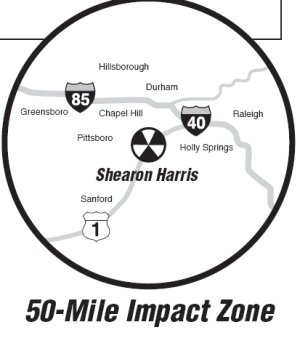
Following up on my Sep. 2006 post “Shearon-Harris Offline: Who tripped over the wire?”, the North Carolina Waste Awareness and Reduction Network (NCWARN) is holding another public hearing Mar. 22nd, 2007 on the 14 years of fire violations at the Shearon-Harris nuclear plant.

FIRE VIOLATIONS AT SHEARON HARRIS NUCLEAR PLANT


Thursday, March 22nd, 7pm
The Barn at Fearrington Village
Google MAP
NC WARN: (919) 416-5077, www.ncwarn.org
15-501 between Pittsboro & Chapel Hill

Public Hearing: New
Information on        legal action against the NRC
 Hosted by NC Senators Ellie Kinnaird and Janet Cowell, and other public officials

 (More on event…Click Here)[PDF]


(More on Harris Fire Violations…Click Here) 


What risks are posed by Harris’ 14 years of noncompliance with federal fire regulations?
Fire is a leading risk factor for nuclear meltdown. When will Harris be in compliance?
Implications of January’s NRC decision to rely on fire mitigation instead of defense against air attacks at US nuclear plants.

From NCWARN’s report:

Fire represents up to 50% of the risk for catastrophic accidents in the U.S. nuclear power industry. That risk calculation assumes fire regulations are being obeyed. Fire can cause operators to lose control of the nuclear reactor and its complex safety systems, leading to overheating of the reactor fuel and large releases of radioactivity. The U.S. Nuclear Regulatory Commission (NRC) has allowed the Shearon Harris Nuclear Plant in Wake County, NC, and others, to operate in clear violation of federal fire safety regulations put into place following a seven-hour fire at Alabama’s Browns Ferry plant in 1975, where only heroic action and sheer luck averted a catastrophic radiation accident.

Harris has been in violation of federal fire regulations since at least 1992, and ranks worst in the nation in at least two critical fire safety criteria. At Shearon Harris, commitments to correct the fire vulnerabilities have been made, then ignored, in a cycle of endless delay over the years, even as more violations continue to be discovered. A 2005 inspection became at least the 10th time Harris reported new violations, adding to a list totaling scores of unprotected components needed to safely shut down and cool the reactor in the event of a plant fire. Shearon Harris has already had several fires in its 19 years. One, called a “major fire” by an industry publication, was caused by an electrical short. It required 30 firefighters, and caused a plant outage lasting for weeks.