Category Archives: Ruminations

One Cat’s Slaughterhouse

Kurt Vonnegut, the satirical novelist who captured the absurdity of war and questioned the advances of science in darkly humorous works such as “Slaughterhouse-Five” and “Cat’s Cradle,” died Wednesday.

CNN Apr. 12th, 2007

A little off track for Citizen Will but I consumed more than my generation’s share of Vonnegut at quite an early age.

“Welcome to the Monkey House”, “God Bless You, Mr. Rosewater”, “Cat’s Cradle”, “Slaughterhouse Five”, “Breakfast of Champions” (!!! for this 10 year-old reader), Kilgore Trout and so much more demonstrated a perverse and subversive twist, at least to someone raised on a steady diet of Asimov, Clarke, Bradbury, Pohl, Le Guin, Silverberg, McCaffrey, Lovecraft, Burroughs (the John Carter of Mars one), Kornbluth, Zelazny, Simak, L’Engle, Norton, Heinlein, Sturgeon, Herbert, Clement, etc. on my beloved sci-fi genre.

Like the twisted worlds of Philip K. Dick, Vonnegut’s works exposed me to the 60’s counter-revolution from a non-authoritative, outside the mainstream media, perspective.

I still vividly recall the Mar. 13th, 1972 PBS showing of Prometheus 5, a truly bizarre, disturbing and, at points, scary pastiche of Vonnegut’s earlier works. Particularly upsetting were the worlds of “Harrison Bergeron” and “Welcome to the Monkey House”.

The world of “Harrison Bergeron” features a shotgun-toting Handicapper General enforcing the law of the lowest common denominator – a false equality regulated by equipping all citizens with artificial “handicaps”.

In the over-populated world of “Welcome to the Monkey House”, the chemically sexually numbed citizenry is encouraged to visit their local Federal Ethical Suicide Parlors and “ethically” remove their small burden on the teetering ecology. Provocative, and in some ways, visionary.

Hard to believe PBS ever showed such strongly dystopian material.

With Vonnegut’s passing, we also lose one of the few remaining iconoclastic American writers who served in World War II. Vonnegut, as a close observer of the Dresden fire bombing, knew the literal heat of war. The Vietnam mess sharpened his dystopian outlook. I wonder if our current mess in Iraq will sharpen the dystopian pens of writers yet to come?

The Power of Sorry

It’s been nearly a year since the General Assembly’s 1898 Wilmington Race Riot Commission released their 1898 Wilmington Race Riot Report.

Tonight, NPR’s Laura Leslie, over on Isaac Hunter’s Tavern reports:

State lawmakers made history today by unanimously (both chambers!) passing a resolution apologizing for their predecessors’ role in promulgating slavery in North Carolina.

Lawmakers from both sides of the aisle spent two and a half hours speaking in support of the apology…about their personal experiences with discrimination, about the bigger social issues at play in this apology, and about the hostile feedback they’ve received from some constituents who see the apology as a waste of time or worse.

House Majority Leader Hugh Holliman delivered a simple but jaw-dropping history lesson — three minutes on what the state should apologize for. You can hear it here.  It’s well worth the download time. 

One of the follow ups was from our eloquent North Carolina NAACP President Rev. William Barber:

…repentance doesn’t mean much unless you’re willing to back it up. 

You can read the NAACP’s full reaction here.

One of the State’s more powerful media outlets, the News and Observer, began to experience the “power of sorry” more than a year ago when they started to unravel former editor Josephus Daniels complicity (“1898 riot designed to disfranchise blacks”) in Wilmington’s terrible tragedy.

The paper’s Nov. 17th, 2006 coverage,The Ghosts of 1898 ,helmed by Oxford native Tim Tyson ( “Blood Done Sign My Name”) extended the amends.

In a week with several reminders of how far we’ve yet to go, the legislature’s unanimous “mea culpa” for their predecessors’ actions (or inactions) is more than welcomed.

Hazardous Consequences: Mystery of the Vault Contest

[CLARIFICATION]

Everyone gets two (2) guesses – their “real” guess and an outlandish assessment (please, keep it clean. Yes, skeletons are welcomed).

[UPDATE:]

Over on SqueezeThePulp former (and soon to be?) Carrboro Board of Alderman candidate, Orange County Democrat Women President, local businessperson and activist Katrina Ryan has offered a delicious La Rez meal for the grand prize winner and guest.

Thanks Katrina for stirring the pot!

[ORIGINAL:]

I’ve covered the devolving fortunes of our Town’s Downtown Development Initiative (DDI) since last Fall.

Throughout, I’ve referred to the Lot #5 development as an expensive boondoggle, a miserable mistake, poor public policy, a looming Behometh, a monument to the triumph of political ego over the public good.

I’ve also called it a potentially vast money pit.

Our elected folks might argue with most of my characterizations but not, it appears, my claim that Lot #5 is a money pit.

According to the recent environmental assay, Lot #5 contains

An unknown feature located at position A was identified as a potential metal vault approximately 8ft by 10 in area.

Former Councilmember, NC legislative bill drafter and longtime Chapel Hill observer Gerry Cohen speculates on the vaults contents:

I’m going to assume that Ross Norwood abandoned the vault when his lease was terminated around 1970 and he was kicked off the site. I will offer advance speculation that it is filled with cash. I’m being serious about this. I think I posted earlier about the swindle with his dollar bill machines, and there was a post in another thread on OP from a former employee at Ross Norwood Esso about “questionable ethics”.

Like Geraldo Rivera’s Al Capone’s mystery vault stunt, the over-hyped Lot #5 project is already fated to disappoint.

Whether the vault exists, has cash in it or not, I thought the mystery was worth some speculative fun and a community reward.

To that end, I’m sponsoring a contest to reward two local community organizations with cash donations.

Post a comment on this thread detailing your ideas about:

  • the most outlandish, Chapel Hill related, treasure this vault might contain (Dean Smith’s bronzed baby shoes?) and
  • the most accurate description you can summon on the vaults contents (a $100,000 in singles as per Gerry) or what “the vault” might actually be (Jerry Garcia’s missing VW Bus?)

Rules:

  • Please keep entries clean and “family friendly”.
  • Winners will be selected based on accuracy and creativity.
  • I will contribute $150 to each winning person’s local charity/organization of choice.
  • Though the awards will stay within our local community, local residency is not required.
  • Sorry, no one working for the construction or excavation firms can participate.
  • Contest closes one hour before the vault is revealed.
  • Finally, while I’ll be the sole judge on both criteria, please feel free to influence the outcome by voting for what you think is the most outlandish, creative idea.

So, some good – and a bit of socially redeeming revenue – will come from building on Lot #5.

I invite other organizations more PR savvy (Liz, maybe the Downtown Partnership?) to build an “event” around this vaults unveiling – it might be the most “rewarding” aspect of this project for years to come.

Hazardous Consequences: A Report, a Rushed Decision, a Regrettable Day for Chapel Hill

The Chapel Hill News’ ‘blog OrangeChat first alerted me to the Town’s completion of the Lot #5 negotiations with RAM Development (more to come in the N&O).

The Town’s April 3rd news release celebrates what I believe will eventually be seen to be a rushed decision foisting a counter-productive, fiscally irresponsible obligation to construct expensive rental properties for out-of-town landlords on our citizen’s dime:

04/03/07 — The $75 million residential and retail complex to be constructed on Town-owned Parking Lot 5 in downtown Chapel Hill moves a step closer to reality. Town Manager Roger L. Stancil today concluded final negotiations and executed the development agreement with Ram Development Co.

April 3rd, 2007, a regrettable day in our Town’s history.

Why? According to our Town’s legal counsel, the only way now to back out of this troubled deal is to default. Default means difficult to defend lawsuits against our Town. Default means probable expensive judgments against our community. Default, after today, puts all our residents firmly on the hook for millions of dollars of expenditures.

The Council last month authorized the Manager to finalize negotiations and execute the agreement. The project will now follow the Town’s normal regulatory process for a Special Use Permit, including review by the Town’s advisory boards and commissions and a public hearing before the Council.

While they did authorize the Town Manager to proceed with negotiations, the Council also directed Roger Stancil to achieve certain goals – like a firm commitment to improve energy efficiency as per ASHRAE 90.1 20% efficiency standards and an increase on-site affordable housing parking.

Without the final modified agreement (not available this evening), it is not clear our Town Manager achieved these goals. Further, for the partial success reported – 5 additional on-site parking – the trade-offs required by RAM to get those spaces remains unknown.

Final negotiations centered on energy efficiency construction. Recognizing the importance of reducing the energy demand of buildings and dependence on energy from fossil fuels, the Council directed that the agreement require the design and construction of the project to meet a minimum 20 percent improvement in energy efficiency (as measured against standards established by the American Society of Heating, Refrigerating and Air-Conditioning Engineers – ASHRAE).

Again, the language of the announcement leaves it somewhat unclear, at least to me, if the commitment to the ASHRAE 90.1 %20 energy efficiency standard is measurably firm.

[UPDATE] From today’s N&O

As part of the final contract, Ram agreed to achieve an energy efficiency level 20 percent better than standards established by the American Society of Heating, Refrigerating and Air-Conditioning Engineers.

It appears the LEEDs trade-off discussed here was the key to ASHRAE acceptance. Of course, without the final contract before us it’s difficult to ascertain how compliance with ASHRAE or LEEDs will be measured.

The project will incorporate sustainable, “green” features that will result in at least 26 points under Leadership in Environment and Energy Design (LEED) standards, the equivalent minimum number of points for basic certification under the LEED system. The Council has established a Town-wide goal to reduce carbon dioxide emissions by 60 percent by 2050 through the Carbon Reduction Program.

Councilmember Sally Greene suggested trading the potentially expensive formal LEEDs review for simple compliance with the LEEDs basic certification goals. Councilmember Jim Ward countered that RAM Development’s assertion of compliance was insufficient – that the review process was a necessary element to achieving those goals. I lean more towards Sally on this with the proviso that a specific, standards-based methodology for measuring compliance outside of the LEEDs process be agreed upon prior to a final commitment (would’ve been nice to also pursue some of the AIA’s 2030 sustainability goals). Again, sans the modified agreement, it’s unclear whether any process for measuring LEEDs compliance is in place.

To the Town’s credit, the environmental reports I asked for in my Mar. 27 petition were provided as part of the announcement.

The completed environmental assessment report will be on the Town’s website.  The assessment detected no underground gasoline tanks, only limited sections of petroleum-impacted soil that will require remediation.

Timed too late for our talented citizens with expertise in geology and environmental remediation to influence Stancil’s decision, this coincident release demonstrates, once again, the ascendancy of clever political gamesmanship over good public policy.

This bit of Town PR vastly downplays the caveats and disclaimers the authors used:

The report’s findings are based on conditions that existed on the dates of ECS’s site visits and should not be relied upon to precisely represent conditions at any other time. ECS did not assess areas other than those discussed in the report.

The conclusions included in this report are based on: ECS’s observation of existing site conditions; our interpretation of site history and site usage information; and the results of a limited program of subsurface assessment, sample screening, and chemical testing. The concentration of contaminants ECS measured may not be representative of conditions between locations sampled. Be aware that conditions may change at any sampled or unsampled location as a function of time in response to natural conditions, chemical reactions, and/or other events.

Conclusions about site conditions under no circumstances comprise a warranty that conditions in all areas within the site and beneath structures are of the same quality as those sampled. Recognize, too, that contamination might exist in forms not indicated by the assessment ECS conducted.

April 2nd’s letter from ECS Carolinas, LLP concerning the “Phase II ESA and Limited Soil Delineation Report”, p. 2

Based on approximate measurements of the property boundary and sample locations, ECS estimates that approximately 8,600 cubic yards (~13,000 tons assuming 1.5 tons per cubic yard) of petroleum-impacted soil may be present at the site. This is a preliminary estimate only; the actual quantity of potentially impacted soils may vary based on conditions observed during soil excavation. [CW: EMPHASIS by ECS]

April 2nd’s letter from ECS Carolinas, LLP concerning the “Phase II ESA and Limited Soil Delineation Report”, p. 6

The concerns of the report’s authors are clear. What is left unsupported is the Town’s cost estimate.

The estimated cost of the clean-up will be $232,000. The Town will assume the costs for remediation, and the developer will fund the excavation.

So, RAM Development will pick up the tab for excavating 13,000 tons/8600 cubic yards of hazardous material and the Town will pay, I assume, to haul it safely off-site and dispose of it in an acceptable manner. Given the author’s caveats and the lack of discussion of hazardous material intrusions into the underlying bedrock, I’d like to see the analysis behind the $232,000 cost estimate.

Is it as solid as RAM Development’s Spring 2006 claim of a total $500,000 in public outlays? I hope not since a 15-fold increase in the environmental costs, similar to the 10 month increase from $500,000 to $7,425,000 for those 161 buried parking spaces, would be in the neighborhood of $3.5 million!

One notable improvement in our Town’s communications is a savvy ability to propagandize, making a gold-filled silk purse out of the hazardous waste sows ear by now trumpeting development on “brownfields”.

“Developing a project in downtown reflects Chapel Hill’s commitment to build on brownfields rather than greenfields in order to preserve our environment,” said Manager Roger L. Stancil. “Brownfields are properties where redevelopment or reuse can be complicated by the presence or potential presence of pollutants or contaminants from past use. Developing on greenfields is to build on undeveloped properties on the urban fringe, often farmland. Chapel Hill intends to keep the greenfields green.”

A month ago we weren’t supposed to worry about hazardous waste on Lot #5. Today it’s an asset.

There’s a lot of fertile “brown” in the “fields” lay bare by this announcement. Once again, the liabilities are down-played, the potential fiscal “surprises” ignored, the value of the project over-stated while the obligations continue to be heaped upon our citizens.

April 3rd, 2007, a regrettable day in Chapel Hill’s history.
Hazardous Consequences: No Official Word, Yet, On Lot #5’s Hazardous Waste Issue

[UPDATE] As of April 3rd, the Town has provided part of what I asked for in the following petition, the environmental report [PDF]. In the Town’s announcement of a conclusion to negotiations, the figure of $232,000 for a remediation was thrown out. This figure, of which I haven’t found a full justification, would supposedly include removal of 13,000 tons of material to either a hazardous waste landfill or some other remediation facility.

More to come.

[ORIGINAL POST]

A quick follow up on my previous post Lot #5 Development: “…up through the ground come a bubbling crude…”.

I’ve sent Chapel Hill’s Town Council a petition (Mar. 29th) asking for a postponement of any further approvals for Special Use Permits, extending or adding new consultancies, preparing the lot for construction, etc. until the financial liabilities attendant to environmental remediation are fully and timely disclosed.

Further, to avoid the recent mess involving the Rogers Road community, siting a trash transfer station on Eubanks and the Orange County Board of Commissioner’s apparent lack of any discernible specific, detailed and publicly revealed process for making their analysis and decision, that the methodology, data and assumptions are published by Council fully seven (7) business days prior to any approval.

A call from the Daily Tar Heel spurred me to take this action. I was hoping the environmental report, which, from my experience, should’ve taken a short time to prepare, would be published for public review by now. According to the DTH’s reporter, it hasn’t.

My concern is that the “clock” would be “run out” on the hazardous waste remediation issue – that Council would move ahead amassing further public (taxpayer) obligations without adequate background.

To help encourage a full, timely, open and responsible discussion of the hazardous waste issue, I’ve submitted the following petition:

Mayor and Town Council,

I’m petitioning Council to postpone ANY further approvals for the Lot #5 Downtown Development Initiative:

1) until the environmental assay of Lot #5 is 100% completed. This would include any recommended
follow up tests, such as monitoring wells, further core sampling, ground-radar location of
tanks or other structures, etc.

2) until the results of the environmental assay have been independently reviewed.

3) until the results, the independent review, the methodology, data, assumptions, geologic maps
and any other factors used to derive the results have been published 7 days prior to the
approval meeting.

4) until an initial estimate and plan for the environmental remediation, if necessary, has been
developed.

5) until the estimate, the methodology, data and assumptions going into that cost estimate have
been published 7 business days prior to the approval meeting.

6) until a financial impact statement, including additional costs, borrowings and wider effects
on the Town’s financial well-being has been developed.

7) until the estimated financial impact and methodology, data and assumptions going into that
evaluation have been published 7 business days prior to the approval meeting.

It also appears that the underlying geology of Lot #5 might be rockier than expected. If this is so,
Council should also postpone further approvals pending an evaluation of increased costs to the
developer and taxpayers of Chapel Hill.

Considering that an expensive environmental remediation might significantly and adversely impact our
Town’s finances, and, in combination with Lot #5’s current taxpayer obligations, possibly necessitate
either a substantial tax increase or reduction in services or both, the fiscally prudent course of
action is to wait until the facts are reported and the conclusions reviewed by the wider public.

Finally, I would like to highlight the importance of giving the public at least 7 business days of
notice. Our citizens are already concerned about the trajectory this project has so far taken.
Some of the greatest concern has come from financial, urban planning, environmental, energy and
commercial real-estate experts.

Let’s give our talented citizenry the opportunity for a careful, measured evaluation of the
Town’s reports and extend the courtesy of providing a reasonable amount of time to draft a
response.

Rushing the project forward without disclosing further anticipated financial obligations does
our citizenry a disservice.

Thank you,

Will Raymond

I’ll post the response as it comes in.

March 28th: A Self-Advocate Path to Being Well, Feeling Fit

Carrboro’s self-advocate leader Ellen Perry told me that March 28th’s “Be Well! Feel Fit!” meeting would be a great introduction for those folks interested in positive, self-directed change.

Ellen is part of the “Self-Advocate Leadership Network”, a project under the auspices of the Human Services Research Institute (HSRI.org):

The Self-Advocate Leadership Network (SALN) is a team of self-advocates and their allies who will travel anywhere to prepare self-advocates to play a leadership role in shaping developmental disabilities systems to promote self-determination, community integration and participant-driven supports.

Who is a “self-advocate”? “A self-advocate is somebody who has a disability and speaks up for themselves.”

Be Well! Feel Fit! Peer Connections, A Way to Wellness

Healthy living is more than eating your spinach, carrots and Brussels sprouts!!!

Healthy living is about…

  • Doing things that make you happy – like swimming, art or cooking classes.
  • Being in good health – both physically and emotionally.
  • Learning how to be safe in intimate relationships.
  • Making new friends.

Who decides what what I do?

In the Be Fit! Feel Fit! program you decide what you want to do.
You can choose to lose weight, learn a new art or craft or learn how to be safe in a relationship – it’s up to you.

What does the Be Fit! Feel Fit! program do?

We try to match you up with resources in your community and support from your peers to help you achieve your health and wellness goal.

The meeting is at Carrboro’s Town Hall, 301 W. Main Street (MAP).

  • 5:00-7:30 pm for NEW members
  • 5:30-7:30 pm for existing members

For more information contact Ellen Perry ( 919-942-5602 ) or Danielle Doughman ( 919-962-4029 ),

A Matter of Process: Greenbridge and Council’s Devolving Standard of Public Review

I haven’t been reticent in my criticism of the process Council used recently to manage the approvals for Greenbridge, the environmental uber-project and possible end of the traditional Northside neighborhood. Adopting a new zone, TC-3, developed and refined during the months bridging Thanksgiving to Christmas, within the context of Greenbridge’s approval ill-served our citizens.

Claims, most notably by Bill Strom, that Greenbridge’s TC-3 is somehow unique (video coming soon) and folks won’t have to worry about another use will be tested all too soon.

Most of the Council members are aware of the public discussion and scrutiny of the 90′ limit and 1.97 density ratio. Unfortunately, the minimal opportunity citizens had to respond within the public hearing process didn’t reflect those hard learned lessons. Only two citizens spent any of their 3 minutes of public comment suggesting the impropriety of making a major change to Downtown’s future geography within the narrow context of Greenbridge. Doubling the density, raising the height limits by %30, with the SUP establishing a height precedent fully %50 above the previous 90′ will carry serious consequences for “human scale” Chapel Hill. Now that door has been opened, does anyone truly believe developers on our doorstep will not press for even more consequential change?

I recall Sally Greene, prior to being elected to Council, making numerous appearances before Council on OI-4 (the most probable zone for Carolina North) counseling not only greater public outreach but public education. She argued process, process, process and was obviously aware that a significant change in public policy demands a significant effort to build understanding.

Yes, the effort to build understanding can also build opposition. One might argue that the best “political” strategy “playing the approval game” is to keep your head down, limit public understanding and bull on through. Good strategy for a “player”, maybe, but terrible public policy.

Tonight, the Chapel Hill News’ breaks the story, on their ‘blog OrangeChat, that the son of one of our Council members sought to represent the developer of Greenbridge.

Sometime last fall, the son of Town Council member Bill Thorpe approached the developers of the Greenbridge condominium towers and offered to work as their public relations consultant.

Thorpe said his son, William Thorpe Jr., is a grown man and did not consult him before making the pitch.

UPDATE:
From today’s followup in the N&O

Thorpe said his son, William Thorpe Jr., is a grown man and did not consult him before approaching the developers. Thorpe said he only heard rumors that his son had asked for a $40,000 consulting fee.

“He was trying to get a contract with them, but I haven’t done anything with them,” Thorpe Sr. said this week. “It had nothing to do with me.”

Yes, we’ve seen our share of national problems with relatives representing interests before their elective relations but certainly this doesn’t rise to that level. Bill spoke of his son during the 2005 election, I don’t recall his saying he did PR. In any case, Bill made it clear his involvement was nothing to be troubled by: “I ain’t got nothing to hide,” Thorpe said this week. “I can tell you right now, I have not asked anybody for no money.”

[UPDATE] GeorgeC over on OPsays the Mayor and Attorney reviewed this, not the Council, yet the article and post both say “Foy said the council did not pursue the matter further…” Now, was that the Mayor using the royal “We” or did the Council know? I’ll ask either the reporter or a Council member next time I see them. If this was the Mayor acting as the lone “decider”, well, that’s a bit troubling in itself.

[ORIGINAL]
The Mayor and Council, it appears, reviewed the issue on discovering it:

Mayor Kevin Foy learned of the situation before a public hearing on the downtown condo project Jan. 17 and asked Town Attorney Ralph Karpinos for advice.

Foy said the council did not pursue the matter further because Thorpe Sr. was not personally involved. Foy said he believed that his colleague’s hands were clean in the matter.

That January 17th meeting was a key public hearing for Greenbridge.

This is most troubling. I can accept Bill Thorpe’s assertions about his son’s involvement. I can appreciate Council and (?) the Mayor responding immediately with a legal consultation and review.

What I can’t understand, and will not accept, is the absence of public disclosure.

Yes, the appearance of impropriety can sting. Trying to mitigate the possible embarrassment and pain of a friend and colleague is laudable. But these are public servants. Many of these Council members, one time or another, during elections or otherwise, have pledged to increase openness and transparency within our local governance. They (?) The mayor had an obligation to reveal, for Bill’s sake, in as tactful a fashion as possible, this story and not leave it to the 4th estate (Chapel Hill News)

The process of openness and transparency must be consistent to be reliable. The public trust demands and deserves disclosure.

And yet another lapse in judgment related to a development deal.

Raleigh LEDs the Way

Comparison in life, I guess, is inevitable.

Hey, even if there’s a tiny bit of vanity bragging about Chapel Hill – “look how smart I am to live in the Southern slice of Heaven” – I probably indulge in it as much as anyone else. Folks brag about how progressive, sensitive to civil liberties, environmentally conscious our Town is in spite of examples to the contrary.

For instance, not too long ago Council member Kleinschmidt suggested Wilson and Rocky Mount were not quite up to Chapel Hill standards yet those communities underwrite more than a hundred hands-on arts programs and have built facilities to support the arts in general. On the other hand, progressive Chapel Hill’s one hands-on arts program teeters on the brink of extinction.

Civil liberties? Chapel Hill leads the way much of the time with the occasional incredible lapse.

Environmentally conscious? Many times with, again, some unfortunate glaring exceptions.

Besides noting Council’s leadership faux pas, Jim Ward recently pointed that even the simplest of energy saving efforts – using efficient light fixtures at Town Hall – never get very far.

Raleigh, though, is making a bold commitment to reduce energy and save some bucks in the process

Last week, the City of Raleigh announced a plan to possibly use light emitting diodes (LED’s) to light city streets throughout Raleigh.

Although more expensive initially, compared with regular lights, LED’s last much longer and use much less electricity. According to city, some LED’s may last as much as 20 times longer than regular incandescent lights.

At a city hall news conference on Friday, Mayor Meeker and the CEO of Triangle-based LED maker Cree, Inc. announced a partnership to perform a cost-benefit analysis to possibly replace as many city lights as possible with LED’s.

The city says that the mayor hopes that the “LED City” initiative will serve as a model for other cities that are considering implementing energy-efficient measures.

“The City of Raleigh is willing to set the pace and invite other municipalities to join in developing energy-efficient civic centers,” Cree CEO Swoboda said. “This leading edge effort is undoubtedly an important driver in LED adoption within the United States.”

Raleigh Chronicle, February 19, 2007

I own shares in Cree. That said, they have a great product that, at least I think, will shake up the world one day.

Raleigh Mayor Meeker said that it is “sound fiscal and environmental stewardship” to investigate the application of LED’s “as broadly as possible.”

The analysis on how LED’s can be used will be performed over the next 18 months, says the city.

In his comments, Mayor Meeker said that there may be “substantial potential savings from converting the City’s more than 33,000 streetlights to LEDs.”

According to the city, Raleigh spends more than $4.2 million annually for electricity to power the streetlights and estimates that 30 percent of its energy costs are for lighting.

According to the city, Raleigh electric provider Progress Energy says the floor equipped with LED lights will use over 40 percent less energy than the standard lighting system and will actually provide better lighting.

Raleigh Chronicle, February 19, 2007

Fixing Chapel Hill’s policy of using inefficient, poorly sited, streetlight fixtures kick started my life as a local concerned citizen. Six years ago, and occasionally since, I’ve asked Council to revise our current lighting policies, direct Duke Power to install more efficient fixtures and adopt the standards developed by light pollution experts for the International Dark-Sky Association.

Better, longer lasting lighting that operates much more efficiently at a cheaper cost when amortized over its extended lifetime.

Seems like an easy decision to me. We should take Raleigh’s invitation to participate.

Raleigh’s Carlton Place: A Downtown Affordable Housing Commitment Worth Emulating

I’ve followed the ins-and-outs of Raleigh’s Carlton Place before the Wallace Deck/Lot #5 developments took flight.

64 of the 80 units – ranging in size from 800 to 1200 sq./ft. – are priced so those making %60 of Wake County’s median income can afford one.

Market rates aren’t too shabby either (market/affordable): 1 BR/1 BA $700/$550 or less, 1 BR/1 BA (with Den) $750/$570, 2 BR/2 BA $875/$600, 3 BR/2 BA $1,100/$670.

Located at the intersection of E. Davie Street and S. Bloodworth Street, less than two blocks from Moore Square, City Market, and the Exploris and Moore Square Museums Magnet middle schools. Its central location provides residents with easy access to all of downtown’s employment, shopping, professional services, public transit, and cultural and recreational opportunities.

Amenities found at Carlton Place include on-site management and maintenance; a variety of one-, two- and three-bedroom floor plans ranging from about 800 to 1200 square feet; a fitness room, business center and laundry room; walk-in closets; washer and dryer hook-ups; cable television and Internet connections; a picnic area and tot lot; and private, off-street parking.

In addition to the on-site amenities, the project was built to include green design elements that help make it an environmentally friendly and cost-effective place to live. Among the green features of the project are: Energy Star appliances; high efficiency heat pumps; low-VOC carpet and paint; carpet padding made from recycled materials; pervious concrete; and native, drought-resistant plants for landscaping.

Off street parking? Are they nuts?

By contrast, the Lot 5 development offers compact affordable units: “21 one-bedroom units be provided in the project, with a square footage averaging 643 square feet.” Qualification starts at %80 of the regional salary (little less than $50K), with the purchase price set accordingly (to what someone earning $50K/year could “afford”). Condo fees capped at %1.5 of that sales price of the affordable units plus utilities.

Of course, folks will “own” their apartment on Lot #5 while those at Carlton Place will only rent. Chapel Hill’s condo owners, then, will experience a modest growth in equity and see a return on their investment (minus the %1.5 yearly fees) while those in Raleigh don’t.

Ownership is supposed to also reduce unit churn – a favored attribute over apartments – an attribute that appears to be unique to Lot #5 as our local affordable housing advocate Robert Dowling noted when commenting on “Mr. Meadowmont” Roger Perry’s new East 54 (University Inn) project:

Meadowmont developer Roger Perry is planning a major project that challenges the town’s inclusionary affordable housing model.

In exchange for the town’s approving high density — half a million square feet on 11 acres — Perry is offering to double the town’s requirement: 30 percent affordable housing, or 60 out of 200 condos.

Robert Dowling, executive director of the nonprofit Orange Community Housing and Land Trust, praised the idea. But he urged the Town Council to reject it. Dowling said the flood of condos would be harder to manage because condos are smaller starter homes that few people would live in for very long.

Lower-cost condos criticized The News & Observer February 17, 2007

Perry’s East 54 units “one- and two-bedroom units would range in size from 700 to 1,000 square feet and would be priced somewhere in the low $100,000s”.

Bigger, cheaper but will churn faster than those condos on Lot #5? Doesn’t compute.

Back to Raleigh, the taxpayers’ outlay was at least 5-fold less than our taxpayers, $1.5M to our $7.5M.

A $1.5 million loan from the city and county helped the non-profit housing company, DHIC, develop a $10 million project. Apartments are available to families earning 60 percent of the median income. In Raleigh, that’s $43,000 for a family of four.

WRAL, Feb. 26th, 2007

Larger, cheaper units with on-site parking, no condo fees, many amenities without creating a slew of publicly financed million dollar condos? That computes.

What about that housing cost disparity?

“It’s so important for downtown to give opportunities for multiple classes to help build a life in downtown,” said Kris Larson, deputy director of the Downtown Raleigh Alliance.

It allows people who work in the service industry downtown to live downtown.

“If only people who can live here have to buy a $350,000 condo, what kind of community is that, it’s not very diverse or vibrant,” said Natalie Connell, of DHIC.

WRAL, Feb. 26th, 2007

Vibrancy. That also computes.

What kind of mix of residents will live in our publicly underwritten Lot #5? Well-to-do students, young professionals, retirees that can drop between $300,000 and $1 million plus on housing?

Raleigh designed in diversity and environmental sanity from the start with their Carlton Place project, as the ‘blog Raleighing reports (Carlton Place Opens With Fanfare):

Eight of the units are set aside for, and affordable to, persons with disabilities. Additionally, 4 units are fully accessible to people with mobility impairments, including curbless showers. One resident benefiting from this is Raleigh native and reigning Ms. Wheelchair North Carolina, Ms. Kelly Woodall.

Carlton Place also received a grant from the Home Depot Foundation to incorporate “Green” elements in the design of the development. Carlton Place features Energy Star appliances, low VOC paint and carpet, pervious concrete, low flow plumbing, and solar reflective roof membranes.

According to Gregg Warren, Executive Director of DHIC, the first residents are employees of The City of Raleigh, Wake County Public Schools, Blue Cross Blue Shield, Capital Area Transit, retail businesses, state government, and Wake Med. Many are now able to walk to work. DHIC is also the developer of Murphy School Apartments and the Prairie Building in downtown Raleigh.

End of the day? If increasing Downtown’s population, diversity and vibrancy in a sustainable, environmentally sound fashion is your goal, Raleigh’s Carlton Place suggests some solutions.

The Carrboro Channel: Streaming Video Tonight

Carrboro continues to beat lead Chapel Hill in innovation – whether it is Downtown music festivals, freely available Internet access or commitment to hands-on arts. In spite of the long effort by Chapel Hill’s now defunct Technology Board to bring video of public Council, Planning Board, forum, etc. meetings to the accessibility inhibited website, the Town is only now poised to deliver.

Carrboro isn’t waiting on us. From the Chapel Hill News timely ‘blog Orange Chat:

The town of Carrboro asks that viewers keep in mind there may be technical difficulties since it’s a test. Currently, only Microsoft Windows users will be able to watch the live stream.

You can connect to the stream at any time before or during the meeting by visiting the government page of the town of Carrboro’s Web site.

Meiling Arounnarath post Watch a live meeting, but not on the ‘tube’.

Now, longtime readers know I have a problem with using proprietary Microsoft-only technology for public records (Proprietary Public Policy: Chapel Hill Streaming Video Goes Live?) but I’m not worried – Carrboro’s IT staff generally hews to the open source way.

Lot #5 Development: “…up through the ground come a bubbling crude…”

Well, not quite “black gold” or “Texas tea” but it appears that more “refined trouble” is brewing under Lot #5 (MAP).

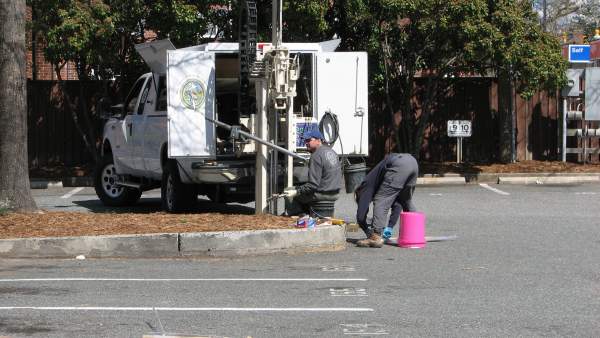
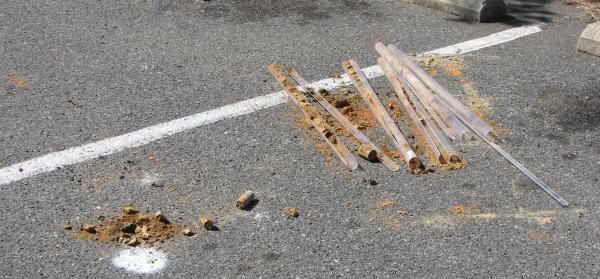
Chapel Hill’s taxpayers will have to wait for next week’s official lab confirmation but, as of today (Mar. 20th, 2007), initial field tests of some of the nearly 30 core samples show “interesting” signs of contamination.

Hazardous waste remediation involving the fractured geology below the lot could prove to be quite expensive – launching the total taxpayer commitment to just south of the $12.5 million of equity that RAM Development, the Town’s private partner, is contractually obliged to contribute.

Of course, RAM will easily recover their equity and make millions on the deal. The fine folks of Chapel Hill will get an expensive hole in the ground.


Folks started calling on the Council to pull their heads out of the sand and do this environmental assay over a year ago, well before entering final negotiations with RAM Development. Council members Jim Ward and Laurin Easthom, before voting against the Lot #5 proposal, strongly argued that the “known unknown” of contamination deserved evaluation before signing the deal.

Unfortunately, caution, that night, was overridden by the zeal for the deal.

Another expensive “known unknown” lurking in the wings has been the cost of digging two stories below Lot #5’s current grade. I work across Church St. and recall the difficulty the developers of my building had with “the ROCK”. “The ROCK” underneath Chapel Hill’s Downtown has been the bane of many a stalwart developer. UNC has spent millions over the last few years tussling with “the ROCK”.

An incidental consequence of the technician’s drilling cores during this current environmental assay is a better understanding of the parking lot’s underlying geology. The optimism the Town showed – expecting to escape the vicissitudes of other Downtown developers – needs to be tempered by the measured reality of the last few days. It appears, again pending a final report, that “the ROCK” on the Franklin St. side of the lot is roughly 10′ below current grade tapering to 20′ on the Rosemary side.

If you live near Downtown, I suggest an early run to the store for ear plugs before blasting begins 😉

Lot #5 Development: Two Pictures 1,000 Words Apart

Looks like this will be the last Spring I watch these trees bloom…


and the last year I’ll see Chapel Hill’s Downtown signature church steeple from the second floor roost of where I work.


Cline Associates Concept Plan Drawing for Lot #5


Corner of Church St. and Frankin St., Chapel Hill, NC – Mar. 18th, 2007 [MAP]


Not quite “Where’s Waldo?” but, to twist a phrase from Sesame Street, one of these things is not like “reality”.


I remember when many of these trees were planted, have watched them develop over the years. I wonder how long I’ll remember their flowering? The memory of those wonderful gateway trees to University Square and along Franklin, since replaced by the green poles of the Church St. signal lights, are still firmly rooted in my mind, maybe these too will persist.

The HeraldSun Turns A Corner: Trouble on the horizon at lot 5

The HeraldSun’s editorial stance on Chapel Hill’s Lot #5 project has always been somewhat “peppy”.

Tom Jensen’s Chapel Hill Herald (CHH) columns have been singularly reflective of the papers ebullient attitude towards this troubled development. In spite of the narrowing scope – halving the size of the project – and escalating taxpayer commitments – keeping the cost the same, increasing the public outlay 15-fold, ignoring the potentially expensive hazardous waste remediation, discounting further cost increases – the message continued to be move forward at a reckless rate and let the details be damned.

Tom,a recent graduate of UNC, political insider, Sierra staffer and Chapel Hill Planning Board member looks forward to the day he can live Downtown:

On a personal note, one of the reasons I love this project is that I would like to live in it myself.

I don’t own a car and I commute by TTA to work in Raleigh every day. Lot 5 is about two minutes away from where I pick up the bus. It would be great to be able to walk right out of my house, catch the bus, and then come home at night and meet my daily needs within walking distance of my condo.

Right now there’s nowhere that meets both the niceness and affordability criteria I would need to see to live on Franklin or Rosemary Street.

Affordability, Tom, considering the $385-$415 per square foot price of the condos, is reserved for those qualifying for the affordable housing component. It might be tough to qualify if Councilmember Strom makes good on his statement that the bulk of these roughly 600 square foot affordable units will be used for families.

Today’s HeraldSun editorial takes a different, more cautionary tack.

Let’s hope they don’t find anything. Let’s hope the environmental assessment, being undertaken this weekend, on downtown parking lot 5 shows no problems at all.

Because if it doesn’t, there are very serious consequences.

Yes, it would be nice to think there is no hazardous material to remove, but with at least one known gas station sited on that lot, it isn’t likely. Serious? The price tag could run into the millions.

And from what I observed this weekend, digging a deep parking deck just got a lot more expensive.

The editorial continues with this interesting assertion:

It is the linchpin for the town’s attempt to reinvigorate downtown, to bring more people to live by the community’s historic core, to create a market for downtown businesses and to make sure the area remains the vital, throbbing heart of Chapel Hill.

As I’ve mentioned before, this project lacks a “communal” center – something like a grocery store – to both serve the residents of the complex and to draw in the thousands of walking distance residents noted in recent cautionary testimony before Council. The commercial component seems oriented towards boutique shopping – Sunglass Huts and Jumba Juice – over sustaining, locally-owned concerns.

Because that goal is so important, the town has been willing to accept a far-less beneficial deal to develop lot 5. What once was an arrangement last year with the private developer that would have cost the town under $1 million, now may cost more than $7 million — and that price could be going up.

We have noted in the past in this space that on balance, the increased financial liability for the town still was worth it. The ultimate benefit — to downtown and the entire community — would offset the increased cost.

It is nice to see a bit of concern about the value returned being somewhat in the ballpark of the value given – even if the editorials numbers are off by a factor of 2 on the low-end. The original investment was $500,000 with a more restrictive land deal – increasing to today’s $7.3 million with a real-estate giveaway. And, of course, the $7.3M figure doesn’t incorporate the true value of the property – commercial real-estate folks have quoted $5-$13 million conservatively, the probable high costs of environmental remediation, the slew of new expensive consultants to manage our Town’s end of the deal and another round of predictable increases (like having to deal with a huge rock under the lot).

But if the consultants conducting the assessment this weekend find evidence of possible environmental contamination at the site — and previous consultants had, in fact, found that kind of evidence — the town, as the owner of the property, would have to pay for any cleanup needed.

There’s no telling, at this point, how much that could cost, but the price tag could be significant, in the millions. If it is, that could jeopardize the entire project. If it is, that probably should jeopardize the entire project.

The town cannot afford — either literally or figuratively — to put excessive sums down the deep hole being bored this weekend at lot 5. Let’s hope it doesn’t come to that, but if it does, the town should be ready to cut its losses and head in a different direction.

Absolutely correct. On the cusp of expanding the Lot #5 moneypit I hope the majority of our Council reassess our citizen’s liability – drops the current deal – totes up the “lessons well-learned” and starts again.