Wed 3 Feb 2010
Chapel Hill’s First Budget Meeting of 2010
Posted by WillR under AffordableHousing , CarolinaNorth , ChapelHill , LocalPolitics , OrangeCounty , UNC[5] Comments
I want to quickly respond to Chapel Hill Mayor Mark Kleinschmidt’s comments this evening.
First, spending $8-12M on the Lot #5 project, building luxury condos and enriching a private developer, is not the same as “protecting our Town’s infrastructure”.
The Lot #5 (West 140) project is discretionary – the push to keep it going is not based on sound economic fundamentals.
Putting Lot #5 on par with filling potholes or expanding the Library is a great political speaking point – but certainly not grounded in reality – suggestions otherwise does the public a disservice.
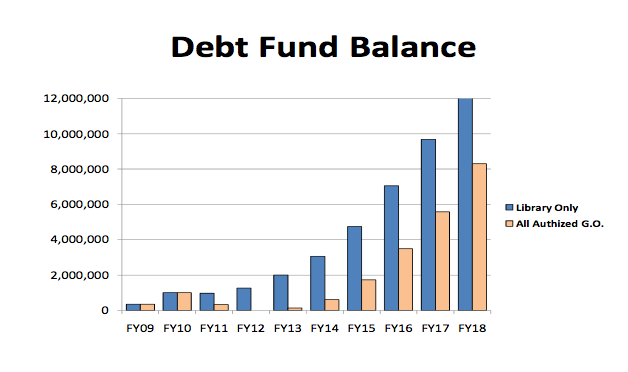
At the same time, other probable debt-related outlays aren’t included in the analysis. Mark suggesting the lump of general obligation (G.O.) debt covers the whole gamut of obligations minimizes the challenge before us.
Beyond that bit of misdirection, Mark knows (or should know) that our Town’s current reserves are low compared to historical reserves on a percentage basis.
That $1.9M increase Mark bandied about sounds big but isn’t considering the $55M hole we’re in. No matter how hard fought the battle to get that $1.9M last year, weighed against future operational and capital demands – like trying to expand the Library – the percentage improvement in overall reserves was slightly better than negligible and doesn’t position us any better to deal with MAJOR outlays (if you use a more reasonable debt ceiling).
To use the credit card example several Council members relied on this evening, there is a qualitative difference between the following two scenarios:
1) Your credit card limit is $10,000 (set in the heady days when the good times rolled). Expecting blue skies everyday, you run up $9000 in debt. You plan to add another $800 ($9800 overall) and set aside $500 to service that debt “just in case”.
2) Your credit card limit is $10,000. You run up $5000 in debt. You set aside $1000 for future payments and plan to take on another $400 for a total obligation of $5400.
Case number one is what Mark is arguing for when he continues to push for the Library expansion, Lot #5, $3.7M in greenway bond debt, etc. (“the whole enchilada”) using the existing debt load as a baseline.
Case number two, which gives the Town much more flexibility in meeting its core needs and is more akin to where we were before the recent massive debt run-up, is what Council members Jim Ward, Laurin Easthom, Matt Czajkowski and Ed Harrison spoke to (in one way or the other).
Council member Gene Pease was right about the wisdom of creating separate budget “silos” for debt and operations. This was something I lobbied for 5-6 years ago and was happy to see implemented.
Yet, as Matt pointed out, Council didn’t discuss the current debt ceiling (and tax rate associated with paying it off) as a maximal point. As history shows, the current ceiling was expediently set based on all the allocated and accumulated debt at that time rather than a careful forward analysis of our residents ability to pay.
It is this kind of thinking that led to the recent big tax increase (which I had predicted 2 years before – based on the “simple math” Mark said I was using this evening).
Part of separating that part of our budget out was to get the kind of visibility we need to “right size” our tax revenue allocations to various core necessities (thanks to Laurin and others for putting it plainly – balancing “needs against wants”).
So, our debt ceiling – which leapt rapidly to handle 2003 to 2009 debt increases – based on extraordinary expenses like the new Town Operations Center – was not set based on a fiscally prudent assessment of our community’s ability to pay (“living within ALL our citizens means”) but on a hunger for stuff which could only be fed by running up our Town’s credit card.
Clearly, our debt load, twice what it was 6-7 years ago and the current debt ceiling are both not sustainable in this economic environment (or with the currently lopsided commercial/residential tax-base). On top of this, we’re also not even close to the reasonable reserve levels we held 5-7 years ago (let alone what we will need to handle predictable jumps – like Lot #5 – to our capital outlays).
As far as future debt not appearing on tonight’s docket, while Laurin and Matt did a good job outlining some probable impacts in the next 3-4 years of capital budgets (like the possibility of repairing/replacing the Police Department) the “elephant in the room” – Lot #5 – once again didn’t get appropriate attention.
When approved, the expectation was that the Lot #5 debt could be paid from parking revenues. The type of debt and method of repayment – certificate of participation (COP), tax incremental funding (TIF, taxing Peter – our local Downtown business folks – to pay for Paul’s profits), paying from parking revenues – remains a bit fuzzy.
If you run the numbers, make a more realistic assessment (I was on the Downtown Parking Task Force and reviewed those numbers carefully) the debt associated with the West 140/Lot #5 taxpayer giveaway will NOT be paid off by the parking revenues (heck, the negative feedback from raising parking rates which will decrease revenues hasn’t been worked out).
Every penny not coming from the variable parking fees revenue has to come from funds earmarked for other purposes – staff raises and benefits for instance. Besides the predictable shortfalls, that revenue variability, in and of itself, is a major concern.
In any case, even if we can make the debt payments out of parking revenues (quite debatable), adding another $8M-$12M of obligations on top of everything else carries its own significant financial impact – including limiting our Town’s ability to borrow for more core needs.
The question isn’t if we’re in a pickle but what is this current Council going to do about it?
I disagree with the suggestion that the Town couldn’t find qualified volunteers to help analyze the budget with fresh eyes and make some reasonable suggestions over the next 4 months.
Given the unique pool of successful local entrepreneurs and talented business folks, professionals from UNC’s Kenan-Flagler institute and business school, CEO/CFO’s living and working here, UNC and other government administrators, former Council members and other concerned citizens with relevant expertise and interest, claiming that we can’t seat a review board now is just a stalling tactic.
The Council did it before and the resulting budget was stronger for it.
Finally, I’m quite disappointed that Mark led the charge to cut-off this valuable source of public input. As Laurin, Jim and Matt argued to various degrees, the budget is the wellspring for everything our citizens want and, more importantly, need. It’s hard to argue any other area needs as much public attention and review as this year’s budget.
The political downside of a citizen review board, of course, is that an independent analysis might upset some folks established agenda, like trying to juggle the discretionary Lot #5 project, expansion of the Library, increased demands on services and responsibilities for maintaining qualified staff.
Here’s the outline I used for my remarks this evening:
(more…)