UNC


I want to quickly respond to Chapel Hill Mayor Mark Kleinschmidt’s comments this evening.

First, spending $8-12M on the Lot #5 project, building luxury condos and enriching a private developer, is not the same as “protecting our Town’s infrastructure”.

The Lot #5 (West 140) project is discretionary – the push to keep it going is not based on sound economic fundamentals.

Putting Lot #5 on par with filling potholes or expanding the Library is a great political speaking point – but certainly not grounded in reality – suggestions otherwise does the public a disservice.

At the same time, other probable debt-related outlays aren’t included in the analysis. Mark suggesting the lump of general obligation (G.O.) debt covers the whole gamut of obligations minimizes the challenge before us.

Beyond that bit of misdirection, Mark knows (or should know) that our Town’s current reserves are low compared to historical reserves on a percentage basis.

That $1.9M increase Mark bandied about sounds big but isn’t considering the $55M hole we’re in. No matter how hard fought the battle to get that $1.9M last year, weighed against future operational and capital demands – like trying to expand the Library – the percentage improvement in overall reserves was slightly better than negligible and doesn’t position us any better to deal with MAJOR outlays (if you use a more reasonable debt ceiling).

To use the credit card example several Council members relied on this evening, there is a qualitative difference between the following two scenarios:

1) Your credit card limit is $10,000 (set in the heady days when the good times rolled). Expecting blue skies everyday, you run up $9000 in debt. You plan to add another $800 ($9800 overall) and set aside $500 to service that debt “just in case”.

2) Your credit card limit is $10,000. You run up $5000 in debt. You set aside $1000 for future payments and plan to take on another $400 for a total obligation of $5400.

Case number one is what Mark is arguing for when he continues to push for the Library expansion, Lot #5, $3.7M in greenway bond debt, etc. (“the whole enchilada”) using the existing debt load as a baseline.

Case number two, which gives the Town much more flexibility in meeting its core needs and is more akin to where we were before the recent massive debt run-up, is what Council members Jim Ward, Laurin Easthom, Matt Czajkowski and Ed Harrison spoke to (in one way or the other).

Council member Gene Pease was right about the wisdom of creating separate budget “silos” for debt and operations. This was something I lobbied for 5-6 years ago and was happy to see implemented.

Yet, as Matt pointed out, Council didn’t discuss the current debt ceiling (and tax rate associated with paying it off) as a maximal point. As history shows, the current ceiling was expediently set based on all the allocated and accumulated debt at that time rather than a careful forward analysis of our residents ability to pay.

It is this kind of thinking that led to the recent big tax increase (which I had predicted 2 years before – based on the “simple math” Mark said I was using this evening).

Part of separating that part of our budget out was to get the kind of visibility we need to “right size” our tax revenue allocations to various core necessities (thanks to Laurin and others for putting it plainly – balancing “needs against wants”).

So, our debt ceiling – which leapt rapidly to handle 2003 to 2009 debt increases – based on extraordinary expenses like the new Town Operations Center – was not set based on a fiscally prudent assessment of our community’s ability to pay (“living within ALL our citizens means”) but on a hunger for stuff which could only be fed by running up our Town’s credit card.

Clearly, our debt load, twice what it was 6-7 years ago and the current debt ceiling are both not sustainable in this economic environment (or with the currently lopsided commercial/residential tax-base). On top of this, we’re also not even close to the reasonable reserve levels we held 5-7 years ago (let alone what we will need to handle predictable jumps – like Lot #5 – to our capital outlays).

As far as future debt not appearing on tonight’s docket, while Laurin and Matt did a good job outlining some probable impacts in the next 3-4 years of capital budgets (like the possibility of repairing/replacing the Police Department) the “elephant in the room” – Lot #5 – once again didn’t get appropriate attention.

When approved, the expectation was that the Lot #5 debt could be paid from parking revenues. The type of debt and method of repayment – certificate of participation (COP), tax incremental funding (TIF, taxing Peter – our local Downtown business folks – to pay for Paul’s profits), paying from parking revenues – remains a bit fuzzy.

If you run the numbers, make a more realistic assessment (I was on the Downtown Parking Task Force and reviewed those numbers carefully) the debt associated with the West 140/Lot #5 taxpayer giveaway will NOT be paid off by the parking revenues (heck, the negative feedback from raising parking rates which will decrease revenues hasn’t been worked out).

Every penny not coming from the variable parking fees revenue has to come from funds earmarked for other purposes – staff raises and benefits for instance. Besides the predictable shortfalls, that revenue variability, in and of itself, is a major concern.

In any case, even if we can make the debt payments out of parking revenues (quite debatable), adding another $8M-$12M of obligations on top of everything else carries its own significant financial impact – including limiting our Town’s ability to borrow for more core needs.

The question isn’t if we’re in a pickle but what is this current Council going to do about it?

I disagree with the suggestion that the Town couldn’t find qualified volunteers to help analyze the budget with fresh eyes and make some reasonable suggestions over the next 4 months.

Given the unique pool of successful local entrepreneurs and talented business folks, professionals from UNC’s Kenan-Flagler institute and business school, CEO/CFO’s living and working here, UNC and other government administrators, former Council members and other concerned citizens with relevant expertise and interest, claiming that we can’t seat a review board now is just a stalling tactic.

The Council did it before and the resulting budget was stronger for it.

Finally, I’m quite disappointed that Mark led the charge to cut-off this valuable source of public input. As Laurin, Jim and Matt argued to various degrees, the budget is the wellspring for everything our citizens want and, more importantly, need. It’s hard to argue any other area needs as much public attention and review as this year’s budget.

The political downside of a citizen review board, of course, is that an independent analysis might upset some folks established agenda, like trying to juggle the discretionary Lot #5 project, expansion of the Library, increased demands on services and responsibilities for maintaining qualified staff.

Here’s the outline I used for my remarks this evening:
(more…)

Remember/Share:
  • blogmarks
  • co.mments
  • del.icio.us
  • digg
  • Furl
  • Ma.gnolia
  • NewsVine
  • Reddit
  • Shadows
  • Wists
  • YahooMyWeb

Ron Stutts and WCHL 1360 invited me to do a commentary on a Chapel Hill issue.

I chose to speak out on the fiscally imprudent idea that we can “have our cake and eat it too”.

Run this and the following four year’s budget numbers, look at anticipated impacts – funding Town retirees’ health-care, fixing Police Headquarters, meeting our clean water responsibilities under the Lake Jordan compact, the doubling in demand on our social services, etc. – and it becomes clear – we can walk away now from the discretionary Lot #5 project – at little additional cost to the taxpayer – or do the Library expansion next year.

We can’t do both.

Thanks to Ron and crew for somehow squeezing 10 pounds of commentary [MP3] into a 5 pound bag. Amazing!

Jan. 25th the Council considered two projects with major financial impacts – the Library expansion and the problematic Lot #5 private/public development project.

After discussing their options at length, they decided to postpone approval of the Library expansion pending a more thorough review of the Town’s spending priorities during the Town’s normal budget process which, by the way, kicks off Wednesday, Feb. 3rd.

This was a reasonable and prudent course of action given the serious fiscal condition of the Town, the weakened economy, continued expectations of poor revenues and Council’s touted commitment to public participation.

Unfortunately, the Lot #5 project didn’t get the same level of concern.

The Town’s debt has doubled to $55M over the last 5 years. It’s been used to fund necessary and discretionary capital improvements like the construction of the new Aquatics Center – which at about $7M was almost on budget – and the Town Operations Center – which at $52M went roughly $10M over-budget.

Supporters claim the typical household will ONLY pay $40 more a year but that $40 only covers the increased cost of operating the Library and not the cost of discharging the $16M bond debt.

The Town Manager says that as we payoff existing obligations we can issue new bonds without increasing taxes. This might be true through 2011, but as the Town’s finance director pointed out, from 2012 on the construction debt pushes our overall debt very close – maybe even exceeding – the level necessary to keep our Town’s AAA bond rating.

At that point a tax increase is certain.

The Town Manager’s analysis is also rather one dimensional – challenges like the Town’s rapidly growing unfunded retirement obligations – projected to be as much as $56M or replacing Police headquarters – $10M if Council had purchased Dawson Hall – were not considered.

So what about Lot #5? Lot #5 requires 8 to 12M taxpayer dollars and represents the Town’s greatest, riskiest discretionary fiscal liability.

Part of the sales pitch for Lot #5 was the supposed need to stimulate development Downtown.

With Greenbridge nearly built and other Downtown projects on the way it’s clear that we didn’t need a stimulus. In fact, directly across Franklin St. the University at University Square is already putting forward a much more interesting, integrative proposal which better fulfills the goals of the Lot #5 project – and at little cost or risk to our taxpayers.

Given that the cost reductions that allowed RAM Development to lower their gold-plated condo prices haven’t been passed on to the taxpayer, that the number of pre-sold units hasn’t grown in-line with those price reductions, and that the Town still doesn’t know how it plans to borrow that $8 to 12M – now is the time to drop Lot #5.

Three years out – three contract extensions granted – no significant improvement in proposal.

What does this have to do with the Library?

We can have a Library expansion – hopefully starting next year – or we can have Lot #5 – we can’t handle both.

Contact Council – ask them to pull the plug on the Lot #5 project now so that we can take on projects that are more central to Council’s charter.

More information on my website, CitizenWill.org.

Remember/Share:
  • blogmarks
  • co.mments
  • del.icio.us
  • digg
  • Furl
  • Ma.gnolia
  • NewsVine
  • Reddit
  • Shadows
  • Wists
  • YahooMyWeb

Here is what I meant to say at this evening’s Council meeting.

Like a lot of my remarks, I find myself editing on the fly, so what I managed to get out in less than 3 minutes wasn’t quite what follows but I believe I made the points I needed.

The simple summary?

We can’t do the Lot #5 (140 West) project and the Library expansion together. Lot #5 hasn’t met its goals, the cost/benefit ratio is decidedly out-of-whack, the necessity quite clearly not there anymore.

Further, the Library expansion project needs to be delayed until taxpayers can bear the total cost. Beyond that, we need to request an extension from the North Carolina Local Government Commission to allow issuing bonds beyond the current deadline so when it is fiscally prudent we can move expeditiously.

Finally, public participation, once again, is barely considered.

Tonight’s remarks:

In 2010 you will be making several key budgetary decisions whose impacts will span the next decade – the Lot #5 (West 140) and Library expansion – two examples.

Lot #5 represents the greatest and riskiest fiscal liability going forward that can be safely dispensed with.

Part of the sales pitch made by some on this Council is we needed this project to kick-start development Downtown.

With Greenbridge nearly built, University Square poised for redevelopment, approval of Grove Park – which will displace the affordable Townhouse Apts. on Hillsborough St. with luxury condos – and other Downtown projects on the way it’s clear that we don’t need that supposed stimulus Lot #5 brings anymore.

It’s time to reconsider this troubled project especially given that:

1) the cost reductions that allowed RAM to lower prices haven’t been significantly passed on to the taxpayer,

2) the number of units pre-sold hasn’t grown in-line with price reductions (33 units pre-sold so far, down from the reported 2008 commitment of 35).

3) the open-ended nature of the cost of the environmental cleanup is still being underplayed,

4) the University at University Square has already put forward a much more sound, interesting and integrative proposal (123 West Franklin) for that stretch of Franklin St. than the expensive – at least to the Chapel Hill taxpayer – Lot #5,

5) still up in the air how we will borrow the money – COPs, TIFs, etc. In any case, however we borrow the $9-10M or more it will limit the Town’s ability to prudently respond in funding core needs,

6) and from what I can see in RAM’s recent missive ( RAM Dec. 22nd, 2009 letter [PDF]) no effort has been made to involve the nearby business and residential community in discussing mitigation of the type of construction-related problems that have plagued Greenbridge or even apprise their future neighbors of current developments (let alone present a coherent and consistent story to the local press).

Three years out and no significant improvement in the proposal. Three extensions to the contract granted by Council. Lot #5 should be shelved now so that the Town can take projects that are more central to its charter.

What does this have to do with the Library?

I want to see the Library expanded but now is not the time.

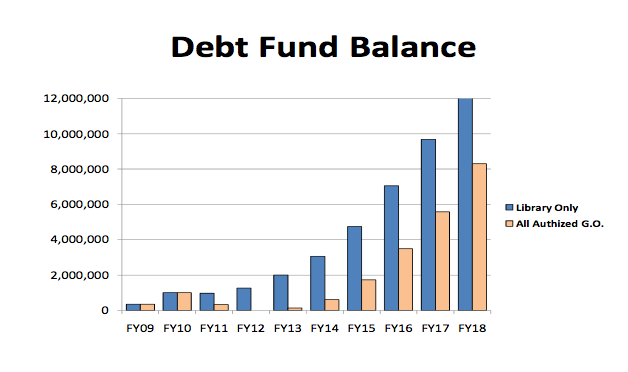
The memos before you [here] paint a fairly rosy picture of the borrowing in terms of adopting new debt but they don’t do a very good job in putting that increased debt in context of our already astonishing – at least by historical Chapel Hill standards – debt load.

Memo #A, in fact, disingenuously characterizes the increase to homeowners using examples of property valuations well below ($200K) the Chapel Hill baseline.

Look at the chart in Memo #A. The rate of increase in the debt load – that rapidly increasing impact on the Town’s flexibility in borrowing – running our debt right up to the debt ceiling for our AAA bond rating – starts in late 2012 and zooms steeply from there.

Of course, besides adding new debt that and anticipated G.O. additions will account for roughly several cents on the current tax rate while the real kicker is the growth in cost of Library operations – which appears to be even more significant.

Worse, the continued structural instability and weakness of our economy gets short shrift.

Now is not the time to take on a large forward liability.

Making a decision based on these figures tonight will be guaranteeing a tax increase or steep cuts or just ignoring basic obligations two years hence.

Here are my suggestions:

1) Shelve Lot #5. We can have a Library expansion – hopefully starting next year – or we can have Lot #5 – we can’t handle both.

2) The Library borrowing should be delayed until prevailing economic conditions show signs of improvement – strengthened sales tax revenues, stable fund markets which will lend money at a more favorable rate – say less than %100 of the 20 year Treasury bond ratio.

3) Have staff prepare a request to NC Local Government Commission to extend Chapel Hill’s time limit for issuing these bonds so the Council and community have adequate time to plan.

4) Use the established public budget process which kicks off next week [2/3/2010 7:00 PM Council Chambers Townhall) to discuss the Library in light of all our Town's needs – competitive staff wages, affordable housing reserve funds, the growing retirement fund deficit (Unfunded Liabilities: Pay As You Go Not Sustainable) among many others.

Last Fall many of many on Council obligingly participated in a special “emergency” meeting to acquire Dawson Hall for police and other key Town services. That urgent need hasn't gone away – the police department's facility still needs attention - why isn't that part of the rosy projections?

Our citizens deserve a diligent evaluation of the cost of the Library expansion and operations within the context of our total budget and foreseeable needs - not wants.

They also deserve to participate - not just get an agenda item 3 days before a decision is scheduled.

5) Finally, postponing tonight will give you the opportunity to carefully consider this proposal in light of all your priorities, give you time to evaluate the rosy picture drawn by these memos against your own understanding of the economy and think about how to engage the community during this weekend's Council retreat.

In addition, it buys needed time for the public to review the current proposal, attend the budget sessions, ask their questions, get their answers and finally weigh in in a thoughtful manner.

Thank you.
[UPDATE: Council Postpones Consideration]

From tonight’s Council flash report:

Consideration of Proceeding with the Library Expansion Project: The Council considered the project schedule and associated costs for expansion of the Chapel Hill Public Library. The Council delayed action and indicated its desire to discuss the expansion costs in greater detail and in the context of the entire Town budget. The Council stated it wants to know what level of funding Orange County will provide toward Library services.

Orange County provides no capital support toward the Town’s Library expenses; this includes all past and present Library construction costs, debt service for same, equipment or special project costs. County support toward Library operating expenses has remained at $250,000 since 1995 and represents 11 percent of this year’s Library operating budget. About 12,000 of the Library’s patrons live in Orange County outside Chapel Hill limits. The number of materials borrowed by these patrons was 386,000 items last year. This represents approximately 40 percent of the Library’s annual circulation.

Remember/Share:
  • blogmarks
  • co.mments
  • del.icio.us
  • digg
  • Furl
  • Ma.gnolia
  • NewsVine
  • Reddit
  • Shadows
  • Wists
  • YahooMyWeb

Given the time of year and Durham’s recent problems in protecting the Lake Jordan watershed, the fiscal impact of mitigating damage which might well be shared by Chapel Hill’s taxpayers, I was tempted to title this post “Trick or Treat on NC54?”

Even if the “development process is broken in Durham”, as LaDawnna Summers, who resigned from Durham’s Planning Commission over the Lake Jordan mess, it is important that both Chapel Hill’s elected folks and greater community engage directly in the NC54/I-40 corridor planning process.

Thirty years ago, when I first came to Chapel Hill, I drove into town on the scenic two-lane NC54 (I-40 from RDU on was still a set of dotted lines on a map). The beautiful pastured hills to the north are now covered by Meadowmont. The woods and vales to the south, by the Friday Center and office parks. And the majestic hill-side entry to the University? Now obscured by the “anywhere USA belt-line architecture” of the road hugging East54.

The process starts Wednesday, Nov. 18th, 2009 from 5pm to 8pm at the Friday Center [MAP]

What: NC-54/I-40 Corridor Study Public Workshop #1
Who: Durham-Chapel Hill-Carrboro Metropolitan Planning Organization (DCHC MPO), City of Durham, Durham County, and the Town of Chapel Hill
When: Wednesday, November 18, 2009, from 5 p.m. to 8 p.m.
Where: William and Ida Friday Center for Continuing Education
100 Friday Center Drive Chapel Hill, N.C. 27599-1020

Fast Facts:

  • The Durham-Chapel Hill-Carrboro Metropolitan Planning Organization (DCHC MPO) will host an interactive community workshop on November 18 to obtain guidance on developing a blueprint for mobility and development in the NC-54/I-40 corridor, a critical gateway linking the City of Durham, Town of Chapel Hill, and University of North Carolina at Chapel Hill.
  • The NC-54/I-40 corridor serves as one of the major gateways between Chapel Hill and southwest Durham, with its interchange with I-40 consistently ranking as the top congested location in the region. Development pressures within the corridor coupled with mobility and capacity issues have highlighted that the existing and planned transportation infrastructure is insufficient to accommodate growth and address land use and transportation problems.
  • To develop land use and transportation strategies to preserve this important corridor, the DCHC MPO, the City of Durham, Durham County, and the Town of Chapel Hill have begun a corridor study to analyze short- and long-term land use issues and multi-modal transportation problems, evaluate opportunities and challenges, and recommend short- and long-range land use and transportation solutions and strategies along the corridor.
  • The vision of the DCHC MPO is to develop and implement transportation plans that are multimodal and that fully integrate land use and transportation issues. To achieve this vision this study will:

    • Clearly define a realistic “blueprint” for an integrated growth and mobility strategy for the corridor;
    • Establish a development framework that strengthens multimodal travel options and reduces vehicle miles of travel;
    • Improve operations, safety, and travel time; and
    • Categorize strategies into near, mid-term, and long-term phases.
  • A critical component of this study is public outreach and involvement. Three public
    workshops will be held as a part of this study, which should be completed in June 2010.

    • The first public workshop on November 18 will present the community profile and
      solicit input on issues, opportunities, and trends to guide the development of future
      scenarios.
    • The second public workshop, tentatively scheduled for late winter 2010, will evaluate
      alternatives and seek public input in the selection of the preferred scenario.
    • The third workshop, tentatively scheduled for spring 2010, will give participants an opportunity to review and refine the corridor master plan and provide input on setting priorities for multimodal transportation and land use strategies, implementation strategies, and phasing.
  • Once the study is finished, the final master plan will be presented to the local and regional
    policy boards and used to inform transportation/traffic analysis, land use decisions, project
    planning, and funding priorities.

    • The total cost for the study is $257,432 with 80 percent of the funding coming from federal transportation planning funds and the remaining 20 percent funded jointly by the City of Durham, Durham County, and the Town of Chapel Hill.
    • Residents interested in joining a group of citizen contacts for this study should contact Leta Huntsinger with the DCHC MPO at (919) 560-4366 ext. 30423 or via email at leta.huntsinger@durhamnc.gov. For more information about this study, visit www.nc54-I40corridorstudy.com .

More on Summers’ resignation:

(more…)

Remember/Share:
  • blogmarks
  • co.mments
  • del.icio.us
  • digg
  • Furl
  • Ma.gnolia
  • NewsVine
  • Reddit
  • Shadows
  • Wists
  • YahooMyWeb

Big thank you to all the volunteers, including many, many UNC students who turned out this morning to help Orange County Justice United do a survey of the Northside and Pine Knolls areas in order to:

  • Position community priorities in the public eye,
  • Build relationships and get support for their social justice agenda by residents and institutions in the Northside neighborhood
  • Document housing issues and community infrastructure in disrepair

Orange County Justice United

is a broad-based, multi-racial, multi-faith, multi-issue, strictly non-partisan citizens’ power organization dedicated to making change on social justice issues (affordable housing, healthcare, education, living wages) affecting the lives of low- and middle-income residents in Orange County.

The organization is partnered with 30+ local churches and social support institutions in promoting their agenda.

Also, thanks to Delores Bailey and Empowerment for providing facilities and logistical support for today’s effort.

Remember/Share:
  • blogmarks
  • co.mments
  • del.icio.us
  • digg
  • Furl
  • Ma.gnolia
  • NewsVine
  • Reddit
  • Shadows
  • Wists
  • YahooMyWeb

I was appointed as one of the “at large” members of the Town’s Sustainability Task Force several months ago.

One of the first issues we took up was representation on the task force itself. Essentially, did the task force membership represent the reasonably broadest possible diversity of viewpoints and experience we needed to craft a sustainable game plan covering Chapel Hill’s growth these next 10 years?

Along with most of the task force, I agreed it didn’t so we asked the Council to grant us permission to broaden our membership and renew the call for volunteers. I’ve been calling folks I know, sending emails, talking to various organizations that might otherwise be disinclined from participating to try to get new members who will broaden our task forces’ perspective.

As of July 20th I’m pleased to say we’ve had an increase in interest – amounting to 10 new applicants:

  • Anne Eshleman (24, student, new resident)
  • Stacia Cooper (47, insurance regulator, 7+ years)
  • J. Patterson Calhoun (31, business manager, newly returned resident [in Triangle 8 years prior])
  • Lister Delgado (40, investor, 5 years in-town/5 years just outside )
  • Donna Bell (38, social worker, 7 years – Northside resident)
  • Kevin Hicks (44, product engineer, 4 years)
  • Christopher Senior (53, green builder, new resident)
  • Daniel Outen (22, student at Kenan Flagler, 3 1/2 years)
  • Todd Woerner (53, chemist/teacher/lab manager, 18 years)
  • Brian Paulson (23, city management, 11 years)

The task force will resume its work mid-August by adding 6 of these 10 (or more I hope) applicants to the position.

I will be reviewing these and any other applications with an eye towards choosing folks that have a distinctly different vision of where Chapel Hill should be in 10 years. By maximizing diversity of considered opinion we should not only end up with a stronger set of recommendations but also a message that is widely acceptable.

Remember/Share:
  • blogmarks
  • co.mments
  • del.icio.us
  • digg
  • Furl
  • Ma.gnolia
  • NewsVine
  • Reddit
  • Shadows
  • Wists
  • YahooMyWeb

Seems like the municipal elections are officially on. Kevin bowed out as mayor. Mark bowed in. Laurin, not surprisingly, ready to go again. And now Penny.

I ran with Penny in 2007 and welcome her 2009 run.

She did her homework, was firm in her convictions, eloquent and handled some rather nasty rebukes by two of the incumbents with grace and good cheer.

I’m hoping that this year, unlike the 2007 campaign where the incumbents orchestrated an issues shut out, will be a year in which the rather substantial problems before our community get not only a fair hearing but elicit specific proposed remedies by the candidates.

Here’s Penny’s announcement:

I am proud to announce my candidacy for Chapel Hill Town Council. While running in the 2007 council race I was honored to meet many folks that live and work in Chapel Hill who share my love for this beautiful town. Chapel Hill has a bright future, and I believe I would be a positive addition to the Town Council as they guide us through the next phase of growth. As a small business owner raising a family in Chapel Hill, I represent the unique perspective of the average everyday citizen. In the coming months I look forward to talking to the people of Chapel Hill to gain an understanding of their priorities, needs, and concerns. I can best represent Chapel Hill by ensuring that everyone has the chance for their voice to be heard as we shape the future of our town.

Remember/Share:
  • blogmarks
  • co.mments
  • del.icio.us
  • digg
  • Furl
  • Ma.gnolia
  • NewsVine
  • Reddit
  • Shadows
  • Wists
  • YahooMyWeb

Councilmember Jim Ward and Mayor Kevin Foy just floated the idea in tonight’s Carolina North work session of charging all UNC students, in conjunction with the University, a fee for bringing their cars to Chapel Hill.

This Council already floated the idea of charging more for Downtown parking, an idea not only at odds with both the Downtown Parking task force recommendations [PDF] (of which I was a member) but also the Friends of Downtown, a group of Chapel Hill business owners and other concerned citizens who want to improve the Downtown experience for visitors and residents alike.

It is clear that Carolina North will shove roughly $800,000 to $2.4 million costs per year (spiking to much more 6-7 years out) onto Chapel Hill’s citizens’ shoulders, but creating a new fee based on your reason for living here doesn’t make sense.

Remember/Share:
  • blogmarks
  • co.mments
  • del.icio.us
  • digg
  • Furl
  • Ma.gnolia
  • NewsVine
  • Reddit
  • Shadows
  • Wists
  • YahooMyWeb

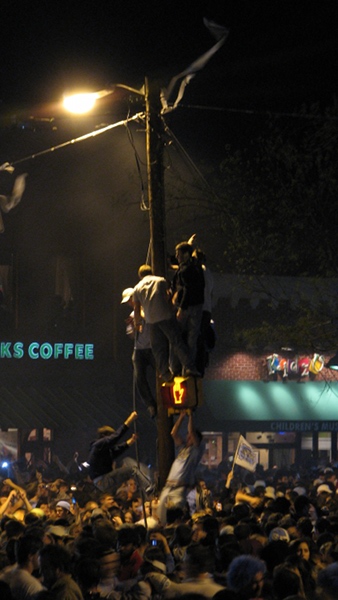
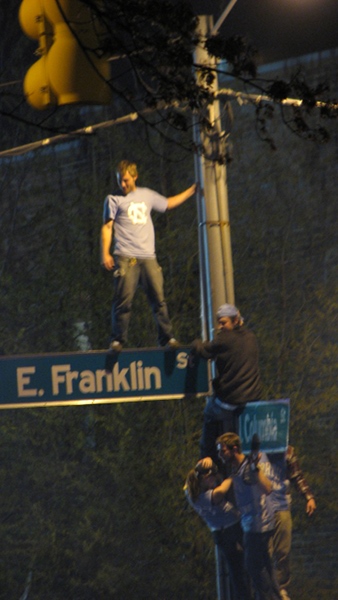
Though I wished UNC had clinched the ACC championship, tonight’s 89-72 stomping of Michigan State provided a conclusive and satisfying end to UNC’s great 2009 basketball season.

In case you haven’t heard the rumble rolling forth from Downtown, UNC fans are as jubilant as the players.

I’ve had the uncanny luck to have seen the 1982, 1993, 2005 and, now, the 2009 national championship celebrations and this one, at least as of 1:35am, seemed to be one of the best managed – no burning cars, major fires or parking lots full of triaged injured fans. Kudos to Town staff, UNC/Chapel Hill/State and local law enforcement, our fire and rescue personnel (who, I presume, missed most of the game prepping for the turnout) and all the other folks that made this year’s celebration a reasonably safe affair.

Congratulations to Roy Williams, the team and the University for an exciting demonstration of excellence.

Remember/Share:
  • blogmarks
  • co.mments
  • del.icio.us
  • digg
  • Furl
  • Ma.gnolia
  • NewsVine
  • Reddit
  • Shadows
  • Wists
  • YahooMyWeb

I’m at the roll-out of tonight’s UNC explanation of the tardy (a year late) Tischler-Bise Carolina North fiscal impact study.

The classroom at the School of Government is fairly packed with elective and governmental staff folks (about 45 from all three governmental bodies – Chapel Hill, Carrboro, Orange County). Beyond a smattering of media folks (Daniel with the Chapel Hill Herald, Jesse with the Chapel Hill News), there’s a handful of concerned citizens.

Other than those “required” to be here (if at least for no other purpose than to say they were there), some of the “usual suspects” include Penny Rich (former candidate Town Council), George Cianciolo (Chapel Hill planning board), Scott Radway (former planning board member), Joe Capowski (former Council member), Terri Buckner (former Tech board member among other civic posts) and myself.

Further comments follow as comments on this post.

Remember/Share:
  • blogmarks
  • co.mments
  • del.icio.us
  • digg
  • Furl
  • Ma.gnolia
  • NewsVine
  • Reddit
  • Shadows
  • Wists
  • YahooMyWeb

I haven’t said much about the fluffy TischlerBise fiscal impact study commissioned and worked on jointly by UNC’s administration, our local governments and TischlerBise’s consultants.

Fluffy? Like previous UNC commissioned analysis – notably the previous Carolina North and Orange County Airport Authority economic justifications – the upside is mostly in intangible (i.e. hard to measure, hard to hold accountable for) benefits and the downside – in hard currency – mostly downplayed, low-balled.

Carolina North could be a great asset to the local community but UNC cannot shift millions of dollars of costs onto the shoulders of local residents.

No matter how the consultants twisted the numbers it is clear that Chapel Hill will take a significant financial hit as Carolina North – the question now is how much?

There’s a preview session setup for Council this evening at UNC’s School of Government (open to the public in case you are interested in seeing some consultancy sleight of hand):

The consultants who prepared the fiscal impact analysis for Carolina North will present their final report to the public March 31. The presentation will begin at 7 p.m. in the Wicker Classroom (2603) at the School of Government on the campus of the University of North Carolina at Chapel Hill.

Free parking is available after 5 p.m. in the School of Government parking deck, with additional paid parking in the N.C. 54 visitor’s lot and the Rams Head deck. Chapel Hill Transit service is available via the RU, G, S and V routes.

My estimate?

At least $15-20 million over the next 10 years or, roughly, 3 to 4 cents per $100 valuation per year of additional tax burden (on-top of our contributions via North Carolina State taxes).

Remember/Share:
  • blogmarks
  • co.mments
  • del.icio.us
  • digg
  • Furl
  • Ma.gnolia
  • NewsVine
  • Reddit
  • Shadows
  • Wists
  • YahooMyWeb

Council member Laurin Easthom says “Now is the time” for the community to get involved with the planning for Carolina North.

Now is the time. Now is the time to comment on Carolina North, the largest development to ever hit the Town of Chapel Hill. The Town Council and UNC Trustees are meeting monthly to hash out a development agreement that will allow UNC flexibility and assurances in its development of Carolina North. If we come to an agreement by June on how Carolina North will develop, we may be done for years in decision making on how things are done. It’s time to wake up, and get active, and come to these meetings so that UNC can hear what you think.

Damn straight, especially if you serve on one of our Town’s advisory boards. The Carolina North train has left the station and is picking up speed, “Now” is definitely the time.

More here.

Remember/Share:
  • blogmarks
  • co.mments
  • del.icio.us
  • digg
  • Furl
  • Ma.gnolia
  • NewsVine
  • Reddit
  • Shadows
  • Wists
  • YahooMyWeb

[UPDATE]

The Daily Tar Heel’s Emily Stephenson chimes in here (DTH ‘blogs). A story on yesterday’s poor turnout here.

[ORIGINAL]

Earlier today (Nov. 19th), UNC’s Board of Trustees approved the draft Carolina North design guidelines making the proposal official UNC policy.

This evening, the first in a series of informational/public feedback sessions on Carolina North was held. With the creation of the Carolina North development agreement well on its way, the Council’s explicit call to advisory boards to attend, if possible, and the aggressive schedule to meet next July’s commitment, I expected a fairly full house.

Crowded house? Not the case.

The meeting started with roughly two dozen citizens in attendance. By the time Jack wrapped his presentation covering UNC’s design intent the group of interested citizenry was down to 19. At the end of the Dr. Owen’s presentation, covering the development agreement process, only 17 non-staff/non-press folks remained. Of those, eleven were drawn from the “usual suspects” ( Fred Black, Joyce Brown, Fred Stang, David Godschalk, George Cianciolo, Lynne Kane, Mike Collins, Loren Hintz, Ed Harrison, Bob Henshaw, me).

Disappointing! As Carolina North’s development director Jack Evans noted this evening, the formal process for approval has begun. The first phase of Carolina North is on its way.

Chapel Hill residents need to wake up and show up.

Every resident will eventually be affected by Carolina North’s development. At least 5 advisory boards will be consulted on both the outline and details of the development agreement. Community groups like the Friends of Bolin Creek and Neighborhoods for Responsible Growth (well represented this evening) could play key roles in shaping the discussion.

There is quite a bit of work before the community. If we follow Pal Alto’s trajectory, the development agreement – which is, as Dr. Owens pointed out again this evening, essentially a binding legal contract – could swell to 200+ pages over the next 8 months (that’s 25 or more pages of detailed legal requirements per month – a heavy responsibility). Those pages will dictate development over a long period. Once set, unlike zoning ordinances, the ability to tweak conditions requires mutual agreement. Mistakes could be difficult to correct.

The community has a tremendous opportunity to shape the outcome at Carolina North. Both UNC and Chapel Hill’s Town Council agreed to involve the public at every point in the process. But, so far, Chapel Hill’s citizens have not turned out.

The negotiations between UNC and the Town will continue to accelerate. The momentum is building rapidly. My concern is that by the time citizens go into reactive-mode – recognizing missing elements in the plan, trying to wedge in protections beyond those outlined – the inertia will be too great and the time too short to significantly change course.

Now is the time for public concern. Now is the time for community involvement.

Because of the extensive impacts Carolina North will have on this community over the next several decades, I’ve asked Council to “bang the drum loudly”, to go beyond simply inviting the public into the process. We need to seek out folks, develop multiple avenues of engagement and draw them into the discussion. That said, at some point it comes down to whether our citizens want to shoulder their part of the burden and work on behalf of folks that will live here decades hence.

Remember/Share:
  • blogmarks
  • co.mments
  • del.icio.us
  • digg
  • Furl
  • Ma.gnolia
  • NewsVine
  • Reddit
  • Shadows
  • Wists
  • YahooMyWeb

UNC’s Chancellor Holden Thorp takes a postion (“Carolina North: A Glass Half-Full Perspective”) on Horace-William Airport’s closure.

One of the most vexing issues, though, has been the future of Horace Williams Airport. As you know, it occupies the heart of the Carolina North acreage. It’s the flattest part of the tract and, therefore, the best place to build Carolina North. So we have to close it.

Now, I realize it doesn’t take a lot of analysis to figure out that closing the airport is important for the future of Carolina North. But figuring out HOW to close the airport . . . that’s another story.

Ultimately, I think it comes down to this. The AHEC program is an extremely important asset to this University and to our state. Our doctors, nurses, other health professionals, and our MedAir pilots are as committed public servants as you will find. The work they do and the service they provide are fundamental to who we are as a university. And we are telling them that we have to close their airport to build Carolina North.

I have analyzed all the options, and I’m convinced that we really do have to close the airport to make Carolina North all that it must be. I’m equally convinced that we should fully support the airport authority authorized by the General Assembly as the best way to pursue creation of an airport in Orange County. It gives the county zoning authority, and it turns over the siting and development to a public body with greater expertise than we have.

For AHEC and MedAir, I think a move to RDU for the short-term is workable. But for the long-term, we owe it to our doctors to appoint the airport authority to see if there’s a better alternative.

We have said all along that we wouldn’t close Horace Williams Airport until we had to. With today’s challenging economic climate, we anticipate that funding for initial Carolina North construction likely will be delayed. Our state appropriation for planning and infrastructure for the Law School relocation to Carolina North is frozen, at least for now. And Alexandria Real Estate Equities, Inc., our partner for the Innovation Center, has put new projects on hold, although they have affirmed their interest in our project.

So, as I posted last night, the University maintains their stance that closure is contingent on Carolina North’s building projects moving forward.

I am disappointed that Holden continues to maintain that the only path to serving AHEC’s needs involves a new general aviation facility. This fixation makes no sense at this point and counters UNC’s own consultant’s recommendations to move AHEC to RDU.

Holden is “convinced that we should fully support the airport authority authorized by the General Assembly as the best way to pursue creation of an airport in Orange County. ”

Sure, the airport authority, with the sovereign powers the State granted it, is probably the best way to get an airport built in Orange County over local residents’ objections.

Where, though, is his concern for the Authority’s other duty – to factually justify the necessity of a general aviation facility? The Authority’s duty to “support the missions of the University of North Carolina at Chapel Hill or the University of North Carolina Health Care System” has to balance against the significant local impacts, the $60-100 million price tag, the infrastructure costs shoved onto local residents.

I applaud Holden’s willingness to engage the community in the discussion via his ‘blog. I wish other local officials took a lesson from him.

I already left him a comment on his post. I hope folks weigh in with their thoughtful and considered input.

Hat tip to Fred Black for highlighting Holden’s comments.

Remember/Share:
  • blogmarks
  • co.mments
  • del.icio.us
  • digg
  • Furl
  • Ma.gnolia
  • NewsVine
  • Reddit
  • Shadows
  • Wists
  • YahooMyWeb

Tonight’s meeting (background) was well attended . Many of the folks attending were there to send the message “No Airport!”. Chapel Hill News reporter Eric Ferriri did a pretty good job covering that part of the meeting over at OrangeChat.

The Chancellor was missing in action. I think that is two of three meetings now.

The Council-Trustee sessions allocate two public comment periods, before and after the main meeting. Jim Ward, responding to tonight’s turnout, suggested doubling the time for public commentary from 10 to 20 minutes. I believe the 8 folks signed up had adequate time to get our points in (though I could easily spend a few hours going through the detail divergences in UNC’s proposals, ways to flesh out the development agreement, setting goals/metrics/methodologies to measure compliance, etc.).

After thanking staff for producing a nearly complete agenda a few days before this meeting (unlike the few hour lead times of the last two meetings), I took a few moments to ask some questions and add some suggestions to my earlier list.
(more…)

Remember/Share:
  • blogmarks
  • co.mments
  • del.icio.us
  • digg
  • Furl
  • Ma.gnolia
  • NewsVine
  • Reddit
  • Shadows
  • Wists
  • YahooMyWeb

Next Page »