Trash Talk: Shall We Stand United? Rogers-Eubanks Community Says “Yes”!

Thursday, November 20th, 2008

I knew that the final siting of the solid waste transfer station might devolve into an “us vs. them” debacle – pitting neighbor against neighbor. Orange County is no stranger to inter-community bickering caused by waste-related issues.

From the beginning, as I made contact with leaders of various organized groups – the Rogers Road community, Hillsborough’s Orange County Community Awareness, Highway 54’s Orange County Voice – I asked that they look at those concerns they have in common and work together as a united front. Fortunately, the folks involved across the county, coming from different perspectives, have found common ground and, essentially, joined together to confront the challenge of managing our solid waste responsibly.

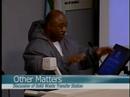
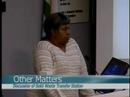
One example ? CEER’s Neloa Jones desire to mitigate community impacts as expressed in her Nov. 17th statement read to the Orange County Board of Commissioners:

Good evening Chairman Jacobs and Other Members of the Board.

My name is Neloa Jones. I am a resident of the Rogers-Eubanks Community, co-chair of the Coalition to End Environmental Racism (CEER), and a member of the Roger-Eubanks Neighborhood Association (RENA).

For 36 years, the Rogers-Eubanks Community has hosted two municipal solid waste landfills, two construction and demolition landfills, a hazardous waste collection site, a recyclables sorting and packaging facility, a mulch/compost site, and a 1/3 acre leachate pond that even the county believed threatened our groundwater.

For these reasons, my community certainly empathizes with ANY community that might also become a host community for solid waste, and I am here tonight to ask that the county GUARANTEE certain provisions and compensation to the community asked to host the waste transfer station.

As suggested in the U.S. EPA Waste Transfer Stations manual, these provisions and compensation might include independent third-party inspections and video monitoring of the facilities, eliminating 3R fees, “funding for road [and] utility improvements,” and “financial support for regulatory agencies to assist with facility oversight.”

Unfortunately, for its 36 years of service to the county, the Rogers-Eubanks Community has never received ANY compensation. We consider this treatment to be unjust and immoral; we do not want another community to receive similar treatment.

For many Rogers-Eubanks residents, our community represents the legacy of ex-slave ancestors who attempted to prosper as they established a community. It represents the legacy of ancestors who wanted to preserve the land to live on and pass to their children and their children’s children.

Our ancestors never envisioned a community blighted by pollution, deflated property values, and the loss of business opportunities. They never envisioned a community blighted by buzzards and vermin, the stench of garbage, and contaminated water. NO, as a member of the Rogers family–FIFTH-generation–I believe that this IS NOT what my ancestors envisioned. As CEER and RENA members, no, we cannot stand by and watch another community destroyed and its quality of life sacrificed. We hope the people of Orange County and our local governments will use the lessons of the past and probe their consciences so that they do what is right for Orange County. Finally, we should ensure that as we look to waste-to-energy and other waste disposal alternatives, we do not bring more technology and waste facilities to Eubanks Road.

Trash Talk: Will We Stand United?

Friday, October 3rd, 2008

A Lion used to prowl about a field in which Four Oxen used to dwell. Many a time he tried to attack them; but whenever he came near they turned their tails to one another, so that whichever way he approached them he was met by the horns of one of them. At last, however, they fell a-quarrelling among themselves, and each went off to pasture alone in a separate corner of the field. Then the Lion attacked them one by one and soon made an end of all four.

Aesop, 6th Century BC

Had an opportunity tonight to listen in on a group of concerned Hillsborough and southwest Orange County citizens discuss the potential siting of the trash transfer facility in their neighborhoods (Eno River Economic Zone – 2 sites and Hwy. 54 corridor – 3 sites).

A number of issues were raised at the meeting: apparent bias in site selection, the “surprise” announcement of the sites on Hwy. 54 and the Hillsborough zone, weighting of access to water and sewer hookups sans cost of making those connections, inadequate traffic studies, confusing or misapplied scoring of technical criteria, whether the BOCC would implement the more costly enclosed transfer site design previously proposed for Eubanks or shave some costs by going with an open pavilion, concern that Chapel Hill’s/Carrboro’s increased transportation costs were improperly used to justify removing Durham County’s transfer site from consideration, underestimation of water use (500 gals. a day!), possible “hidden” reasons for acquiring 82 acres ($7.5 million the current asking price) instead of a smaller tract, if incineration and ultimate in-county disposal got due attention and a slew of others which I’m sure the Rogers Road community are well acquainted with.

Nathan Robinson, the environmental engineer I wrote about Sept. 16th, a founding member of Orange County Community Awareness, gave the clearest deconstruction of the current solid waste transfer site selection mess that I’ve seen. Orange County’s consultant, Olver, should review his presentation to improve their own dog-n-pony show.

Nathan quickly out-lined the dimensions of the issue, discussing what a solid waste transfer site does, how it is laid out, managed and maintained before launching into an analysis, from his professional viewpoint as an environmental engineer, of the problems associated with the current siting process.

Nathan’s concerns mirror a number of mine, especially in terms of the weighting of the selection criteria, the incredibly confusing community criteria feedback procedure, biased scoring of the technical criteria, analysis of environmental consequences and the evaluation of Orange County’s waste creation “center of gravity” (my Mar. 9th, 2007 post on that issue: 2035 Orange County’s Garbage Center of Gravity? ).

As folks that have read my ‘blog know (or have heard me whinge on about local issues elsewhere), I promote reality-based decision-making using measurable criteria. Not all issues are amenable to this approach. Sometimes you have to make a subjective call – say as to the weighting of the importance of environmental justice in the current transfer site process. As I noted a couple years ago, the previous decision by Orange County’s Solid Waste Advisory Board to plop this new facility back on Eubanks sorely lacked rigor, objectivity and transparency.

I questioned SWAB’s ability to make a sound decision because they didn’t generally use objective, understandable, measurable criteria – technical or otherwise – and what criteria they did use were inequitably evaluated differently depending on context and perceived necessity.

Because of that disconnect, I lobbied the Board of Commissioners (BOCC) to create a more thoughtful process grounded by sound engineering principles, guided by community standards. I was encouraged by the process they adopted, but, just as the BOCC themselves admitted on return from their summer break, greatly concerned by Olver’s implementation.

The folks of Rogers Road shared my concerns and expressed their uneasiness at the BOCC’s Sept. 16th meeting.

Of the concerns expressed and the comments made at the meeting, two need serious highlighting.

First is the statements by Hillsborough’s elective folks – like Mayor Stevens and Commissioner Gering – to this community that “they didn’t know” about the process or potential siting of the solid waste facility near Hillsborough. I attended several Assembly of Orange County Governments meetings where these issues got a thorough airing. As a quick Google of minutes of these meetings document, Hillsborough’s reps had to know that these sites were in-play.

Second, and really the most encouraging of all the comments, was Nathan’s call to adopt a united and collaborative approach in dealing with these outstanding issues.

He said, clearly, that he has come to understand the depth of Rogers Roads concerns, their 36 year struggle to simply have promises made – promises completed. He said, clearly, that equitable environmental justice was a relevant criteria and that this was not a battle between neighbors. When a few comments from the folks assembled veered into the “us versus them” realm, Nathan and some of the other organizers rose to say that their emphasis was on the overall process – their focus to get an reliably objective analysis within the established criteria and remove the confusion around the more subjective components of Olver’s mission.

Finally, and the most heartening of all, Nathan said he was meeting with Rogers Road resident (and champion) Rev. Campbell today to see how they could work together. I well remember the landfill expansion fight – which pitted neighbor against neighbor. An attempt to avoid that rancor from the outset gives hope the community won’t fracture. Interestingly, the folks around the county starting to deal with UNC’s new airport authority, already recognize that a united approach is a better approach.

My hope? That the BOCC improves the process. That they realize that the solid waste transfer decision is a beginning. And they work knowing how these issues are resolved will set the template for the new landfill selection process.

If you’re just stumbling upon my site and want some background, here’s a few posts and links to get you up to speed:

Additional posts on the issue are available by doing a search on “trash” from the sidebar.

Tracey Coleman on Rogers Road: Most Popular Video To Date

Tuesday, October 9th, 2007

At 1460 hits, this video is by and far the most popular one I’ve posted on youTube. No surprise to me as Tracey did an incredibly eloquent presentation on the flawed Solid Waste Advisory Board’s search for a new trash transfer site.


Election 2007: Sierra Club Endorsement

Sunday, October 7th, 2007

I do know that the Sierra Club, in 2005, thought I was a candidate well-suited for addressing our Town’s environmental issues.

Will Raymond has been one of the most outspoken and effective citizen activists in Chapel Hill in recent years. We look forward to him using his talents to advocate for the environment as a member of Town Council. In particular we are excited about his initiatives to promote energy efficiency in town buildings. He will also work to protect lesser known creeks in the Chapel Hill area and to minimize the number of single occupancy vehicles causing air pollution and traffic congestion at Carolina North.

We strongly encourage Sierra Club members and any residents of Chapel Hill who care about the environment to support these four candidates in the November 8th election. They are the best hope for a Town Council that will always make reducing environmental impact a top priority as Chapel Hill grows bigger.

With two years of additional activism – on Carolina North, energy efficiency, open space and environmental protections, Roger Road, environmental standards – by the very measure the Club used in 2005, one might expect a 2007 endorsement.

Over the last two years, I knew I had built a solid reputation for putting our environment front and center. I brought to the table a number of established innovative solutions for reducing environmental impacts, promoting sustainable alternatives and reusing/recycling wasted resources.

Above all, I kept it simple: “Walk the talk.”

As recently as this Spring, when our Council wavered on eco-friendly standards for their Downtown development, I was there making the case for measurable goals. Three of the incumbents, Hill, Strom and Greene, voted for their public-private project even though the developer refused to be held to a goal of %20 energy reduction as measured by acceptable standards.

On the same project, I was there first on the hazardous waste remediation – sizing our obligation, funding the effort accordingly. The same three incumbents downplayed the costs to our Town’s open-ended obligation to clean up that environmental mess.

I’ve supported mandating ASHRAE and AIA 2030 environmental standards for energy efficient buildings, well beyond what some of the incumbents have called for.Beyond that, over the last two years I’ve lobbied (and successfully got) the Town to purchase bio-fuels for its fleet, though I’ve yet to get the majority to agree to targeted reductions in fuel use.

I’ve called for a stronger emphasis on reducing noise and light pollution, including adopting the precepts of the Dark Skies Initiative

As part of the Horace-William’s Citizens Committee (HWCC), I brought metrics to the environmental assay process – setting goals, discussing methodologies for measuring achievement of those goals.

Unfortunately, that necessary additional work was canceled when the Mayor pulled the plug on the HWCC. Fortunately, UNC’s Leadership Advisory Committee on Carolina North did listen and made a serious environmental assay of the Horace-William’s property a key requirement for moving forward.

On other issues, preserving open space, using the wasted landfill gas (LFG) for Town operations, teaming with the County on bio-fuels production, I have been at the forefront – calling for specific measures that would not only improve our local ecology but recycle/reuse wasted resources (two bangs for the same buck).

Whether it was right-sizing our Town’s vehicle fleet (still not done after a commitment to do so over 4 years ago), calling for the Town to get Duke Energy to use much more efficient light fixtures in our street lights (6 years now without action by Council), using technology to reduce car trips to the new Town Operations Center (ignored, and no longer championed by the dissolved Technology Board) – my efforts have been backed by solid, detailed, research and marked by a pragmatic, practical approach to solving problems.

Throughout, I’ve called on our Town to “walk the talk.”

Where was the concern for tree protection, for instance, when Southern Park was clear cut? Where was the commitment to carbon reduction (CRED) by reducing our Town’s fuel use or replanting appropriately at the new Town Operations center?

Lots of talk, but very poor follow through. Deeds, in the case of our incumbents, don’t always follow the words.

But it hasn’t just been about the environment. What about social justice?

Strangely ignored by our local Sierra Club, the environmental consequences of siting the landfill, and, now, the trash transfer station in the Rogers Road community have been well known for years. I remember two of the neighborhoods representatives, Fred Battle and Rev. Campbell, asking for relief at a Council meeting nearly eight years ago (and many times since).

They were asking Chapel Hill to make good on promises made a decade prior – to show some basic, decent, human concern.

The burden has only increased over the years but our elected folks have just not responded adequately to our neighbors just concerns. Many of their concerns – slowing down traffic, picking up spilled litter, improving the safety along Rogers Road – could be addressed by low cost means. Our Town, which has dumped trash in their backyards, could certainly allocate some funds to deal with the sewer and water problems.

Yet, two of our incumbents, Jim Ward and Bill Strom, over eight years, have moved slowly, if at all, to address this case of obvious environmental injustice. In spite of escalating requests, over the last four years, Cam Hill and Sally Greene joined Bill and Jim in mostly ignoring the pleas of our neighbors.

Yes, there was murmured concern but when it came to making measurable progress – the results were anemic – and quite unsatisfying to the Rogers Road community.

Not only have I spoken out on behalf of our neighbors, I’ve documented their case and have made specific proposals for addressing some of their concerns.

Why the Sierra Club refuses to address this environmental injustice in their own backyard I don’t know.

I do know that when I asked their political committee why I wasn’t asked about this glaring issue during my interview, two of the members told me that they thought it wasn’t part of the Club’s or Chapel Hill’s docket. I pointed out that the next Council will definitely be ruling on the County’s solid-waste plans and Rogers Road – even if we dispense with common neighborly courtesy – is squarely our Town’s concern.

In the recent League forum you can compare my response to those of the incumbents (40 minutes in).

Once you review the footage, I’d ask, “Who would you want standing in your corner?”

In 2005, the Sierra Club said I was a candidate well-suited for addressing our Town’s environmental issues:

Will Raymond has been one of the most outspoken and effective citizen activists in Chapel Hill in recent years. We look forward to him using his talents to advocate for the environment as a member of Town Council. In particular we are excited about his initiatives to promote energy efficiency in town buildings. He will also work to protect lesser known creeks in the Chapel Hill area and to minimize the number of single occupancy vehicles causing air pollution and traffic congestion at Carolina North.

Yes, these last two years, I built upon that activism – on Carolina North, energy efficiency, open space and environmental protection – the Sierra Club endorsed.

But I knew this year, because of Sierra Club politics at the State level, and because of my repeated calls to the Sierra Club’s leadership to take a principled stand on a number of environmental issues, I had very little chance to secure an endorsement. I had some small hope that the Club would surmount the politics and select the candidates that have shown the courage to “do” over those that have had the opportunity to “do more” and haven’t.

So, a small hope but little expectation. Given the Club’s assurance that they would carefully review my record, I did expect they would get my name right:

Dear Ray,
One great thing about Chapel Hill is that fact we have so many candidates with positive ideas about the environment and who have contributed to the community. Based upon the interviews, forum, voting records and other information we made our recomendation to the state Sierra Club. I’m glad to hear about your concerns about carrying capicity for Chapel Hill and hope you will continute to pursue them, however we decided to endorse other
candidates who had more experience. Thank you for spending time with us to share your ideas and thoughts and of
course, please keep on talking them up.
I was unable to post the forum. I am having copies made. If you contact me after Tuesday I can lend you a copy of the DVD.

Sincerely,
Loren Hintz

Voting records? I’ll have to wait for that opportunity. On every other 2005 Club expectation, I delivered.

As far as sharing my ideas and “talking them up” to promote a sustainable community that lives within the limits of its “carrying capacity” Loren, you can count on that.

Sincerely.
Rogers Road Community’s Petition for Redress

Friday, September 21st, 2007

Kirk Ross posted Neloa Jone’s request for governmental redress (”the setting right of what is wrong”) over on the Carrboro Citizen’s ‘blog:

The Rogers-Eubanks “Coalition to End Environmental Racism” (CEER)

Background

For nearly one hundred and fifty years, African-American families have lived in what is now known as the Rogers-Eubanks Community. In the late 1800s, Rogers Road was a wagon-track through black-owned family farmland and sawmills that stretched from Homestead to Eubanks and Millhouse Roads. There was once a school on Eubanks Road, Morris Grove, founded by a former slave, for black children not allowed to attend school elsewhere. As decades passed, this land was passed down to children, to grandchildren, to great-grandchildren, and in some cases, to great-great grandchildren. Some land was lost to debt, some simply sold. However, African Americans continued migrating to this community; they purchased land and established homes. Today, this community is a predominantly low-income neighborhood, but it remains socially cohesive and culturally rich in spite of the solid waste facilities that have worked to destroy it.

In 1972, when the Town of Chapel Hill decided to use 120 acres of land on Eubanks Road for the first landfill—this was a thriving community, and it was strongly opposed to having a landfill near them. However, Mayor Howard Lee convinced this community to accept the landfill for ten years, promising that afterwards no other landfills would be opened near them and a park and other basic amenities would be provided when the landfill closed.

That was 35 years ago.

And inspite of the fact that Orange County prides itself on being aggressively opposed to social and environmental injustice, it has refused to honor decades of broken promises made to the Rogers-Eubanks Community. Local governments continue to expand solid waste facilities in this area: since 1972, two municipal solid waste landfills have been opened; two industrial waste landfills have been opened. We have yard and hazardous waste collection sites, recycling and garbage drop-off centers, a Materials Recovery landfill (MRF), and let’s not forget about that toxic, smelly leachate pond (1/3 of an acre) right next to Mrs. Gertrude Nunn’s property. The newest proposed addition to these ever-expanding solid waste facilities is the transfer station. And even though some people believe that closing the landfill and building a transfer station will improve conditions in the community, WE contend that it will not. Along with the transfer station, garbage collection trucks, and 18-wheelers we will still have the vermin, the stench, more air pollutants, and more noise. We will also have increased traffic that poses increased danger to our children and other citizens.

So our question tonight is this: why are low-income communities and communities where people of color live always the most vulnerable to solid waste facilities?

The National Environmental Justice Advisory Council has concluded that “WTS are sited disproportionately in areas adjacent to poor communities and communities of color.” The New York Times recently reported that “low-income communities . . . shelter most of America’s polluting facilities”; African Americans are “79 percent more likely than whites to live in areas where air-pollution levels pose health risks.” Professor Robert Bullard of Clark Atlanta University contends that “the people who live closest” to waste facilities are those “who have the fewest resources,” but that “doesn’t mean [they] should be dumped on.”

On March 3, 2006, the Solid Waste Advisory Board (SWAB) passed a resolution recommending that the transfer station be located on Eubanks Road. Why? Because Eubanks Road is convenient, because the County can put the transfer station here cheaply, because the County will be saved the hassle of having to search for another site, AND because there was a GOOD chance that THIS community that has been dumped on for 35 years would not object TOO LOUDLY. On March 27, 2007, the Orange County Board of Commissioners voted unanimously to accept this recommendation from SWAB to locate the transfer station on Eubanks Road.

What we are asking for tonight?

This community wants Orange County to stop dumping garbage and toxic waste in their backyard.

The Rogers-Eubanks “Coalition to End Environmental Racism” (CEER) supports this community in its demands for environmental justice. And these are our demands:

• We want you to eliminate immediately the Rogers-Eubanks Road Community as a site for the proposed solid waste transfer station.

• We want you to halt all solid waste activities in this community no later than November 2009.

• We want you to honor the promises made to this community over the past 35 years for having endured the negative impacts of having garbage dumped in our backyard.

• We want you to address quality of life issues immediately by providing this community with municipal water and sewer services and other community enhancements to ensure the health and safety of the residents.

All of us here tonight have a lot of work to do, and we are certain that having heard us tonight, you will do what’s right and bring environmental justice to the Rogers-Eubanks Community. Thank you.

Rogers Road Community: Honor the Promises!

Thursday, September 20th, 2007

Speaking on behalf of her neighbors, Neloa Jones made an unprecedented plea to the Orange County Assembly of Governments to “honor the promises!”


Direct link to video.

I cannot do justice to Ms. Jones passionate eloquence in trying to condense her statements but if I was forced to summarize, I would simply say her and her neighbors are demanding deeds and not words.

Election 2007: Sierra Club Interview

Wednesday, September 19th, 2007

X-Posted from Will Raymond for Town Council 2007:

The local Orange-Chatham Sierra Club participates in the local election process two ways: endorsing candidates and sponsoring a forum.

Last Sunday, Chairman Bernadette Pelissier, Political Chair Loren Hintz and member Matthew Scheer interviewed me on behalf of the Sierra Club to determine if I qualified for an endorsement.

Questions spanned local zoning policy, a discussion of good and bad infill, personal commitment to environmental protection and Carolina North.

Folks that read CitizenWill already have a good idea about where I stand on many of these issues.

Surprisingly some issues, like local waste management, the trash transfer station and Rogers Road community’s complaints, our storm water utility policy or in-town open space preservation didn’t make the list. Of course, you can only fit so much into a 45 minute interview.

I appreciate these members taking the time to review my thoughts on Carolina North, zoning policy, pragmatic carbon reduction strategies, transit, etc. (I tried to cram way too much into my answers and digressions).

The Chapel Hill forum takes place next Tuesday, September 25th, 7-9pm at the Chapel Hill Town Hall. The event will be broadcast on our local public access channel.

In 2005 I did secure the local club’s enthusiastic endorsement. Here’s what they said two years ago:

Will Raymond has been one of the most outspoken and effective citizen activists in Chapel Hill in recent years. We look forward to him using his talents to advocate for the environment as a member of Town Council. In particular we are excited about his initiatives to promote energy efficiency in town buildings. He will also work to protect lesser known creeks in the Chapel Hill area and to minimize the number of single occupancy vehicles causing air pollution and traffic congestion at Carolina North.

We strongly encourage Sierra Club members and any residents of Chapel Hill who care about the environment to support these four candidates in the November 8th election. They are the best hope for a Town Council that will always make reducing environmental impact a top priority as Chapel Hill grows bigger.

We’ll know by mid-October if the work I’ve done since – on Carolina North, as a member of the Horace-William’s Citizen Committee sub-committee on environment, tracking and publicizing the landfill/transfer site problems on Rogers Road – will secure an endorsement in 2007.

Rogers Road Community: A Unified Front

Tuesday, September 18th, 2007


Rev. Campbell

David Richter

Tracy Coleman

Jeff Kingman

Jeanne Stroud

Nancy Ignia

Sharon Cook

The Rogers-Eubanks Coalition to End Environmental Racism, a coalition of the

  • Chapel Hill -Carrboro Branch of the NAACP
  • Environmental Justice Network
  • West End Revitalization Association
  • Women’s International League of Peace and Freedom
  • Orange County Progressive Democrats
  • and members of UNC-CH Faculty, Students, and Staff

are calling for folks to turn out at the Thursday, Sept. 20th Joint Assembly of Governments Meeting, 7:30pm at the Southern Human Services Center [MAP]

Support the Residents of the Landfill Neighborhoods*

at the Joint Assembly of Governments Meeting (Orange Co., Hillsborough, Carrboro and Chapel Hill)

• No to the proposed transfer station
• Shut down the stinking landfills
• Safe water hookups
• Safe and cheap sewer services

Improve the quality of life for Landfill Neighborhoods.*

Thursday, September 20, 2007 at 7:30 p.m.
Southern Human Services Center
2501 Homestead Road, Chapel Hill

*The predominantly Black neighborhoods along Rogers Road and parts of Eubanks Road were seen as politically impotent to stop the placement of stinking landfills and other waste products of the more powerful white residents in the recent past. This is called Environmental Racism.

For more information: camko@bellsouth.net

What issues does the Rogers Road community want addressed?

Here’s a quick overview from some of my posts covering our neighbors continuing plight:

Hat tip to OrangePolitics.

Is the Rogers Road Community Worth $53,000?

Friday, August 17th, 2007

Being in government has its advantages.

Concerned citizens trying to get a good baseline on the cost of adding a bus route through the Rogers Road community didn’t net a response in 2005 (I know, I took a stab at it 2 years ago when I ran for Town Council).

Ahh, but if you’re a Carrboro Board of Alderman member, like Dan Coleman, running for office – presto, cost estimates nice and tidy.

From today’s emails, this interesting analysis from our Transportation department’s Steve Spade:

We have looked at the 2 options to serve Rogers Road via the HS Route that we discussed.

Option 1 – Extend existing bus

If we continue to run 1 bus but extend it north on Rogers Road 15 minutes travel time would be added to the route. Service frequency would drop to 45 minutes. Daily platform hours would be 5.9 hours daily. There would be no change in the current operating cost.

Option 2 – Add a second bus

When a second bus is added and the route is extended to Rogers Road the service frequency improves to 20 minutes. Platform hours would increase to 9.3 hours daily. The additional 3.4 hours would cost $202 daily or $52,800 annually.

Further analysis here [XLS: FIXED LINK, thanks Terri].

In 2005 I wanted to see service not only passing through the Rogers Road community but work as an element of a greater plan, sans annexation, to integrate the northern reaches of our greater community into Chapel Hill/Carrboro’s economic, social and educational life.

Since then, we’ve spent $949,025 of Federal monies on the digital notification NextBus system (which is reported to expand this Fall at a cost of ???).

Wouldn’t $53,000 , if that’s an accurate estimate, spent servicing Rogers Road and adjoining areas be a better investment in our wider community’s future?

Rogers Road: Unify the Community with a Back To School Bash

Wednesday, July 25th, 2007

There’s a thread over on OrangePolitics (“Historic Rogers Road Community Enhancement Plan Development and Monitoring Task Force “) covering the historic ills and vexations of the Rogers Road community.

I plan to discuss some of the comments in a future post but couldn’t pass up this request by Rev. Robert Campbell (who, thankfully, has recently joined that forum to bring his 34 years of Rogers Road experience to the local ‘blog-o-spheres attention).

The Faith Tabernacle Church will have its Back to School Bash on 08-11-07. We give out school supplies to school age children on this date. Drop off your donations at 8005 Rogers Road to show your support to unify this community as well as Orange County for this back to [school] bash is for [all] no matter where you are from.

Love can go far.

Robert Campbell
919-933-6210

As this recent Carrboro Citizen article (” Be it further resolved”) by Taylor Sisk reveals, Rev. Campbell is neither a stranger to the Rogers Road community

The sanctuary of the Faith Tabernacle Oasis of Love Church is certainly no refuge for Robert Campbell. Outreach is his calling. For 34 years, Rev. Campbell has been ministering to the needs of a finely knit community on and around Rogers Road of, as Campbell observes, “many faces, many skills.”

or a weak advocate for their cause

Campbell quickly became active in the community. He recalls that things “really escalated in the latter part of the ‘80s, right on into the middle part of the ‘90s, when they really began to start searching for another place to put a landfill, and we spent countless hours negotiating with the politicians—right here in this sanctuary. We had it set up where you had community members that were part of a fact-finding group that came up with ideas, that came up with things that the neighborhood wanted done.”

Tonight, responding to a series of comments, Rev. Campbell provided some context and then suggested how the Chapel Hill/Carrboro community can pitch in to help their neighbors (Rev. Campbell is new to this, I edited his comments slightly for clarity):

We do many things out on Rogers Road promoting the good will of this community. We do not sit back and do nothing.

The good neighbor program has not worked for this part of Chapel Hill. Rather all government agents have over looked this area when it comes to enhancement. Took pave roads some twenty plus years to come to this community. Municipal water – I will go as far as to say the municipality dropped the ball when Robert’s Assocation did the first development in this community.

Someone looked the other way – no water, no sewage, no sidewalks, no real insight for the future. And we are still making excuses. Let us do the right thing now. Let us help make Orange County a better place.

We are to be our brother keeper. Let us look one another in deed, let us be doers of the word and not just hearers and talkers. Let us work together.

With this said, the Faith Tabernacle Church will have its Back to School Bash on 08-11-07. We give out school supplies to school age children on this date. Drop off your donations at 8005 Rogers Road to show your support to unify this community as well as Orange County for this back to [school] bash is for [all] no matter where you are from.

Love can go far.

Robert Campbell
919 -933-6210
1711 Purefoy Dr.
Chapel Hill N.C. ,27516

Simple. Straightforward. Practical. I like it and, after a quick check with Robert to see what is needed most (the results I’ll post here), will be dropping some supplies by soon.

Unedited version follows:
(more…)

Trash Talk: I Like Vinegar on My BBQ

Saturday, March 17th, 2007

The old Southern saying goes “You can catch more flies with honey than with vinegar.”

Then again, there’s nothing like a little vinegar or Tabasco to cut though the cloying fat of smoked BBQ.

An open e:mail to the Orange County Board of Commissioners:

On Tuesday evening, at the Orange County BOC meeting in Hillsborough it became glaringly apparent there was a complete failure of do diligence in the Waste Transfer Station site selection process. In fact there was no real process at all. Chairman Carey, 2 years of talking is not a process, it was just 2 years of talking and no basis for a decision.

Unfortunately if this failure is allowed to stand the people who will most directly carry the consequences and burden will be the working class African American community on Rogers Road, the same people who have carried the burden of the county’s landfill for 34 years. There is absolutely no way to deny that this failure to act professionally is in itself an act of environmental injustice. There is much irony in that Orange County is considered the most progressive county in North Carolina, and home to Senator Edwards and his Presidential Campaign which is centered around helping the “Other America”.

My anger was apparent at the meeting and still apparent in this e-mail, I make no apologies. I am not a politician or a policy wonk. Nor do I make a pretense of tactful persuasion. My wife’s parents lived their lives in north central Philadelphia and were 50 plus year members of the Zion Baptist Church which was led for many years my the late Reverend Leon Sullivan. When visiting my in-laws they would bring us to the church even though I am not a Christian. Listening to Reverend Sullivan was always an education and an inspiration. In my early twenties I remember Reverend Sullivan talking about personal integrity and professional integrity and that both were tied hand in hand. He told us that we can not claim to have one without the other. He was relating this concept from his involvement with American and international business executives and political leaders.

It became obvious in Tuesday’s meeting that the Waste Transfer siting process had , no professional integrity, no intellectual integrity, no moral or ethical integrity and formed no solid basis for any decision. Chairman Cary, in your e-mail response of 2/17/07 to my request of all the leaders of this community to take as stand on this issue, you said to quote:

“… it would be premature and unethical in my opinion for any elected official to respond to you as you have requested prior to considering all information which must be considered to make an informed decision on this matter.”

With all due respect, by calling for a vote on this issue on Tuesday you were violating your own stated ethical standard. It is clear The Orange County BOC nor anyone else for that matter has all the facts needed to make an informed decision. It is now in the open that the Orange County BOC has never directed anyone or any group to get all the facts.

It is also misleading that the BOC can only start “mitigation talks” to compensate the Rogers Road community after a site is chosen. The Rogers Road community has already earned that compensation through their 34 years of sacrifice. Why should they have to acquiesce to a Waste Transfer Station to receive compensation? Discussions can start whenever the BOC decides to do so.

It was also clear that Commissioner Foushee, Commissioner Jacobs and Commissioner Gordon were struggling with what they witnessed Tuesday night. Commissioner Foushee was the first to speak with eloquence and concern, articulating her distress on the deficiencies of the process to date. She expressed the desire to get this right. If an academic study were to be conducted on the right and wrong ways to site a waste facility as things currently stand Greensboro would be the case study of the right way and Orange County would be the contrasting case study on how get it all wrong. I am asking all the commissioners: Are you proud of where we are on this issue? Are you proud of how we got here? Is this an example of good governance?

If each of you abide the principle of tying personal and professional integrity together then you have no choice but to vote against siting the Waste Transfer Station on Eubanks Road. You have no choice but to restart the siting process.

David Richter

I published David’s earlier correspondence with Commissioner Moses Carey highlighting the lack of a systematic approach in selecting a waste transfer site. Since then, even knowing of this troubling deficit, Carey pushed for an immediate vote to solidify the choice of the Eubanks Road site.

But some sense prevailed during last week’s Orange County Board of Commissioner’s meeting as the other BOCC members responded to both the illogic of the current situation and to the many folks that showed up to ask for more prudence. They directed staff not only to do a more exhaustive evaluation but to incorporate a more multi-dimensional approach like the one I’ve previously suggested.

I’ve heard a few comments from folks that David is coming on a little too strong. I understand his passion.

The calculated lack of process was destined to produce one answer – an answer BOCC member Carey is obviously comfortable with – an answer extending the 34 years of ills the Rogers Road community has borne by decades.

That deficit is so glaring, the troubling consequences to the Rogers Road community so apparent, it is an injustice crying for redress.

And when the redress comes slowly, grudgingly, even a bit bitterly from our elected folk, well, a little bit of vinegar is quite excusable.

Trash Talk: Systematic is the New Watchword

Wednesday, March 14th, 2007

The commissioners asked county staff to do a more exhaustive search of sites, citing solid waste management director Gayle Wilson’s statement that the process of looking for a transfer station site hadn’t been as “systematic” as previous searches for landfill space.

From today’s N&O report on last night’s (Mar. 13th) BOCC meeting.

After reviewing the Orange County Solid Waste Advisory Board (SWAB) and Landfill Owner’s Group minutes covering the transfer station site search, I’m more convinced than ever we need a decision matrix that incorporates more dimensions than a straight engineering site selection suggests.

That matrix should assign values to social, environmental, economic, growth, transportation impacts and assess possible sites against that more “full blooded” metric. I’ll be interested in seeing if staff will first create a new process for evaluation or tailor the current criteria to narrow the search.

The lack of a systematic approach didn’t stop BOCC member Moses Carey from pushing forward for an immediate decision:

Chairman Moses Carey had pushed the board to make a decision Tuesday, citing a time crunch. A consultant hired by the county said it will take as long as four years to get a transfer station up and running. The Eubanks Road landfill is expected to be full by late 2010.

Not quite sure why taking the time for a measured approach now will greatly delay a project scheduled for 2010. Given the current status, a delay now to select more appropriate criteria – say criteria suggested by the landfill’s current neighbors – is the most prudent path.

Draft timetable from Mar. 13th’s agenda item:

Trash Talk: Do you have a Minute? How about 17 years worth?

Tuesday, March 13th, 2007

I appreciate folks dropping by and sampling my blather.

While I write CitizenWill from a Will-perspective, I also try to be somewhat objective in my analysis. Not just say, for instance, that Greenbridge is too tall but to actually measure and model its footprint in GoogleEarth. I also like to link to my source materials so that folks can cut through my BS and do their own homework.

In fact, one reader just asked for some of the SWAB minutes I’ve drawn upon. I’ll deliver that plus 17 years of Orange County BOCC minutes to boot.

Unfortunately, quite a few documents are Adobe PDFs. Worse, many are actually scanned as images instead of textual documents that a Google or Yahoo can index making searching a real beast (for a couple hundred bucks, the county could purchase OCR software to convert those images to text).

Textual PDFs of the Orange County Solid Waste Advisory Board (SWAB):

The following are the minutes for the landfill’s LAND OWNER’S GROUP (LOG) 0/01/1990 to 04/01/2007 [no, I haven't read them all - yet ;-) ]
I’ve tried to remove duplicate references and narrow the list to those minutes most pertinent to both the landfill and transfer station site selection.

WARNING! The list is over a hundred items long and may take a while to load on a dial-up Internet connection.

(more…)

Trash Talk: Mar. 13th’s Board of Commissioners Review

Tuesday, March 13th, 2007

[UPDATE] I won’t be able to attend this evening. Good luck folks.

In case you missed it, there’s a meeting on siting the new trash transfer station on Eubanks Rd. this evening.

The discussion is item # 9b on the agenda.

The BOCC meeting starts at 7:30 pm in the Battle Courtroom 106 E. Margaret Lane, downtown Hillsborough [MAP].

If you get there early, are ‘net savvy and would like to see the video of BOCC meetings on-line, you might want to consider spending a few moments asking for online access when 5f. Authorization to Debut Live Casting of BOCC Meetings [PDF] comes up.

Commissioners, not everyone has cable.

I might not make it this evening but I bet there will be plenty of good folks speaking their minds. Good luck all.

Trash Talk: If not Eubanks, where?

Tuesday, March 13th, 2007

Given the anticipated growth patterns in Orange County, siting the transfer station near a high capacity transit corridor would seem to be best. The BOCC has two additional sites located at just such a location – the Eno Economic Development District [EEDD] (as I noted in Orange County’s Garbage Center of Gravity).

The EEDD is not without some flaws, including the nearby Eno River, but given the access to the already heavily travelled Hwy. 70/I-85 and a nearly adjacent railroad corridor, the EEDD’s transit profile appears quite promising.

After reviewing the various advisory board, staff and other recommendations made over the last few years on siting a transfer station I’m struck by how options were narrowed in absence of other factors.

It would be great if the reassessment that Mark Chilton has called for would include a new kind of decision matrix that took into account a wider variety of factors for deciding a new location:
economic, social and environmental impacts, future growth – including Carolina North, the current and projected centers of waste creation (like UNC), energy costs, etc.

In other words, we need a decision matrix that incorporates more dimensions than a straight landfill engineering problem. That matrix should assign values to social, environmental, economic, etc. impacts and assess possible sites against that metric.

The two US70E sites referenced in tonight’s agenda item [PDF] are:

5412 US70E. Tax Value: $654,435. Asking Price: $3.8M. Size: 19.05 acres.

5701 US70E. Tax Value: $326,942. Asking Price: $2.0M. Size: 16.27 acres.

Google MAP of general area.

Here are the profiles for each of the selected sites:

5412 US 70E (click image to expand) 5701 US 70E (click image to expand)

Contact

Archives

Donate:

RSS Feeds:

Government

Media

Local Politics

Categories:

Monthly:

Recent Posts

Recent Comments

AffordableHousing arts Campaign CarolinaNorth Carrboro ChapelHill Chatham CitizenWill CivilLiberties Community Development Downtown EconomicDevelopment Elections Endorsements environment Event Government Hillsborough LocalArts LocalPolitics Lottery Media MunicipalNetworking NationalPolitics OrangeCounty Orthogonal Ruminations SxSWi Technology Transportation UNC Uncategorized WeaverStreetMktLawn Zorch

Meta