Local IndyWeek reporter Fiona Morgan covers the story of a “copyright comic” in the tech-oriented magazine Wired.
Fair-use is an important tool for online activisim, as is copyright. Many online authors, for instance, use a Creative Commons content license to ensure widest dissemination of their message.
To make the issue a bit more digestable, three law professors (two from Duke) created the comic book: Bound by Law.
Practicing what they preach, the comic book is freely available under a Creative Commons license.
Fiona routinely covers tech-related issues for the IndyWeek, for example, this week’s important coverage of NC ‘net neutrality and media consolidation.
Just as consumers are becoming aware of things like net neutrality and media consolidation, Congress and the North Carolina legislature are acting like nobody’s paying any attention.
…on June 13, the Finance Committee of the N.C. House passed the Video Service Competition Act without amending any of the no-brainer changes suggested by public interest groups that would have made it a little less of a travesty. A state version of the Internet TV provisions currently winding through U.S. Congress, this bill would abolish the current rules governing cable television service. Telephone companies such as Verizon and BellSouth have been pushing hard for this bill, because it would allow them to expand from broadband Internet to video service without having to negotiate with local governments. The bill will soon go to the full House for a vote; the Senate version, having passed one committee, makes one more committee stop before going to the floor.
Thanks go to ibiblio’s Paul Jones for the story tip.
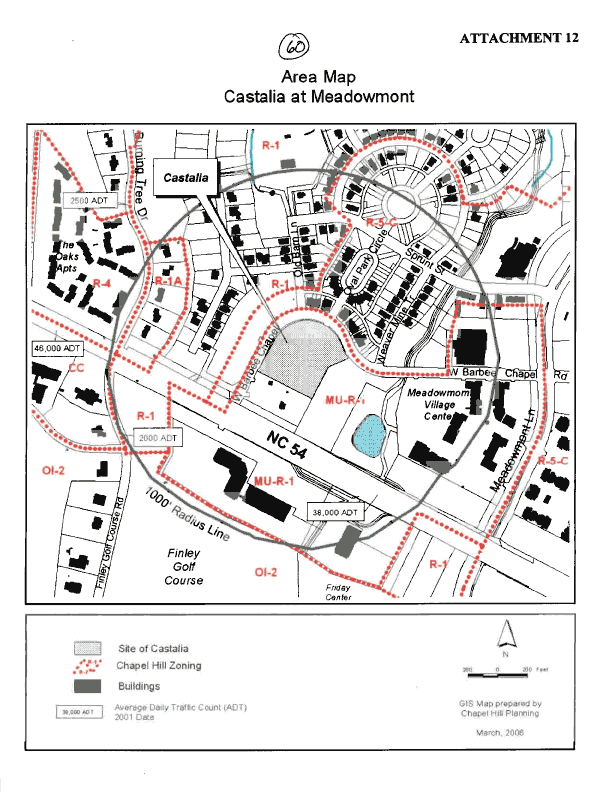
Council once again reviewed local businessman Michael Rosenberg’s (Health Decisions Inc.) Meadowmont palace Castalia. Castalia is a proposed mixed-use building, currently sited prominently in Meadowmont.
Tonight’s discussion focused on visibility.
Councilman Cam Hill gave a bit of a mixed message, saying in part that if the building really would be as hard to see from N.C. 54 as the architectural drawing purported, then that might be tempting. But he said he really didn’t think it was going to be that well screened.
HeraldSun, June 20th
Meadowmont? Not visibile? Where have I heard that before?
Let’s turn the wayback machine’s dial to Oct. 5th, 1994:
Design Review Board member Bob Stipe inquired whether proposed commercials buildings on the north side of NC 54 would be visible to passing vehicles. Mr. Davis said yes, adding that the buildings would have a maximum height below the area’s existing tree line. Julie Andresen inquired whether the developer was proposing a mixture of office and retail uses. Mr. Davis said yes. Ed Harrison inquired whether existing trees on the site would be preserved. Mr. Davis stated that the majority of trees up to three hundred and fifty feet into the site would be preserved.
Where did those trees go?
I’ve read that Castalia is the source of sacred waters used to clean Delphian temples . Maybe those waters could be used to clean out another mythic mess, Meadowmont’s Augean stable of promises.
I asked the Council to look into LFG two years ago and then made it part of my environmental proposals for the 2005 Council campaign. Recently, UNC has suggested using the old 35 acre Horace Williams landfill site to produce clean energy for Carolina North.
Now, from the June 17th Chapel Hill News, comes this Letter to the Editor outlining successful uses for LFG.
Landfill gas projects (LFG) have been around since the late 1970s creating cheap renewable energy to citizens. When landfills decompose they create a gas called methane, which is 23 times more effective at trapping atmospheric heat then carbon dioxide. This gas can remain in the atmosphere for up to 15 years, increasing the speed of global climate change.
LFG projects capture 60 percent to 90 percent of methane released from landfills and help to improve the air quality of the surrounding communities as well as creating more jobs for the community. Each LFG project is equivalent to removing the emission from 14 million cars and will decrease the use of oil by 150 million barrels, which is a nice thing to hear since we have depleting natural resources.
Cost savings have helped companies such as General Motors save more than $5 million per year from their five LFG projects and SC Johnson in Racine, Wis., is saving $1 million per year. Of the 140 projects taking place in the United States, more than 700 landfills can cost-effectively install LFG projects.
Why don’t we do our part in helping the environment and increasing the change in our pocket? More information: 888-782-7937 or www.ncgreenpower.com. — Ronna Fischer, Chapel Hill
Thanks Ronna for pressing forward on local LFG.