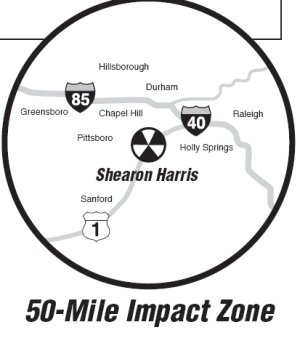
Following up on my Sep. 2006 post “Shearon-Harris Offline: Who tripped over the wire?”, the North Carolina Waste Awareness and Reduction Network (NCWARN) is holding another public hearing Mar. 22nd, 2007 on the 14 years of fire violations at the Shearon-Harris nuclear plant.
What risks are posed by Harris’ 14 years of noncompliance with federal fire regulations?
Fire is a leading risk factor for nuclear meltdown. When will Harris be in compliance?
Implications of January’s NRC decision to rely on fire mitigation instead of defense against air attacks at US nuclear plants.
From NCWARN’s report:
Fire represents up to 50% of the risk for catastrophic accidents in the U.S. nuclear power industry. That risk calculation assumes fire regulations are being obeyed. Fire can cause operators to lose control of the nuclear reactor and its complex safety systems, leading to overheating of the reactor fuel and large releases of radioactivity. The U.S. Nuclear Regulatory Commission (NRC) has allowed the Shearon Harris Nuclear Plant in Wake County, NC, and others, to operate in clear violation of federal fire safety regulations put into place following a seven-hour fire at Alabama’s Browns Ferry plant in 1975, where only heroic action and sheer luck averted a catastrophic radiation accident.
…
Harris has been in violation of federal fire regulations since at least 1992, and ranks worst in the nation in at least two critical fire safety criteria. At Shearon Harris, commitments to correct the fire vulnerabilities have been made, then ignored, in a cycle of endless delay over the years, even as more violations continue to be discovered. A 2005 inspection became at least the 10th time Harris reported new violations, adding to a list totaling scores of unprotected components needed to safely shut down and cool the reactor in the event of a plant fire. Shearon Harris has already had several fires in its 19 years. One, called a “major fire†by an industry publication, was caused by an electrical short. It required 30 firefighters, and caused a plant outage lasting for weeks.

To try to get the conversation caught up to date (and put the notes in a format Google, Yahoo, etc. will index), I’m republishing the further conversations the Orange County Solid Waste Advisory Board (SWAB) has had on land fill gas utilization.
Current membership (as of January 2007) and contact list for the SWAB includes:
| Contact List |
| Members |
| Name |
Representing |
Email |
Work # |
Home # |
FAX # |
| Jan Sassaman (Chair) |
Chapel Hill (A) |
janopus@nc.rr.com |
933-1609 |
|
|
| Randolph Kabrick |
Chapel Hill (B) |
rkabrick@retec.com |
484-2200
|
942-4062
|
484-8100 |
| Albert F. Vickers |
Carrboro (B) |
alvickers@cleansites.com |
656-5271 |
929-0502 |
929-0011 |
| Linda Bowerman |
Carrboro (A) |
lbowerman@mindspring.com
|
967-8571 |
|
|
| Vacant |
Hillsborough (A) |
Contact Donna Armbrister donna.armbrister@hillsboroughnc.org |
732-1270 ext. 71 |
|
|
| Remus Smith |
Hillsborough (B) |
|
732-3807 |
732-3807 |
|
| Bonnie Norwood |
Orange County (A) |
|
|
967-4401 |
|
| Joe Clayton |
Orange County (B) |
jclayton@nc.rr.com |
644-6981 |
|
|
| |
| Commissioner Liaisons |
| Mike Nelson |
Board of County Commissioners |
mnelson@co.orange.nc.us |
|
|
|
| Barry Jacobs |
Board of County Commissioners |
barry.j@mindspring.com |
732-4941 |
732-4384 |
732-4486 |
| |
| UNC Liaison |
| B J Tipton |
UNC-CH |
btipton@fac.unc.edu |
962-7251 |
|
962-8794 |
| |
| Staff |
| Rod Visser |
|
rvisser@co.orange.nc.us |
245-2308 |
|
644-3004 |
| John Link |
|
jlink@co.orange.nc.us |
245-2300 |
|
644-3004 |
| Gayle Wilson |
|
gwilson@co.orange.nc.us |
968-2885 |
|
932-2900 |
| Blair Pollock |
|
bpollock@co.orange.nc.us |
968-2788 |
|
932-2900 |
From May 4th, 2006’s meeting [PDF]:
Landfill Gas
Wilson states that we are going to initiate a further study to examine two options for possible utilization of the landfill gas. One is to work with the University to determine if it is feasible [for use of the gas by the University] and if so what the economics would be of piping actual gas to Chapel Hill North. It’s probably not worth it if they’re not going to build anything there for six or seven years (as they will miss gas production peak). The other alternative is to consider providing energy for a cluster of government buildings on Eubanks Road, which would be the Animal Shelter, the Operations Center, possible transfer station and a school. In two to three months we’ll have that report and know if it’s a go or not. Economically an option with the University would make more sense and be less costly. They won’t have to worry about generating electricity, putting it on the grid, negotiating with Duke Power; they would clean up the gas a little and pipe it directly to a UNC boiler.
Sassaman asks what will be required for the collection system.
Spire states that [it will require] the wells, piping it altogether to a main header and depending how much it will have to be cleaned up, compressed and used to run a micro turbine or if we can clean it up less and put it in a pipeline to the University.
Wilson notes the industry is moving towards micro turbines and away from internal combustion engines which are noisier and tend to produce more emissions.
Smith asks what does a “well†look like?
Spire replies that a well is a hole dug into the trash that a PVC pipe is stuck into to draw the gas into using a vacuum pump. The wells are 18 to 24 inches in diameter. You can put a lot in and put lateral pipes to connect to vertical headers.
Wilson notes its likely gas will be extracted only from the south side, not the north side.
Spire notes that Greensboro’s landfill is already producing gas.
Norwood asks if there is anyway to gather information about the dangers of the installation?
Wilson states that it’s dangerous with a small “dâ€. It’s not like it is going to blow up 20 or 30 acres. It’s dangerous if you don’t know what you are doing. It’s possible that someone right next to the extraction point might be killed, but I don’t think it’s dangerous to the neighborhood.
Sassaman notes that this is not high-pressure pipeline gas. It is low-grade gas with moisture, CO2, other contaminants.
Pollock notes that the gas company does not want this gas in their pipeline.
From August 3, 2006 SWAB minutes:
Landfill Gas Study
Wilson states that the consultant is tentatively scheduled for the September 12th [BOCC] meeting to make a presentation on one half of the study that they are doing. They have been asked to do a study on providing energy for county facilities on Eubanks Road, which will potentially include a school, a new animal shelter, our operations center and possibly a transfer station. That part is done and will be presented at a future meeting. The other half of the study is to evaluate the feasibility of providing energy pipe line gas to Carolina North, the University facility. We have been instructed that before that study is done to meet with the University. We are in the process of setting up the meeting with the University.
Sassaman asks if the SWAB will get a chance to look at the study before it is presented on the 12th.
Wilson states that you are welcome to see the report.
The formal report was actually delayed (as reported by Wilson in October).
From the minutes of September 7th, 2006:
Landfill Gas Study
Wilson states that there is a landfill gas feasibility study looking at two potential possibilities. One is utilizing landfill gas to provide energy to a complex of local government facilities on Eubanks Road. That part of the study is complete.
The other option is providing energy to the University for their Chapel Hill North facility. That part of the study is underway. That report should be ready for the Commissioners in another month or so and will be shared with you all. The next step is once the report is complete the Commissioners will indicate a preference for one or the other and then the next step of more evaluation and measurement will happen.
Pollock asks if there will be consideration of making electricity but everything to be direct fire.
Wilson states that the University option is essentially cleaning up the gas and piping it directly to them. The other option has sub-options but is generating electricity.
From the minutes of October 5th, 2006:
Landfill Gas Study
Wilson states that I also met with Olver today regarding this project, regarding the option to power a cluster of local government facilities including school, Animal Shelter and our new facility on Eubanks Road or piping gas or generating power for Carolina North. The effectiveness of this is determined by when they will have something on the ground. If it is six or seven years out this is not a good option as we will be going down in gas production. Generally we’re venting gas; we flare gas from one wet well as there have been some special [odor] issues at that manhole. [CitizenWill: emphasis mine]
Kabrick asks is there a draft report.
Wilson replies not at this time. There are draft spreadsheets. The consultant is going to make some changes, take that to the University staff for comments and make a final report to BOCC and UNC and the BOCC will have to decide if they want to pursue one option or the other. The UNC option is break even, [the other is worse]. We can’t take advantage of the credits that a private developer could. The whole set of credits is complicated.
Kabrick asks if you have talked to UNC about the carbon reduction program that the Town has signed up for. This will be a good way to do something with greenhouse gases.
There might’ve been additional discussion post Nov. 2006 but those minutes are not online.
Side note: Minutes of meetings are an important source of information. A delay of months, especially in a discussion as critical as the trash transfer station, is unreasonable. That said, if the county staff are as overwhelmed by the workload as Chapel Hill’s Clerk’s office, then the delay is understandable – but not forgivable.
But it isn’t the folks doing the work that need forgiveness, it is the job of our elective officials, especially those banging their chest about transparent open governance, to provide sufficient manpower and resources to get the job done.
Given that, as a frequent consumer of our public records, and someone that thinks our diligent Clerk’s office needs more help, I’ll be asking Town Council this budget season to allocate sufficient resources for the timely production and publishing of written, audio and video records.
I quoted in my post Trash Talk: 1 Megawatt of Waste Not Methane, Want Not Energy… a February, 2006 GeoTimes report titled Recovering Landfill Gas for Energy. Two of the authors, Amarjit Riat and Wayne Blake-Hedges work just North of us at Virginia’s Fairfax County I-95 landfill complex [MAP & INFO]:
Riat, a professional engineer, is chief of the I-95 Landfill Complex in Fairfax County in northern Virginia, and has 20 years of experience in construction and management of sanitary landfills. Blake-Hedges is senior engineering technician for the I-95 Landfill Complex, and has 16 years of experience in construction, operation and maintenance of landfill gas systems.
What struck me about this article was the breadth of experience Fairfax County developed in implementing their land fill gas recovery system – a system first implemented 17 years ago.
The landfill gas extraction system in Fairfax County started in 1989, to keep landfill gas from migrating offsite to a neighboring prison complex (Lorton Youth Center) and for future beneficial use of the gas. The original 27 exterior passive vents were converted to extraction wells, including seven interior extraction wells. The seven interior wells were meant to serve as enrichment wells, to ensure that the gas composition had enough methane to allow the gas to be burned in an incinerating flare. On startup of this system, the flow of gas was considerably greater than anticipated, with flows averaging 700 to 900 cubic feet per minute. The county awarded a contract for landfill gas utilization to Michigan Cogeneration Systems, Inc. (Michigan Cogen), in 1990, when it began construction of its first landfill gas-to-electricity plant. The plant went online in December 1991. This first plant utilized 1,150 cubic feet per minute of landfill gas to generate 3 megawatts of electricity for direct sale to Dominion Virginia Power, the local electrical utility. The plant houses four generator units, each capable of producing 800 kilowatts of electricity. Approximately 200 kilowatts are used by the plant, leaving a 3-megawatt net output. Subsequently, the I-95 landfill began expanding its landfill gas collection system and piping to deliver gas to the new landfill gas-to-electricity plant.
Building upon their initial success, Fairfax has expanded their utilization of recovered gas and continued to upgrade their facility as recently as 2005.
In 1992, Michigan Cogen began constructing a second 3-megawatt electrical generation facility. This plant became operational in January 1993, and is essentially identical to the first plant. Like the first, it is also solely fueled by landfill gas. This system consisted of 75 additional interior landfill gas extraction wells, 22 horizontal collection trenches and collection piping.
In May 1997, Michigan Cogen began operating its third landfill gas utilization project. This facility compresses the landfill gas into 10 pounds per square inch, removes the majority of moisture and then delivers the dry gas to the Noman Cole Pollution Control Plant for use in sludge incineration. In an afterburner process, the gas cleans up the emissions from sludge incineration.
This landfill gas replaces natural gas previously purchased from Washington Gas. Instead, pipelines deliver gas directly from the I-95 landfill to the Noman Cole Pollution Control Plant. Landfill gas utilization by the pollution control plant is extremely variable and is based on the amount of sludge incinerated and the moisture contained in the sludge, but averages between 300 to 1,400 cubic feet per minute.
In March 2005, five standard natural gas infrared heaters were retrofitted and installed in the maintenance building of the I-95 landfill. These units replaced two existing propane-fired forced air heaters and tapped the existing pipeline that delivers landfill gas to the Noman Cole wastewater facility. A simple treatment system was installed to remove any remaining moisture and contamination. After treatment, the gas is delivered to the heaters through a stainless steel piping system. The radiant heaters use a maximum of 30 cubic feet per minute of landfill gas.
An interesting factoid they present is that “A 1-megawatt electric power plant working on an internal combustion gas engine needs a sustained flow of about 350 standard cubic feet per minute of landfill gas.”
As I noted before, based on SWAB member Randy Kabrick’s 500,000 cubic feet of methane being out-gassed from our “older”, less productive landfill into the atmosphere daily, our county is currently wasting at least 1 megawatt of electrical generation capacity.
Worse, methane as a greenhouse gas is considered to be more harmful than CO2.
Methane is about 21 times more powerful at warming the atmosphere than carbon dioxide (CO2) by weight (see box below). Methane’s chemical lifetime in the atmosphere is approximately 12 years. Methane’s relatively short atmospheric lifetime, coupled with its potency as a greenhouse gas, makes it a candidate for mitigating global warming over the near-term (i.e., next 25 years or so).
EPA
Worse yet, the “21 times more powerful” is considered by some to be a gross underestimation as the NASA reports Methane’s Impacts on Climate Change May Be Twice Previous Estimates.
Of course, the benefits extend beyond displacing “outside the county” sources of energy and mitigating gas releases:
Using landfill gas for energy is a win-win opportunity. Landfill gas utilization projects involve citizens, nonprofit organizations, local governments and industry in sustainable community planning, and they create partnerships. These projects go hand in hand with community and corporate commitments to cleaner air, renewable energy, economic development, improved public welfare and safety, and reductions in greenhouse gas emissions.
Directly using landfill gas to offset the use of another fuel (natural gas, coal and oil) is occurring in about one-third of the currently operational projects. This direct use of landfill gas can be in a boiler, dryer, greenhouse or other thermal applications. Innovative direct uses include firing pottery and glass-blowing kilns; powering and heating greenhouses and an ice rink; and heating water for an aquaculture (fish farming) operation. Industries currently using landfill gas include auto manufacturing; food processing; pharmaceutical manufacturing; wastewater treatment; consumer electronics; and paper and steel production, just to name a few.
Generating energy through the landfill gas projects provides many environmental benefits. The projects assist in destroying methane, a potent heat-trapping gas, and offset the use of nonrenewable resources such as coal, natural gas and oil. They help reduce air pollution, and the landfill gas emitted from decomposing trash is a reliable and renewable fuel.
The benefits from the I-95 landfill project are approximately equal to any one of these: removal of emissions equivalent to 50,000 vehicles, planting 72,000 acres of forest, offsetting the use of 1,300 railcars of coal or powering 3,800 homes.
The technology is also cost-saving. The savings in fuel costs are approximately $500,000 annually from the landfill gas use at the Noman Cole Pollution Control Plant and $5,800 from use of landfill gas for heating the maintenance building at the I-95 landfill.
This from folks that have decades long experience with this technology. The complete Feb. 2006 GeoTimes article is here.
To flesh out my earlier post “Trash Talk: Waste Not Methane, Want Not Energy” here’s a few comments from the April 6th, 2006 Orange County Solid Waste Advisory Board (SWAB).
There’s a few inline comments demarcated by [CitizenWill:…].
Landfill Gas Preliminary Report (discussed after item 1)
Tipton [BJ Tipton – member ] states that other than what was in the newspaper I don’t know a lot about what is going on. I just wanted to get the update.
Wilson [Gayle Wilson – OC staff] states that a presentation was given at the Assembly of Government’s meeting March 30 regarding this. Back in 1997-98 an EPA representative, myself and another staff member met with UNC Energy Services officials who were in the process of designing a fourth boiler (at UNC) and that was when they decided to look at modifying the boiler to use landfill gas. The University never formally responded.
Over the years the use of landfill gas at Chapel Hill North has come up. Phil Barner of UNC facility services called at the end of October early November and stated as they were talking about Carolina North they wanted to know about using landfill gas. I explained that we had a consultant do a report and would be glad to send it to him. After the report was sent in February, I didn’t hear anymore about it until a couple of weeks ago.
Then we got a letter from Carolyn Efland at UNC about landfill gas.
Now there appears to be competing interest in landfill gas. Some of the Commissioners are interested, if it’s feasible, in powering the new Animal Shelter, a new elementary school to be developed on Eubanks Road, our Operations Center and possibly the transfer station. The University has some interest as well. We are in the process of discussing further work with our consultants to do an additional evaluation regarding each of those potential uses. We know that we have gas, but if Carolina North isn’t coming on line for another six or seven years it won’t be worth it.
There are no partners imminent, like next June.
Sassaman [Jan Sassaman – member] states that the gas would have to be used, you can’t store it.
[CitizenWill: Don’t understand this comment as the gas can be converted into methanol or liquid natural gas or propane, etc.]
Smith [Remus Smith – member] asks if the landfill was closed tomorrow how many years would it take to produce gas?
Wilson states that gas worthy of recovery – 12-15 years of time left.
Tipton states that the report talks about the flow.
Wilson states that there are two landfills. The old one on the north is down the [gas production; it started in 1972] curve. The one on the south side isn’t half way up the curve. It has some good stuff coming from it now, but it will not produce for a long period of time [because it’s small].
[CitizenWill: Below we find out this “good stuff” is being vented!]
Kabrick [Randy Kabrick – member] asks if it is being flared now?
Wilson states that we are passively venting it. We have one flare at a central point. I have been resistant in the past because I didn’t want to scare the neighbors lighting up the landfill like a birthday cake. Now we are going to take another look at it even though we are below the regulatory threshold for recovering it.
Kabrick estimates 500,000 cubic feet a day are vented.
[CitizenWill: 500,000/day is roughly 350 cubic feet per minute. This article from GeoTimes points out that “A 1-megawatt electric power plant working on an internal combustion gas engine needs a sustained flow of about 350 standard cubic feet per minute of landfill gas.” So, we’re pissing away from this small, old landfill 1 MEGAWATT of electrical generation capacity.]
Wilson notes that the biggest single cost of recovery is the network of piping that must be installed and for an active landfill it’s more difficult until it’s closed.
Spire [Paul Spire – staff] notes that there is no infrastructure for recovery on the south side now at all and there are problems with putting this gas into the pipeline; the gas company doesn’t want it.
Wilson notes that [unlike Duke Power] the gas company is not required to accept landfill gas.
Tipton asks when will this group take any action on this?
Wilson states that I plan to keep you all apprised of any reports. If you all have any input it would not be out of line to make a recommendation. You will be hearing more about it in the next six months.
As I noted above, we are currently venting from the smaller, older (1972) landfill enough gas to drive a 1 megawatt electric power plant. 1 megawatt of discarded capacity seems like a profligate waste to me.
Imagine what we could do with the “newer” landfill.
Imagine if we used fuel cells with land fill gas [PDF] instead of internal combustion (more expensive upfront but the lack of nasty byproducts make it worth considering).
Imagine if we positioned our county to be more self-sufficient, reduce dependence on Duke Power’s coal-fired misery and generate some positive cash flow to boot!
Is that the Orange County we live in?
Another back and forth between Orange County Democrats over the Iraq debacle, local Representative Price’s efforts to scale it back and the party’s local leadership communicating that effectively (OrangePolitics Art on Weaver and Nudge Price, No More War Funding).
On the cusp of Bush’s Iraq “surge” the moment has come for the Democratic Party, and our local Representative David Price (contact), to make a stand.
This far and no farther, if for no other reason than the selfish desire to preserve what shred of credibility remains with their party’s leadership.
As I noted, Iraq 2007 has been quite bloody for civilians as exemplified by these individual incidents:
- 01/16/07 100 killed, 245 wounded
- 01/22/07 75 killed, 160 wounded
- 01/30/07 38 killed, 100 wounded
- 02/01/07 60 killed, 150 wounded
- 02/03/07 120 killed, 340 wounded
- 02/12/07 90 killed, 190 wounded
- 02/18/07 60 killed
- 03/06/07 120 killed, 200 wounded
The coalition casualties continue to mount.
In Iraq:
There have been 3,451 coalition deaths — 3,193 Americans, two Australians, 134 Britons, 13 Bulgarians, six Danes, two Dutch, two Estonians, one Fijian, one Hungarian, 32 Italians, one Kazakh, three Latvian, 19 Poles, two Romanians, five Salvadoran, four Slovaks, 11 Spaniards, two Thai and 18 Ukrainians — in the war in Iraq as of March 12, 2007, according to a CNN count.
CNN
In Afghanistan:
There have been 536 coalition deaths — 367 Americans, one Australian, 52 Britons, 45 Canadians, three Danes, three Dutch, nine French, 18 Germans, nine Italians, one Norwegian, one Portuguese, four Romanians, one South Korean, 20 Spaniards, two Swedes — in the war on terror as of March 12, 2007, according to a CNN count. Below are the names of the soldiers, Marines, airmen and sailors whose deaths have been reported by their country’s governments. The troops died in support of the U.S.-led Operation Enduring Freedom or were part of the NATO-led International Security Assistance Force (ISAF) in Afghanistan.
CNN
Compromised beyond reason, the vastly weakened Democrat-sponsored legislation creeps through Congress.
Pelosi also fielded criticism from lawmakers for removing language from the bill barring military action against Iran without congressional approval. She said the issue would be addressed in future legislation.
“We’re having folks expressing every doubt, every reservation, every aspiration they have for this bill,†said Rep. Xavier Becerra, D-Calif., another supporter.
In a bid to broaden its appeal, leaders stripped the Iran requirement and omitted language favored by several liberal members that would have specifically prohibited funding of military operations after fall 2008.
While the liberals said this threat would help enforce the deadline, Democratic leaders viewed the politically charged language as unnecessary.
The measure provides nearly $100 billion for two wars, including more money than Bush had requested for operations in Afghanistan, and to address what Democrats called training and equipment shortages. House Republicans say they will work to sink the measure, and the White House threatens a veto.
USA Today
No withdrawal by 2008. No restrictions on an Iranian adventure. $100 billion for “readiness training and equipment” on top of the $540+ billion already ear-marked for 2007/2008 (this with the US already accounting for 48% of 2006’s total military spending).
Price should say “No deal”.
[UPDATE] Allison Gunn posted the same notice over on OP, with this additional note:
“For further information about campaigns to alter the development, see the Friends of Bolin Creek website: www.bolincreek.org” .
Also, I contacted Tiffany Clarke to see if they could video the proceedings. She’s currently looking into that – maybe the folks at the People’s Channel could lend a hand?
[ORIGINAL]
I haven’t been posting much about UNC’s Carolina North project (note: new website:carolinanorth.unc.edu) but that doesn’t mean I haven’t been keeping an eye on recent developments.
For instance, reviewing in detail the Final Report of the UNC Leadership Advisory Committee [PDF] which will supposedly inform UNC’s development plans.
Of course, UNC might take advantage of Town Council’s recent leap from the environmental high ground, complete crushing of citizen’s concerns and rush to sprout 120′ to 135′ buildings Downtown to scale their plans upward (or downward in the environmental case).
The community will have an opportunity to review and comment on UNC’s vision over the next couple months starting March 27th (I’ll be in Nashville, unfortunately).
UNC’s outreach here is a notable improvement over years past – at least at the presentation level. It will be interesting to see how they incorporate the general community’s feedback as the project progresses.
Folks, the clock is ticking on this – the UNC Board of Trustee’s are rushing to a decision next October – so please weigh in now so our community can get the best result.
The University will host a new series of meetings about Carolina North for the campus and local communities on the last Tuesday of each month through May, beginning Tuesday, March 27.
You are invited to attend one of two sessions on March 27. The first session will be at 3:30 p.m., Room 2603, School of Government, Knapp-Sanders Building. The presentation will be repeated at 5:30 p.m. in the same location. Parking is available in the Highway 54 lot and Rams Head deck. The School of Government parking deck is available only for the 5:30 p.m. meeting.
University representatives will present potential uses of Carolina North and three conceptual approaches to its development. Attendees will have opportunities to ask questions and share comments. The feedback will help the university as it develops a concept plan for the UNC-owned property.
The conceptual plans that will be presented draw on the guiding principles developed by the Leadership Advisory Committee for Carolina North, an ecological assessment of the property and sustainability strategies.
At the same time the university is working on its plans, several supporting studies are under way or planned involving the campus and various government and community entities. Topics include transit, transportation and fiscal impact.
University officials believe Carolina North, the 900-plus-acre tract located about two miles north of the main campus in Chapel Hill, represents an unprecedented opportunity to develop a mixed-use academic community that will benefit the campus and the community.
The university’s Board of Trustees has directed the administration to submit a development plan for Carolina North to local governments by next October.
For more information about Carolina North, go to the website, http://carolinanorth.unc.edu.
Tiffany Clarke
Carolina North
304 South Building, Campus Box 4000
Chapel Hill, NC 27599-4000
Phone 919/843-2025
Fax 919/962-1476